Osiągnięcie związane z rewolucyjnym przełomem w fizyce.06.10.2026
Francis Halzen (23.03.1944) belgijski naukowiec, obecnie pracujący na
University of Wisconsin-Madison, został laureatem Nagrody Nobla z fizyki za „wkład w powstanie
IceCube Neutrino Observatory i odkrycie neutrin wysokich energii pochodzenia astrofizycznego”.
Nagroda Nobla z fizyki za badania neutrin w lodzie Antarktydy07.10.2026
(...) Noblista zaproponował wykorzystanie krystalicznie czystego antarktycznego lodu na biegunie południowym do rejestrowania nieuchwytnych cząstek elementarnych. Jak poinformowała PAP dr hab. Justyna Łagoda z NCBJ, wizję wychwytywania neutrin na biegunie przedstawił w 1988 roku na spotkaniu naukowców w Łodzi (chodzi 5th International Symposium on Very High Energy Cosmic Ray Interactions - przyp. PAP). Jego koncepcja doprowadziła do powstania obserwatorium IceCube – gigantycznej struktury o objętości kilometra sześciennego, wyposażonej w ok. 5 tysięcy czujników światła umieszczonych w czystym lodzie na głębokości do dwóch kilometrów. (...)
https://naukawpolsce.pl/aktualnosci/news%2C115314%2Cnagroda-nobla-z-fizyki-za-badania-neutrin-w-lodzie-antarktydy.htmlhttps://www.nobelprize.org/prizes/physics/2026/press-release/https://www.national-geographic.pl/nauka/nagroda-nobla-2026-z-fizyki-zostala-przyznana-czym-sa-kosmiczne-duszki-wysokoenergetyczne-neutrina/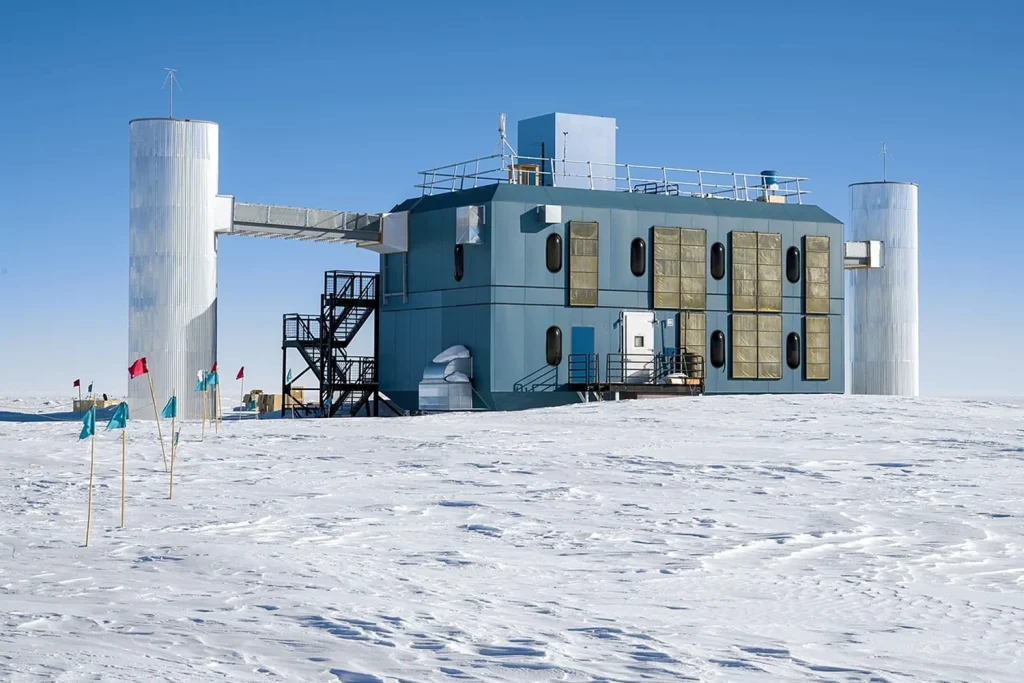 Obserwatorium Neutrin IceCube w 2023. Fot. Christopher Michel / Wikimediahttps://serwisnaukowy.uw.edu.pl/nobel-2026-z-fizyki-za-zlapanie-neutrin-o-wysokiej-energii-w-antarktyczny-lod/Badacz neutrin z AGH: Nagroda Nobla potwierdza kluczową rolę neutrin w badaniu Wszechświata
Piotr Włodarczyk (Centrum Komunikacji i Marketingu AGH): Jak odbiera Pan tegoroczną Nagrodę Nobla z fizyki, którą otrzymał Francis Halzen, pomysłodawca i współtwórca detektora IceCube?
Prof. Artur Ukleja: Ta nagroda jest potwierdzeniem tego, że badając wysokoenergetyczne neutrina, idziemy w dobrym kierunku. Jako AGH jesteśmy uczestnikami podobnego eksperymentu KM3NeT, który zlokalizowany jest w głębinach Morza Śródziemnego. W jego ramach zrekonstruowaliśmy neutrino o najwyższej niespotykanej dotychczas energii – 220 PeV [link do artykułu]. Okazało się, że możemy skutecznie poszukiwać cząstek o bardzo potężnych energiach, rzędów -eksa i petaelektronowoltów, które zdarzają się niezwykle rzadko. Eksperymenty IceCube i KM3NeT ze sobą współpracują. Wraz z eksperymentem P-ONE, tworzymy sieć Global Neutrino Network, żeby pokryć jak największy obszar nieba i zmierzyć jak najwięcej tego typu cząstek. (...)
https://www.agh.edu.pl/aktualnosci/detail/badacz-neutrin-z-agh-nagroda-nobla-potwierdza-kluczowa-role-neutrin-w-badaniu-wszechswiataNobel z fizyki za podglądanie kosmosu spod lodu. Co mogą nam powiedzieć neutrinaAnita Czupryn 6 października 2026, 19:49
Francis Halzen otrzymał Nobla z fizyki za wkład w powstanie obserwatorium IceCube i odkrycie wysokoenergetycznych neutrin z kosmosu. - To są badania wiedzione czystą ciekawością – mówi dr Grzegorz Łach, fizyk z Uniwersytetu Warszawskiego i wyjaśnia, co z tych badań wynika dla nas.
ak najprościej wytłumaczyć, za co Francis Halzen dostał Nagrodę Nobla?Wytłumaczę to za pomocą książki Stanisława Lema „Głos Pana”. Lem napisał, że zostaje odkryty sygnał, który jest właśnie tytułowym Głosem Pana. Nie jest to sygnał radiowy ani świetlny, tylko sygnał niesiony przez neutrina. Przez długi czas nie mieliśmy aparatury, która potrafiłaby wykrywać takie sygnały z odległego kosmosu. Można więc powiedzieć, że tegoroczna Nagroda Nobla jest za skonstruowanie urządzenia, które pozwala je rejestrować, i za odkrycie wysokoenergetycznych neutrin pochodzących ze źródeł astrofizycznych. (...)
https://i.pl/nobel-z-fizyki-za-podgladanie-kosmosu-spod-lodu-co-moga-nam-powiedziec-neutrina/ar/c1p2-29416349Nobel Prize in physics awarded to Francis Halzen for his work detecting ‘ghostly’ cosmic particles
By Issy Ronald, Katie Hunt Updated 20 hr ago
(...) Halzen, 82, told the Nobel news conference by phone from Italy that it was a “great surprise” and “pleasure” to win the award.
“When we started this project, everybody realized this was maybe a good idea but very few thought it would work, including myself,” he said. “So this was kind of an adventure where success wasn’t guaranteed.” (...)
https://edition.cnn.com/2026/10/06/science/nobel-prize-physics-francis-halzen-winner-intlNobel prize in physics goes to Francis Halzen for south pole work on neutrinos
Ian Sample Science editor Tue 6 Oct 2026 13.25 CEST
(...) “It feels strange,” Halzen told a press briefing on winning the prize. “I hope it reflects on the really courageous people who joined me in the beginning of this project when no really respectable, conservative physicist would have joined me, but many talented people did.” (...)
Halzen realised that brief flickers of light from neutrino collisions could be detected in clear, glacial ice and in 1988 put forward a plan to convert a chunk of the south pole into a neutrino observatory. The detector uses Earth to shield against the background noise of cosmic rays, and has downwards-facing light sensors to detect neutrinos passing through the planet from the northern hemisphere. Apart from a hostile environment for the team, the site benefited from being far from sources of interference and the risk of vibrations from earthquakes. (...)
Halzen, who received the news while travelling in Italy, said he was working on a new proposal and hoped that winning the prize would help in getting it approved.
Dr Patrick Dunne at Imperial College London welcomed the prize. “For all of human history the only way we’ve been able to understand things outside our solar system is with light. Detecting neutrinos from astrophysical sources opens up a new lens, so it isn’t overstating things to liken this to when Galileo first pointed a telescope at the stars,” he said. (...)
https://www.theguardian.com/science/2026/oct/06/nobel-prize-in-physics-francis-halzen-south-pole-neutrinos-icecube-detectorZa co dali Nobla z fizyki? Odkrycie w lodzie AntarktydyThe Nobel Prize @NobelPrize 11:48 AM · Oct 6, 2026
BREAKING NEWS
The Royal Swedish Academy of Sciences has decided to award the 2026 #NobelPrize in Physics to Francis Halzen “for decisive contributions to the IceCube Neutrino Observatory and the discovery of high-energy neutrinos of astrophysical origin.”
https://x.com/NobelPrize/status/2107407528157986903The Nobel Prize @NobelPrize 5:31 PM · Oct 28, 2026
“Without understanding neutrinos, we’ll never understand the universe.”
Physics laureate Francis Halzen has laid the foundation for a new type of astronomy. His idea was to use naturally occurring ice, rather than water, to capture the secretive elementary particles called neutrinos. The result was the IceCube Neutrino Observatory, which can track neutrinos that originate in the distant cosmos.
So, why is it interesting to capture neutrinos? These elusive particles carry with them information about their sources. Since neutrinos have no electrical charge, they’re not deflected by the magnetic field between the earth and their distant cosmic sources. When these particles are detected and captured, we can learn more about where they are produced, for example the environment around a black hole. This knowledge about cosmic sources would otherwise not be accessible to us.
When a neutrino collides with an atomic nucleus, a charged particle can be produced which emits a blue light. This flash of light can be tracked by sensors in the clear glacial ice of the IceCube Neutrino Observatory. The South Pole’s ice has many advantages, as it is free from various types of interference and the area is geologically stable, with no earthquakes. Still, it was not an easy project.
During the press conference, Francis Halzen commented on this:
”When I reflect on this at this moment, I have to emphasise how lucky I was. Because when we started this project, everybody realised it was a good idea, but very few thought it would work, including myself. This was kind of an adventure where success was not guaranteed. We were lucky to overcome the various challenges, partly because the talent of our collaborators and partly because of luck. It was a long journey but it finally worked.”
Learn more at https://nobelprize.org/prizes/physics/
https://twitter.com/NobelPrize/status/2115481477622186316
 Wątek: The Nobel Prize (Przeczytany 6423 razy)