Curiosity Detects Large Methane Burst on Mars, NASA Orders Follow-Up TestingBy Paul Scott Anderson, on June 22nd, 2019
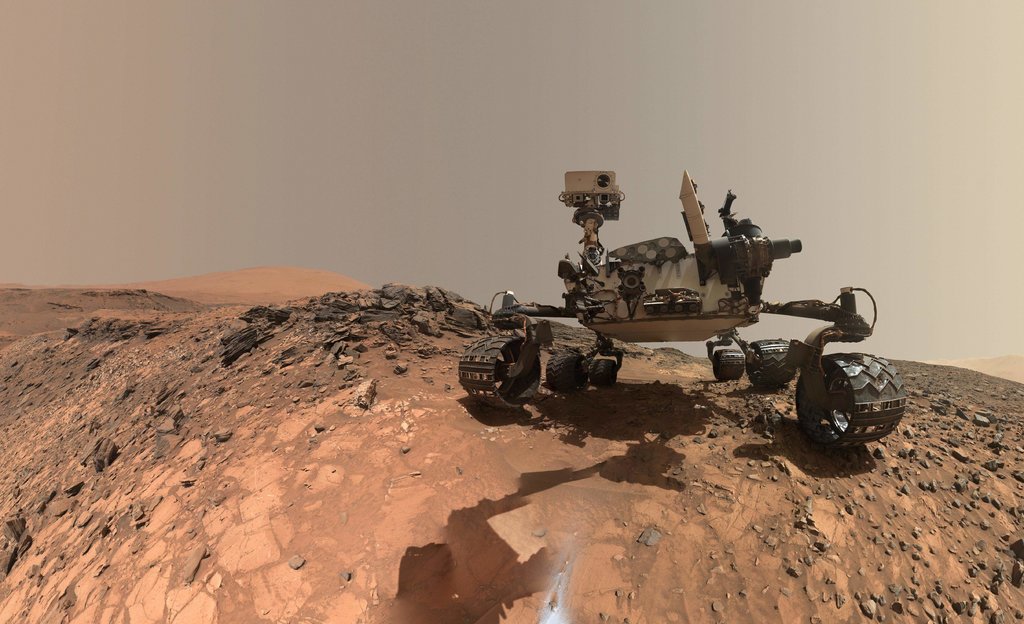 Self-portrait of Curiosity in Gale Crater on Mars. Photo Credit: NASA/Agence France-Presse/Getty ImagesIt seems that Mars is belching methane again. NASA’s Curiosity rover has detected a new burst of the gas, it was reported today in the New York Times.
The new detection of the gas – which can come from either biology or geology – happened last Wednesday.
The news hasn’t been formally announced by NASA yet, but scientists involved did talk to the NYT about it. And now the team is going to do follow-up experiments this weekend to further analyze the results.
“Given this surprising result, we’ve reorganized the weekend to run a follow-up experiment,” Ashwin R. Vasavada, the project scientist for the mission, wrote to the science team in an email that was obtained by The Times.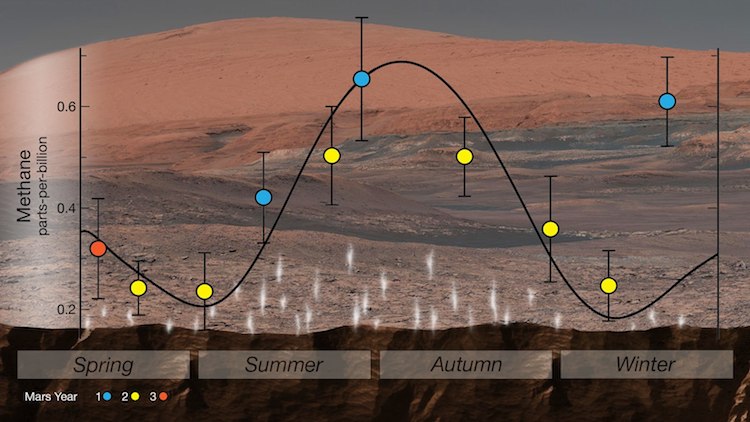 Diagram depicting the seasonal variation of methane in the Martian atmosphere as detected by Curiosity. Image Credit: NASA/JPL-CaltechThe new results from the rover should be back on Earth by Monday. The subsequent testing was considered important enough that other previously scheduled science work was postponed to do the follow-up testing.
Previously, the largest spike in methane detected by Curiosity was 7 ppb (parts per billion), back in 2013. But the spike from this past week was three times larger, at 21 ppb.
Since 2013, Curiosity had also found evidence that the methane was seasonal, peaking during the summer. This latest observation would seem to fit that pattern as well.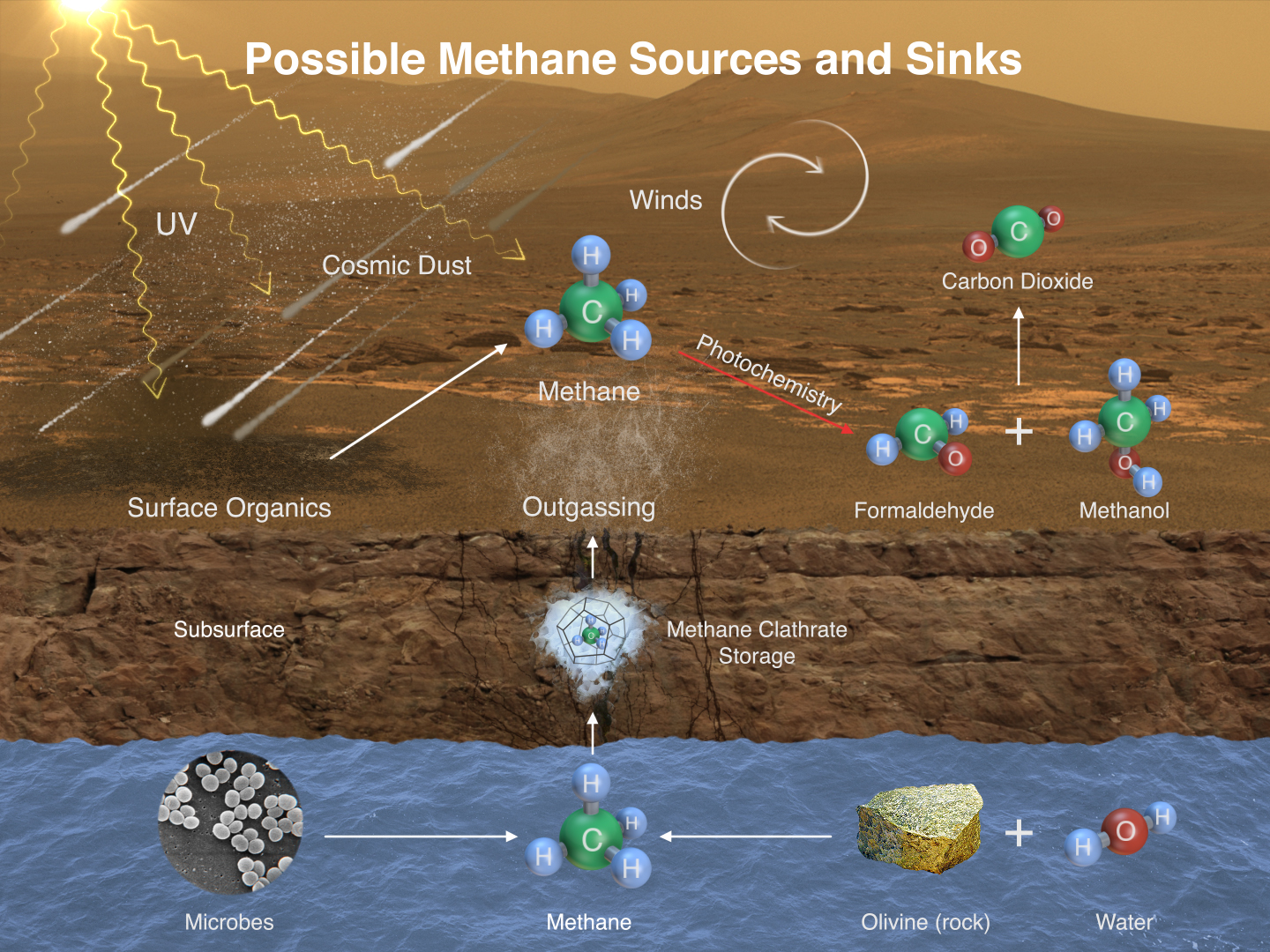 This image illustrates possible ways methane might be added to Mars’ atmosphere (sources) and removed from the atmosphere (sinks). NASA’s Curiosity Mars rover has detected fluctuations in methane concentration in the atmosphere, implying both types of activity occur on modern Mars. Image Credit: NASA/JPL-Caltech/SAM-GSFC/Univ. of MichiganThe methane levels detected previously were not enough for the rover to be able to study the isotope of the gas, to try to determine whether it is biological or non-biological in origin. Even then, a definitive answer would not be easy with the equipment Curiosity has. Whether the scientists can do an isotope analysis this time or not is not known yet.
ESA’s Trace Gas Orbiter (TGO), part of the ExoMars mission, had found no methane when it examined the atmosphere last year, but that may simply be due to the fact that the methane cycle appears to be seasonal.
It turns out that TGO passed over Curiosity’s location in Gale crater on the same day as the methane detection. Marco Giuranna, a scientist at the National Institute for Astrophysics in Italy, and who is in charge of the methane measurements from the Mars Express orbiter, said that there have been other observations as well, both before and after the big one from Curiosity.
“A lot of data to be processed,” Dr. Giuranna said. “I’ll have some preliminary results by next week.”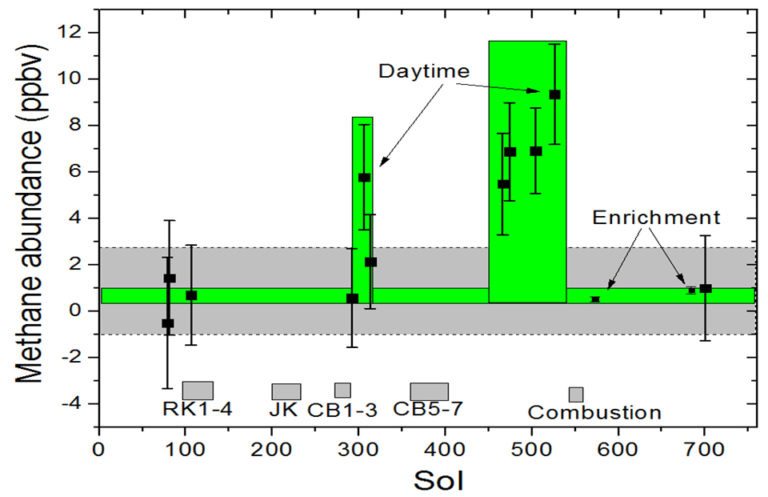 Previous methane measurements by NASA’s Curiosity in Mars’ Gale Crater, showing the spike in 2013. The graph covers a span of time from August 2012 to September 2014, labeled on the horizontal axis by the number of sols, or Martian days, since the rover’s landing on Mars — sols 1 through 750. Image Credit: NASA/JPL-CaltechMost of the methane on Earth comes from living organisms, but the origin of Mars’ methane is not know yet. It could be either biological or geological, or both. Even just a geological source would be very interesting however, since it could mean there is still active geology in Mars’ subsurface, which itself could provide heat and moisture for possible microbes.
The largest-ever confirmed plumes of methane were previously detected by telescopes on Earth, at a maximum of 45 ppb in 2003. There have been numerous detections by telescopes and Mars orbiters since then, although none of those were shown to be seasonal. From Earth telescopes, a global average value of 10 ± 3 pppb was observed in 1999. The Mars Express spacecraft measured a global average abundance of 15 ± 5 ppb from 2004 to 2010, while the Mars Global Surveyor spacecraft measured abundances ranging from 5 to 60 ppb, although the claims of local variations were later withdrawn. The background level of methane seen by Curiosity has been about 0.69 ± 0.25 ppb, in between spikes.
This new detection of methane is exciting, but we will will have to wait just a bit to hear more details. Stay tuned to AmericaSpace for more information as it becomes available.Source:
https://www.americaspace.com/2019/06/22/curiosity-detects-large-methane-burst-on-mars-nasa-orders-follow-up-testing/
 Wątek: [AS]Curiosity Detects Large Methane Burst on Mars, NASA Orders Follow-Up Testing (Przeczytany 1754 razy)