Zdjęcia skafandra kosmonauty wykonane 16.03.2015 w Muzeum Pamięci Kosmonautyki w Moskwie.
The spacesuit worn by Alexei Leonov on the first-ever spacewalk on March 18, 1965. The suit was photographed at the Memorial Museum of Cosmonautics in Moscow on March 16, 2015.
https://bsky.app/profile/contactlight.de/post/3lkgv423fc22pAlexei Leonov performed the first ever spacewalk today in 1965. It was surreal meeting this space hero who was not only kind, but a captivating storyteller!
https://twitter.com/AstroPeggy/status/1902014718518128901#OTD 60 years ago ✨
Voskhod 2 launched on March 18, 1965, with ASE Founding Member Alexei Leonov aboard.
Fun fact: This flight was the first to include a spacewalk!
https://twitter.com/ASE_Astronauts/status/1901982559342588030Первый выход в космическую бездну: 60 лет назад состоялся легендарный полёт Павла Беляева и Алексея Леонова18 марта 2025
https://www.gctc.ru/main.php?id=7056Испытательно-тренировочный комплекс «Гидролаборатория» в ЦПК теперь носит имя А.А. Леонова19 марта 2025
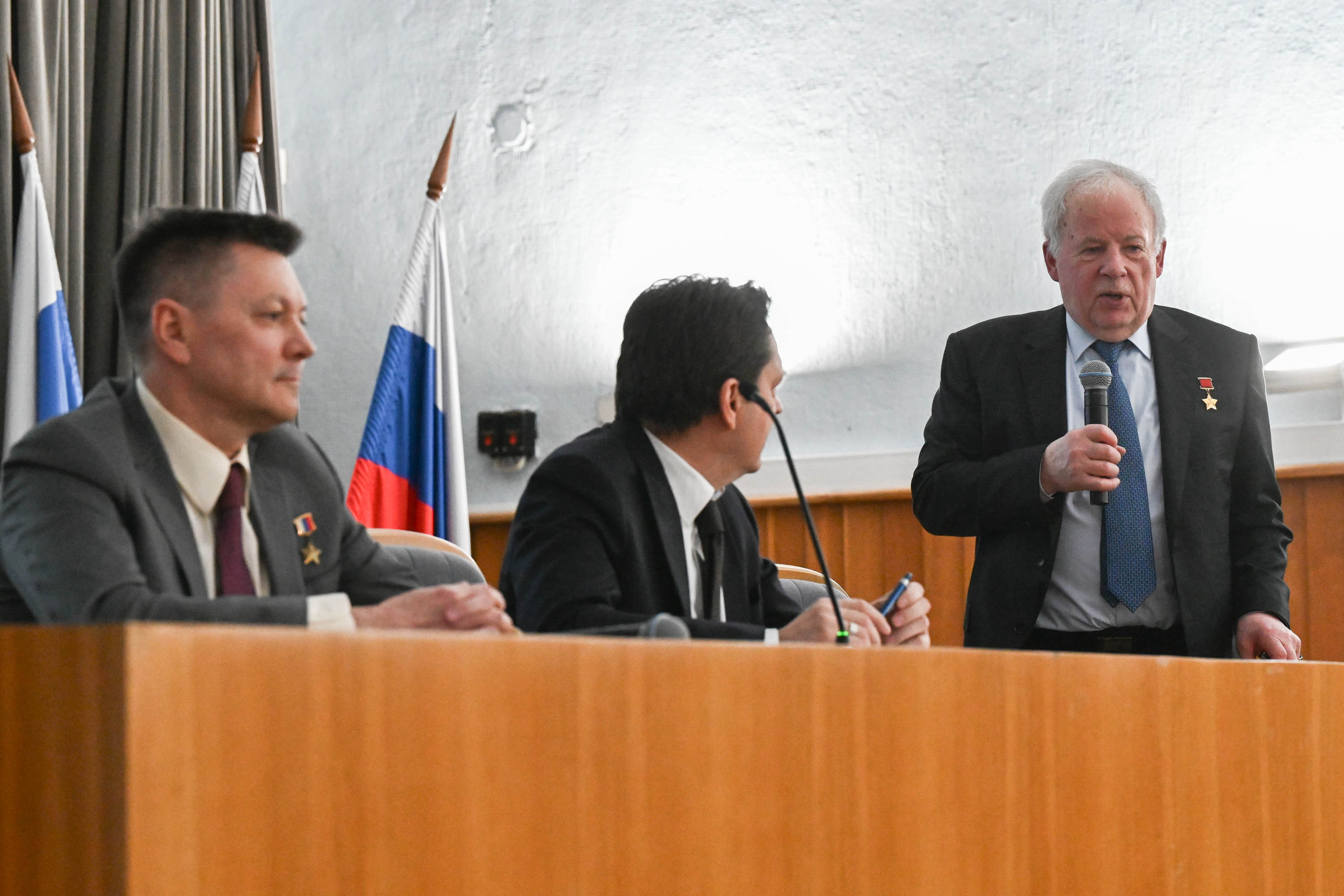
(...) России, лётчик-космонавт РФ Валерий Корзун в своём выступлении зачитал отрывки из редкого документа. После возвращения на Землю экипажа Павла Беляева и Алексея Леонова состоялся разбор из полёта, на котором присутствовал Владимир Михайлович Комаров, и он делал заметки. И эти заметки специалисты передали В.Г. Корзуну, который познакомил с ними сотрудников ЦПК. (...)
https://www.gctc.ru/main.php?id=7064THE MAN WHO DIDN'T WALK ON THE MOON
By Thomas O'Toole July 17, 1994
ON A WINTER EVENING IN 1967, two black Zil limousines made their way across Red Square in Moscow. Sitting in the first car were Andrian G. Nikolayev and his wife, Valentina Tereshkova, both veteran cosmonauts; Georgi T. Beregovoy, a Red Air Force general who would become the head of the cosmonaut corps, and Aleksei Leonov, who two years earlier had become the first man to walk in space. Behind them in a second black Zil sat the top two men in the Soviet hierarchy, President Leonid I. Brezhnev and Prime Minister Aleksei N. Kosygin.
As they passed through the gates of the Kremlin on their way to a reception, the limousines slowed. Suddenly, a man wearing the hat and dark overcoat of a policeman stepped from the shadows. The passengers in both cars could see that he held an automatic pistol in each hand. They also saw the fierce look on his face.
"He began firing immediately, killing the driver of our car," Aleksei Leonov remembers. "I looked down and saw two bullet holes on each side of my coat where the bullets passed through. A fifth bullet passed so close to my face I could feel it go by. This man was shooting at me, thinking I was Brezhnev. He was angry because he had been conscripted into the army. When it was over, Brezhnev took me aside and told me: 'Those bullets were not meant for you, Aleksei. They were meant for me, and for that, I apologize.' "
Today, Leonov looks back on the event with mild disbelief. A cosmonaut for 32 years and deputy director of the Soviet cosmonaut training corps for more than a decade until his retirement in 1992, Leonov has risked death for his nation enough times that a near assassination seems like part of his job description. Now 60, Leonov looks the same as he did when his nickname was the Siberian Bear. He still doesn't wear glasses, not even to read or paint. (His work has hung in the Smithsonian National Air and Space Museum in Washington.) As outgoing as any politician, he has met Charles de Gaulle, Juan Carlos of Spain, Prince Philip of Great Britain, the royal families of Greece and Denmark, and Pablo Picasso, who once said he was eager to meet the first artist to orbit the earth.
A smart and candid space traveler, Leonov recently spent three days in New York describing in rich detail his days as a cosmonaut and revealing previously unknown facets of the Soviet lunar mission. On his mind was the 25th anniversary of the Apollo 11 moon landing. On July 20, 1969, the astronaut Neil Armstrong, with Buzz Aldrin at his heels, became the first person to stand on the moon -- an achievement the American and Soviet Governments had battled for a decade to claim. The memory of that one small step retains a private clarity for Leonov. In 1967, he had been chosen to command the first Soviet mission around the moon and was that nation's odds-on favorite to land there. Had the Russians won the space race, Leonov, not Armstrong, would likely be remembered today as mankind's great leaper.
"My engineer was already picked," Leonov says proudly. "Was I trained and ready to go? Da, da, da!"
BORN THE SON OF A COAL MINER IN THE SIBERIAN village of Listvayanka, Aleksei Arkhipovich Leonov knew by age 6 that he wanted to fly -- the faster and higher the better. He was granted the first part of his wish when he was accepted to flight school at age 18. By age 23, he was flying MIG-15 jet fighters on reconnaissance missions in East Germany.
"I could see American F-86's and F-100's on the other side of the border, doing the same reconnaissance missions I was doing," Leonov recalls. "I found out later that Tom Stafford was one of those Americans." In 1975, Leonov and Stafford would be commanders of the Apollo-Soyuz Test Program, the first joint mission between the Americans and the Russians.
On Oct. 4, 1957, the Russians launched Sputnik, announcing a seemingly unbreakable grip on the orbital realm. Leonov was 24 when the call went out a year later for the first cosmonauts. Fighter pilots, accustomed to risk and to making quick decisions, were ideal candidates. Youth and inexperience were unimportant; the first Soviet cosmonauts were at least 10 years younger than and had less than half the flying time of their American counterparts.
Out of more than 3,000 fighter-pilot applicants, 45 were interviewed and tested. Leonov was among the eight who survived the first cut. In March 1960, the original 8 and 14 new candidates were invited to Chkalovsky Airport outside Moscow for training. Among those chosen with Leonov was Yuri Gagarin; the two became fast friends.
The cosmonauts' first task was to improve their parachuting ability. Unlike American spacecraft, the early Soviet vehicle -- a one-man design that carried the first six cosmonauts into space -- had no parachute. Instead, returning cosmonauts were ejected at 12,000 feet and left to parachute themselves to earth. The practice was as dangerous as it was unorthodox. During one training jump, a gust of wind blew Leonov and Pavel Belyayev, another cosmonaut, together in a tangle of parachute cords. Leonov landed safely, but Belyayev broke his left leg, losing whatever chance he had to be one of the first six cosmonauts in space.
Leonov lost out for a different reason. The six candidates, announced in late 1960, had to be small enough to fit the tight dimensions of the Vostok spacecraft. "I was too tall," the 5-foot-8-inch Leonov says today. "The first six were all shrimps."
The Soviet space czar at the time was a rocket scientist named Sergei Korolev, who picked the 5-foot-6-inch Gagarin for the first mission, on April 12, 1961. "Yuri Gagarin was destined to be the first man in space," says Leonov. "You could tell by the way he held himself, by the way the directors looked at him. When Gagarin was picked, nobody was unhappy with it."
Gagarin was followed into orbit by Gherman Titov on Aug. 6, 1961. On Feb. 20, 1962, John Glenn became the first American to orbit the earth, followed three months later by the American Scott Carpenter. The race was in full tilt. On Aug. 11 of that year, while astronaut Wally Schirra was being readied for flight, the Russians launched Andrian Nikolayev into space, then launched the cosmonaut Pavel Popovich the following day. Two men flew in space simultaneously for the first time. For the next three years, the United States and the U.S.S.R. traded accolades. The Russians sent the first woman -- Valentina Tereshkova -- into space and were first to orbit three men on the same craft. The Americans were busy preparing the first rendezvous of two spacecraft, Geminis 6 and 7.
So far, however, nobody had attempted to send a man outside his orbiter on a spacewalk. Leonov says that Korolev approached him as early as 1961 with the idea. "Korolev looked at me one day and said, 'You, my eagle, I will ask you to put on the spacesuit and see if you can do some tasks,' " Leonov recalls. Every day for the next two and a half years, Leonov lifted weights, swam, ran and bicycled rigorously. He also trained endlessly in his spacesuit and in the air lock that Korolev had attached to a new Voskhod spacecraft especially for his mission.
In February 1965, as an experimental precursor to Leonov's flight, an unmanned Voskhod mission was sent into space. The mission seemed to be going well, but when it came time for the Voskhod to re-enter the Earth's atmosphere, the spacecraft had disappeared from Soviet radar screens. "The supposition was that it was blown out of space by the Americans," Leonov says.
In fact, engineers discovered, two ground-to-space signals had overlapped, creating a new "signal" that the on-board computer interpreted as a message to blow up the spacecraft, which it obligingly did. The mishap presented a fresh dilemma: The Russians now had only one Voskhod left in which to risk Leonov and his co-pilot, Belyayev. Moreover, the explosion had destroyed any useful data from the unmanned mission. The Russians knew the Americans were planning a spacewalk with Ed White, probably in late May or early June of 1965. Korolev left the decision to Leonov and Belyayev.
"We replied that we didn't want to lose a year," Leonov says. "We were at the height of our preparedness. We had no qualms about what awaited us."
On March 18, 1965, their Voskhod carried them into orbit. Leonov donned his spacesuit, closed the hatch to the craft and stepped out into the air lock. After acclimatizing for 50 minutes, Leonov stepped into open space over the Black Sea. Leonov was exhilarated. "I said to myself, It's true, the earth is round."
The next 12 minutes were the most hair-raising of his life. "Near the end of my walk I realized that my feet had pulled out of my shoes and my hands had pulled away from my gloves. My entire suit stretched so much that my hands and feet appeared to shrink. I was unable to control them. It was as if I had never tried the suit on even once."
In his oversize suit, Leonov was unable to re-enter the air lock. Leonov tried entering feet first, without success. When he tried going in head first, his shoulders wouldn't follow. He couldn't bend his knees or flex his feet. He tried rolling in, but that didn't work either. By now, Leonov was sweating uncontrollably. Near despair and almost out of breath, Leonov made one last effort, pulling himself in by the hands while doing the space equivalent of a leg press.
"I violated instructions as soon as I got into the air lock and closed the hatch," he says. "I opened my helmet because I couldn't see anything. I was drenched in sweat. I was completely exhausted."
Leonov's ordeal had only just begun. When the air lock was set free, the spacecraft began to roll uncontrollably at 17 times the normal rate, raising the cabin temperature and making Leonov and Belyayev dizzy. The roll ceased once the hatch was fully closed, and the cosmonauts prepared for re-entry. But where to land? Leonov aimed for the city of Perm, west of the Ural Mountains. "We could have landed in Red Square," he says. "But I chose Perm, because even if I miscalculated, I would still land in Soviet territory. I did not want to land in China."
As the Voskhod fell toward earth, its landing cabin separated from the orbital cabin as planned, but the cable that joined them refused to break loose. The craft tumbled downward, spinning like a dumbbell. The gravitational force inside reached 10 G's, bursting the blood vessels in the eyes of both cosmonauts. The cable and orbital cabin at last broke free, enabling the landing craft to open its parachutes and land softly. When Leonov and Belyayev opened the hatch, however, they found themselves surrounded by dense forest and up to their chins in snow. They had no idea where they were -- about 100 miles from Perm, it turned out. The cosmonauts, soaking wet and freezing in temperatures far below zero, climbed back inside. "How soon do you think they'll pick us up?" Leonov asked Belyayev. "Maybe in three months," Belyayev replied, "they'll pick us up with dog sleds."
After trying their radio, the cosmonauts sent out a distress signal in Morse code, and a Siberian station responded that help was on the way. Two long days later, a helicopter found them. Their agonizing ordeal was over.
As late as 1967, Leonov recalls the Soviet Union still had a good chance of beating the Americans to the moon. By then, unmanned Soviet spacecraft had already been first to orbit the moon, land there, send a robot rover out and return samples of lunar soil to earth. In 1966, Leonov says, the Russians had organized a manned mission to the moon, selected 20 cosmonauts to train for it and settled on a daring strategy: to land one man -- Leonov -- in the Sea of Tranquillity, the same spot where Armstrong and Aldrin eventually touched down.
"If things had gone well, we would have made three manned flights around the moon," Leonov says. The first manned circumlunar mission was scheduled for early 1968 in an attempt to beat the Apollo 8 flight -- piloted by the astronauts Frank Borman, Jim Lovell and Bill Anders -- which flew in December. "We knew the American timetable, more or less."
The Soviet plan to land on the moon entailed major risks. Whereas the American mission would send three men into an orbit about 70 miles above the lunar surface, the Russians would send only two men on a similar trajectory. A landing craft, big enough for only one person, would be attached to the Soviet orbiter. To save weight, there would be no air lock connecting the orbiter and the lander. Instead, Leonov would spacewalk to the lander.
The landing strategy was riskier still. The on-board computer was programmed to lower the landing craft to 10 miles above the moon, then lower it a second time to within 400 feet. Once there, Leonov would select a landing site and instruct the computer to head toward it. "The man making the landing would have three seconds to redesignate his landing site if he didn't like the first site," Leonov says. "The Apollo team had 30 seconds to do that. Three seconds is almost impossible. Everybody thought that was a very dangerous approach to landing."
Leonov never got the opportunity to try. In May 1966, Sergei Korolev, a man Leonov describes as the guiding genius behind all the early Soviet successes, died during routine surgery. In his absence, the Soviet lunar mission derailed. Zond 1, the first in a series of unmanned test flights designed to fly around the moon and back starting in November 1967, was a complete disaster. Two subsequent Zond flights succeeded, but two others failed miserably. By 1969, after Apollo 11 had made its historic landing, the Russians had only one Zond spacecraft left. Today it sits in a museum in Moscow. "Zond did not work because Sergei Korolev was not around to see that it worked," Leonov says wistfully.
Leonov also attributes the American success to the simplicity of the Apollo program, which produced little of the waste and duplication the Soviet program did. (Whereas the Americans developed one rocket, the Saturn V, to send men to the moon, the Russians built two versions; one of them, a 30-engine monstrosity, blew up both times it was tested.) Leonov also praises the American willpower to see the lunar landing through to the finish. "A lot of the credit has to be given to Kennedy, when he established the deadline at the end of the decade," Leonov says. "Kennedy said a man has to land on the moon and that man has to be American."
Though Leonov is offically retired, you would never know it. He is a spokesman in Russia for the Swiss Omega Watch Company and is a board member of one of Russia's largest investment funds. He lives with his wife, Svetlana, in Star City, near Moscow. And he travels the world constantly, visiting friends like Tom Stafford in Oklahoma and giving lectures on the importance of space flight. In New York, posing for pictures in front of a mothballed Gemini spacecraft on the U.S.S. Intrepid, Leonov chats eagerly with curious tourists and schoolchildren, behaving for all the world like some celebrity politician running for re-election.
Still, Leonov can't always hide his disappointment. When asked whether he watched the Apollo 11 landing and how he felt about it, he turns quiet and quickly changes the subject. Any residual bitterness, however, is tempered by the knowledge that the odds of his making that one small step were slim. "We would have beaten Borman," Leonov says with conviction. "But I don't think we would have landed before Armstrong."
Few people know better than Leonov what it was like to be a Space Age pioneer -- or how long gone those pioneering days are. "When Sputnik went up, I thought it would be at least 20 years before man followed Sputnik into space," Leonov says. "I was wrong. But times have changed. The moon is now very far away."
https://www.nytimes.com/1994/07/17/magazine/the-man-who-didnt-walk-on-the-moon.html
 Wątek: Aleksiej Archipowicz Leonow (1934-2019) (Przeczytany 13232 razy)