Autor Wątek: The Space Review  (Przeczytany 203273 razy)

0 użytkowników i 1 Gość przegląda ten wątek.

Offline Orionid

  • Weteran
  • *****
  • Wiadomości: 30619
  • Very easy - Harrison Schmitt
Odp: The Space Review
« Odpowiedź #450 dnia: Kwietnia 05, 2026, 20:04 »
14/IV 2026 [66-70]

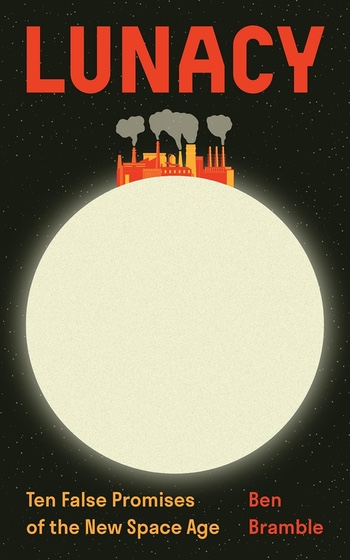
66) Review: Return to Launch
by Jeff Foust Monday, April 6, 2026


Return to Launch: Florida and America’s Space Industry
by Stephen C. Smith
University of Florida Press, 2026
hardcover, 348 pp., illus.
ISBN 978-1-68340-656-3
US$38
https://www.amazon.com/exec/obidos/ASIN/1683406567/spaceviews

During a press conference last Monday in the windowless briefing room at the Kennedy Space Center Press Site, the discussions about preparations for the Artemis 2 launch were interrupted by a rumble. The first thing that came to mind was thunder—it’s Florida, after all—but there were no storms in the vicinity. The rumbled continued far longer than one expected for any storm. A reporter calling into the briefing, unaware of the commotion, continued to ask his question while those in the room smiled, aware of what was going on.
https://www.thespacereview.com/article/5192/1

67) Ownership without oversight: Australia’s on-orbit supervision gap
by Jeremy Kruckel Monday, April 6, 2026


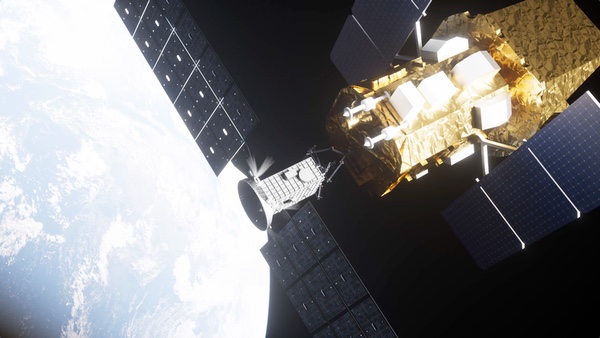
An image of a Chinese satellite taken by Continuum-1, a satellite now owned and operated by Australian company HEO. (credit: HEO)

When HEO acquired full title and operational control of an in orbit satellite from Satellogic in late 2025, Australia gained its first dedicated asset under Australian ownership. The satellite, renamed Continuum-1, was launched years earlier by the United States on a SpaceX Falcon 9 from Cape Canaveral. Australia played no role in its launch and is not a launching state under the Liability Convention.
https://www.thespacereview.com/article/5193/1

68)  Thirty years later, Mars 96 has not been found
by Dante Sanaei Monday, April 6, 2026

Unprecedented scientific collaboration, catastrophic failure, and an uncertain final resting place


Concept illustration of Mars-96 penetrators descending toward the Martian surface. (credit: NPO Lavochkin / Russian Academy of Sciences, via NASA SP-4515)

On the night of November 16, 1996, a strange light moved slowly across the skies of Chile. Observers in remote mountain regions described a brilliant object traveling horizontally along the horizon, far brighter than any star and leaving behind a luminous trail that lingered in the thin air. Unlike a meteor’s sudden flash, this phenomenon endured. For nearly a minute it crossed the darkness, shedding faint fragments that glowed briefly before fading from view. In the Andes, a landscape defined by silence and vast distances, the event felt both unmistakably real and deeply uncertain—something that did not belong in the usually peaceful night sky.
https://www.thespacereview.com/article/5194/1

69) Pinning the tail on the Moskva: POPPY and the dawn of satellite ocean surveillance
by Dwayne A. Day Monday, April 6, 2026


The Moskva's Top Sail radar was new and unique to that ship when it conducted sea trials in the Black Sea in 1967, making it possible for American signals analysts to connect the radar emissions to a specific vessel. This demonstrated that it was possible to track ships at sea from space. (credit: US Navy, modified by Benjamin Claremont)

In 1963, American reconnaissance satellites overflew a shipyard in Mykolayev, Ukraine, on the Black Sea, and photographed evidence of a new large vessel under construction. But it was not until 1965 that satellite photographs revealed it to be “an unusual ship,” in the words of a CIA report. Later that year, it became clear that it “was a helicopter platform, with either an ASW or amphibious assault mission.” It was launched in 1967 and began sea trial inside Soviet waters. This was a time when the Soviet Union was beginning to send its fleet further out to sea, challenging the US Navy, and any new large warship was of great interest to the Navy admirals.
https://www.thespacereview.com/article/5195/1

70) Artemis eclipses
by Jeff Foust Monday, April 6, 2026


Artemis 2 lifts off from the Kennedy Space Center April 1. (credit: NASA/Bill Ingalls)

At the final pre-launch briefing for the Artemis 2 mission March 31, a reporter asked NASA senior test director Jeff Spaulding if he was aware of any planned pranks for launch day. The launch, after all, was scheduled for April 1—April Fool’s Day—and astronauts have a long track record of practical jokes.

15/IV 2026 [71-75]

71) A tale of two Martian cities
by Thomas Gangale Monday, April 13, 2026


How should future Martian settlements be governed? (credit: SpaceX)

“Quid est enim civitas nisi concors hominum multitudo?” — Marcus Tullius Cicero, De Republica 1.39

“For now we see through a glass, darkly.” No Hari Seldon, as in Isaac Asimov’s Foundation, stands ready with psychohistory to predict humanity’s future on the Red Planet. Yet the choices we make today about governance, rights, and human nature will shape the first permanent settlements on Mars in the 2040s and 2050s—and, by extension, the long-term trajectory of our species beyond Earth. The early decades of the colonial period on Mars will not arrive with a finished constitutional order already in place. Instead, two distinct settlements are likely to emerge, each still in the process of formation.
https://www.thespacereview.com/article/5197/1

72) Who watches the birds? Cold War era launch vehicle photographs
by Dwayne A. Day Monday, April 13, 2026


The first HEXAGON reconnaissance satellite sits on its pad at Vandenberg Air Force Base in 1971. Twenty of these schoolbus-size satellites were launched, with one failure. They photographed huge amounts of territory during each mission, enabling photo-interpreters to detect and assess adversary weapons capabilities. (credit: Peter Hunter Collection)

During the Cold War, the US Air Force launched hundreds of rockets from both the East and West Coasts. Usually, the military made some kind of announcement that a launch had occurred, or was about to occur, without releasing any further details, and for many years, rarely releasing any photographs. The result was that many military space launches—probably a significant majority of them—had no public photographic evidence that they happened. But starting in the late 1990s, an Australian space enthusiast by the name of Peter Hunter began collecting photographs of United States Thor, Delta, Atlas, and eventually Titan launches. Hunter was a 747 pilot for Qantas, and during his long layovers in Los Angeles he visited an archive of launch vehicle photos near San Diego. He was able to gain access to it through his professionalism, charm, and Australian accent. Over many years of hard work, he produced a collection of high-resolution scans of as many launches and launch vehicles as possible, later providing copies to multiple museums and historians.
https://www.thespacereview.com/article/5198/1

73) Strategic celestography and lunar competition: Artemis, CLEP, and the struggle for positional advantage
by Glenn Scofield Monday, April 13, 2026


The Moon and Earth seen during the Artemis 2 mission. (credit: NASA)

Human exploration of the Moon is often presented as a scientific endeavor, but the scale and scope of contemporary lunar exploration programs suggest that great power competition is expanding into the broader Earth–Moon system. As the United States and China expand their presence beyond geocentric orbit, lunar resource distribution and cislunar orbital dynamics are shaping a new phase of strategic competition. This rivalry increasingly revolves around two evolving lunar architectures: the US-led Artemis campaign and the Chinese Lunar Exploration Program (CLEP) with its Chang’e series of missions. Both programs seek to expand access, presence, and operational reach throughout the Earth–Moon system, and both will grow more capable as commercial launch systems and autonomous spacecraft operations continue to mature.
https://www.thespacereview.com/article/5199/1

74) Opening the path to the lunar surface
by Jeff Foust Monday, April 13, 2026


The Orion spacecraft Ingenuity splashes down to conclude the Artemis 2 mission April 10. (credit: NASA/Josh Valcarcel)

The timeline for the Artemis 2 mission included a six-minute blackout during reentry as the Orion spacecraft, entering the atmosphere at nearly 40,000 kilometers per hour, created a plasma sheath the cut off radio communications. Engineers determined exactly when the blackout would begin and when it should end, allowing for communications to resume.

That didn’t mean, though, that controllers weren’t nervous. “Blackout, there’s really no beating around the bush with that,” Rick Henfling, entry flight director, said at a press conference Friday night. “It’s a difficult time because the flight control team wants to see data. We want to look at the data, we want to provide input to the flight crew on how to fly their spaceship. And when we don't have data, we’re trying to figure out what to do with ourselves.”
https://www.thespacereview.com/article/5200/1

75) Artemis 2, Apollo 8, and the problem with history
by Dwayne A. Day Monday, April 13, 2026


In December 1968, the crew of Apollo 8 flew a risky mission to orbit the Moon for the first time. Was the decision to fly this mission primarily because the LM was not ready and NASA did not want to lose time and momentum, or was it because the CIA concluded that the Soviet Union might attempt such a mission before NASA? (credit: NASA)

Last week, as the Artemis 2 crew looped around the Moon, taking spectacular photos and deftly handling media inquiries, numerous podcasts and news programs had on experts to explain why NASA was conducting this mission, and why it was pursuing the Artemis program to land people on the Moon. The answers were, of course, diverse. There were claims that NASA wants to find and use resources on the Moon like water ice and helium-3. There were statements that this was about competing with China. There were those who pointed out the pork-barrel politics aspects of the program. And, of course, there were the ones who claimed that this was about vision, about exploration, about boldly going where no one has gone before (at least since 1972, anyway.) None of these rationales was convincing, and all of them together are vaguely accurate but unsatisfying. What is lacking today is the clarity of the Cold War and the Apollo program. But even Apollo was a bit less clear than we think.
https://www.thespacereview.com/article/5201/1
« Ostatnia zmiana: Kwietnia 23, 2026, 15:58 wysłana przez Orionid »

Offline Orionid

  • Weteran
  • *****
  • Wiadomości: 30619
  • Very easy - Harrison Schmitt
Odp: The Space Review
« Odpowiedź #451 dnia: Kwietnia 17, 2026, 17:20 »
16/IV 2026 [76-80]

76) Who watches the birds? Cold War era launch vehicle photographs (part 2)
by Dwayne A. Day Monday, April 20, 2026


Launch of the first KH-11 KENNEN electro-optical satellite in December 1976 from Vandenberg Air Force Base in California. This satellite established a new and revolutionary capability for the US intelligence community. (credit: John Hilliard Collection)

Starting in the late 1990s, an Australian space enthusiast by the name of Peter Hunter began collecting photographs of United States Thor, Delta, Atlas, and eventually Titan launches. Over many years of hard work, he produced a collection of high-resolution scans of as many launches and launch vehicles as possible, later providing copies to multiple museums and historians.
https://www.thespacereview.com/article/5202/1

77) When the orbital layer is the kill chain
by Bharath Gopalaswamy Monday, April 20, 2026

AI and drones are getting all the credit. Space is doing most of the work.


While AI and drones have received most of the attention in the ongoing confict with Iraq, space capabilities have played a critical role. (credit: US Central Command)

In the weeks since Operation Epic Fury began on February 28, 2026, the public debate about artificial intelligence in warfare has focused almost entirely on Maven, on Palantir, on whether an AI model selected the targets struck in Minab, and on the legal and ethical implications of machines operating inside a kill chain. These are real and urgent questions. But they are the wrong questions if what you want to understand is what has fundamentally changed about the character of modern conflict and what is most at risk in the conflict that follows this one.
https://www.thespacereview.com/article/5203/1

78) Commercial space station developers make their business case to NASA
by Jeff Foust Monday, April 20, 2026


Commercial space station developer Vast showed off its plans at the 41st Space Symposium while making the case there are sufficient markets for such stations. (credit: Space Symposium)

The general mood of last week’s Space Symposium conference in Colorado Springs was one of celebration of Artemis 2. With splashdown happing the Friday before the conference started, NASA and others used the event to take a victory lap for the first crewed flight to the Moon in more than half a century. (Organizers also likely breathed a sigh of relief that the mission ended before the conference began, ensuring that top NASA officials, including administrator Jared Isaacman, could attend.)
https://www.thespacereview.com/article/5204/1

79) Big little rocket: The N1 Moon rocket and the cognitive dissonance of spy satellite photography
by Dwayne A. Day Monday, April 20, 2026


Satellite photo of an N1 rocket on its launch pad at Baikonur. The United States tracked the development of the Soviet lunar program primarily using reconnaissance satellites. (credit: via Harry Stranger)

Throughout the 1960s, American reconnaissance satellites overflew the sprawling Soviet launch complex in Kazakhstan, photographing construction and equipment, looking for changes and new developments indicating new Soviet rocket and missile projects. The CIA designated the facility Tyuratam (sometimes Tyura-tam), but the Soviets called it Baikonur. In 1963, a CORONA reconnaissance satellite detected the first signs of a big new construction project, and it would become a key target for American intelligence collection for the remainder of the decade—and remain a bit of an enigma for decades longer.
https://www.thespacereview.com/article/5205/1

80) Mirroring mango salad: How ISS culture shaped Artemis 2
by Deana L. Weibel Monday, April 20, 2026


Astronauts on the ISS (left) and Orion during a ship-to-ship call as part of the Artemis 2 mission, as seen from Mission Control. (credit: NASA JSC/Robert Markowitz)

Artemis 2 has frequently been described as humans returning to the Moon,[1] and it has sometimes been seen as an attempt to pick up where the Apollo missions left off. In truth, however, the Artemis missions, specifically Artemis 2, aren’t exactly either one of those things. The Apollo missions took place in a completely different time period, with a different level of access to technology and during an era when space exploration itself was still new. More than 50 years later, the Artemis 2 mission reflects a transformation that is not just about the use of new programming and equipment but also a significantly changed culture.
https://www.thespacereview.com/article/5206/1

17/iV 2026 [81-85]

81) The TWINSTAR mission concept: A pragmatic path to finding Earth 2.0
by Sherine Ahmed El Baradei Monday, April 27, 2026


The TWINSTAR starshade in its compact, origami-wrapped launch configuration, designed to fit within standard rocket fairings for transport to the Sun-Earth L2 point. (credit: NASA/JPL-Caltech)

The search for a “Twin Earth”—a terrestrial world orbiting a Sun-like star with a breathable atmosphere—is the defining challenge of modern astrophysics. The Astrophysics 2020 Decadal Survey (National Academies, 2021) explicitly identified “Pathways to Habitable Worlds” as a top priority. However, the engineering hurdle is staggering: isolating the light of a planet from the overwhelming glare of its parent star requires a contrast ratio of 10-10, the equivalent to spotting a firefly next to a searchlight from thousands of miles away.
https://www.thespacereview.com/article/5207/1

82) Redefining success in space diplomacy: emerging space nations in the Artemis Era and the case of Türkiye
by Elif Yüksel Monday, April 27, 2026


Turkish astronaut Alper Gezeravcı on the International Space Station during the Ax-3 private astronaut mission in 2024. (credit: Axiom Space)

For decades, nations measured space progress through visible technological achievements: how many satellites they built and launched, which rockets they developed, and which orbits they reached. Today, the frontier has expanded to include participation in lunar missions, Mars exploration, and asteroid initiatives. These indicators remain valid measures of technological capability. Yet capability alone no longer defines success in space diplomacy.
https://www.thespacereview.com/article/5208/1

83) A Fortress Moon for cislunar security
by Alan T. Dugger Monday, April 27, 2026


The Orion spacecraft flying around the Moon during the Artemis 2 mission. (credit: NASA)

Geosynchronous Orbit, 16 October 2034, 02:19 UTC

The maneuver was filed as routine. A Chinese-licensed commercial spacecraft operating in geosynchronous orbit had submitted its trajectory adjustment notice 72 hours in advance, declaring its intent to depart Earth orbit and enter a translunar transfer. It was headed toward the Moon.

The mission profile identified the craft as a communications relay demonstrator supporting future lunar infrastructure as part of China’s International Lunar Research Station. Its launch, weeks earlier, had attracted little attention beyond the technical community. Commercial lunar missions had become increasingly common is the era of ILRS and Artemis. Its mass, propulsion profile, and declared purpose were consistent with its notice.

https://www.thespacereview.com/article/5209/1

84) Science Power Platform: the ISS’s cancelled power module
by Maks Skiendzielewski Monday, April 27, 2026


One of the 180GK configurations explored in the 1980s. Image: RKK Energia

The Science Power Platform is a name many station enthusiasts have heard, but it’s one for which it is surprisingly hard to find a detailed description. Before the name disappeared from International Space Station planning documents and “Assembly Complete” illustrations in the late 1990s, the module it represented was a key element of the station’s Russian Orbital Segment and a vital part of the accelerated assembly sequence that convinced the US to push ahead with the international project at full steam.

In the end, the SPP was not as necessary as initially thought and, after suffering from a wave of funding cuts that plagued the Russian program in the ’90s and a series of redesigns that aimed to simplify the module while maximizing its utility, it was ultimately quietly dropped from the launch manifest.
https://www.thespacereview.com/article/5210/1

85) The great launch constraint
by Jeff Foust Monday, April 27, 2026


New Glenn lifts off on the NG-3 mission April 19. (credit: Blue Origin)

On the morning of April 19, Blue Origin’s New Glenn lifted off from Cape Canaveral, Florida, on the rocket’s third flight. The launch was widely anticipated for several reasons. One was that this was the first time New Glenn was using a reused booster. The first stage, called “Never Tell Me The Odds” by the company, flew the previous New Glenn launch, NG-2, last November, landing on the company’s ship Jacklyn in the Atlantic.

Reuse is vital to the business case for New Glenn, given the size and expense of the booster. Rather than taking the iterative approach SpaceX used for Falcon 9 landing and reuse a decade ago, Blue Origin needed to get landing and reuse down right away. (While the booster itself was previously flown, the company had swapped out its seven BE-4 engines between the two missions; CEO Dave Limp said that allowed them to test upgrades while saving the engines used on NG-2 for later flights.)
https://www.thespacereview.com/article/5211/1
« Ostatnia zmiana: Maja 04, 2026, 08:29 wysłana przez Orionid »

Offline Orionid

  • Weteran
  • *****
  • Wiadomości: 30619
  • Very easy - Harrison Schmitt
Odp: The Space Review
« Odpowiedź #452 dnia: Kwietnia 23, 2026, 16:10 »
18/V 2026 [86-90]

86) Review: Open Space
by Jeff Foust Monday, May 4, 2026


Open Space: From Earth to Eternity—the Global Race to Explore and Conquer the Cosmos
by David Ariosto
Knopf, 2026
hardcover, 384 pp., illus.
ISBN 978-0-593-53503-5
US$35
https://www.amazon.com/exec/obidos/ASIN/0593535030/spaceviews

One aspect of NASA’s revamped lunar exploration plans announced in March is a sharp increase in the number of lunar lander missions the agency plans to help develop its lunar base (see “Igniting a new vision for NASA”, The Space Review, March 30, 2026). The first of three phases of the plan calls for 21 landings from 2026 through 2028, including nine landings in 2027 and ten in 2028.
https://www.thespacereview.com/article/5212/1

87) The fallacy of the Overview Effect: perception, power, and strategic reality in space
by Christopher M. Stone Monday, May 4, 2026


The effect that spaceflight has on people, like William Shatner, may be misinterpreted. (credit: Blue Origin)

Since the dawn of human spaceflight, some astronauts have described a profound cognitive shift upon viewing Earth from orbit—an experience termed the “Overview Effect” (White, 1987). This phenomenon is frequently associated with desires for global unity, environmental awareness, and the perceived insignificance of political boundaries. From this vantage point, the Earth appears to be a single, borderless system, seemingly reinforcing the notion that divisions among peoples and nations are artificial constructs of limited importance.
https://www.thespacereview.com/article/5213/1

88) Governance is always late to the party. Here's why that's not an accident.
by G. Theresa Quitto-Dickerson Monday, May 4, 2026


Emerging in-space activitiers like satellite servicing pose governance challenges. (credit: Astroscale)

Consider the governance position of nearly any operator who has completed an on-orbit servicing mission in the last three years. The hardware performed. The asset transferred. By every technical measure, the operation succeeded. And by the time the paperwork caught up, legal scholars were still sorting out which liability framework applied, whose safety standards governed the handoff, and whether the jurisdictional question had ever been formally resolved. This is a representative scenario: one that has repeated, in some configuration, across multiple missions and multiple actors in the emerging in-space services market.
https://www.thespacereview.com/article/5214/1

89) The Moonbase moment
by Jeff Foust Monday, May 4, 2026


An illustration of a proposed lunar base, the centerpiece of the NASA Ignition event in March. (credit: NASA)

Since early 2020, a group called the Lunar Surface Innovation Consortium (LSIC, pronounced “ell-sick”) has been meeting regularly to discuss the infrastructure needed for any future presence on the Moon, from power to resource utilization. The companies, universities, and other organizations that are part of LSIC had been working to identify key technologies and development strategies, even as NASA’s plans to use any such infrastructure were vague, at best.
https://www.thespacereview.com/article/5215/1

90) Battle for the heavens: intelligence satellite vulnerability in the 1970s
by Dwayne A. Day Monday, May 4, 2026


The Soviet co-orbital anti-satellite weapon was first developed in the 1960s and became operational by the 1970s. This one is in a Russian museum. By the 1970s, the Soviet Union was developing additional anti-satellite weapons. (credit: TV Zvezda)

Starting in the late 1960s, the Soviet Union began testing a new anti-satellite weapon system that maneuvered a satellite close to its target and then fired a shaped explosive charge at it, showering it with metal fragments. The United States detected these tests and, over the next few years, US satellite operators became concerned that in event of a war, the Soviet Union could negate America’s military and intelligence space assets.
https://www.thespacereview.com/article/5216/1

19/V 2026 [91-95]

91) Three steps forward but one step back
by Dale Skran Monday, May 11, 2026


The Starlab commercial space station is among the concepts threatened by NASA’s proposed changes to its Commercial EO Destinations program. (credit: Starlab Space)

Some Artemis components, such as the Space Launch System (SLS) and Orion, long held a complex position in the space community. For some, it was an exciting venture back to the Moon and on to Mars. For others, it was a Congressionally mandated boondoggle focused on a jobs program leading nowhere. A key part of the Artemis architecture was the lunar Gateway, which existed mainly because the underpowered Orion service module could not directly reach low lunar orbit.
https://www.thespacereview.com/article/5217/1

92) Strategy is easy, but logistics is hard. Golden Dome proves it.
by Bharath Gopalaswamy and Daniel Dant Monday, May 11, 2026


One concept for the Golden Dome missile defense system with space-based elements. (credit: Redwire)

General Omar Bradley’s aphorism, “Amateurs talk strategy; professionals talk logistics,” has aged remarkably well. Today, it frames the central challenge facing the United States as it pursues the Golden Dome for America: a visionary, multilayered homeland defense architecture that depends less on conceptual brilliance than on industrial endurance.
https://www.thespacereview.com/article/5218/1

93) Flagships on a budget
by Jeff Foust Monday, May 11, 2026


The Nancy Grace Roman Space Telescope, NASA’s next astrophysics flagship mission, in a high bay at the Goddard Space Flight Center in April. (credit: J. Foust)

Last month, NASA held a media day for its latest astrophysics flagship mission, the Nancy Grace Roman Space Telescope. Reporters crowded into a viewing gallery overlooking a high bay at the Goddard Space Flight Center. In the high bay was Roman, lit to give it almost a purplish hue. The spacecraft recently completed environmental testing and was being prepared for shipment to the Kennedy Space Center for launch.
https://www.thespacereview.com/article/5219/1

94) Exquisitely unnecessary: very high resolution satellite reconnaissance
by Dwayne A. Day Monday, May 11, 2026


A declassified image of an Iranian launch site taken in 2019 by an American reconnaissance satellite. Even though it is degraded, the image still provides an indication of the kind of detail available from the most powerful reconnaissance satellites. (credit: US government)

How good is good enough when it comes to satellite imagery? Today it is common for commercial satellites to produce images with ground resolution of 0.2 to 0.3 meters (with 0.5 to 1 meter being more common), but the US intelligence community has long been rumored to have systems considerably better, reportedly able to discern objects on the ground down to 0.1 meters—a capability often referred to as “exquisite.” Although the details are classified, some historical information has been released indicating that at several periods during the early years of satellite reconnaissance, from approximately 1963 to 1969 and then from 1969 to 1973, the US National Reconnaissance Office (NRO) grappled with the question of the requirement for a “very high resolution” imagery system, and determined that it was not necessary. Despite this, the NRO eventually accomplished such high resolution by upgrading existing systems.
https://www.thespacereview.com/article/5220/1

95) After Gateway: the case for a middle power lunar consortium
by Phil McCrory Monday, May 11, 2026


NASA’s decision to end the lunar Gateway (above) offers an opportunity for international partners to work together on their own lunar exploration program. (credit: NASA)

On March 24, NASA administrator Jared Isaacman announced the “pausing” of the lunar Gateway; an effective cancellation for the current project. ESA, JAXA, and CSA—whose combined hardware investments exceeded several billion dollars—learned of the decision alongside the general public. ESA’s Director General said the agency was “consulting closely with its Member States, international partners and European industry to assess the implications.” ESA has set a deadline of June, when the ESA Council holds its next meeting, to determine what that assessment produces.
https://www.thespacereview.com/article/5221/1
« Ostatnia zmiana: Maja 13, 2026, 23:18 wysłana przez Orionid »

Offline Orionid

  • Weteran
  • *****
  • Wiadomości: 30619
  • Very easy - Harrison Schmitt
Odp: The Space Review
« Odpowiedź #453 dnia: Maja 06, 2026, 01:36 »
20/V 2026 [96-100]

96) Review: It’s (Just) Rocket Science
by Jeff Foust Monday, May 18, 2026


It’s (Just) Rocket Science: Exploring Physics Through Spaceflight Missions
by Trisha Muro
Johns Hopkins University Press, 2026
hardcover, 376 pp., illus.
ISBN 978-1-4214-5426-9
US$32.95
https://www.amazon.com/exec/obidos/ASIN/1421454262/spaceviews

In the preface of It’s (Just) Rocket Science, Trisha Muro recalls an incident when she was a teacher and a student asked to drop out of her high school physics class. Why did the student want to drop the class? “I was hoping it would be more like story physics,” she recalls the student saying. Story physics? Muro didn’t ask for an explanation then, but was—and still is—perplexed.
https://www.thespacereview.com/article/5222/1

97) Deep Black on the West Coast: honoring the Secretary of the Air Force Office of Special Projects and the Star Catchers
by Dwayne A. Day Monday, May 18, 2026


A new memorial was dedicated at the National Museum of the United States Air Force on May 15, honoring the men and women who worked for the secretive Secretary of the Air Force Office of Special Projects (SAFSP) in California. (credit: Pat Pressel)

On Friday, May 15, a ceremony was held on the grounds of the National Museum of the United States Air Force in Dayton, Ohio to dedicate a monument to the people who worked for a secretive organization on the West Coast. The Secretary of the Air Force Office of Special Projects, or SAFSP, was located not far from the Los Angeles International Airport. It still exists, by a different name, but for decades during the Cold War it was so secret that there were few public references to it. People who worked there often referred to it only as “Special Projects,” if they mentioned it at all.
https://www.thespacereview.com/article/5223/1

98) Critiquing and defending the Overview Effect
by Frank White Monday, May 18, 2026


Seeing the Earth from space can have a transformative impact. (credit: Blue Origin)

Let me begin my response to Christopher Stone by thanking him for his article in The Space Review (see “The fallacy of the Overview Effect: perception, power, and strategic reality in space”, The Space Review, May 4, 2026).My ideas are sharpened by responding to those who are critical of them, and he has clearly taken the theory of the Overview Effect seriously. His essay therefore calls for a serious response. Moreover, if there are others who see the Overview Effect as he does, my reply to him will answer them as well.
https://www.thespacereview.com/article/5224/1

99) The Isaacman honeymoon
by Jeff Foust Monday, May 18, 2026


The Nancy Grace Roman Space Telescope, NASA’s next astrophysics flagship mission, in a high bay at the Goddard Space Flight Center in April. (credit: NASA/Aubrey Gemignani)

The clearest sign of NASA administrator Jared Isaacman’s relationship with Congress came about halfway through a hearing April 28 by the Senate Appropriation Committee’s commerce, justice, and science (CJS) subcommittee when Sen. Chris Van Hollen (D-MD), ranking member of the subcommittee, took the microphone for a second round of questions about the agency’s fiscal year 2027 budget proposal.

“Mr. Administrator, this would be a very different hearing if I believed the budget request from the administration your best judgement,” he told Isaacman. “To me, this is just a carbon copy of what OMB submitted last year, and I really think it’s a disgrace to the NASA mission.”
https://www.thespacereview.com/article/5225/1

100) Space launch and reentry environmental concerns are real, but can be mitigated
by Michael Puckett Monday, May 18, 2026


New launch vehicles like Starship may launch more frequently, but have a lower environmental impact. (credit: SpaceX)

A recent wave of reporting has raised concern about the atmospheric effects of rocket launches. A February 2026 article in Nature described research suggesting that metallic vapors from reentry of rocket and spacecraft components could influence atmospheric chemistry and climate if launch rates increase substantially.[1][2] These concerns are grounded in a growing body of atmospheric research examining how rocket emissions behave when injected directly into the stratosphere and mesosphere.
https://www.thespacereview.com/article/5226/1

Note: Because of the Memorial Day holiday, next week’s issue will be published on Tuesday, May 26.

21/V 2026 [101-105]

101) Deep Black on the West Coast (part 2): Honoring the Air Force Special Processing Facility
by Dwayne A. Day Tuesday, May 26, 2026


In 2014, a plaque was dedicated at the National Museum of the United States Air Force in honor of the people who worked at the Air Force Special Projects Processing Facility in Massachusetts. The facility was responsible for producing film from top secret reconnaissance missions. (credit: AFFSPF Alumni Association)

On Friday, May 15, a ceremony was held on the grounds of the National Museum of the United States Air Force in Dayton, Ohio to dedicate a monument to the people who worked for a secretive organization on the West Coast. The Secretary of the Air Force Office of Special Projects, or SAFSP. But another group that was also technically part of SAFSP was left out of the ceremony.
https://www.thespacereview.com/article/5227/1

102) Reassessing NASA procurement strategy: A hybrid approach
by Eli Lichtenstein Tuesday, May 26, 2026


NASA has used cost-plus contracts on some parts of Artemis, like SLS (above), but fixed-price versions elsewhere. (credit: NASA/Sam Lott)

NASA is reshaping its spaceflight strategy on a scale not seen since the Space Shuttle’s phaseout in 2011. Unsatisfied with the pace of the Artemis program, administrator Jared Isaacman has proposed an ambitious agenda: monthly robotic lunar landings, annual crewed missions to the Moon, and a permanent surface base.

After decades of relegation to low Earth orbit, a refocus on more complex and long-term crewed missions is to be applauded. But each of these goals requires NASA to procure vehicles and other hardware, a detail NASA has yet to decide on. “The procurement method, how we would do it, I think that’s still open,” said NASA Associate Administrator Amit Kshatriya.[1] As noble as NASA’s goals are, history shows that how NASA intends to achieve them is just as important.
https://www.thespacereview.com/article/5228/1

103) Zarya: the three lives of the propulsively landed Super-Soyuz
by Maks Skiendzielewski Tuesday, May 26, 2026


General layout of the 7K-SM spacecraft. (Image: Vadim Lukashevich/buran.ru, processing by the author)

An earlier version of this article erroneously treated what is actually the 7K-SM as simply the initial version of Zarya, but the projects were distinctly different spacecraft, despite the many similarities. With newly published project documentation, both spacecraft can be described in more detail than before.

In the late 1980s, with the development of the first modules of Mir nearing its end and their launches on the horizon, NPO Energia started work on the station’s successor; another generational step after Salyut-6, which introduced multiple docking ports allowing continuous crewed operation and resupply missions; and Mir, which became the first truly modular station, drastically expanding the available volume and bringing specialized modules to the mix.
https://www.thespacereview.com/article/5229/1

104) Fear and panic in orbit around the Red Planet: Missions to Phobos and Deimos
by Dwayne A. Day Tuesday, May 26, 2026


Phobos is one of two mysterious moons of Mars. Over the decades many robotic and human missions have been proposed to visit the moons, but only now is a Japanese mission about to head to Phobos. Here, planetary scientist Paul Byrne blows up Phobos, just because he can. (credit: Paul Byrne)

They are named for the Greek gods of fear and panic, and flight. Phobos and Deimos are small moons orbiting Mars that have long harbored a mysterious secret. Where did they come from? Are they captured moons, drawn in by Mars’ gravitational pull, or are they pieces of Mars itself, thrown off the planet by a massive collision? There have been many proposals to send both robotic and human missions to the moons of Mars, but a Japanese mission launching later this year should finally help to answer this mystery.
https://www.thespacereview.com/article/5230/1

105) Starships are meant to eventually fly
by Jeff Foust Tuesday, May 26, 2026


SpaceX’s Starship lifts off on its Flight 12 mission May 22. (credit: SpaceX)

In a week filled with remarkable events for SpaceX, perhaps the strangest was the cameo appearance last Thursday during the company’s webcast for the latest Starship launch attempt. On a previous flight, it was Elon Musk who dropped by the webcast; this time, it was… Nicki Minaj?

Yes, it was the singer whose claim to fame was the song “Starship,” recorded long before SpaceX publicly announced plans for a vehicle that would eventually become Starship. While this was the 12th test flight of Starship/Super Heavy, this was the first that Minaj attended—or any launch, for that matter, she said.
https://www.thespacereview.com/article/5231/1
« Ostatnia zmiana: Czerwca 04, 2026, 09:46 wysłana przez Orionid »

Polskie Forum Astronautyczne

Odp: The Space Review
« Odpowiedź #453 dnia: Maja 06, 2026, 01:36 »

Offline Orionid

  • Weteran
  • *****
  • Wiadomości: 30619
  • Very easy - Harrison Schmitt
Odp: The Space Review
« Odpowiedź #454 dnia: Maja 21, 2026, 03:59 »
22/VI 2026 [106-110]

106) The “public” in public space agency
by Alex Li Monday, June 1, 2026


The Earth setting behind the Moon as seen by the Artemis 2 crew. (credit: NASA)

“I would suggest to you that when you look up here, you’re not looking at us. We are a mirror reflecting you. And if you like what you see, then just look a little deeper. This is you.”
— Jeremy Hansen, Artemis 2 mission specialist

On April 10, 2026, the Orion spacecraft carrying Reid Wiseman, Victor Glover, Christina Koch, and Jeremy Hansen came home after a nearly ten-day mission around the Moon. The mission took the crew roughly a quarter of a million miles from Earth. At its farthest point, they were farther from home than anyone else had ever gone.
https://www.thespacereview.com/article/5232/1

107) Lost and found on the Pacific floor: the Nimbus SNAP-19 nuclear generators
by Dwayne A. Day Monday, June 1, 2026


The SNAP-19 debris on the bottom of the Santa Barbara Channel off the California coast. In 1968, several search efforts were mounted to locate the radioactive payload, which proved elusive. (credit: NASA)

On May 18, 1968, a Thorad-Agena rocket carrying the third NASA Nimbus Earth observation satellite lifted off from its pad at Vandenberg Air Force Base on the California coast. As it rose it started to arc out over the Pacific. But within two minutes, as it was over the Santa Barbara Channel, it began straying off course and the flight safety officer blew it to smithereens. Among the debris falling into the water north of San Miguel Island were two SNAP-19 radioisotope thermoelectric generators, or RTGs, carrying plutonium fuel.

The satellite was designated Nimbus B-1. Its RTGs were a new design developed after a 1964 accident involving a Transit satellite equipped with an RTG spread radiation in the atmosphere. They provided about 50 watts of power. The SNAP-19 was designed to contain the radioactive material during an accident. Whereas NASA could have left the rocket and satellite debris where it was, the plutonium had to be recovered.
https://www.thespacereview.com/article/5233/1

108) Debris with telemetry: the cyber pathway to Kessler
by Daniel Morgan Monday, June 1, 2026


Disabling control of hundreds of megaconstellation satellites could lead to cascading collisions in congested orbits. (credit: ESA/ID&Sense/ONiRiXEL)

It is a Tuesday morning in the late 2020s. At a satellite operations center on the Eastern Seaboard of the United States, a duty controller is halfway through a coffee when the first telemetry anomaly arrives. A spacecraft in the operator’s mid-inclination shell, one of several thousand small satellites at an altitude of roughly 550 kilometers, has failed to acknowledge a routine stationkeeping burn. Ninety seconds later, a second satellite in an adjacent orbital plane reports the same fault. Then a third. In a cascade that takes less than four minutes to develop, 200 satellites across three commercial megaconstellations stop responding to maneuver commands.
https://www.thespacereview.com/article/5234/1

109) Big badaboom: the effects of a Saturn V launch pad explosion
by Dwayne A. Day Monday, June 1, 2026


In the AppleTV+ series "For All Mankind," a Saturn V exploded on the launch pad. NASA evaluated this possibility during the Apollo program. (credit: Apple)

On May 28, a New Glenn rocket became the biggest rocket ever to explode on the launch pad. There have been other bigger rocket failures before, most notably a Soviet N1 Moon rocket that blew up above its pad in 1969 and rained fiery hell below—the N1 rocket had more fuel, and made a bigger boom, than the New Glenn. Of course, there have been some innovative Starship failures, a Titan 34D that blew up over its launch pad in 1986, and many smaller missiles and rockets that blew up or over their pads at Cape Canaveral during the 1960s.

Although it was not the biggest, that New Glenn kind of explosion—let’s not call it an “anomaly”—was a concern during the Apollo program of the 1960s. Up until recently, the Saturn V was the largest rocket ever built by the United States. A true monster of a launch vehicle, it generated over 33 million newtons of thrust at liftoff and carried 2.5 million kilograms of fuel and oxidizer. If the Saturn V exploded, it could do so with the force of a small atomic bomb, the equivalent of half a kiloton, or about 1/26th the size of the bomb that destroyed Hiroshima. Naturally, this was a significant concern for Apollo program officials.
https://www.thespacereview.com/article/5235/1

110) Artemis and the blue micromoon
by Jeff Foust Monday, June 1, 2026


NASA administrator Jared Isaacman surveys the damage to Blue Origin’s Launch Complex 36. (credit: NASA/John Kraus)

The full moon last weekend was called by some a “blue micromoon”. Blue because it was the second full moon of the month, or blue moon. Micromoon came from the fact that the Moon was more distant from the Earth than average, making it appear slightly smaller; the opposite of the “supermoon” hyped in recent years, even though the difference is size is difficult for the unaided eye to notice.

The term might also reflect the mood in the space exploration community over the weekend. Barely 48 hours after NASA provided more details, and nearly $1 billion in contracts, to advance the lunar base plans it announced in March (see “Igniting a new vision for NASA”, The Space Review, March 30, 2026), the agency suffered a serious setback when one of the key vehicles needed for those plans exploded on the launch pad. Just how serious a setback, and how much further away the Moon now seems, is uncertain.
https://www.thespacereview.com/article/5236/1

23/VI 2026 [111-115]

111) Review: The Ultraview Effect
by Jeff Foust Monday, June 8, 2026


The Ultraview Effect: What We Can Learn from Astronauts about Awe, Humility, and Exploring the Unknown
by Deana L. Weibel
University of California Press, 2026
hardcover, 240 pp., illus.
ISBN 978-0-520-40952-1
US$24.95
https://www.amazon.com/exec/obidos/ASIN/0520409523/spaceviews

The concept of the “Overview Effect” is widely known in the space community: the change in perspective many people experience when they see the Earth from space. Popularized, and named, by Frank White four decades ago, it is something that today many people anticipate experiencing when going even on suborbital flights, although reactions vary and its significance remains debated (see “The fallacy of the Overview Effect: perception, power, and strategic reality in space,” The Space Review, May 4, 2026, and “Critiquing and defending the Overview Effect,” The Space Review, May 18, 2026.)
https://www.thespacereview.com/article/5237/1

112) The first alien intelligence may not be alive
by David W. Falls Monday, June 8, 2026


The first sign of extraterrestrial intelligence we discover may not be biological.

If intelligent life exists beyond Earth, we may be picturing the wrong kind of encounter.

Most of us imagine other beings as biological creatures. They may look strange, but we still tend to imagine bodies. Eyes. Limbs. Skin or something like it. A living organism standing on another world, looking back at us. That image is powerful because it keeps alien life close enough to human life for us to understand it.

But the first intelligence we encounter may not be biological at all. It may not breathe, eat, or sleep. It may not reproduce in any ordinary sense. It may not have a face, a voice, or a body shaped by evolution. It may be a machine.
https://www.thespacereview.com/article/5238/1

113) Why the vagueness of the Outer Space Treaty was a strategically calculated move
by Aditya Raj Monday, June 8, 2026


Soviet Ambassador Anatoly F. Dobrynin, UK Ambassador Sir Patrick Dean, US Ambassador Arthur J. Goldberg, US Secretary of State Dean Rusk, and US President Lyndon B. Johnson at the signing of the Outer Space Treaty on January 27, 1967 in Washington. (credit: British Pathé)

The NASA-led Artemis program is ramping up to return humans to the surface of the Moon for the first time since the Apollo 17 mission in 1972. These mission are within the framework of the Artemis Accords.

These accords reaffirm the principles of the 1967 Outer Space Treaty (OST) that are frequently criticized as outdated and geopolitically ambiguous. Yet it’s worth noting that the same criticisms of the treaty’s vague terms helped sustain the primary objective of intergovernmental cooperation and peace. This has occurred even without any major political animosity from the Cold War era to the present. Peaceful relations among spacefaring nation-states are achieved through the stable legal framework for space activities provided by the OST.
https://www.thespacereview.com/article/5239/1

114) America’s most exposed power projection platforms
by David G. Hanson Monday, June 8, 2026

Why United States Space Force installations must be treated as warfighting infrastructure


Schriever Space Force Base in Colorado, one of the Space Force facilities that plays key roles in military space operations. (credit: US Space Force photo by Dalton Prejeant)

The United States Space Force (USSF) is unique among the military services not merely because it operates in space, but also because it fights from fixed locations on Earth while delivering effects globally and continuously. Unlike Army brigades, Navy strike groups, Marine Corps expeditionary units, or Air Force wings that deploy into theaters of operation, the Space Force overwhelmingly executes its missions through an employed-in-place operational concept, where combat operations are conducted from permanent installations on U.S. and allied soil. This reality fundamentally alters the strategic importance of Space Force installations.
https://www.thespacereview.com/article/5240/1

115) Yesterday’s Future: space settlement and castles in the sky
by Dwayne A. Day Monday, June 8, 2026


In 1976, Isaac Asimov published an article in National Geographic magazine about a 2026 visit to a giant space station. The article was illustrated by the late Pierre Mion. (credit: Pierre Mion, National Geographic)

Fifty years ago this week, millions of Americans opened up their mailboxes to find the July issue of National Geographic, giving them their first introduction to the idea of cities in space. The issue contained an article by Isaac Asimov about life on a giant space station 50 years in the future—the mysterious and exotic year of 2026.

For most of the 20th century National Geographic was one of the primary ways that Americans learned about the rest of the world, as well as different cultures within the United States. July 1976 was the American bicentennial and National Geographic’s editors chose that issue to include a vision of America’s future 50 years hence.
https://www.thespacereview.com/article/5241/1

24/VI 2026 [116-120]

116) Space race or space divide: orbital AI and the Global South’s exclusion crisis
by Maheen Butt Monday, June 15, 2026


SpaceX has proposed launching as many as one million orbital data center satellites, and other companies have proposed constellations of thousands of such satellites. (credit: SpaceX)

Several months ago, Elon Musk announced that SpaceX, recently merged with his artificial intelligence company xAI, would place data centers into orbit around the Earth. This announcement was not an isolated development. Google had already unveiled its Project Suncatcher in November 2025, with plans to launch approximately 80 data-center satellites into orbit by 2027. The startup Starcloud successfully trained the first AI model in space in December 2025.
https://www.thespacereview.com/article/5242/1

117) Sovereign capability and assured access: a tension in Europe’s space strategy
by Nicholas Borroz Monday, June 15, 2026


German launch company Isar Aerospace uses a spaceport at Andøya, Norway. (credit: Isar Aerospace)

Europe’s strategic debate is increasingly framed around sovereignty. In space, energy, digital infrastructure, and other critical domains, the European Union quite reasonably wants assured access to key capabilities under its own control. Yet despite a reshuffling of the global order, Europe has not retreated into autarky, and it cannot realistically do so. No major political entity can build, host, and operate all critical infrastructure entirely within its own borders.
https://www.thespacereview.com/article/5243/1

118) The Budapest Maneuver: why small nations need their own “little NASA”
by Mihail Istvanovics Várdai Monday, June 15, 2026


Poland has used its space agency to maximize opportunities with ESA, including flying an astronaut to the International Space Station. (credit: POLSA)

As the so-called “second space age” accelerates, the global narrative has shifted toward a rivalry between the Artemis Accords and the International Lunar Research Station over lunar resources. For countries like Hungary, this isn’t just a spectator sport: it’s a strategic vulnerability.

There is one contradiction: although small states are becoming more dependent on space technology (navigation, communication, and Earth observation), they still act as mere consumers. For the EU’s push for autonomy in space, national initiatives are critical in contribution to this objective. While large countries actively develop their lunar outposts, smaller states face an immediate question: How do we graduate from consumer to partner?
https://www.thespacereview.com/article/5244/1

119) Hello, Madison! A top-secret Cold War mission over Wisconsin’s capital
by Dwayne A. Day and Harry Stranger Monday, June 15, 2026


In 1964, a GAMBIT reconnaissance mission conducted photographic experiments over the United States, taking these three photos of the capitol building in Madison, Wisconsin in rapid succession. (credit: Pierre Mion, Harry Stranger)

The GAMBIT reconnaissance satellite program was started in 1960 to obtain higher-resolution photos of targets in the Soviet Union, specifically ballistic missiles. GAMBIT was designed to enable positive identification of targets and decent measurements of them, taking over the role of the U-2 spyplane after Gary Powers was shot out of a cold Siberian sky. The first GAMBIT launched in summer 1963, and although it worked, there were teething problems for the early missions. On March 11, 1964, the sixth GAMBIT, Mission 4006, was launched atop an Atlas-Agena rocket from California’s Point Arguello Launch Complex II, Pad 3 (later part of Vandenberg Air Force Base). In addition to its mission of photographing targets in the Soviet Union, it was also used to expand the spacecraft’s capabilities. This was done during several passes over the United States, including over the Midwest.
https://www.thespacereview.com/article/5245/1

120) Artemis 3 take shape
by Jeff Foust Monday, June 15, 2026


The Artemis 3 crew of (from left) Andre Douglas, Luca Parmitano, Randy Bresnik and Frank Rubio. (credit: NASA/Robert Markowitz)

In late February, NASA announced several changes to its Artemis lunar exploration effort. Among them was a change to Artemis 3, which was set to be the first crewed landing attempt. Instead, it would be a test flight in low Earth orbit that would rendezvous and perhaps dock with lunar landers from Blue Origin and/or SpaceX (see “Accelerating Artemis,” The Space Review, March 2, 2026.)

But NASA provided few details about that revised Artemis 3 at that announcement or in subsequent events. That included the crew who would fly the mission. The Artemis 2 crew was named in April 2023 for a mission then set to fly in late 2024—it ultimately launched almost exactly three years after the crew was named—and without the complications of docking with other spacecraft. NASA, particularly after the successful completion of Artemis 2, would only say it would name the crew “soon” without more specifics.
https://www.thespacereview.com/article/5246/1
« Ostatnia zmiana: Czerwca 17, 2026, 19:56 wysłana przez Orionid »

Offline Orionid

  • Weteran
  • *****
  • Wiadomości: 30619
  • Very easy - Harrison Schmitt
Odp: The Space Review
« Odpowiedź #455 dnia: Czerwca 04, 2026, 09:57 »
25/VI 2026 [121-125]

121) Review: The Echoing Universe
by Jeff Foust Monday, June 22, 2026


The Echoing Universe: How Radio Astronomy Helps Us See the Invisible Cosmos
by Emma Chapman
Basic Books, 2026
hardcover, 352 pp.
ISBN 978-1-5416-0185-7
US$32.00
https://www.amazon.com/exec/obidos/ASIN/1541601858/spaceviews

Earlier this month, Caltech announced a proposed radio observatory was ready to start construction. The Deep Synoptic Array (DSA) will feature 1,650 radio dishes, each about six meters across, spread across 300 square kilometers in a desolate valley in Nevada. The project is being funded by Schmidt Sciences, the philanthropic organization that announced plans in January for DSA and three other observatories, including a space-based telescope larger than Hubble. The project is counting on economies of scale to make this observatory affordable, as well as nontraditional suppliers: Caltech noted that each antenna’s feed structure includes “two concentric cake pans designed for the project by the baking pan company Fat Daddios.”
https://www.thespacereview.com/article/5247/1

122) Space autonomy needs an authority architecture before 2027
by Burak Oktenli Monday, June 22, 2026


As spacecraft gain the ability to perform autonomous maneuvers to approach or evade other spacecraft, there needs to be a set of guidelines about how those autonomous actions are performed. (credit: True Anomaly)

Imagine a US early warning satellite operating in geosynchronous orbit. During routine operations, its sensors detect an unexpected co-orbital threat rapidly closing the distance. The targeted satellite has mere seconds to execute an evasion maneuver or deploy defensive countermeasures. However, the unforgiving reality of orbital mechanics, vast distances, and physics dictates a massive light-time delay between the satellite and the ground command center. The time required for a human operator on Earth to see the threat on a screen, analyze the geometry, secure approval through the chain of command, and transmit a “fire” command to the satellite’s thrusters far exceeds the closing window of the threat. When that decisive moment arrives and real-time human control becomes physically impossible, who makes the call? Does a machine hold the authority to execute a strategic maneuver that could trigger an international crisis?
https://www.thespacereview.com/article/5248/1

123) Yellow Fleets: stranded ships in Suez and the Persian Gulf
by Dwayne A. Day and Harry Stranger Monday, June 22, 2026


In 1967, 15 merchant ships became stranded in the Suez Canal. They were not released until 1975. Here several of the ships are moored together in 1973 in a recently declassified HEXAGON reconnaissance satellite photo. (credit: Harry Stranger)

For months now, many ships have been trapped in the Persian Gulf due to the conflict that has raged there, their crews living under increasingly miserable conditions until finally getting relief or safe transit out. The ships have shown up in satellite photos of the region, although their crews have had other ways of making their situation known, including news reports and social media, stranded by a war they didn’t expect.

Something similar also happened 58 years ago in the Middle East, although gaining much less attention then and now mostly forgotten. But recently declassified satellite photos showing the trapped ships in 1971 serve as a reminder that history often rhymes.
https://www.thespacereview.com/article/5249/1

124) A history of the APAS docking system
by Maks Skiendzielewski Monday, June 22, 2026


Simplified model of the APAS-75 interface. (credit: Zemlya i Vselennaya, №3 1992)

APAS, short for Androginno-Periferiynyy Agregat Stykovki (lit. “Androgynous Peripheral Docking System”), and later given the English backronym “Androgynous Peripheral Assembly System,” began its life during the Apollo-Soyuz Test Project in the early 1970s. A compromise solution for docking two technologically unrelated spacecraft without one sharing the other’s docking hardware, or one being inherently “superior” by design, the APAS system let either spacecraft assume the active role in the docking.[2]

The design was given the single APAS-75 name—denoting the year of the mission—but in actuality both the American and Soviet teams designed their own, distinctly different hardware to a common standard.
https://www.thespacereview.com/article/5250/1

125) Financing the final frontier: ledger or lens?
by Bharath Gopalaswamy and Daniel Dant Monday, June 22, 2026


While the Pentagon has released few details about its plans for Golden Dome, some estimates project it could cost more than $1 trillion over two decades. (credit: Boeing)

When the Congressional Budget Office estimated recently that Golden Dome for America would cost $1.2 trillion to develop, deploy, and operate over 20 years, the figure was treated in much of the press as a verdict on the program’s viability. The estimate may prove accurate, or it may prove high or low as the architecture matures and the threat picture evolves.

The more consequential question is not whether the number is right. It is which lens we apply to it. As the cost of a weapons program, $1.2 trillion looks unaffordable, but as the 20-year investment required to defend the homeland against a generational shift in adversary delivery systems, it looks proportionate to the task and consistent with the scale at which previous national infrastructure has been built.
https://www.thespacereview.com/article/5251/1

26/VI 2026 [126-130]

126) Deep Black on the West Coast (part 3): The many missions of the Air Force’s Special Projects office
by Dwayne A. Day Monday, June 29, 2026


In May 2026, at the National Museum of the United States Air Force, a monument was dedicated to the people who worked for the Secretary of the Air Force Office of Special Projects, or SAFSP, often referred to as “special projects.” SAFSP managed and operated highly classified intelligence satellite programs during the Cold War. (credit: JPII)

On May 15, 2026, a ceremony was held on the grounds of the National Museum of the United States Air Force in Dayton, Ohio, to dedicate a monument to the people who worked for a secretive organization on the West Coast. The Secretary of the Air Force Office of Special Projects, or SAFSP, often referred to as “special projects,” was a key component of the National Reconnaissance Office (NRO), which itself was highly classified and not formally declassified until 1992. (See “Deep Black on the West Coast: honoring the Secretary of the Air Force Office of Special Projects and the Star Catchers,” The Space Review, May 18, 2026, and “Deep Black on the West Coast (part 2): Honoring the Air Force Special Processing Facility.”, May 26, 2026.)
https://www.thespacereview.com/article/5252/1

127) A new age for astronomy enabled by space-based solar power
by Benjamin Calloway Monday, June 29, 2026


An illustration of a space-based solar power concept. (credit: European Space Agency)

Space-based solar power (SBSP) is a developing mode of renewable power generation for Earth and beyond that works by harnessing the Sun’s energy in space via satellite and directing it to the ground or another spacecraft. Solar power satellites have the capability to generate five to ten times as much electricity from sunlight compared to ground-based solar panels and can freely direct that power anywhere within their sight, which can be over a third of the Earth’s surface for a single satellite in a high orbit.
https://www.thespacereview.com/article/5253/1

128) The last days of the Persian Cats
by Dwayne A. Day and Harry Stranger Monday, June 29, 2026


Iran received 79 F-14 Tomcats from the United States before the revolution created an adversarial relationship between the countries. Iran sought to maintain the aircraft as long as possible in the following decades, and the United States monitored their dwindling fleet using reconnaissance satellites and other methods. (credit: S.M.J. Tabib via Wikimedia Commons)

In Top Gun: Maverick, the hot shot hero saves the day by stealing an F-14 Tomcat, taking out some baddies, and then landing on an aircraft carrier. The movie never states who he stole the Tomcat from, but the only other country that flew them was Iran. In the 1970s, Iran was a close ally of the United States and was supplied with some of the latest and most sophisticated American weapons, including the cutting-edge F-14 Tomcat interceptor aircraft and its highly-capable, long-range Phoenix missile.
https://www.thespacereview.com/article/5254/1

129) Security and sustainability in space: a proposed cap-and-trade model for orbital debris mitigation
by Isha Gupta Monday, June 29, 2026


Approaches used to limit the production of greenhouse gases could also be used to address orbital debris. (credit: ESA/Spacejunk3D, LLC)

On February 10, 2009, Iridium 33 and Cosmos 2251 collided in low Earth orbit (LEO), creating 1,800 debris fragments.[1] Collateral from the American and Russian satellites spread over multiple planes over the course of one year, threatening existing space infrastructure [Figure 1]. Following the initial collision, debris multiplied from additional impacts with other debris. This single collision demonstrates the exponential threat debris can have on critical infrastructure that is essential to daily life and national security.
https://www.thespacereview.com/article/5255/1

130) A swift effort to boost the prospects for satellite servicing
by Jeff Foust Monday, June 29, 2026


Northrop Grumman’s L-1011 aircraft, Stargazer, takes off from Wallops Flight Facility in Virginia June 18 carrying a Pegasus XL spacecraft with the Link servicing spacecraft. (credit: NASA/Jeanette Kazmierczak)

On Tuesday evening local time, the last operational L-1011 aircraft will take off from Kwajalein Atoll in the Pacific Ocean. After flying to the south, the plane will enter a racetrack pattern and, on a southeastern leg, release a Pegasus XL rocket.

The launch is likely the last for the Pegasus, which first flew in 1990. “This is the last mission that we have on contract today,” Wes Collier, vice president of launch systems at Northrop Grumman, said at a briefing about the launch earlier this month.
https://www.thespacereview.com/article/5256/1
« Ostatnia zmiana: Lipca 01, 2026, 08:04 wysłana przez Orionid »

Offline Orionid

  • Weteran
  • *****
  • Wiadomości: 30619
  • Very easy - Harrison Schmitt
Odp: The Space Review
« Odpowiedź #456 dnia: Czerwca 24, 2026, 10:03 »
27/VII 2026 [131-135]

131) The Mars Tax: Starship’s toll on American lunar ambitions
by Ethan Hicks Monday, July 6, 2026


An illustration of the lunar lander version of Starship that SpaceX is developing for the Human Landing system program (credit: SpaceX)

As the Apollo 9 Command Module orbited the Earth in 1969, the Lunar Module (LM) approached for docking and testing. It was the final system needed to carry humans to the Moon mere months later. Artemis 3 is slated to fly a similar mission in 2027, testing the Human Landing System (HLS) in Earth orbit ahead of a planned 2028 Artemis 4 landing. This time, however, one of the vehicles awaiting the astronauts in orbit will not be a lunar lander: it will be a Mars rocket. Designed primarily for a Mars mission, SpaceX’s Starship is significantly over-engineered for its assigned role as the HLS and remains far from mission-ready one year out from its Artemis 3 rendezvous.
https://www.thespacereview.com/article/5257/1

132) Transforming domains: Space, military justice, and the Air Force Judge Advocate General’s Corps in 2050
by Todd Pennington Monday, July 6, 2026


Gen. John W. “Jay” Raymond, the first chief of space operations of the Space Force, speaking at a conference in 2022. (credit: US Air Force photo by Eric Dietrich)

Two phenomena with inexorable momentum today will continue on their current trajectories for the foreseeable future. By 2050, I predict they will drive changes in the Air Force and the Space Force resulting in a Judge Advocate General’s Corps dramatically different from the one we know today. These two phenomena are the growth of the US Space Force (and the “space domain”) and the decline of the military justice system (and the “military justice domain”).
https://www.thespacereview.com/article/5258/1

133) “Vastly, hugely, mind-bogglingly big”: The Galaxy Garden as a Milky Way analog
by Deana L. Weibel Monday, July 6, 2026


The Galaxy Garden at Paleaku Gardens Peace Sanctuary on Hawaiʻi Island. (credit: Deana L. Weibel)

How can the galaxy be made knowable?

My research suggests that the universe itself is overwhelming for those who study it, whether through astronomy, through efforts to prepare spacecraft or human bodies for space exploration, or through the firsthand experiences of astronauts peering through the windows of the International Space Station or during brief moments of contemplation on spacewalks. It is too big, the scale is too large, the quantity of celestial objects is literally incomprehensible.[1]
https://www.thespacereview.com/article/5259/1

134) Rededicating a space museum
by Jeff Foust Monday, July 6, 2026


The new “RTX Living in the Space Age Hall” at the National Air and Space Museum. (credit: J. Foust)

When the Smithsonian Institution’s National Air and Space Museum opened on July 1, 1976, it did so in a suitably Space Age way. As President Gerald Ford and the museum’s director, Apollo 11 astronaut Mike Collins, looked on, a signal from NASA’s Viking 1 Mars mission arrived at Earth and was transferred to an engineering model of the sampling arm on Viking’s lander. The arm then cut a ceremonial ribbon, formally opening the museum.
https://www.thespacereview.com/article/5260/1

135) Astropolitics and the post-Earth economy
by David S. Rogers Monday, July 6, 2026

What holds civilization together when the speed of light is too slow?


As civilization expands beyond Earth, governance structures will have to account for a lack of instantaneous communications we take for granted on Earth today. (credit: SpaceX)

Civilization first learned delay on foot. Before mounted courier systems, postal relays, telegraph lines, and satellites, authority moved at the speed of the human body. Ancient Israelite communities, like many early civilizations, depended on runners and messengers to carry law, warning, ritual time, and political instruction across distance. In Jerusalem, the sighting of the new moon was not merely an astronomical event; it was information that had to travel. Couriers carried sacred time outward, and distant communities learned to live with approximation.
https://www.thespacereview.com/article/5261/1

28/VII 2026 [136-140]

136) Review: HOTOL and Skylon
by Jeff Foust Monday, July 13, 2026


HOTOL & Skylon: The Story of Britain’s Spaceplanes
by Rob Coppinger
British Interplanetary Society, 2026
hardcover, 268 pp., illus.
ISBN 979-8198066182
US$26.87
https://www.amazon.com/exec/obidos/ASIN/B0H2VQX8DZ/spaceviews

Next week, the aerospace industry will convene outside London for the biennial Farnborough International Airshow. Space has a growing presence at the show, with a hall dedicated to space companies and a series of presentations on space industry topics, but Farnborough is still, well, an air show, dominated by aircraft companies and suppliers. The flight line is filled air aircraft ranging from widebody airliners to fighter jets to helicopters on static display, with nary a rocket or satellite around.
https://www.thespacereview.com/article/5262/1

137) The mystery of Mission Zero
by James Behling Monday, July 13, 2026


The Payload Hazardous Servicing Facility (PHSF) at the Kennedy Space Center. (credit: NASA)

When walking down the main corridor of the south end of the Multi-Operations Support Building (MOSB) at the Kennedy Space Center (KSC), there are photos of the missions that the Payload Hazardous Servicing Facility (PHSF) and MOSB have supported over the years. They are in chronological order, going down one wall and back up the other. All the missions supported are represented with photos except one: the very first one.
https://www.thespacereview.com/article/5263/1

138) The whole world looking up: inspiration from the Moon
by Richard T. Logue Monday, July 13, 2026


An artist’s concept of three solar sails, each designed to reflect different colors of light, seen in the vicinity of the Moon.

Picture a clear evening, the kind where the Moon hangs large and low and people drift outside just to look at it. Then, a few degrees off the Moon's edge, three points of light kindle in a row—one red, one white, one blue—each sharper and brighter than any star in the sky. They do not streak, or twinkle, or fall; they simply hold, steady and unblinking, and the crowd makes the sound crowds make at fireworks. Across a band of the planet thousands of kilometers wide, millions of strangers are looking at the same patch of sky at the same instant, sharing the same involuntary thought: what is that?
https://www.thespacereview.com/article/5264/1

139)  The Iranian use of space operations during Epic Fury
by Matthew Mowthorpe, Markos Trichas, and Damian Terrill Monday, July 13, 2026


Iran’s Khayyam satellite, the countryÆs only high-resolution imaging satellite, took this image of the Vogtle nuclear power plant in US state of Georgia.[4]

This article analyzes how Iran used access to both commercial satellite imagery and imagery likely provided by both China and Russia to target US facilities in the Gulf states with drones and missiles. The imagery highlighted in the article is unlikely to have been used by Iran, however, it is shown to demonstrate the effectives of the Iranian strikes against US facilities in the region. Iran used ground-based jammers to disrupt both GPS and satellite communications during the conflict. Iranian support cyber campaigns were also used to target both US and Gulf entities.
https://www.thespacereview.com/article/5265/1

140) Atoms for space: Past US space nuclear power and propulsion programs
by Dwayne A. Day Monday, July 13, 2026


Extended stays on planetary surfaces will likely require nuclear power sources, to augment solar power systems and/or to provide emergency power. This artist’s impression shows a nuclear reactor providing power to a Moon base. (credit: Antares Nuclear)

The Nuclear Age and the Space Age were inevitably intertwined from the start. Missiles with nuclear warheads became rockets for launching spacecraft. Early US studies of satellites in the 1950s included a nuclear power source for the satellite. Because nuclear power was relatively compact and the United States was spending massive sums developing it in the 1950s, satellite designers began evaluating it for powering spacecraft. Rocket engineers also began considering nuclear power for propulsion as early as 1947.
https://www.thespacereview.com/article/5266/1
« Ostatnia zmiana: Lipca 19, 2026, 14:40 wysłana przez Orionid »

Offline Orionid

  • Weteran
  • *****
  • Wiadomości: 30619
  • Very easy - Harrison Schmitt
Odp: The Space Review
« Odpowiedź #457 dnia: Lipca 08, 2026, 14:39 »
29/VII 2026 [141-145]

141) Behind Once Upon a Time in Space: James Bluemel on the human stories of spaceflight
by Emily Carney Monday, July 20, 2026


The Mir space station seen from the STS-79 shuttle mission in 1996. (credit: NASA)

Once Upon a Time in Space, a four-part documentary series that premiered on the BBC last year and is currently airing on US PBS stations, goes beyond providing a linear primer on human spaceflight from its mid-century origins to the present. Starting with its first episode, Once Upon a Time in Space delves into human spaceflight beginning with the Space Shuttle era, which yielded the first space travelers who truly looked like “America,” to the present, a time still characterized by continuing international partnerships in space but unfortunately dotted by political strife and wars.
https://www.thespacereview.com/article/5267/1

142) Superstar in the Smithsonian: the FARRAH satellite
by Dwayne A. Day Monday, July 30, 2026


Half-scale model of FARRAH satellite now hanging in the Smithsonian's National Air and Space Museum in Washington, DC. FARRAH was built by Lockheed and launched into a low polar orbit in 1982 where it detected radar and other electronic emissions from the Soviet Union and other countries. Later FARRAH satellites operated until 2008. (credit: D. Day)

At the beginning of July, the Smithsonian’s National Air and Space Museum reopened several galleries that had been closed for renovations for many years. Hanging from the ceiling in one of the newly reopened galleries is a half-scale model of a formerly top-secret signals intelligence satellite from the Cold War known as FARRAH. It was named after actress Farrah Fawcett, who rocketed to fame in the late 1970s after appearing on a poster in a swimsuit and then being cast as one of the angels in the popular TV show “Charlie’s Angels.”
https://www.thespacereview.com/article/5268/1

143) The arsenal’s new owners
by Bharath Gopalaswamy and Daniel “Sphinx” Dant Monday, July 20, 2026


New companies and new investment are reinvigorating the space industrial base. (credit: Karman Space & Defense)

A change of ownership is underway in the American defense industrial base, and it carries more promise than alarm. For half a century, the arsenal had one shape: a handful of original equipment manufacturers, “the Primes,” building to government requirements, financed through the annual appropriations cycle.
https://www.thespacereview.com/article/5269/1

144) Getting to yes—or no
by Jeff Foust Monday, July 20, 2026


Reflect Orbital received FCC authorization for a satellite that will test the ability to reflect sunlight to spots on the ground. (credit: Reflect Orbital)

On July 9, the FCC issued an order approving communications for Eärendil-1, the first satellite built by Reflect Orbital, in multiple bands for telemetry and control. The approval itself was not unusual, as the FCC issues similar approvals on a regular basis. This week, in fact, the FCC plans to vote on a proposal to create what it calls a “licensing assembly line” to speed up approvals of satellite applications.
https://www.thespacereview.com/article/5270/1

145) Vikram-1: A success for India’s entire space ecosystem
by Ajey Lele Monday, July 20, 2026


Skyroot Aerospace’s Vikram-1 rocket lifts off July 18 on its inaugural launch. (credit: Skyroot Aerospace)

India became a spacefaring nation on July 18, 1980, when the Indian Space Research Organisation (ISRO) successfully launched the SLV-3 rocket and placed Rohini (RS-1), a 35-kilogramexperimental satellite, into low Earth orbit. Exactly 46 years later, on July 18, 2026, a private Indian space company, Skyroot Aerospace, successfully launched Vikram-1, India’s first privately developed orbital rocket, into space. This historic flight, named Mission Aagaman (the Arrival), successfully placed six payloads into a 450-kilometer orbit at an inclination of 60 degrees, marking a significant milestone in India’s growing private space sector. This launcher is named after Prof. Vikram Sarabhai, who pioneered the Indian space program.

Vikram-1 is a small orbital launch vehicle developed by Skyroot Aerospace, based in Indian city Hyderabad. The vehicle is designed to provide orbital launch services for payloads of up to 480 kilograms. This vehicle is developed for launching small satellites into 500-kilometer low and Sun-synchronous orbits. This four-stage vehicle is a combination of solid propulsion technology and liquid-fueled orbital maneuvering engines. The first three stages are solid-propellant stages called Kalam-1200, Kalam-250, and Kalam-100. Each of these stages have a burn time of approximately 80 to 100 seconds. The fourth and final stage is equipped with a cluster of four Raman-1 engines powered by monomethylhydrazine and nitrogen tetroxide. These engines are designed to enable precise orbital insertion and final orbit adjustments.
https://www.thespacereview.com/article/5271/1

30/VII 2026 [146-150]

146) To win the Moon, divide the labor
by Alexander William Salter Monday, July 27, 2026


Privately developed lunar landers will play a key role in NASA’s lunar ambitions. (credit: Astrobotic/Intuitive Machines/Firefly Aerospace)

This April, four astronauts sailed around the Moon aboard NASA’s Orion capsule—the first crew to make that voyage since 1972. In May, on the Texas coast, SpaceX launched the first flight of Starship Version 3, a machine bankrolled not by Congress but by private capital, on which the company has now staked more than $15 billion of its own money. The commercial space revolution and the return to the Moon have arrived at the same moment. But can private enterprise coexist with public imperatives?

The answer is a resounding yes. We need both business and government to get the most out of space. In fact, some basic economic theory can help us understand the comparative advantage of each.
https://www.thespacereview.com/article/5272/1

147) Affordability for Artemis
by Robert G. Oler Monday, July 27, 2026


An illustration of Orion docking with a Starship vehicle in low Earth orbit on Artemis 3. (credit: SpaceX)

Should a Democratic House and Senate emerge from the upcoming midterms, the prime goal of the relevant committees on spaceflight should be defining the status of all the parts of the human lunar program. Today the status of each segment of the effort, paid for with taxpayer money, hides in the fog of purpose-based ambiguity.

Once the public knows where the program is, and how much federal money it will take to get to wherever it is going, then the issue of where it is going and why should become part of our politics. Where to start?
https://www.thespacereview.com/article/5273/1

148) Starship may become useful before it becomes reusable
by Paul Almond Monday, July 27, 2026


Starship lifts off on its 13th suborbital test flight July 24. (credit: SpaceX)

SpaceX’s Starship-Super Heavy system is usually discussed in terms of its most ambitious promised capabilities: full reusability, rapid turnaround, very large payloads to orbit, and eventual operations beyond low Earth orbit. Those aims matter, but they can make the program look more binary than it really is. Starship is often treated as either an experimental vehicle still working through flight-test failures, or as a future fully reusable transport system that will radically reduce the cost of reaching orbit.

That framing misses an important intermediate possibility: Starship may become commercially useful before it becomes fully reusable.
https://www.thespacereview.com/article/5274/1

149) Orbiting Solar Observatories: Nancy Grace Roman and solar science from spinning spacecraft
by Trevor Williams Monday, July 27, 2026


Nancy Grace Roman with a scale model of OSO-1 in 1962 (credit: NASA)

When NASA was created on October 1, 1958, a major focus of its work was to be on space science. The new agency absorbed the facilities of the National Advisory Committee for Aeronautics (NACA); incorporated two Army establishments, the Army Ballistic Missile Agency at Redstone Arsenal and the Jet Propulsion Laboratory; and took over the Vanguard rocket program from the Naval Research Laboratory. These covered the areas of aeronautics and launch vehicle design, but did not address spacecraft design and operations. A new center was therefore established to cover this area: this was initially called the Beltsville Space Center [1, p. 28], but was renamed Goddard Space Flight Center (GSFC) on May 1, 1959, in honor of the American rocketry pioneer Robert H. Goddard, who launched the first liquid fueled rocket on March 16, 1926.
https://www.thespacereview.com/article/5275/1

150) Preserving the legacy of the ISS
by Jeff Foust Monday, July 27 2026


The International Space Station is scheduled for retirement, and a destructive reentry, as soon as 2030. (credit: NASA)

Last week marked the 15th anniversary of the end of the final Space Shuttle mission, STS-135, and only now are the all the orbiters getting to the final homes. In June, the California Science Center previewed its revised display for the shuttle Endeavour in the new Samuel Oschin Shuttle Gallery. Inside, Endeavour is displayed as though it was on the launch pad, mounted on a external tank with two solid rocket boosters attached and a gantry beside it.

“It is the fulfillment of a decades-long dream and will stand as an enduring source of inspiration for generations of scientists, engineers, and explorers,” Jeffrey Rudolph, president and CEO of the museum, said in a statement about the new center, set to open to the public in November.
https://www.thespacereview.com/article/5276/1
« Ostatnia zmiana: Sierpnia 04, 2026, 12:57 wysłana przez Orionid »

Offline Orionid

  • Weteran
  • *****
  • Wiadomości: 30619
  • Very easy - Harrison Schmitt
Odp: The Space Review
« Odpowiedź #458 dnia: Lipca 22, 2026, 09:00 »
31/VIII 2026 [151-155]

151) Review: Little Blue Dot
by Jeff Foust Monday, August 3, 2026


Little Blue Dot: How GPS Shaped the Modern World
by Katherine Dunn
Bloomsbury Publishing, 2026
hardcover, 384 pp.
ISBN 978-1-63973-431-3
US$29.99
https://www.amazon.pl/dp/1639734317?ar_srct=T1&tag=spaceviews

What is the most valuable service provided from space? Communications immediately comes to mind; it has certainly been the most lucrative commercial service over the decades even as it evolved from transatlantic telephony to direct-to-home TV broadcasting to broadband. Earth observation is another candidate, particularly weather data; countless lives have been saved by improved weather forecasting enabled by satellites. National security is also a candidate, given the roles satellites have played in shaping, or preventing, conflicts.
https://www.thespacereview.com/article/5277/1

152) Government funding before VC: the inverted capital stack for space startups
by Samson Williams Monday, August 3, 2026


Companies that first use the government’s SBIR/STTR program may be at an advantage to those who start with venture funding. (credit: Rogue Space Systems)

The prevailing assumption in the startup ecosystem is that the capital stack has fixed rungs. Friends and family. Angels. Seed round. Series A. The ladder ascends in a predictable sequence, and if you are building hardware—especially space hardware—you are told you need venture capital earlier because your burn rate is higher and your development cycles are longer.
https://www.thespacereview.com/article/5278/1

153) Price it like a Tomahawk, not a Falcon 9: the case for sovereign microlaunch as deterrence
by Evangelos Dimitriou Monday, August 3, 2026


A 2022 launch of Astra’s Rocket 3.3, an example of a microlauncher. (credit: Astra Space)

When Russia invaded Ukraine in 2022, one of the most consequential pieces of military infrastructure wasn’t a tank or an air-defense battery: it was a satellite constellation owned by a private American company. Ukraine’s access to Starlink connectivity became, at various points, a subject of negotiation, a point of leverage, and a reminder that even close allies depend on infrastructure they do not own and cannot guarantee. It is not hard to imagine a starker version of that scenario: a nation’s own observation or communication satellites disabled outright by an adversary’s anti-satellite weapon, while the normal channels for replacing that capability—commercial rideshare manifests, allied launch slots—are suddenly unavailable, politically encumbered, or simply too slow.
https://www.thespacereview.com/article/5279/1

154) The roads to the Moon
by Ernesto Gabriel Arias Monday, August 3, 2026


An illustration of NASA’s concept for a lunar base at the south polar region of the Moon. (credit: NASA)

Most observers believe that the new lunar race is about getting there first. They are wrong. History does not always reward those who arrived first. It remembers those who built the infrastructure upon which everyone else eventually operated.

But the true lunar race is not about repeating the feats of Apollo. It is about who establishes the first permanent logistical infrastructure capable of defining the operational standards of cislunar space.
The Vikings reached America centuries before Columbus, but their arrival did not transform the world. They did not build ports, stable trade routes, or a network capable of sustaining a continuous flow. Rome followed a different path: its power rested not just on its legions, but on an extraordinary network of roads, ports, and common laws that integrated territories and facilitated exchange for centuries. The legions left. The roads remained. Roman law remained.
https://www.thespacereview.com/article/5280/1

155) Lemons to bitter lemonade: from the Samos E-5 to the LANYARD reconnaissance satellite (part 1)
by Dwayne A. Day Monday, August 3, 2026


The first Samos E-5 reconnaissance satellite was launched in November 1961 from Vandenberg Air Force Base in California. The Samos E-5 was designed to return both its exposed film and camera to Earth. The first launch was a test payload that failed. The E-5 camera was later modified to become the KH-6 LANYARD reconnaissance camera. (credit: Peter Hunter Collection)

On a cold winter evening around Christmas 1961 in Boston, Massachusetts, Itek engineers Walter Levison and Jack Herther drove to the home of Edwin “Din” Land, one of President John F. Kennedy’s top intelligence advisors. Land was the president of the Polaroid Corporation, maker of the instant camera, and according to all who knew him, a genius inventor. He had also served as a top advisor to President Dwight D. Eisenhower on intelligence issues since 1956, particularly on advanced technologies such as reconnaissance cameras. When John F. Kennedy entered office in January 1961, Land had continued providing this advice, serving as a member of Kennedy’s Presidential Foreign Intelligence Advisory Board, or PFIAB.[1]
https://www.thespacereview.com/article/5281/1

32/VIII 2026 [156-160]

156) Seeing through the storm: SAR imagery’s evolution beyond defense applications
by Kateryna Sergieieva Monday, August 10, 2026


Intel Ohio One construction monitoring. Passing clouds partially obstruct the optical imagery (left), whereas SAR radar (right) penetrates the cover to map exact structural geometry, metallic foundations, and material density. (credit: EOS Data Analytics)

Cloud cover shouldn’t get a vote in who survives, but it did for many years. Relief teams sat waiting for a clear satellite pass over a flooded valley or a collapsed building, and the ground kept shifting underneath them the whole time. Synthetic aperture radar (SAR) put an end to that wait. Agencies still filing SAR satellite imagery under “specialty backup” rather than “standard tool” are burning time they don’t have and risking lives they can’t get back.
https://www.thespacereview.com/article/5282/1

157) Who will believe the space logs in 2040?
by Burak Oktenli Monday, August 10, 2026

Space governance and the quantum audit problem


Satellites log activities and transmit those data to Earth, but often rely on encryption systems vulnerable to hacking by quantum computers. (credit: L3Harris)

Space operations have become exercises in relentless logging. Every thruster firing, every conjunction warning, every proximity operation, and every anti-satellite test generates a stream of telemetry that is meticulously recorded. Today, these logs are operational necessities, but decades from now they will become critical geopolitical evidence. If a state actor claims in 2037 that a commercial satellite intentionally interfered with its military asset, the resolution of that crisis will depend entirely on the historical data recorded today.
https://www.thespacereview.com/article/5283/1

158) Decisions without deciders: authority at machine speed in the space enterprise
by Bharath Gopalaswamy and Daniel “Sphinx” Dant Monday, August 10, 2026


When space systems increasingly rely on automation and AI, there needs to be ways to audit the decisions those systems make. (credit: Boeing)

In February, Operation Epic Fury opened with space and cyber forces rather than with aircraft. Less remarked was a second shift underneath it. A growing share of the decisions that determine who sees, who talks, and who moves in a contested environment are now executed by software in milliseconds, against rules written months in advance. The governance problem this creates is simple to state: machine-speed allocation now makes sovereign decisions before any accountable human can reconstruct them. At machine speed, governance is whatever was specified before the crisis.
https://www.thespacereview.com/article/5284/1

159)   International lunar consultations: future-looking developments at the Committee on the Peaceful Uses of Outer Space
by Giorgio Cardile Monday, August 10, 2026


A UN team is examining how to better coordinate lunar surface activities to avoid future conflicts over landing sites and resources. (credit: ESA)

As lunar exploration accelerates, avoiding interference is a pressing diplomatic issue. In 2024, the United Nations Committee on the Peaceful Uses of Outer Space (COPUOS) established the Action Team on Lunar Activities Consultation (ATLAC) to facilitate expert exchanges. Its mandate complements Article IX of the Outer Space Treaty and other COPUOS groups.
https://www.thespacereview.com/article/5285/1

160) Lemons to bitter lemonade: from the Samos E-5 to the LANYARD reconnaissance satellite (part 2)
by Dwayne A. Day Monday, August 10, 2026


Artist illustration of an upgraded Thor rocket with three solid rocket motors. Thor had become a workhorse by 1963, and the LANYARD satellite required the greater thrust provided by this rocket. (credit: Douglas Aircraft)

The action of shutting down the Samos E-5 reconnaissance satellite program in early 1962 and transferring its equipment to a covert program—meaning one that was not publicly acknowledged—required some bureaucratic sleight-of-hand. Lockheed was in possession of Itek’s E-5 cameras, and so the NRO arranged for Itek to “buy back” the equipment from Lockheed, using a payment that was actually provided by NRO and constituted Lockheed’s initial payment for work on LANYARD.[1]
https://www.thespacereview.com/article/5286/1
« Ostatnia zmiana: Sierpnia 11, 2026, 23:58 wysłana przez Orionid »

Offline Orionid

  • Weteran
  • *****
  • Wiadomości: 30619
  • Very easy - Harrison Schmitt
Odp: The Space Review
« Odpowiedź #459 dnia: Lipca 29, 2026, 06:21 »
33/VIII 2026 [161-165]

161) The Soviet space program as seen from Washington, 1964–1968
by Andrea Zullo Monday, August 17, 2026
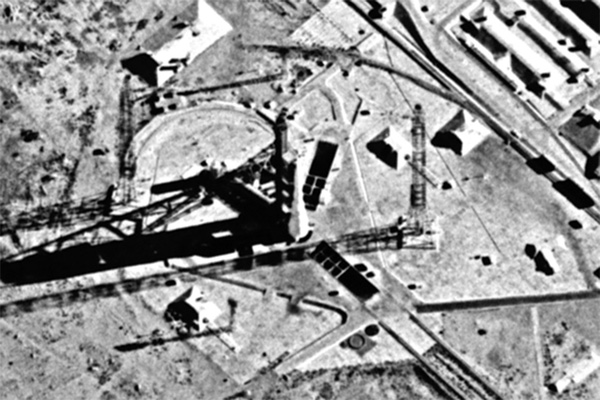

Satellite photo of an N1 rocket on its launch pad at Baikonur. The United States tracked the development of the Soviet lunar program primarily using reconnaissance satellites. (credit: via Harry Stranger)

The centrifuge on which Yuri Gagarin trained, before becoming, in April 1961, the first man to fly in space, was not of Soviet manufacture. It had been built in West Germany, installed at a research complex on the outskirts of Moscow, and tested in early March of that year. The detail is not merely a curiosity in itself. It matters above all because Washington knew it. In a report by the CIA’s Office of Scientific Intelligence, dated December 1964,[1] American analysts had already put in writing that part of the equipment the Soviet Union used to prepare its cosmonauts had been purchased in the West: two large West German pressure chambers, for which the report estimated a cost of about twenty-one million marks, a little over five million dollars at the time, and a Swedish centrifuge used to train Valentina Tereshkova, the first woman to fly in space.
https://www.thespacereview.com/article/5287/1

162) Colonizing Antarctica and other anti-space fables
by Milan M. Ćirković Monday, August 17, 2026


The National Science Foundation’s McMurdo Station in Antarctica. (credit: NSF/Elaine Hood)

There is a persistent red herring that emerges whenever feasibility and desirability of space colonization is debated: “Why don’t we colonize Antarctica?” Or, perhaps a more sophisticated version: “Why don’t we colonize Antarctica first?” Shouldn’t that be easier? Shouldn’t that be more “natural”?[1]

These are ostensibly reasonable questions that, on some further reflection, turn out to be irrelevant, misguided, and confusing, not to mention often malevolent. There are at least five different reasons why that is so, outlined here roughly in order of decreasing importance.
https://www.thespacereview.com/article/5288/1

163) Two futures on the Moon
by Alexander William Salter Monday, August 17, 2026
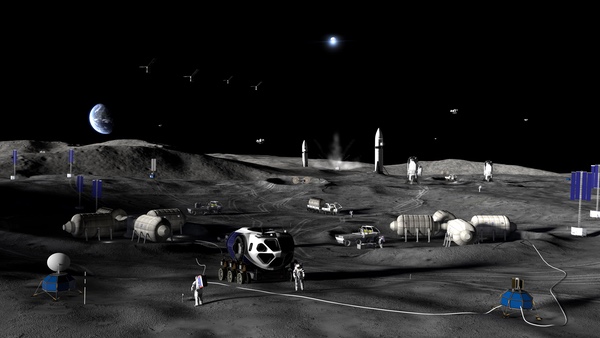

An illustration of NASA’s concept for a lunar base at the south polar region of the Moon. (credit: NASA)

In November 2023, Chinese and Russian defense researchers secretly gathered in Guangzhou to plot the destruction of American commercial satellites.

Documents from those meetings, revealed this July by a joint investigation from The Insider, Der Spiegel, and Le Monde, describe a partnership to build weapons to counter Elon Musk’s Starlink constellation. The goal is to combine Russian battlefield experience with Chinese industrial might to jam, hack, and even physically kill a major satellite network. One Chinese presentation called the constellation’s hundreds of satellites a “space blockade” and proposed cheap “one-against-many” weapons to shoot them down faster than SpaceX could launch replacements.
https://www.thespacereview.com/archive/5280a.jpg

164) Lemons to bitter lemonade: from the Samos E-5 to the LANYARD reconnaissance satellite (part 3)
by Dwayne A. Day Monday, August 17, 2026
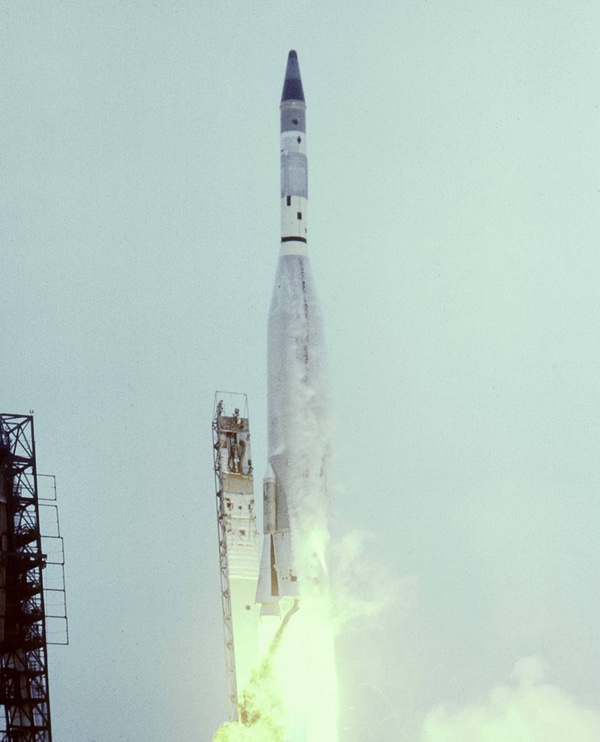

Launch of a CORONA E-6 reconnaissance satellite in June 1962. The E-6 had a pointed reentry vehicle that carried the exposed film from the two cameras. Five Samos E-6 missions were launched in 1962 and all failed. The E-6 was later developed into the SPARTAN experimental reconnaissance program. (credit: Peter Hunter Collection)

The Samos E-5/LANYARD reconnaissance project was not the only effort to get something useful out of the Samos reconnaissance satellite program. When the Samos program was underway, the US Air Force sought to develop both a higher-resolution satellite—the E-5—as well as a satellite that could image large areas of the Earth at lower resolution so that photo interpreters could look for changes and new construction. That program was named the Samos E-6. But the Samos E-6 also suffered development problems and was canceled. Like the E-5, the Samos E-6 was also revived in an effort to adapt the camera system to use proven CORONA technology. That project was known as SPARTAN, named not for the famous Greek warriors, but for frugality (see “Lemons to bitter lemonade: from the Samos E-5 to the LANYARD reconnaissance satellite (part 2),” The Space Review, August 3, 2026, and part 1.)
https://www.thespacereview.com/article/5290/1

165) Wishing for rockets
by Jeff Foust Monday, August 17, 2026


A ULA Vulcan on the pad before its first—and, so far, only—launch of the year in February. (credit: ULA)

Last month, Cambridge University researchers published a study hailing a breakthrough in access to orbit. Launch costs, they argued, were cheaper than ever, at $3,868 per kilogram, and projected to fall further: $1,569 per kilogram by 2030 and $273 per kilogram by 2040.

“The cost of space launch technology is now falling faster than during one of history’s greatest transport revolutions,” said the lead author, Alessio Terzi, referring to the rise of steam-powered ships in the 19th century.

One industry executive had a succinct response to that study. “I wish,” said the official, speaking on background. “I don’t think Cambridge professors have been buying many rockets recently.”

If they had, that official and others have said, they would find a highly constrained market where it is difficult to find a ride to orbit—and if you do, you’re likely paying a premium price for it. That is a combination of rockets currently grounded, rockets whose introduction continues to be delayed, and worries about the future of a program that has provided affordable access to space for smallsats.

Wishing for rockets to resume launches

The lineup of rockets currently grounded is impressive—or would be, if it wasn’t maddening to customers. Blue Origin’s New Glenn, of course, is out of service since an explosion during a static-fire test in May that seriously damaged its Cape Canaveral launch pad. ULA’s Vulcan has not flown since February, when a solid rocket booster on a launch suffered a “significant performance anomaly,” although the rocket was able to successfully complete its mission. India’s PSLV rocket, a workhorse for India’s space program and a popular option for some companies, has suffered back-to-back failures. Last week, Japan’s H3 performed its first operational launch since a failure last December (it did conduct a successful test flight in June of a different variant of the vehicle, which carried only a few smallsats.)

That is significant capacity sidelined, to the detriment of customers ranging from the US Space Force to Amazon, whose Amazon Leo constellation is relying in large part on New Glenn and Vulcan.
https://www.thespacereview.com/article/5291/1

34/VIII 2026 [166-170]

166) Review: Lunacy
by Jeff Foust Monday, August 24, 2026


Lunacy: Ten False Promises of the New Space Age
by Ben Bramble
Princeton Univ. Press, 2026
paperback, 200 pp.
ISBN 978-0-691-28128-5
US$18.95
https://www.amazon.pl/dp/0691281289

Space advocates have long offered grandiose visions of how space could solve problems on Earth and provide a better, even utopian, future for humanity. Space settlements would provide new homes for people. A million-person city on Mars offers similar opportunities. Space-based solar power offers plentiful, clean energy. Mining of asteroids and the moon could provide key metals and helium-3 for future fusion reactors. These are all visions, though, that have failed to come true—at least, not yet.
https://www.thespacereview.com/article/5292/1

167) Capability before prestige: A realistic astronomy and space-science strategy for Bangladesh
by Shaikh Afnan Birahim Monday, August 24, 2026


Bangladesh is taking steps in space science, such as installing a radio astronomy antenna on a university building. (credit: CASSA)

Bangladesh is poorly positioned to host a world-class ground-based optical observatory. Its humid climate, long monsoon season, low elevation, dense population, and growing light pollution create structural disadvantages compared with dry, high-altitude sites in Chile, Hawaii, the Canary Islands, and the Himalayas.

This does not leave Bangladesh without a viable path into astronomy and space science. It means the country must pursue a model suited to its geography, technical capabilities, and national needs. The central policy question is not whether Bangladesh can become another Chile, but where it can build internationally relevant capability on realistic foundations.
https://www.thespacereview.com/article/5293/1

168) At the corner of No and Where: the cold Cold War mystery of Aspidnoye airfield
by Harry Stranger and Dwayne A. Day Monday, August 24, 2026


The Aspidnoye airfield was constructed in the far north of the Soviet Union probably in the early 1960s. It consisted of a very long runway obviously intended to handle large aircraft. But it was not paved, and no support infrastructure was built around the airfield. When it was photographed by American reconnaissance satellites, it presented a mystery. (credit: Harry Stranger)

There is an old American joke about a remote location that is not quite in the middle of nowhere, “but you can sure see it from there.” The Soviet Aspidnoye airfield was the middle of nowhere, and for a period in the Cold War it must have been a puzzle for American intelligence analysts who watched it from above scratching their heads about why it existed at all.
https://www.thespacereview.com/article/5294/1

169) The smoldering dead end: a history of solid rocket motors and their economic scaling limits
by Michael Puckett Monday, August 24, 2026
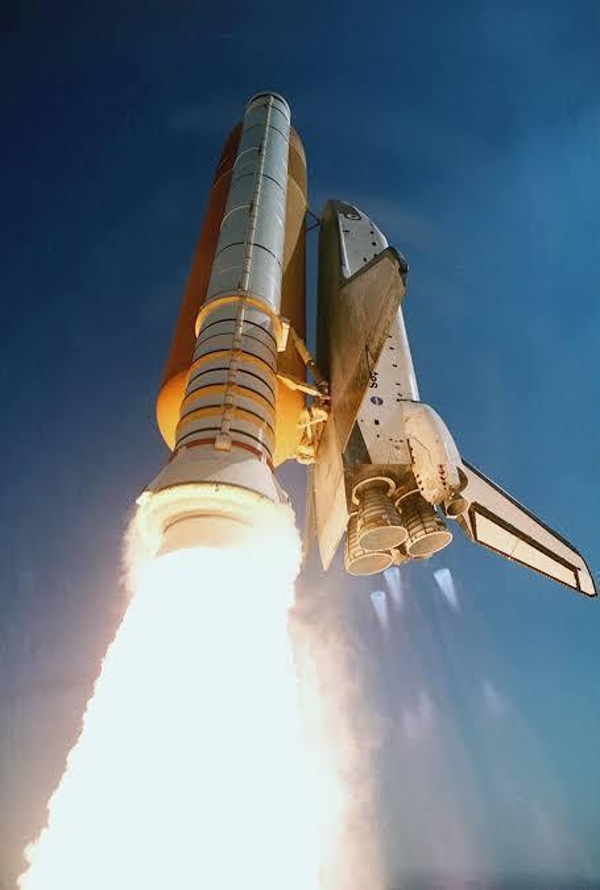

Space Shuttle Endeavour lifts off on STS-49, its first flight, May 7, 1992. The solid rocket boosters, burning at full thrust, cannot be shut down once ignited. (credit: NASA)

The solid rocket motor/booster (SRM/SRB) is a propulsive agent that, once initiated, burns to depletion, requiring no external input. That made it the backbone of Cold War deterrence, but it has never made it the foundation of an economical, scalable, high-cadence space launch architecture, and it never will.

Thermodynamic and ballistic constraints

The performance of any rocket propulsion system is, at its core, a function of two parameters: the specific impulse (Isp) of the propellant combination and the propellant mass fraction of the stage. These are not independent—propellant chemistry governs achievable Isp while structural requirements govern mass fraction—but together they determine, via Tsiolkovsky’s rocket equation, the delta-v a stage can deliver per unit of total initial mass. The rocket equation—Δv = Isp × g₀ × ln(m₀/m_f)—means that every percentage point of Isp or mass fraction advantage compounds multiplicatively across a flight profile. Every architectural decision in launch vehicle design is, ultimately, a negotiation with this equation.
https://www.thespacereview.com/article/5295/1

170) Three wires, three zeros
by Florian Gutzwiller Monday, August 24, 2026

Three failed space-tech investments and the warning signs I paid to ignore
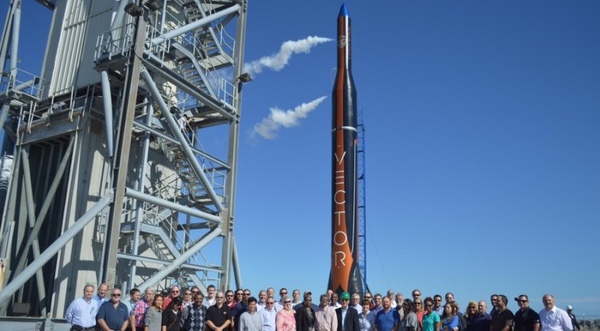

Vector Launch raised millions of dollars but failed to attempt an orbital launch before going under. (credit: Vector Launch)

A little while ago, I stood on stage at ETH Zurich for a F*ckUp Night. The format is precisely what it sounds like: say what failed without turning the wreckage into a hero’s journey. No redemption arc, no claim that losing the money was secretly a gift. That night was about my whole entrepreneurial career, but here I want to zoom in on one special case: my three failed space tech investments.
https://www.thespacereview.com/article/5296/1

35/VIII 2026 [171-176]

171) Review: The Soviet Space Program and International Collaboration during Perestroika
by Louis Friedman Monday, August 31, 2026


The Soviet Space Program and International Collaboration during Perestroika, 1985-1991
by Olga Dubrovina
Palgrave Macmillan
hardcover, 424 pp.
ISBN 9783032031563
US$159.99
https://www.amazon.pl/s?k=The+Soviet+Space+Program+and+International+Collaboration+during+Perestroika

I looked forward to reading this book by Olga Dubrovina, an Eastern European historian specializing in international relations now at the University of Milan.[1] The subject is personal for me: My involvement with the Soviet space program during the six years of Perestroika (and its aftermath) were the most interesting and engaging of my life.[2] I witnessed the lapse of communism, the extraordinary spacecraft encounters with Halley’s Comet, and the rebirth of American space exploration after a decade of darkness.
https://www.thespacereview.com/article/5297/1

172) A look inside the small building showed decades-old test equipment linked to General Electric.
Little building, big mystery

by James Behling Monday, August 31, 2026

A look inside the small building showed decades-old test equipment linked to General Electric.

Recently, a volunteer at the Cape Canaveral Space Force Museum came into the museum with several mysterious photos showing the inside of a small (11 by 22 feet, 3.35 by 6.7 meters) unknown and apparently long abandoned facility on Cape Canaveral Space Force Station*. The facility’s purpose was unknown to museum staff, prompting a bit of sleuthing based upon limited clues. One of photos was taken through the only window in the facility, revealing instrumentation that obviously dated to the early years of missile launch operations on the Cape.[1]
https://www.thespacereview.com/article/5298/1

173) Learning from a satellite servicing mission’s failure
by Jeff Foust Monday, August 31, 2026


An illustration of the Link spacecraft grappling the Swift spacecraft to reboost it. (credit: Katalyst Space)

For someone whose company had given up on its bid to save a NASA space telescope, Ghonhee Lee was remarkably upbeat.

On August 19, NASA and Katalyst Space Technologies announced they had jointly agreed to abandon efforts to raise the orbit of NASA’s Neil Gehrels Swift Observatory, a gamma-ray telescope in a decaying orbit. Katalyst launched its Link spacecraft in early July on a mission to attach to Swift and raise its orbit before Swift reentered in the coming months (see “A swift effort to boost the prospects for satellite servicing,” The Space Review, June 29, 2026.)
https://www.thespacereview.com/article/5299/1

174) Space has a billionaire problem, but it also has a billionaire solution
by Kelsie Goddard Monday, August 31, 2026
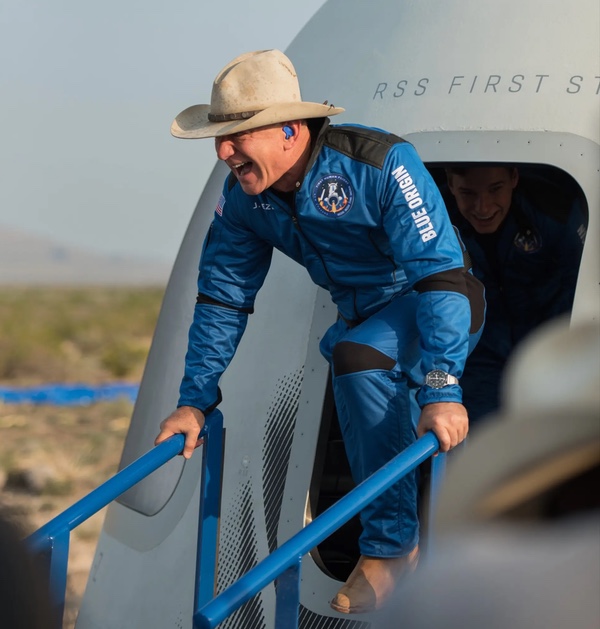

While some associate space with the flights of billionaires like Jeff Bezos, their efforts have had benefits for others. (credit: Blue Origin)

In American pop culture, space has increasingly become synonymous with a “billionaire’s club.” To many Americans, especially college students entering an uncertain economy, the spectacle of billionaires launching rockets feels profoundly detached from everyday life. Still, the conversation requires more nuance than public discourse usually allows. The growing role of wealthy private actors in commercial space may signal a predictable stage of technological development rather than a dystopian one. This is a textbook case of hierarchical diffusion, as described below.
https://www.thespacereview.com/article/5300/1

175) Commercial space is not an endless field of innovation: an assessment of the good, the bad, and the ugly
by Charles S. Galbreath Monday, August 31, 2026


Figure 1: A false perception of commercial space as an endless field of capabilities. (credit: author)

Demand for space capabilities and effects has outpaced the government’s ability to provide them. At the same time, the commercial space sector has expanded to meet critical needs. Commercial providers can offer capabilities more quickly and with less government risk than traditional acquisition approaches. As a result, commercial capabilities are a cornerstone of Secretary of Defense Pete Hegseth’s Acquisition Transformation Strategy.
https://www.thespacereview.com/article/5301/1

176) Space Battleship Yamato vs. the Starship Enterprise
by Dwayne A. Day Monday, August 31, 2026

Space Battleship Yamato was a Japanese anime television show that premiered in 1974. The premise involved a spaceship based upon the World War II battleship. Like Star Trek, it has had a cultural relevance, but it is much more tied to Japan’s wartime experience, whereas Star Trek has influenced American space, science, and engineering culture. (credit: Office Academy)

Japanese society has long struggled with its World War II legacy. Whereas in Germany many people eventually felt shame for their country’s actions during the war, in Japan, many felt more shame for losing the war rather than starting it. Unlike in allied countries, where it was acceptable to feel and express pride in involvement and victory in World War II, Japan has not celebrated its wartime actions, but rather than try to atone for the country’s brutal occupation of China and Korea, Japan has often chose instead to focus on Japanese victims of the war. Japan’s political leadership has sought to portray a pacifist attitude in the 80 years since the war’s end, while angering countries that Japan occupied and brutalized by refusing to acknowledge what happened, such as the Korean “comfort women” who were forced into sexual slavery.
https://www.thespacereview.com/article/5302/1
« Ostatnia zmiana: Września 02, 2026, 08:03 wysłana przez Orionid »

Offline Orionid

  • Weteran
  • *****
  • Wiadomości: 30619
  • Very easy - Harrison Schmitt
Odp: The Space Review
« Odpowiedź #460 dnia: Sierpnia 26, 2026, 10:16 »
36/IX 2026 [177-182]

177) Review: To the Black
by Jeff Foust Tuesday, September 8, 2026


To the Black
directed by Scott Edwards
94 minutes

A little more than a year ago, Firefly Aerospace achieved one of the great milestones of a business by going public. The company has become known as a lunar lander developer, with one successful mission under its belt, a second scheduled to launch early next year, and several more in development. It has expanded into spacecraft and other capabilities, including angling for work in the Golden Dome missile defense system.
https://www.thespacereview.com/article/5303/1

178) ISRO’s comeback with the successful launch of EOS-05
by Ajey Lele Tuesday, September 8, 2026


The GSLC Mark II rocket before the launch of the EOS-05 spacecraft. (credit: ISRO)

On September 4, the Indian Space research Organisation (ISRO) successfully launched the GISAT-1A satellite, also called as EOS-05, by the Geosynchronous Satellite Launch Vehicle (GSLV-F17). The satellite was placed into a sub-geosynchronous transfer orbit and subsequently it will be raised to its intended geostationary orbit through a series of on-board orbit-raising maneuvers. This is an approximately 2,367-kilogram satellite meant for disaster monitoring, weather tracking, agriculture, and forestry. This is India’s first imaging satellite to operate from a geosynchronous orbit. GSLV-F17 is the 19th flight of India’s Geosynchronous Satellite Launch Vehicle (GSLV).
https://www.thespacereview.com/article/5304/1

179) Backfire to space: The Backfire bomber and Skif rocket system
by Dwayne A. Day Tuesday, September 8, 2026


In 2003, a Russian rocket and aircraft design team proposed the Skif air-launch rocket system to place small payloads into orbit. Skif would have used a medium-range Tu-22M3K Backfire bomber to carry the rocket. (credit: Max Bryansky, Russian AviaPhoto Team, Airliners.net)

When it was first spotted by American reconnaissance satellites in the late 1960s, the Soviet Union’s Backfire bomber was intriguing, even a bit ominous. It was a sleek, pointy-nosed, swing-wing medium bomber, clearly designed to go fast and blow stuff up. Throughout the 1970s, the Tu-22M Backfire was a source of argument between the CIA and the US Air Force over how far it could go. Was it medium-range, intended primarily for European use and maritime attack, or longer-range and capable of attacking the continental United States? By the late 1970s that debate was largely settled and the Backfire did not have the range to be a menace to the United States, but it was also increasingly a threat to US Navy aircraft carrier battle groups (see “The Backfire bomber controversy,” The Space Review, December 22, 2025.)
https://www.thespacereview.com/article/5305/1

180) Space Academy (no, the other one)
by Dwayne A. Day Tuesday, September 8, 2026


Space Academy was a short-lived Saturday morning television show that aired in the fall of 1977. It featured a diverse cast of young space cadets exploring the galaxy and having adventures. (credit: Filmation Studios)

When Star Wars premiered in May 1977, it was an immediate smash hit and prompted many imitators. In September 1977, Space Academy debuted on Saturday mornings on the CBS network. It lasted for 15 episodes. Space Academy was produced by Filmation Studios, which was responsible for several live action and numerous animated shows in the 1970s and 1980s aimed at younger audiences. Space Academy was a good premise—young students in space having adventures and learning to become better people—undercut by insufficient funding and the nature of kids’ television production in the 1970s. Ironically, although limited by a low budget, it was the most expensive TV show aimed at kids at that time.
https://www.thespacereview.com/article/5306/1

181) Mission Impossible: How Star Trek used the aerospace community to try and win an Emmy
by Glen E. Swanson Tuesday, September 8, 2026


A two-page spread taken out in the April 17, 1967 issue of the Daily Variety shortly after Star Trek was renewed for a second season. The ad served to promote the series for Emmy consideration. Photo courtesy of Daily Variety. (credit: Daily Variety)

This year marks the 60th anniversary of the network television premiere of Star Trek. During the show’s original network airing from 1966 to 1969, Gene Roddenberry sought to create a work of science fiction that would engage viewers not only through clever storylines and modern visual effects, but also by presenting his message in a scientific and technological context that felt believable. Roddenberry, a former World War II combat and commercial airline pilot, used his connections in the aerospace industry to seek out knowledgeable individuals and agencies to guide his show’s popular fiction and give it real credibility. This helped elevate Star Trek to greater recognition among influencers in science, industry and the military.
https://www.thespacereview.com/article/5307/1

182) The 1962 Iowa Summer Study
by Danny Robb Tuesday, September 8, 2026


Two pages of the brochure sent to Iowa Summer Study invitees[3]

In June of 1962, scientists from around the United States descended on Iowa City for a summer study on science in space. Among the roster of more than 200 attendees were names like Van Allen, Kuiper, Shoemaker, Spitzer, Whipple, Drake, and Sagan. They were enticed by a nice brochure, a generous honorarium, and the promise that they could shape the future of space exploration.
https://www.thespacereview.com/article/5308/1

37/IX 2026 [183-187]

183) The road to the asteroid belt runs through the Moon
by Chad McElroy and Jacob Smagula Monday, September 14, 2026


A new generation of asteroid mining companies can benefit from technologies and capabilities first developed for the Moon. (credit: Brian Versteeg/Deep Space Industries)

We are living through a new wave of lunar exploration, one quite different from the “flags and footprints” ethos of the Cold War expeditions. This time, the goal is lunar permanence, and the technologies required to stay on the Moon are, almost incidentally, many of the same technologies needed to enable the extraction of resources from asteroids.
https://www.thespacereview.com/article/5309/1

184) Voyager 6 seeks the Creator
by Dwayne A. Day Monday, September 14, 2026


In December 1979, Star Trek: The Motion Picture premiered. The plot centered on a powerful and vast “living machine” traveling to Earth to seek its “creator.” The heart of the machine was a NASA spacecraft, Voyager 6, launched near the end of the twentieth century. The prop for the movie was constructed in fall 1978 after the production sought to borrow a full-scale mockup from JPL. (credit: Paramount)

Voyager 6 was launched in 1998 from the Space Shuttle Columbia headed toward the outer solar system. Whereas Voyagers 3, 4, and 5 had each been sent to explore other planets, Voyager 6 was intended to explore beyond the known solar system, beyond even distant Pluto. But Voyager 6 fell silent ten years into its journey and was not heard from again… until 275 years later, when it returned to Earth and nearly destroyed it.
https://www.thespacereview.com/article/5310/1

185) The Junkers spaceplane
by Hans Dolfing Monday, September 14, 2026


Figure 1: The Junkers RT-8 model at “Le Bourget”, June 1965. (credit: Airbus Heritage) [1.xxiv]

In the aftermath of World War II, it was only in 1953 that West Germany was allowed by the Allied forces to restart its aerospace research, while spaceflight activities were only restarted by 1960.[10] Many experienced aerospace engineers were spirited away to the United States via Operation Paperclip or, alternatively, to the Soviet Union. Some aerospace engineers, including their dreams and Peenemünde experiences, stayed behind, which became the core to a West German spaceflight R&D revival in the early 1960s.
https://www.thespacereview.com/article/5311/1

186) A collision probability is not permission to maneuver
by Burak Oktenli Monday, September 14, 2026


An illustration of how SpaceX monitors other space objects to detect potential collisions. (credit: SpaceX)

In six months, SpaceX's Gen 1 and Gen 2 Starlink satellites performed 207,152 propulsive collision-avoidance maneuvers. While that number is remarkable, the more consequential figure in the company's July 1 report to the FCC may be 3 × 10⁻⁷ (three chances in ten million), the probability-of-collision threshold above which SpaceX says its satellites will maneuver, supplemented by miss-distance criteria.
https://www.thespacereview.com/article/5312/1

187) An analysis of Ukraine’s missile strike on the Progress rocket factory
by Bart Hendrickx Monday, September 14, 2026


Assembly line for Soyuz-2 rockets at the Progress factory in Samara. Source

In mid-August, Ukrainian forces launched a missile attack on an industrial area in Samara, a city on the banks of the Volga river in southwest Russia. It soon emerged that the target of the strike had been the Progress Rocket and Space Center, the manufacturer of Russia’s Soyuz-2 series of rockets. These are the workhorses of Russia’s space program, launching the vast majority of the country’s civilian and military satellites as well as piloted and cargo missions to the International Space Station. Any major disruption of their assembly lines could have a significant impact on Russia’s space program even in the short term. Closer analysis now shows that while the attack may have inflicted significant damage, it probably achieved only part of its objectives.
https://www.thespacereview.com/index.html
« Ostatnia zmiana: Września 23, 2026, 06:38 wysłana przez Orionid »

Offline Orionid

  • Weteran
  • *****
  • Wiadomości: 30619
  • Very easy - Harrison Schmitt
Odp: The Space Review
« Odpowiedź #461 dnia: Września 16, 2026, 07:33 »
38/IX 2026 [188-193]

188) The letters Tsiolkovsky asked for
by Vladimir Beskorovainyi Monday, September 21, 2026

A 1934 fireball, 970 pages of replies, and the first machine-readable edition of the father of astronautics’ personal archive


Konstantin Tsiolkovsky‘s archive was digitized years ago, but not in a machine-readable or searchable form. (credit: Konstantin E. Tsiolkovsky State Museum of the History of Cosmonautics)

On May 14, 1934, a fireball passed over the Moscow region. Five weeks later, on June 21, the newspaper Izvestia printed a short note by Konstantin Tsiolkovsky, titled “Who saw the bolide?”, asking eyewitnesses to write to him in Kaluga.

They did. His personal archive preserves 221 files, or 970 pages, of replies: a physics teacher at an agricultural technical school, a livestock specialist, a foreman at a chemical plant, a head of a technical control department, a magazine editor, a village council. The responses spanned weeks: 195 letters in June, 20 more in July. Tsiolkovsky annotated the letters and began an article, “On the bolide of May 14, 1934,” which he never finished.
https://www.thespacereview.com/article/5314/1

189) The Gulf states did not buy imagery independence
by Kelevitch Monday, September 21, 2026


Göktürk-1 is a Turkish imaging satellite that could be used as part of the Mecca Joint Defence Agreement with Pakistan and Saudi Arabia. (credit: Turkish Defense Ministry)

The most quoted number to come out of the Persian Gulf war this year was assembled from photographs the enemy published. In May, the Washington Post documented damage to at least 228 structures and pieces of equipment at 15 US military sites across six Gulf states. It did so by geolocating 128 satellite images put out by Iranian state-affiliated media and checking 109 of them against Sentinel-2 frames from Copernicus. American commercial imagery had been withheld since April at the request of the US government. A European civil program helped determine what had happened on Arab soil, along with pictures supplied by the state doing the bombing.
https://www.thespacereview.com/article/5315/1

190) A crater of our own making: what the SpaceX lunar impact reveals about the future of Moon governance
by Rachita Agrawal Monday, September 21, 2026


A Lunar Reconnaissance Orbiter image of the crater (center, partially overlapping another crater) created when a Falcon 9 upper stage hit the Moon in August. (credit: NASA GSFC/Intuitive Machines)

On August 5, humanity left another mark on the Moon. A Falcon 9 upper stage, used in the January 2025 launch of two commercial lunar landers, struck the lunar surface after more than a year in space. NASA’s Lunar Reconnaissance Orbiter subsequently photographed the resulting crater, approximately 18 meters across and no more than 3 meters deep. The images revealed bright and dark ejecta extending from the impact site, exposing material that had remained beneath the Moon’s weathered surface.
https://www.thespacereview.com/article/5316/1

191) The orbit is the territory: rethinking spacepower in a domain where nothing stays still
by Michael Uhall Monday, September 21, 2026


Territory takes on new meaning in space when everything is in motion but some things, like satellite constellations, offer permanent infrastructure.

A satellite in low Earth orbit circles the planet roughly every 90 minutes, and a constellation of such satellites is never at rest. Each spacecraft continually shifts position relative to the Earth, to its neighbors, and to whatever ground systems it serves. What the constellation produces, however, can be remarkably stable: persistent communications coverage, navigation, remote sensing, early warning, or surveillance. The objects move without pause while the pattern they compose endures, which means that orbital infrastructure occupies space without occupying it in the sense we are used to, where occupation means staying put.
https://www.thespacereview.com/article/5317/1

192) To E-3 or not to E-3: the liminal Samos E-3 program
by Dwayne A. Day Monday, September 21, 2026


The first Samos E-1 reconnaissance satellite was launched in October 1960 but failed to reach orbit. The E-1 and E-2 satellites used film-readout technology. The Samos E-3 was a successor proposed in July 1959 using a newer technology and having higher resolution. It was never built. (credit: Peter Hunter Collection)

Samos was the United States’ first reconnaissance satellite program, emerging from a US Air Force project known as Weapons System 117L in 1957. Briefly named Sentry, the renamed Samos quickly expanded into more than a half-dozen different satellite types, resulting in 11 flights, including several launch failures.
https://www.thespacereview.com/article/5318/1

193) Coming to terms with the end of the Falcon 9
by Jeff Foust Monday, September 21, 2026


A Falcon 9 lifts off September 13 carrying three O3b mPower satellites for SES. (credit: Katalyst Space)

Last week, space industry executives gathered in Paris for the annual World Space Business Week conference, an opportunity to discuss the state of the commercial space field as well as make deals and announce contracts.

This year, there were few contracts to announce since the conference was preempted by the International Space Summit, held the preceding week also in Paris. The French government, which organized the summit, encouraged French and other European space companies to make their major announcements there, ranging from launch contracts by Arianespace to satellite manufacturing awards for IRIS², the European secure connectivity constellation. (...)

There are also issues about the compatibility of commercial satellites with Starship, which initially will have a unique slot-shaped payload bay door. That works well for the “flatsat” designs SpaceX has developed for Starlink and Starmind, but not for more traditional commercial satellites. The company has offered a version with a larger clamshell payload bay door for larger spacecraft, but it’s unclear how available that will be.

Starship also does not help on the smaller end of the market, those smallsats that had relied on Falcon 9 rideshare missions for regular and relatively inexpensive access to Sun-synchronous and mid-inclination orbits. SpaceX has hinted in the past it might offer a similar rideshare program for Starship, although the vehicle would likely be oversized for that application. (...)
https://www.thespacereview.com/article/5319/1

39/IX 2026 [194-199]

194) Australia’s $100 million astronaut question: what would it actually buy?
by Richard de Grijs Monday, September 28, 2026


Australia’s Katherine Bennell-Pegg completed astronaut training at ESA in 2024 and is awaiting a potential flight to space. (credit: Australian Space Agency)

Australia may soon have to decide whether sending one of its own astronauts to the International Space Station (ISS) is worth something like A$100 million (US$70 million).

Put that way, the quick answer can sound obvious. A hundred million dollars is a substantial sum for a country with a relatively small civil space budget. An astronaut flight can easily be dismissed as an expensive national prestige project.

But that may be the wrong question. The real issue is not simply whether Australia should pay to put an astronaut in orbit, but what national capability it would gain in return.
https://www.thespacereview.com/article/5320/1

195) Cross the sea by deceiving the sky: Rethinking China’s 2026 debris events
by Christopher Stone Monday, September 28, 2026


A Long March 6C lifts off in August. The rocket’s upper stage later fragmented, creating debris in low Earth orbit. (credit: CASC)

The ancient Chinese stratagem “Cross the Sea by Deceiving the Sky,” the first of the Thirty-Six Stratagems, rests on a simple principle: conceal a real objective in plain sight by embedding it within something ordinary, repetitive, or apparently benign. When an activity becomes routine, an adversary stops treating it as a warning. Deception succeeds not because the action is invisible, but because everyone sees it and assumes it means something harmless.
https://www.thespacereview.com/article/5321/1

196) The dilemma of space weaponization
by Ajey Lele Monday, September 28, 2026


Secretary of the Air Force Troy Meink used a September 14 conference speech to disclose that the US has “space control” weapons in orbit. (credit: US Air Force photo by Andy Morataya)

For decades, the international community has broadly maintained that outer space should remain a peaceful global common, free from the deployment of any weapons. However, a recent US announcement has challenged this longstanding norm and prompting a major scare about the space weaponization.

On September 14, Secretary of the Air Force Troy Meink stated at a conference that the United States has deployed weapons in space and would use them to defend the country and its forces, if required. He argued that the US needs such capabilities in orbit to signal to potential adversaries that it is prepared to respond to hostile actions in the space domain. The deployment supposedly provides the US with on-orbit space-control capabilities. The US administration has not disclosed the nature or capabilities of these weapons, but considers their deployment an important step towards establishing deterrence in space. The US has chosen not to disclose the nature of these weapons, arguing that doing so would compromise the element of surprise and potentially weaken their deterrent value.
https://www.thespacereview.com/article/5322/1

197) The watchers and the warning: what a Himalayan flood asks of Golden Dome
by Bharath Gopalaswamy and Daniel Dant Monday, September 28, 2026


Satellite images were used to study the aftermath of floods in the Himalayas but could not provide people living there with timely warnings. (credit: Satellite Image Credit: WorldView-3 © Vantor (2026), provided by European Space Imaging (acquired on 27/08/2026 at 05:05 UTC). All images are provided under COPERNICUS by the European Union and ESA, all rights reserved.)

At about 20 minutes to nine on the morning of August 26, high above the Lhende Khola on the Nepal side of the Tibetan border, a section of glacier gave way. The ice and rock that fell into the valley either caused or deepened a temporary blockage of the river, and when that blockage failed it released a wall of water and debris that traveled nearly a hundred kilometers downstream. In the district of Rasuwa, the surge erased the border crossing at Rasuwagadhi, flattening buildings and smoothing the ground where a town had stood. Downstream, the Trishuli rose as much as nine meters in 30 minutes. The villages of Timure and Syapru Besi were struck first. Bodies were later recovered far to the south, in Gorkha, Tanahun, and Chitwan. Dozens of bridges are gone, roads are severed, hundreds of megawatts of hydropower are offline, and the losses are counted in the billions. The dead and the missing are counted in people.
https://www.thespacereview.com/article/5323/1

198) Starship (finally) reaches orbit
by Jeff Foust Monday, September 28, 2026


Starship lists off September 28 on Flight 14, its first orbital mission. (credit: SpaceX)

On September 28, a SpaceX rocket reached orbit for the first time. Again.

On September 28, 2008, Falcon 1 successfully reached orbit for the first time on the vehicle’s fourth launch. The first three had failed, all for different reasons, and the company’s future was at stake. Another failure could have meant the end of the company.

“I think my nervous system almost got fried watching that flight,” SpaceX CEO Elon Musk said on the company’s webcast of the launch shortly after Falcon 1’s upper stage and its inert payload reached orbit. “I don’t know what else to say. It’s so fricking awesome my mind is blown.” (See “A sign of progress”, The Space Review, September 29, 2008.)

On September 28, 2026, it was Starship’s turn. This was the 14th flight of Starship/Super Heavy; the first 13 had all been intentionally suborbital, albeit with varying degrees of success. While some of those earlier flights had gone almost all the way to orbit, this time SpaceX planned to place Starship’s upper stage in orbit and deploy 26 Starlink V3 satellites, larger next-generation spacecraft for the company’s broadband constellation.
https://www.thespacereview.com/article/5324/1

199) Nuke the site from orbit: American orbiting nuclear weapons during the Cold War
by Dwayne A. Day and Hans Dolfing Monday, September 28, 2026


In 1961, a major aerospace company produced a secret report on orbiting nuclear weapons for attacking the Soviet Union. The details of that report have never been made public until now. (credit: Chesley Bonestell)

In Robert Heinlein’s 1948 novel Space Cadet, the protagonist is tasked with the mission of maintaining a constellation of “rocket bombs” in orbit around the Earth, capable of being called down on a city at a moment’s notice and destroying it. In the immediate post-World War II era, when nuclear weapons, rockets, and satellites looked like the future of warfare, the idea seemed obvious. Yet it was never developed and deployed, and scholars of Cold War nuclear history have not mentioned it. What has now been revealed with the declassification of several documents is that in the early 1960s, an Air Force contractor evaluated an “Earth Satellite Weapon System (ESWS)” that would have placed three dozen nuclear bombs in polar orbits so that they could be commanded to reenter and destroy targets primarily within the Soviet Union. This concept, the analysts discovered, had many problems.
https://www.thespacereview.com/article/5325/1
« Ostatnia zmiana: Września 29, 2026, 19:33 wysłana przez Orionid »

Offline Orionid

  • Weteran
  • *****
  • Wiadomości: 30619
  • Very easy - Harrison Schmitt
Odp: The Space Review
« Odpowiedź #462 dnia: Września 23, 2026, 07:05 »
40/X 2026 [200-204]

200) Review: New Space Capitalism
by Jeff Foust Monday, October 5, 2026


New Space Capitalism: The Entrepreneurial Path to the Stars
by Rainer Zitelmann
Skyhorse Publishing, 2026
hardcover, 304 pp.
ISBN 978-1-5107-8821-3
US$32.99

NASA and commercial space station developers are facing a special case of the broader launch bottleneck plaguing the industry (see “Coming to terms with the end of the Falcon 9”, The Space Review, September 21, 2026.) When the Falcon 9 ends, so will Crew Dragon, the only operational orbital crewed spacecraft in the Western world. While Crew Dragon is under contract for several more NASA commercial crew missions to the International Space Station—a recent contract modification extended the contract through Crew-17, with Crew-13 having launched last week—those working on commercial successors to the ISS can no longer count on using Crew Dragon for their stations.
https://www.amazon.pl/s?k=New+Space+Capitalism%3A+The+Entrepreneurial+Path+to+the+Stars

201) US space dominance: big changes are ahead
by Katie Inman, Peter Baumgaertner, Edward J. Rojas, Shiva Goel, Paul Stimers, David M. Ehrlich, and Elizabeth C. Perry Monday, October 5, 2026


New policies will affect the space transportation and broader space industries in the US. (credit: SpaceX)

President Donald Trump’s August 20, 2026, National Space Transportation Policy emphasizes infrastructure development and entry into the commercial marketplace for space manufacturing, research, launches, and other activities as steps to ensure US space dominance. In a separate publication the same day, the Office of Space Commerce (OSC) published a request for expressions of interest in participating in a “mission authorization proposal pilot process” by which space operators may obtain mission authorization in a streamlined manner. In addition, the Federal Aviation Administration (FAA) published a request for information (RFI) on August 25 seeking input from industry on infrastructure development and establishment of safe corridors for space travel. The Federal Communications Commission (FCC) released a public notice that same day seeking comment on ways to advance the National Policy by expanding spectrum access for space launch and reentry activities.
https://www.thespacereview.com/article/5327/1

202) Military space museum, quo vadis?
by Dwayne A. Day Monday, October 5, 2026


The National Museum of the United States Air Force opened its new space gallery in 2016. With the creation of the Space Force, does the museum have any incentive to continue to display the Air Force’s space history? (credit: All photos by Dwayne Day)

For decades, the National Museum of the United States Air Force had very little space history on display. A decade ago, the museum, located next to Wright-Patterson Air Force Base near Dayton, Ohio, opened a new military space gallery, raising the hope that the subject was about to get greater attention. However, during a recent visit, I realized that this hope is apparently fading.
https://www.thespacereview.com/article/5328/1

203) Beyond the spacecraft: how space exploration became a design language
by Syed Hasan Monday, October 5, 2026


Space engineering requirements and influence design, as in the case of spacesuits. (credit: Axiom Space)

Space exploration has influenced far more than the technology required to leave Earth. Over the past several decades, the visual language of spacecraft, spacesuits, launch vehicles, satellites, and planetary exploration has gradually found its way into fashion, automotive and industrial design, architecture, consumer electronics, and other aspects of everyday life. Reflective surfaces, lightweight materials, protective structures, aerodynamic forms, technical fabrics, continuous curves, and shield-like shapes are now familiar elements of modern design, even when the objects incorporating them have no direct connection to aerospace.
https://www.thespacereview.com/article/5329/1

204) From debris mitigation to orbital sustainability
by Graham Turnock Monday, October 5, 2026

The next stage of space governance


Current debris mitigation approaches are not sufficient to ensure long-term orbital sustainability as the number of satellites and debris objects grows. (credit: ESA/Spacejunk3D, LLC)

For more than two decades, the international response to space debris has followed a broadly consistent model. Technical experts have developed guidelines for reducing debris generation, those guidelines have been endorsed through the United Nations, and individual states have progressively incorporated them into national regulatory systems.

That model has achieved a great deal. Debris mitigation is now an accepted element of responsible space activity. Standards for post-mission disposal, passivation, and collision avoidance have become progressively more demanding. National regulators increasingly expect satellite operators to demonstrate how they will limit debris generation and dispose of spacecraft after their missions.
https://www.thespacereview.com/article/5330/1

41/X 2026 [205-209]

205) After the ISS: What happens when humanity loses its shared home in space?
by Alex Kennedy Monday, October 12, 2026


The International Space Station photographed from Space Shuttle Endeavour during STS-130 in February 2010. (credit: NASA; photo ID S130-E-006575.)

One day, probably sometime in the early 2030s, people will look toward a remote stretch of the Pacific and wait for something extraordinary to fall out of the sky. The International Space Station will be coming home.

Not intact, of course. After decades in orbit, most of the largest object humanity has ever assembled in space will burn apart during a controlled reentry. Some pieces may survive long enough to reach an uninhabited part of the ocean. NASA and its partners have been planning that ending for years, including a dedicated vehicle intended to guide the station through its final descent.
https://www.thespacereview.com/article/5331/1

206) Starship’s real test may begin after launch
by Inna Galinger Monday, October 12, 2026


Starship lists off September 28 on Flight 14, its first orbital mission. (credit: SpaceX)

On September 28, on its 14th flight, Starship reached orbit for the first time and deployed 26 Starlink V3 satellites. It’s one of the most impressive pieces of engineering I’ve seen in years.

The vehicle is designed to carry more than 100 tonnes to orbit. If SpaceX gets the reusability and flight cadence it’s aiming for, the industry will have a transportation system unlike anything it has had before. Still, what I keep thinking about isn’t the rocket, but what happens to the economy around it.
https://www.thespacereview.com/article/5332/1

207) The tragedy of the orbital commons: Megaconstellations, space weapons, and debris
by Alexander William Salter Monday, October 12, 2026


A chart from a 2025 report on debris and active satellites in orbit, data that is already out of date. (credit: ESA)

On September 14, Air Force Secretary Troy Meink told a conference in Maryland that the United States “now has on-orbit space control weapons capable of defending the joint force against hostile adversary action.” The next day the Space Force’s new chief, Gen. Douglas Schiess, confirmed it. A service statement described “kinetic and non-kinetic means to affect adversary capabilities through disruption, degradation and even destruction, if necessary.” After decades of deliberate ambiguity, Washington has admitted that it keeps weapons in orbit.
https://www.thespacereview.com/article/5333/1

208) Bounders and RAMs: satellites track a unique bomber at the Soviet Ramenskoye flight test center (part 1)
by Dwayne A. Day and Harry Stranger Monday, October 12, 2026


The Soviet M-50 Bounder bomber was reported in a breathless Aviation Week article in December 1958. Despite early claims, the plane was not nuclear powered, and did not have long range. It was photographed numerous times by American reconnaissance satellites during the 1960s, such as this mid-1960s photo of the M-50 at the Ramenskoye/Zhukovsky airfield near Moscow. (credit: Harry Stranger)

In December 1958, the pages of Aviation Week were filled with breathless prose about an amazing new aircraft. According to a reporter writing for the magazine, a top secret, highly advanced high-speed aircraft was spotted in flight by multiple observers. There was no official confirmation of its existence, but it was clearly the kind of highly advanced airplane that the government would not want anybody to know about. The article was accompanied by an artist’s illustration of a sleek, bizarre-looking craft.
https://www.thespacereview.com/article/5334/1

209) Flying under the radar: Russia’s tacit reliance on Chinese SAR satellites (part 1)
by Bart Hendrickx Monday, October 12, 2026


Taijing-4-03, a Chinese radar satellite flying under the Russian cover name Okulus-01. Source

Russia currently operates only a handful of government-owned radar imaging satellites, prompting several private startups to step in to fill this gap in the domestic remote sensing market. To secure these capabilities, many of these entities have discreetly turned to China’s commercial space industry. This low-profile cooperation is unfolding across three distinct levels: white-labeling orbiting Chinese satellites under Russian cover names, engineering domestic satellite buses to house imported Chinese radar payloads, and actively marketing Chinese radar imagery to Russian state and commercial consumers.
https://www.thespacereview.com/article/5335/1
« Ostatnia zmiana: Października 21, 2026, 10:24 wysłana przez Orionid »

Offline Orionid

  • Weteran
  • *****
  • Wiadomości: 30619
  • Very easy - Harrison Schmitt
Odp: The Space Review
« Odpowiedź #463 dnia: Października 14, 2026, 11:23 »
42/X 2026 [210-215]

210) The surprising case for space mining
by Alex Wood-Osterwald Monday, October 19, 2026


An array of changes could make mining on the Moon or other celestial bodies feasible. (credit: ESA)

Throughout the history of space exploration, there has been an underlying (and sometimes partially ignored) debate about its overall purpose: whether it is for pure research, political goals, or for providing more resources. What has been lacking throughout is a clear explanation of the net benefits.

Space mining has been touted as a potential solution to this issue: a means of enabling exploration, while providing benefits to humanity on Earth, giving access to greater resources and reducing the terrestrial environmental footprint of human activities. Recent developments within the space industry and the wider economy are leading to rapid changes in both. There are now several plausible scenarios in which space mining will occur much more quickly than is usually considered realistic, perhaps within the next five to ten years.
https://www.thespacereview.com/article/5336/1

211) A riddle, wrapped in a mystery, inside a payload container: the curious case of Defense Support Program Satellite F-11
by Dwayne A. Day Monday, October 19, 2026


DSP satellite 12, which was designated as Flight 11, or F-11 upon reaching orbit, was used in a previously unknown and unusual test in April 1982. Here it is shown in a shuttle payload container and attached to an Inertial Upper Stage. Neither this satellite or similar models used the IUS or were launched on the shuttle, and the official history does not mention that it was considered for either. (credit: NASA)

Recently, the Space Force announced the retirement of the last of its Defense Support Program satellites. The DSP satellites, as they were called, first entered service in the early 1970s with a mission of detecting missile launches. The satellites were large spinning cylinders with an infrared telescope pointed off-axis so that as they spun in their geosynchronous orbits, the telescope swept over the face of the Earth and slightly above it. The hot exhaust of a missile could be detected and its trajectory plotted. A total of 23 DSP satellites were launched, the last in 2007. Although the program was publicly acknowledged, many aspects of it were secret, leaving significant unknowns. And now a new mystery has emerged: photographs of a DSP satellite in the early 1980s in an unusual situation.
https://www.thespacereview.com/article/5337/1

212) The ghost beneath the shuttle Columbia
by Robert M. Kelso Monday, October 19, 2026


An illustration of the Soviet T2K lunar lander. Kosmos 398, a version of that lander launched in Earth orbit, passed near the shuttle Columbia in 1995.

Kosmos 398, STS-73, and the last echo of the US/Soviet Moon race

Some moments in spaceflight are remembered because something extraordinary happened. Others are remembered because, for a few minutes, the people who were there suddenly realized that they were looking at something extraordinary.

This was one of those moments.

It was November 1995. The Space Shuttle Columbia was in orbit on STS-73, the second United States Microgravity Laboratory mission. Seven astronauts were aboard, working around the clock on a remarkably successful scientific mission. Columbia was flying at approximately 150 nautical miles in a 39-degree-inclination orbit. The mission would eventually last nearly 16 days before Columbia returned to Earth on November 5.
https://www.thespacereview.com/article/5338/1

213) RAMs and Blackjacks and shuttles: the Soviet Ramenskoye flight test center (part 2)
by Dwayne A. Day and Harry Stranger Monday, October 19, 2026


Early 1980s artwork produced for the Department of Defense artwork of the Soviet Buran space shuttle atop its Bison carrying aircraft. American reconnaissance satellites photographed a Bison with a Buran on top after it ran off the runway at the Ramenskoye flight test center outside Moscow in 1983. (credit: Department of Defense)

Throughout the 1960s and 1970s, the United States continued flying reconnaissance satellites over the Soviet Union’s flight test center at Ramenskoye outside Moscow, looking for new and unique developments. The CIA named it Ramenskoye after a nearby suburb, but the Russians referred to it as Zhukovsky. It was the Soviet equivalent to Edwards Air Force Base. If a new fighter or bomber—or even more exotic aircraft—was developed in the Soviet Union, it would most likely show up there first, and American satellites would photograph it, provided the skies were clear.
https://www.thespacereview.com/article/5339/1

214) The commercial space station competition finally begins
by Jeff Foust Monday, October 19, 2026


Officials from four companies working on commercial space stations speak on an International Astronautical Congress panel on October 6 (from left): Jonathan Cirtain of Axiom Space, Max Haot of Vast, Marshall Smith of Starlab Space, and Randy Lillard of Blue Origin. (credit: IAF)

In procurement notices over the summer, after NASA released a draft request for proposals for the next phase of its Commercial LEO Destinations (CLD) program, it promised companies that the long-awaited final version of the RFP would be out by the end of September. Yet by late in the day on September 30, there was no sign of that final RFP.

NASA’s excuse was that, well, it was really busy. “You can imagine we have a lot of things going on,” Dana Weigel, manager of NASA’s Low Earth Orbit program, said at a September 30 briefing previewing the upcoming launch of the Crew-13 mission to the ISS. That included both the Crew-13 launch as well as an announcement two days earlier about additional support NASA was giving Boeing to aid in the certification and future operations of its Starliner vehicle.
https://www.thespacereview.com/article/5340/1

215) Flying under the radar: Russia’s tacit reliance on Chinese SAR satellites (part 2)
by Bart Hendrickx Monday, October 19, 2026


China’s Chaohu-1 radar satellite, now flying under the Russian cover name Elsat-1. (credit: Spacety)

As outlined in part 1, the Russian startup Novyy Kosmos is marketing radar imagery from two satellites that it identifies as Okulus-01 and Okulus-02 in a user guide on its website. Closer analysis has revealed that these are actually cover names for two Chinese radar satellites. Shortly after the article appeared on The Space Review last week, Novyy Kosmos replaced the user guide with an edited version from which all information on Okulus-01 has been completely erased and the radar performance characteristics of Okulus-02 have been removed as well. [1] This leaves little doubt that the company decided to modify its public documentation after the true identity of the satellites had been exposed. As it turns out, Novyy Kosmos is not the only Russian company that is using cover names to obscure its reliance on Chinese space assets.
https://www.thespacereview.com/article/5341/1

44/X 2026 [216-220]

216) Space situational awareness in Southeast Asia
by Iuna Tsyrulneva Monday, October 26, 2026


A space tracking radar site being developed by the US, UK, and Australia in Western Australia. (credit: Apache Drone Photography)

In recent years, orbits have become more crowded as large constellations and frequent launches have added many new satellites, which now number more than 14,000 as of earlier this year.[1] Moreover, the European Space Agency estimates that 40,000 of pieces of space debris larger than ten centimeters are being actively tracked,[2] with far more debris being too small to track reliably.
https://www.thespacereview.com/article/5342/1

217) Sensor-to-shooter is a decision, not a wire
by Bharath Gopalaswamy and Daniel Dant Monday, October 26, 2026


One concept for the Golden Dome missile defense system with space-based elements. (credit: Redwire)

On September 14, at the Air and Space Forces Association conference, Secretary of the Air Force Troy Meink said plainly what no American official had said before: the United States has space control weapons in orbit, “capable of defending the joint force against hostile adversary action.”

The same day, General Michael Guetlein, Golden Dome’s program manager, described how the system’s command and control would work. In peacetime, he said, it can be “100% human-in-the-loop.” As the threat accelerates, “we can move more and more toward more and more automation.” Golden Dome must make decisions at machine speed.
https://www.thespacereview.com/article/5343/1

218) Dodging bullets and firing blanks
by Jeff Foust Monday, October 26, 2026


Voyager’s Griffin-1 lander remains on track to launch late this year after completing environmental testing. It is only US robotic lander still planning a launch in 2026 after others suffered delays. (credit: Voyager Technologies)

For all the talk about a race to the Moon between the United States and China, there’s been little in the way of actual missions to the Moon this year.

Beyond the successful Artemis 2 lunar flyby in April, the most anticipated lunar mission this year was China’s Chang’e-7. The mission featured an orbiter and lander, with the latter touching down near the lunar south pole. That lander also included a rover and a hopper, along with a suite of instruments to prospect for water ice.
https://www.thespacereview.com/article/5344/1

219) Two commons, one pattern: the ethical kinship of the ocean and outer space
by Stephen P. Wood Monday, October 26, 2026


As the space community grapples with issues like orbital debris, the oceans provide lessons on what not to do. (credit: ESA/Spacejunk3D, LLC)

In 1609 the Dutch jurist Hugo Grotius argued in Mare Liberum that the sea could belong to no one: it was too vast to be possessed and too abundant to be exhausted.[1] Three and a half centuries later, the Outer Space Treaty of 1967 declared outer space, the Moon, and other celestial bodies the “province of all mankind,” free for exploration and use by all states and not subject to national appropriation.[2] The two texts are separated by 358 years, yet they rest on the same premise: that some places are so large, so remote, and so resistant to ownership that they belong to everyone. In practice, as history has repeatedly shown, places that belong to everyone tend to belong to whoever arrives first with the means to use them.
https://www.thespacereview.com/article/5345/1

45/XI 2026 [221-225]
« Ostatnia zmiana: Października 27, 2026, 22:38 wysłana przez Orionid »

Offline Orionid

  • Weteran
  • *****
  • Wiadomości: 30619
  • Very easy - Harrison Schmitt
Odp: The Space Review
« Odpowiedź #464 dnia: Października 27, 2026, 22:40 »
220) The myth of the space Pearl Harbor: why space superiority requires staying power
by Matt Isler, Alex Gilbert, Morgan Bazilian, and Jahara Matisek Monday, October 26, 2026


A Russian satellite that made close approaches to an Iceye commercial radar-imaging satellite (above) illustrates the emerging threats to space systems. (credit: Iceye)

On September 14, Air Force Secretary Troy Meink announced that the United States has “on-orbit space control weapons capable of defending the Joint Force against hostile adversary action.” He declined to say what kind of weapons they are or how many are in orbit. The disclosure sharpens a question US strategy has yet to answer: what using such weapons would actually achieve in a war.
https://www.thespacereview.com/article/5346/1

Polskie Forum Astronautyczne

Odp: The Space Review
« Odpowiedź #464 dnia: Października 27, 2026, 22:40 »