https://twitter.com/ASE_Astronauts/status/1758129435201454157In April 2011, ASE member Serebrov participated in a @UNESCO event celebrating the 50th anniversary of the historic first human spaceflight of Yuri Gagarin.
Today, we remember Alexander on his 80th birthday. ✨
Aleksandr Serebrov, 69, Dies; Cosmonaut Who PerseveredBy Douglas Martin Nov. 16, 2013
 Commander Aleksandr Viktorenko, left, and Aleksandr Serebrov, an engineer, flew to the space station Mir in 1989.Credit...TASSThe Soviet Union led humanity into the heavens, sending the first satellite, man and woman into space, and all were duly celebrated by their country. The cosmonaut Yuri Gagarin, the first person to orbit the Earth, on April 12, 1961, received his nation’s highest award, Hero of the Soviet Union.
Two decades later, the cosmonaut Aleksandr A. Serebrov, who died on Nov. 12 at 69, earned the same honor. But by the time his country’s mighty rocket boosters had lifted him into space four times in the 1980s and ’90s, the heroics of its space program were mostly memory. Mr. Serebrov received little of the acclaim lavished on Colonel Gagarin.
Indeed, as the country’s economy sank — ultimately triggering the demise of Communist rule in 1991 — the space program could only stagger on, its budget severely cut. To help keep itself going, the program resorted to selling rides to Russia’s Mir space station, the only permanent space outpost at the time, finding customers among scientists and space programs in other nations.
And it offered novel space for advertising. An Italian insurance company placed an ad on the side of a booster rocket, while the manufacturer of New Dawn perfume bought space on a launching pad. Cosmonauts floating in space appeared in television commercials. Tourists with deep pockets were invited to visit what had long been ultrasecret space installations.
“Their economy was in shambles,” a history published by NASA said, “and the future of their legendary space program looked worse than uncertain.”
Mr. Serebrov, a civilian, persevered through it all, becoming one of the few cosmonauts to fly for both the Soviet Union and its successor, the Russian republic. A flight engineer and researcher on important missions, he also helped design space stations and other high-tech gear, once held the record for the number of walks in space and went on to advise top leadership on space matters.
Not that it was easy. His last mission, from July 1993 to January 1994, was delayed for five months for logistical reasons. Then he and another cosmonaut were kept on Mir for 49 extra days because the factory that made spacecraft engines was teetering on the edge of bankruptcy as a result of government spending cuts. Less powerful rockets used by weather forecasters were commandeered to take the men supplies.
Insult was added to injury. In December 1993, when Russians voted in their first free parliamentary election since 1918, nobody remembered to send ballots to the Earth-circling cosmonauts. Mission Control reported that Mr. Serebrov and his comrades were “rather upset.”
After he retired from the cosmonaut corps in 1995, Mr. Serebrov advised President Boris N. Yeltsin and other Russian leaders. When a fire erupted on Mir in 1997, he argued strongly that the endangered cosmonauts were not responsible. Known for his outspokenness, he pointedly told Mr. Yeltsin that the problems “could be found on Earth.”
Mr. Yeltsin seemed to get the message. A week later he said, “It is necessary to remember that cosmonauts work in extreme conditions, beyond human abilities.”
Mr. Serebrov had taken a copy of the Guinness Book of Records to that meeting, to show Mr. Yeltsin that he held the record for the most walks in space, 10. (The current record-holder, Anatoly Solovyev, has 16.)
Mr. Serebrov spent 371.95 days in space and 31.63 hours walking there. In 1982, on his first mission, a fellow crew member was Svetlana Savitskaya, the second woman in space. (The first was Valentina Tereshkova in 1963.)
An engineer by training, Mr. Serebrov helped design and was the first to test a one-person vehicle — popularly called a “space motorcycle” — to rescue space crews in distress and repair satellites. He also helped design the Salyut 6 and 7 space stations and Mir, where his contributions included choosing interior colors: white for the ceiling, brown for the floors and green for the walls.
The color choices, he said, were not just a matter of fashion; in the weightlessness of space they help a crew member know where he is. “Color is direction,” Mr. Serebrov said.
He died in Moscow, the Russian news agency Itar-Tass said. It did not report a cause. His survivors include his wife, Kateryna, and one child, the agency said.
Aleksandr Aleksandrovich Serebrov was born in Moscow on Feb. 15, 1944. He graduated from the Moscow Physics Technological Institute and then did graduate work there. In 1978, he was selected as one of seven civilian cosmonaut engineers. On his missions, he had the title of flight engineer or research consultant.
In the 1998 book “Dragonfly: NASA and the Crisis Aboard Mir,” by Bryan Burrough, Mr. Serebrov is described as “garrulous,” “headline-grabbing” and good for a memorable quotation. Once asked what was the most challenging thing about walking in space, he replied, “To control the urge to answer a call of nature.”
Mr. Serebrov later started a group to inspire students to study science and joined with the Japanese philosopher and author Daisaku Ikeda in a dialogue on scientific and Buddhist perspectives of the universe. That dialogue was published as a book in Russian, Japanese and Korean.
On his last mission, Mr. Serebrov took along a Game Boy to play Tetris, the tile-matching puzzle video game released in the Soviet Union in 1984.
When, in 2001, Rémy Martin devised a container for drinking cognac in space — equipped with a straw and an antileak valve — Mr. Serebrov acknowledged that he and other cosmonauts had long imbibed small amounts of cognac and vodka. Syringes helped.
“I think it’s good,” he said of the Rémy initiative. “I like French cognac — it’s dry.”https://www.nytimes.com/2013/11/18/science/space/aleksandr-serebrov-cosmonaut-of-fettered-times-dies-at-69.htmlСЕРЕБРОВ АЛЕКСАНДР АЛЕКСАНДРОВИЧ. КОСМОНАВТ № 52/110.15 февраля 2023
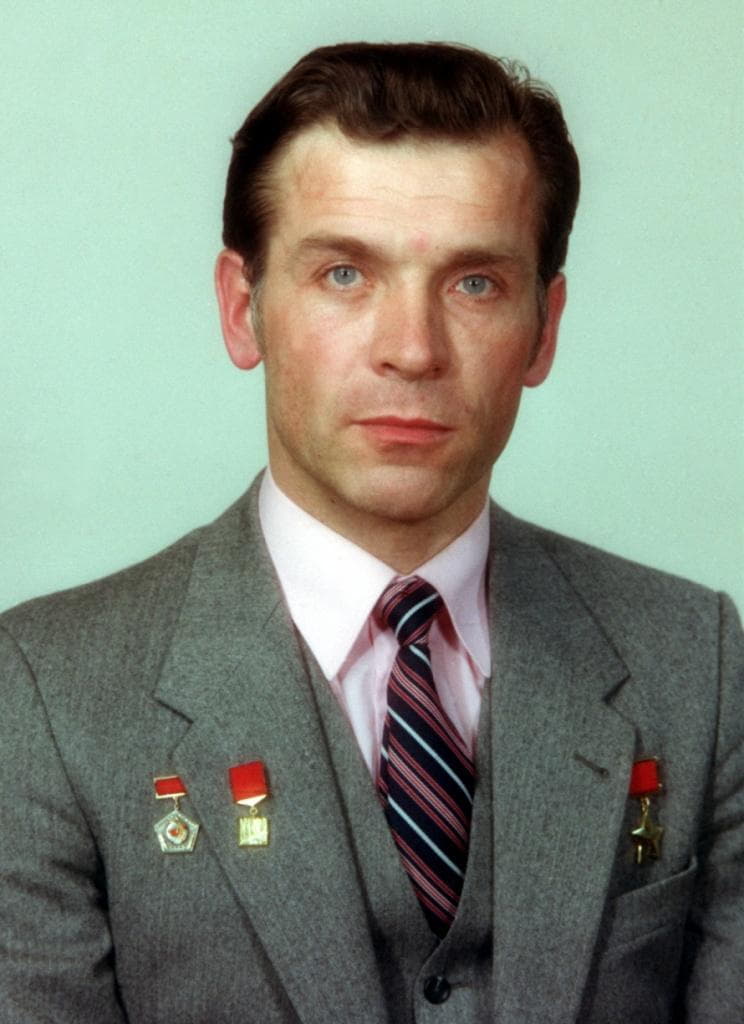
Серебров Александр Александрович - Герой Советского Союза, лётчик-космонавт СССР. Продолжительность пребывания в космосе составила 372 дня 22 часа 53 минут 49 секунд. Совершил 10 выходов в открытый космос, суммарной продолжительностью 31 час 49 минут
 https://museumgagarin.ru/news/serebrov_aleksandr_aleksandrovich_kosmonavt_52_110/Cosmonaut Alexander Serebrov dies at 69, flew four space missions
November 14, 2013 — Alexander Serebrov, a Soviet-era cosmonaut who once held the Guinness World Record for the most spacewalks and who was the first to test drive a "space motorcycle," has died at 69, according to Russia's federal space agency.
Serebrov's death at his Moscow apartment Tuesday (Nov. 12) was described as "sudden" by Roscosmos officials as part of a statement posted on the agency's website. (...)
Serebrov's 196-day stay on orbit almost ended in tragedy when he and his commander, Vasili Tsibliyev, lost control of the Soyuz TM-17 spacecraft after undocking, colliding with Mir twice. Fortunately, the Soyuz and space station escaped serious damage — the Mir crew did not even feel the impact — and Serebrov and Tsibiyev returned to Earth the same day on Jan. 14, 1994. (...)
http://www.collectspace.com/news/news-111413a-cosmonaut-alexander-serebrov-obituary.html
 Wątek: Aleksandr Aleksandrowicz Sieriebrow (1944-2013) (Przeczytany 3750 razy)