Boeing, SpaceX readying for crew capsule abort testsOctober 31, 2019 Stephen Clark
 Boeing’s Starliner pad abort test will last 95 seconds from launch through touchdown of the crew module. Credit: Boeing
(...) The Starliner capsule slated for next week’s pad abort test is mounted on top of the same type of adapter that will connect the real spacecraft to the top of ULA’s Atlas 5 rocket. When the craft ignites its four launch abort engines, vent doors on the adapter will open to prevent an over-pressure event.
For the pad abort test, the four launch abort engines, or LAEs, will ignite for 5.1 seconds, producing a combined 160,000 pounds of thrust to propel the spacecraft off a test stand at White Sands. The smaller orbital maneuvering and attitude control, or OMAC, thrusters will fire for 10.1 seconds to initiate a roll maneuver and govern the capsule’s orientation.
Then thrusters will pulse to flip the spacecraft around and fly tail first on an arc that will take the vehicle to a maximum altitude of approximately 4,426 feet (1,349 meters) above ground level around 18.6 seconds after takeoff.
The thrusters will stop firing 17 seconds after takeoff, and a series of pilot, drogue and main parachutes will begin deploying at T+plus 20 seconds, according to Boeing.
The craft will jettison its service module at T+plus 34 seconds to fall to the ground. The crew module will then release its base heat shield, then inflate airbags to cushion the capsule’s landing at White Sands around 95 seconds after liftoff. (...)
https://spaceflightnow.com/2019/10/31/boeing-spacex-readying-for-crew-capsule-abort-tests/Boeing and SpaceX preparing for commercial crew abort testsby Jeff Foust — October 30, 2019
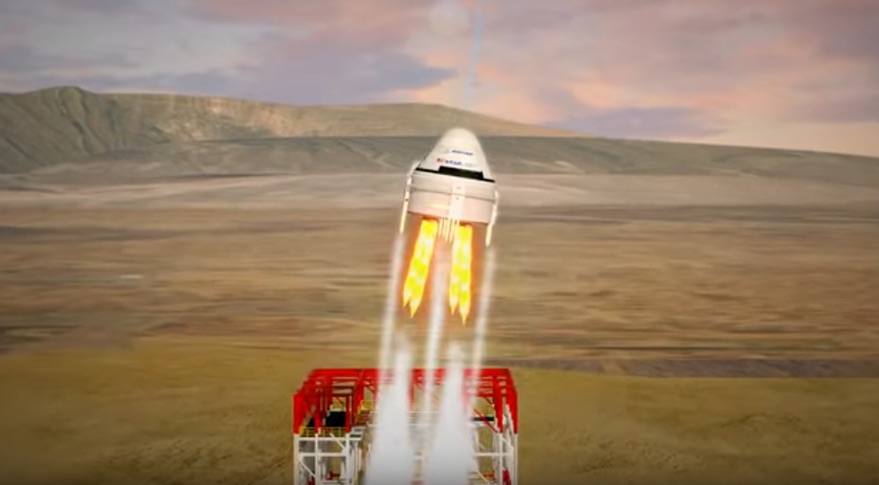 In the upcoming pad abort test, a CST-100 Starliner will use its abort motors to fly off a pad at White Sands Missile Range for a 90-second flight, demonstrating its ability to escape a malfunctioning rocket on the launch pad. Credit: Boeing
WASHINGTON — Boeing and SpaceX are on schedule to perform two critical tests of their commercial crew vehicles in the next week with hopes that both vehicles will be ready to carry astronauts by early next year.
In an Oct. 30 presentation to the NASA Advisory Council’s Human Exploration and Operations committee, Kathy Lueders, manager of NASA’s commercial crew program, said that Boeing was still working towards a Nov. 4 pad abort test of its CST-100 Starliner spacecraft that the company announced three weeks earlier.
In that test, at the White Sands Missile Range (WSMR) in New Mexico, the Starliner will fire the abort engines in its service module to simulate escaping a launch vehicle on the pad. The Starliner will fly about 1.5 kilometers high, landing 1.5 kilometers downrange 90 seconds later. (...)
That OFT mission is scheduled for launch Dec. 17 on a United Launch Alliance Atlas 5 from Cape Canaveral. That rollout of the Starliner from a Boeing facility at the Kennedy Space Center to a ULA processing center for integration onto the Atlas 5 will take place about a week after the pad abort test, she said. (...)
Boeing officials have previously said that they have completed testing of their parachutes, but that final certification of them is pending the outcomes of the pad abort test and Orbital Flight Test. SpaceX recently announced it was testing a new version of the Crew Dragon parachutes, called Mark 3, that have higher safety margins than earlier versions, which suffered at least one failure in a test earlier this year. (...)
https://spacenews.com/boeing-and-spacex-preparing-for-commercial-crew-abort-tests/
 Wątek: Boeing CST-100 Starliner (Przeczytany 177657 razy)