LiftoffSentinel wystartował z Plesiecka 16.02. o 17:57:45,065 z Plesiecka wystrzelona została RN Rokot/Briz-KM, która wyniosła w T+1h 15' 23"vna orbitę o parametrach: hp=801 km, ha=817 km, i=98,62° satelitę teledetekcyjnego Sentinel-3A.
http://lk.astronautilus.pl/n160216.htm#01Sentinel-3A liftoffSentinel-3A launchhttps://www.esa.int/ESA_Multimedia/Images/2016/02/Sentinel-3A_liftoff5https://twitter.com/ESA_History/status/1626218790240374785European oceanography satellite rides Russian rocket into orbitFebruary 16, 2016 Stephen Clark
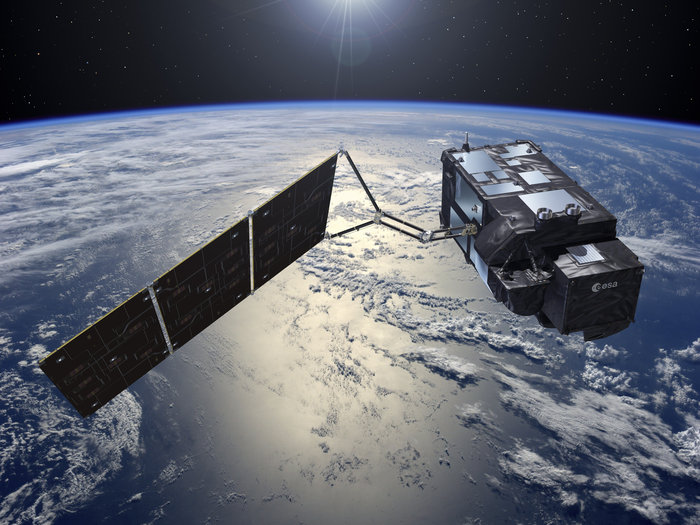 Artist’s concept of the Sentinel 3A satellite in orbit. Credit: ESA–Pierre Carril
(...) “This is the third of the Sentinel satellites launched in the less than two years – and it is certainly a special moment. It also marks a new era for the Copernicus Services, with Sentinel 3 providing a whole range of new data with unprecedented coverage of the oceans,” said Volker Liebig, director of ESA’s Earth observation programs.
Managed by the European Commission — the executive body of the EU — the Copernicus program is Europe’s most expensive space project. It will be the world’s largest Earth observing system when complete in the early 2020s, and Europe will have spent nearly $10 billion on the program by the end of the decade. (...)
https://spaceflightnow.com/2016/02/16/european-oceanography-satellite-rides-russian-rocket-into-orbit/Europe’s Sentinel-3A Earth observation satellite successfully launchedPeter B. de Selding February 16, 2016

(...) That is the case with Sentinel-3A, whose multi-instrument payload will monitor ocean wave height, sea and land temperature, sea-ice area and thickness and contribute to weather forecasting.
Europe’s 30-nation Eumetsat organization, based here, will operate Sentinel-3A after a five-month commissioning phase managed by the 22-nation European Space Agency (ESA).
The European Commission – the executive arm of the 28-nation European Union — owns the Copernicus network and has set aside 4.3 billion euros for it in its current seven-year budget running to 2020.
With a recent prime contract award to Thales Alenia Space of France and Italy for the third and fourth copies of Sentinel-3A satellites, this piece of the Copernicus puzzle is now assured of data continuity for at least 14 years – each satellite has a minimum expected life of seven years – and more like 24 years given the amount of on-board fuel each spacecraft carries.
Sentinel-3A was contracted in April 2008, with the identical 3B contracted in early 2010 for a total of 530 million euros, or $576 million at today’s exchange rates, for the two satellites. The 3C and 3D models were contracted earlier this year in a single contract that valued each satellite at 225 million euros. (...)
https://spacenews.com/europes-sentinel-3a-earth-observation-satellite-successfully-launched/https://www.nasaspaceflight.com/2016/02/russian-rokot-sentinel-3a-launch/https://www.eoportal.org/satellite-missions/copernicus-sentinel-3#spacecrafthttps://www.thalesgroup.com/en/worldwide/space/press-release/successful-launch-sentinel-3a-satellite-built-thales-alenia-spacehttps://space.skyrocket.de/doc_sdat/sentinel-3.htmhttps://twitter.com/CopernicusEU/status/1758450762294686118Happy 8th launch anniversary to our #Sentinel-3A 🎂!
This #Copernicus 🇪🇺🛰️ satellite has helped to improve our understanding of #OurPlanet 🌍
⬇️Copernicus #Sentinel3A image of Sicily 🇮🇹 acquired yesterday 15 February
 Wątek: Starty rakiet (I kwartał 2016 roku) (Przeczytany 68191 razy)