We Built the Saturn V (1)
Memories of a giant-in-progress.
By Mark Betancourt Air & Space Magazine October 2017
:focal(1638x2756:1639x2757)/https://public-media.smithsonianmag.com/filer/08/62/0862a808-d3dc-446f-96e4-f950e7496571/09d_on2017_opener_saturnv3s71-17620_orig_live.jpg) The ninth Saturn V lifts off in January 1971 to start the Apollo 14 mission. The first people to ride the mighty booster were the Apollo 8 crew in December 1968. Recalled Bill Anders, “It felt to me on the first stage ride like an old freight train going down a bad track.” (NASA)
The ninth Saturn V lifts off in January 1971 to start the Apollo 14 mission. The first people to ride the mighty booster were the Apollo 8 crew in December 1968. Recalled Bill Anders, “It felt to me on the first stage ride like an old freight train going down a bad track.” (NASA)The “V” stood for the five giant F-1 rocket engines—still the most powerful ever built—clustered at the bottom of the Saturn V’s first stage. At one point a four-engine version, the Saturn IV, had been considered, but in the complicated tradeoffs that led to the final design of NASA’s moon rocket, the “V” variant won out.
What became the Saturn grew out of a U.S. military requirement in the late 1950s for a booster big enough to launch large satellites. Wernher von Braun, who had dreamed as a young engineer in Germany of a rocket capable of reaching the moon, was enlisted with his U.S. Army (later NASA) team in Huntsville, Alabama, to lead the effort. When, in 1961, President John Kennedy announced his plan to land an American on the lunar surface by the end of the decade, von Braun got his original wish, and a vast army of engineers, technicians, builders, and bookkeepers went to work to realize the dream.
The rocket’s three stages were built and tested by a cadre of private contractors and subcontractors at facilities stretching from California to Alabama. When the pieces were ready, they traveled by barge and custom-made aircraft to Cape Kennedy in Florida, for assembly in what is still the largest single-story building on Earth.
Thirteen Saturn Vs rolled out of that building on a massive “crawler” to their launch pads. At more than $100 million each (equivalent to $750 million today), they departed Earth, then fell in pieces into the ocean.
What they accomplished, sending Americans farther into space than ever before or since, is still one of the nation’s proudest achievements. Perhaps the most impressive thing about the Saturn V was that the first one ever flown—50 years ago this November and scarcely five years after Kennedy’s edict—worked perfectly. And not one failed.
Many thousands of men and women toiled to bring the moon rocket into existence, often putting their personal lives aside and losing untold hours of sleep in the effort. Here, in excerpts from oral histories they recorded, books they wrote, and interviews with Air & Space, a few of them share their experiences working on one of humankind’s greatest machines. Some of the excerpts have been edited for clarity.
 A full-scale engineering model at Michoud. Saturn required not just rocket experts but construction crews to build some of the world’s biggest buildings. (NASA)A Staggering ChallengeGLYNN LUNNEY, Apollo Flight Director
When I first heard President Kennedy’s [September 1962 “We choose to go to the moon”] speech at Rice University, I was overwhelmed at the magnitude of it. I mean, we were struggling with Mercury spacecraft that weighed 2,000 or 2,500 pounds. [Now] we were talking about spacecraft that would be 10 or 20 times bigger. For me it was just an overwhelming thought that we could actually go and land on the moon and bring somebody back….
The boldness of the decision-making and the challenge that it presented to the country, and to the technical community, was just staggering to me. But we were so busy that it was “Well, okay, I guess we’re going to do that. So let’s get on.”
28 Years OldLEE SOLID, RocketdyneI was the senior executive for the [Rocketdyne] company during those years, with a staff of engineers, technicians, quality [control] folks, and all of the support functions, logistics, and so forth. Rocketdyne provided 33 of the engines [on the Saturn V]. Really the only engine we didn’t have was the descent engine on the lunar module. We had engines on every other stage.
And I was a relatively young guy. When I started working on Saturn, I was 28. We were a relatively young workforce, no doubt about it. On a project of that magnitude, the demand was for engineers, and the schools were putting them out, and this is what they were coming to.
I’d been involved in the Atlas [rocket] program, and for a while there, about every other one we were launching, we blew up. So it was kind of a gutsy thing to put a human being on this relatively unproven [Saturn]. If an Atlas failed, and range safety had to destroy it over land or even just over the beach, we went out and picked up the hardware and laid it out on the floor of a hangar and figured out what happened. If you could figure it out—and in most cases we could—why, you fixed the problem and went and launched another one.
You couldn’t really do that with the Saturn, just because of the massiveness. That Saturn 1C stage, with those five F-1 engines, is a massive piece of hardware. If that sucker was going to blow, it was not only going to take itself and the whole vehicle, but it was going to take the launch pad and most everything halfway back to the firing room in the explosion. Luckily, that never happened.
 The Saturn V weighed six million pounds and stood 363 feet tall, taller than the Statue of Liberty. The five F-1 engines on its first stage alone produced 7.5 million pounds of thrust. (NASA)
I got to know the [Kennedy Space] Center director, Dr. Kurt Debus, quite well, because every time we had an engine problem on a test stand, or anywhere, he wanted an explanation. I would roll up my blueprints and toddle over to his office and lay them out on his desk and explain to him what we did or didn’t do, and what the failure was. That was the technology we had—rolled-up blueprints. You can imagine today, I’d have done my Powerpoint charts, and taken my laptop over there, and shown him all kinds of animations. But everything we did was basically manual, and we worked with handwritten procedures.
We worked hard. There wasn’t any such thing as a 40-hour week. We basically worked around the clock, seven days a week. So it sort of became a way of life. The way I felt about it was, I grew up on a farm, nobody could work me harder than my dad. Working 15 hours a day was no big change for me.
The Perils of Rocket FuelART REINERS, North American AviationNASA’s Marshall Space Flight Center [in Alabama] had about 11 different sites we were responsible for, including Cape Canaveral. We developed all kinds of course material to teach people how to build the Saturn I and the Saturn V.…We had programs we taught on how to go in and clean up a Saturn after it had been [test] fired. It wasn’t just a matter of take it out, wash it off, and bring it back. No, you had to go inside the tanks and wash them down. Once a man is inside the tank, he’s only good for about 10 to 15 minutes with a Scott pack [breathing apparatus], and then he’s out of air. So you had teams of people working the internals of these tanks. It was called confined entry, and we taught a program on confined entry. We did lose one man due to nitrogen. He ended up in a 100 percent nitrogen atmosphere one day, and that was the end of that….
We lost a man on the test stand because we had a liquid oxygen leak and the liquid dripped on the flooring of the test stand. The guy came along and saw it. It had built up into like a little icicle and he kicked it and it blew his leg off. He had on rubber shoes, which had some oil or something on them, and oil in contact with cryogenic is just disastrous.
We’d Blow Up the BombPAUL CASTENHOLZ, RocketdyneThe F-1 rocket engine was completely new because of its size. We had tested small engines, even the J-2 [used on the Saturn second and third stages], which was about half the size or less. But our operations with smaller sizes were never anything like the F-1.
We ran a test with the [F-1 thrust] chamber, and all of a sudden it blew up and wrecked the stand and damaged the chamber. The test stand was about 200 yards away from the place where we, the test crew, were surrounded by concrete and glass. I was there, and was horrified. The propellant is flowing out of big breaks, all over everything on the test facility, so everything is on fire. A very big fire, very damaging to the test facility, and we could see every bit of it.
The problem turned out to be combustion instability of the oxygen in very large chambers. We had never seen that in smaller chambers, because they were confined, and they had no chance of combusting in step form. Because we were carrying men on top of this vehicle, we could not stand any combustion instability, because it would blow the chamber apart, and probably decimate the people that were riding it.
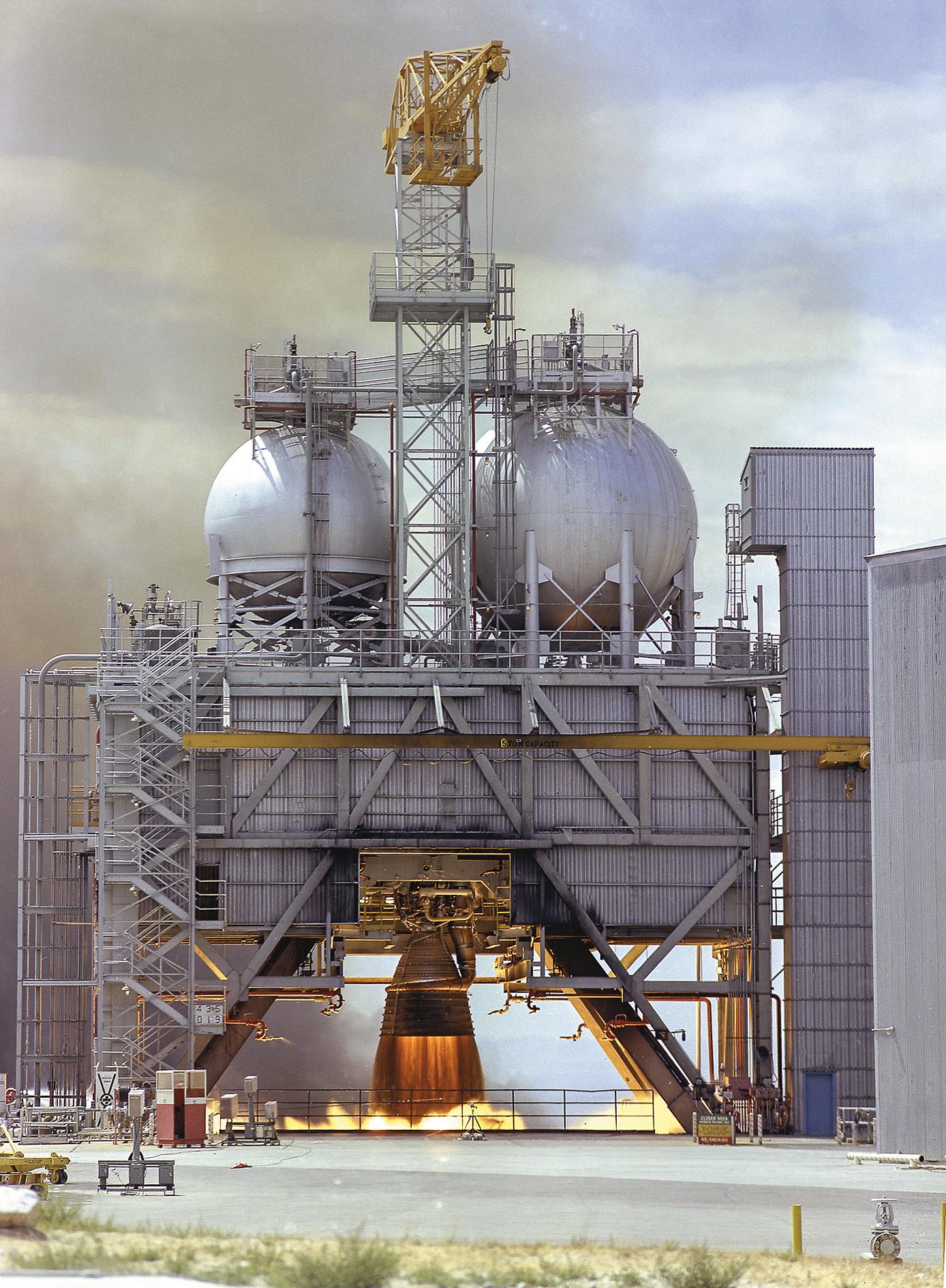 Rocketdyne’s kerosene-burning F-1 engine, exhaling fire in a 1960 static test, was in development even before the Saturn V. The nozzle measured 12.5 feet across at its widest. In flight, the five engines burned 4.5 million pounds of fuel in 150 seconds. (NASA)
We put hundreds of cameras in the thrust chamber, their lenses pointed to the combustion zone near the injector. We inserted pyrotechnic “bombs” in cavities [outside the chamber], and we’d blow up the bomb to determine how big of an explosion it would take [to cause the instability]. We took months to evaluate the amount of surge we could put into it.
After about two years we came up with a design that used dams in the injector face to form cavities, which were small enough to not allow surges. We ran some 50 to 100 tests, with absolutely no instability. So we thought, Well, we’ve beaten the problem of running a stable, very large thrust chamber with these propellants.
Boom Times in Cotton CountryJIM NOBLITT, BoeingI originally came [to Huntsville, Alabama] in 1964, and it was a boom town. You couldn’t find a place to live. There wasn’t a rental place anywhere in Huntsville. They were turning cotton fields into real estate developments, so I bought a new house in a place called Hazeline Estates, and I will never forget the red mud and the varmints in that old cotton field. They had mice and field urchins of all kinds. [The Boeing office] was an old cotton warehouse in Huntsville that they converted into an office building.
We were fairly close to where the [rocket] test stands were, down near the Tennessee River. And the big event was the day they fired the Saturn V for one of the first times. They had an inversion layer over Huntsville, and the pressure wave from the rocket went up and hit that overlaying [air mass] and came down over the town. We had a guy across the street with bay windows, and they must have been vibrating an inch or two, those bay windows, because there was so much overpressure. That got everybody in town’s attention.
I bought my house in ’64, and in late ’66, when I moved out, the program was on a decline, and Huntsville went from a boom town to a bust town almost. I couldn’t sell my house for nine months.
Going to the moon was a dream. Getting off the planet, this whole thing, was something we’d all talked about. I can remember going to college and talking with one of my neighbors about somebody flying in space. She thought I was crazy, even the idea of getting a rocket and flying up into space and orbiting the earth—You’re crazy! That ain’t never gonna happen! I was from a small town, and that was almost unimaginable, there was no basis for believing that. Maybe Huntsville was the believers, I don’t know.
But you know, there’s also a mundane day-to-day. You’re doing a job, you’re an engineer, you’ve got some little niche in this whole grand scheme of things. You didn’t go to work every day thinking about some guy landing on the moon. I had a carpool, so you know, you get up in the morning, you get in the carpool, you talk about the events of the day. You didn’t talk about going to the moon. You talked about what you did this weekend, what you’re going to do next weekend.
 Wątek: [Air & Space Magazine] We Built the Saturn V (Przeczytany 3024 razy)