50 lat temu trwały przygotowania do startu
Apollo 950 Years Ago: Apollo 9 Spacewalk PreparationsDec. 12, 2018
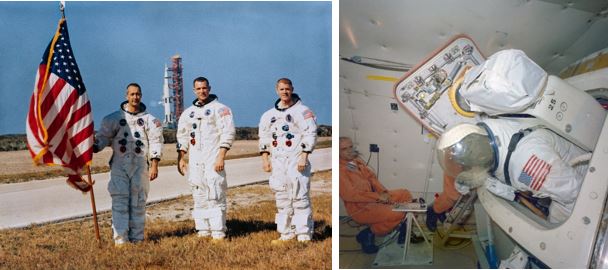 Left: Apollo 9 crew of (left to right) McDivitt, Scott, and Schweickart in front of the Apollo 8 Saturn V at Launch Pad 39A.
Right: Schweickart aboard a KC-135 aircraft practicing ingress and egress from a CM mockupAs Apollo 8 was preparing for its historic mission to orbit the Moon, Apollo 9 astronauts Commander James A. McDivitt, Command Module Pilot (CMP) David R. Scott, and Lunar Module Pilot (LMP) Russell L. Schweickart were in training for their upcoming flight which would be notable in its own way. At the time planned for late February 1969, Apollo 9 was the first crewed mission to test the all-important Lunar Module (LM), the vehicle that took two astronauts down to the Moon’s surface and returned them to the waiting Command Module (CM) in lunar orbit. On its first uncrewed test flight, Apollo 5 in January 1968, the LM had performed so well that NASA deemed a second unpiloted test flight unnecessary. During Apollo 9, in the relative safety of Earth orbit, McDivitt and Schweickart planned to enter the LM, undock from Scott who would remain in the CM, and fly the LM up to 100 miles away, testing the systems of its descent and ascent stages before performing a rendezvous and docking with the CM and reuniting with Scott. (...)
https://www.nasa.gov/feature/50-years-ago-apollo-9-spacewalk-preparations50 Years Ago: Apollo 9 Rolls Out to Launch PadJan. 28, 2019
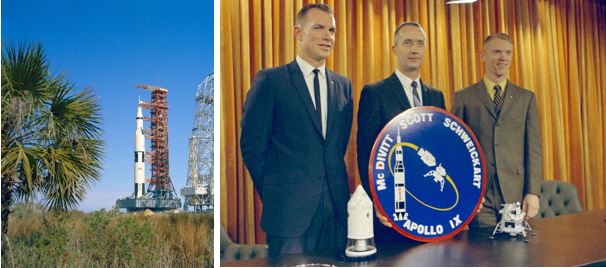 Left: Rollout of the Apollo 9 Saturn V rocket. Right: Apollo 9 crew of (left to right) Scott, McDivitt, and Schweickart.
(...) International Latex Corporation (ILC) of Dover, Delaware, developed two versions of the Apollo A7L space suit for NASA – one for intravehicular activity (IVA) and one for extravehicular activity (EVA) which included the Portable Life Support System (PLSS) backpack. Both types of the suit could operate under vacuum conditions, but the crewmember wearing an IVA version remained attached to the spacecraft via hoses that provided life support such as oxygen. The EVA version’s PLSS provided the required oxygen during spacewalks away from the vehicle, as would be required on the lunar surface. For Apollo 9, McDivitt and Schweickart wore the EVA version (even though McDivitt was not scheduled for an EVA) while Scott wore the IVA. (...)
https://www.nasa.gov/feature/50-years-ago-apollo-9-rolls-out-to-launch-pad50 Years Ago: Mobile Quarantine Facility Tests at Sea and at “altitude”Jan. 31, 2019
 Left: Mobile Quarantine Facility (MQF) arriving outside of the SESL. Middle: MQF being installed in Chamber A of the SESL. Right: Three test subjects inside the MQF being prepared for the simulated altitude test.
In preparation for the first landing of humans on the Moon, NASA instituted a quarantine program for astronauts and their samples returning from lunar landing missions to prevent contamination of Earth with any possible lunar pathogens. An integral component of the back-contamination prevention process was the Mobile Quarantine Facility (MQF). Following lunar landing missions, the MQF housed astronauts and support personnel from their arrival onboard the prime recovery ship shortly after splashdown through transport to the Lunar Receiving Laboratory (LRL) at the Manned Spacecraft Center (MSC), now the Johnson Space Center in Houston. Under contract to NASA, Melpar, Inc., of Falls Church, Virginia, converted four 35-foot Airstream trailers into MQFs, delivering the first unit in March 1968 and the last three in the spring of 1969. The first unit, MQF-001, was used extensively for testing, with lessons learned incorporated into the later models. One of those exercises included placing the MQF aboard a US Navy vessel in April 1968 for compatibility testing. Deficiencies uncovered by that test were corrected in time for the second sea trial in early 1969. (...)
https://www.nasa.gov/feature/50-years-ago-mobile-quarantine-facility-tests-at-sea-and-at-altitude50 Years Ago: Apollo 9 Preparations at L-6 weeksFeb. 1, 2019
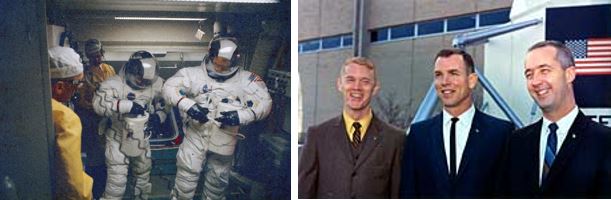 Left: McDivitt (left), Scott (emerging from the spacecraft), and Schweickart (right) during emergency egress training.
Right: Apollo 9 crew of (left to right) Schweickart, Scott, and McDivitt, pose in front of a model of a Lunar Module at
the Grumman plant in Bethpage, NY.Preparations for the Apollo 9 mission continued in January 1969. Commander James A. McDivitt, Command Module Pilot (CMP) David R. Scott, and Lunar Module Pilot (LMP) Russell L. Schweickart were in training for their upcoming flight which at the time was planned to launch in late February 1969. Apollo 9 was the first crewed mission to test the all-important LM, the vehicle that took two astronauts down to the Moon’s surface and returned them to the waiting Command Module (CM) in lunar orbit. In the relative safety of low Earth orbit, McDivitt and Schweickart planned to enter the LM, undock from Scott who would remain in the CM, and fly the LM up to 100 miles away, testing the systems of its descent and ascent stages before performing a rendezvous and docking with the CM and reuniting with Scott. Schweickart and Scott also planned to conduct the first spacewalk of the Apollo program, and also the only one planned before the spacewalk on the Moon’s surface, to test the reliability of the space suit. (...)
https://www.nasa.gov/feature/50-years-ago-apollo-9-preparations-at-l-6-weeks50 Years Ago: Apollo 9 Passes Countdown TestFeb. 14, 2019
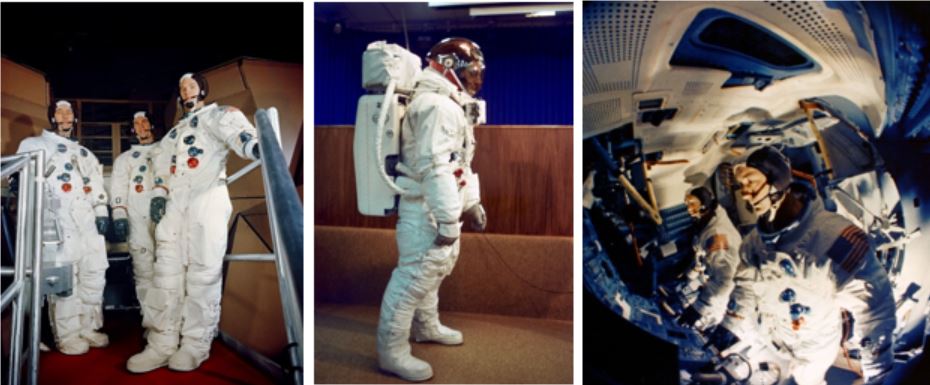 Left: Apollo 9 crew of (left to right) McDivitt, Scott, and Schweickart, pose in front of the CM simulator at KSC. Middle: Test subject demonstrates the Apollo A-7L spacesuit and PLSS backpack tested during Apollo 9. Right: Schweickart (left) and McDivitt in the LM simulator at KSC.
With two weeks to go before the planned lift off, preparations were well underway for the Apollo 9 mission, the first to test the critical Lunar Module (LM) with a crew on board. The 10-day Earth orbital mission was planned to launch on Feb. 28, 1969. Commander James A. McDivitt, Command Module Pilot (CMP) David R. Scott, and Lunar Module Pilot (LMP) Russell L. Schweickart, the prime crew of Apollo 9, were spending time in mission simulators preparing for the first Apollo mission to test all major components of the lunar landing mission. McDivitt and Schweickart planned to enter the LM, which they nicknamed
Spider, undock from Scott who would remain in the CM, callsign
Gumdrop, and fly the LM up to 100 miles away, testing the systems of its descent and ascent stages before performing a rendezvous and docking with the CM and reuniting with Scott. Schweickart and Scott planned to conduct the first spacewalk of the Apollo program, the only one scheduled before the spacewalk on the Moon’s surface, to test the reliability of the Apollo A-7L space suit and the Portable Life Support System (PLSS) backpack. The plan was for Schweickart to exit the LM through its side hatch onto the porch, and then using handrails translate over to Scott who would be in the open CM hatch, in a demonstration of a backup transfer path in case there was a problem with the internal transfer hatches and tunnel. Schweickart would then retrace his steps back to the LM. The crew described the mission to reporters during a press conference at the Manned Spacecraft Center (MSC), now the Johnson Space Center, on Feb. 8. (...)
https://www.nasa.gov/feature/50-years-ago-apollo-9-passes-countdown-testEDIT 18.02.2024
 Practice! Practice! Practice!
#OTD in 1969, the Apollo 9 crew was hard at work training for their upcoming mission, originally slated to launch on Feb 28.
McDivitt, Scott, and Schweickart's preparations for the first flight of the Apollo Lunar Module: https://go.nasa.gov/4bJevROhttps://x.com/NASAhistory/status/1758899110696874346Artykuły astronautyczne Wątek: Apollo 9 (Przeczytany 10395 razy)