Dragon leci do ISS 04.05.o 06:48:58 z Cape Canaveral wystrzelona została RN Falcon 9R, która wyniosła w T+8' 39" na orbitę
statek transportowy
Dragon SpX-17. Jego uchwycenie i przyłączenie do ISS wykonane zostanie 06.05.2019
o 12:00/13:30. W T+8' 27" pierwszy stopień RN wylądował na barce ASDS OCISLY na Atlantyku.
http://lk.astronautilus.pl/n190501.htm#01Udany początek misji CRS-17 BY KRZYSZTOF KANAWKA ON 4 MAJA 2019
 Start rakiety Falcon 9 do misji CRS-17 / Credits - SpaceX
Czwartego maja rakieta Falcon 9 wyniosła kapsułę Dragon do misji zaopatrzeniowej w kierunku Międzynarodowej Stacji Kosmicznej.
Do startu doszlo 4 maja o godzinie 08:48 CEST. Start nastąpił z wyrzutni LC-40 na Florydzie. Rakieta Falcon 9 wyniosła kapsułę Dragon do misji zaopatrzeniowej w kierunku Międzynarodowej Stacji Kosmicznej (ISS). Lot przebiegł prawidłowo i Dragon został wprowadzony na prawidłową orbitę wstępną skąd będzie “gonić” ISS.
Tuż po ósmej minucie od startu doszło do udanego lądowania pierwszego stopnia Falcona 9 na platformie morskiej. Start, lądowanie oraz wprowadzenie kapsuły Dragon nastąpiło po nocnej stronie Ziemi.
 Pierwszy stopień Falcona 9 “ląduje na ogniu” – misja CRS-17 / Credits – SpaceX
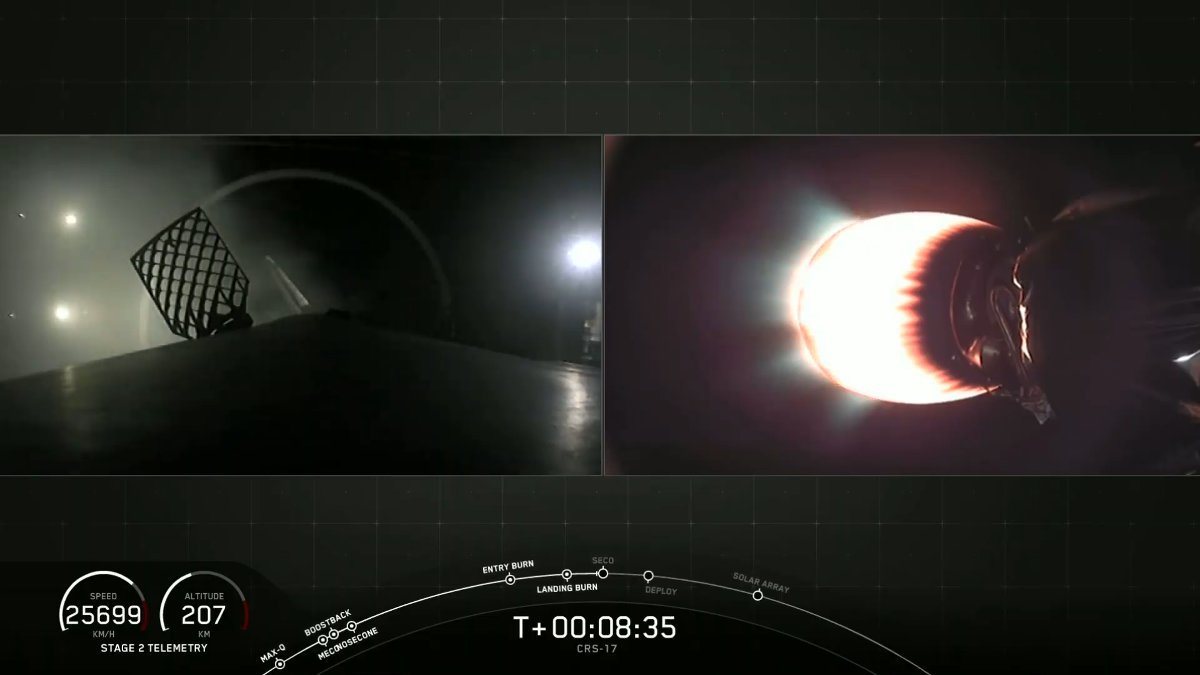 Pierwszy stopień (po lewej) tuż po lądowaniu na platformie morskiej, drugi stopień (po prawej) kończy swoją pracę – misja CRS-17 / Credits – SpaceX
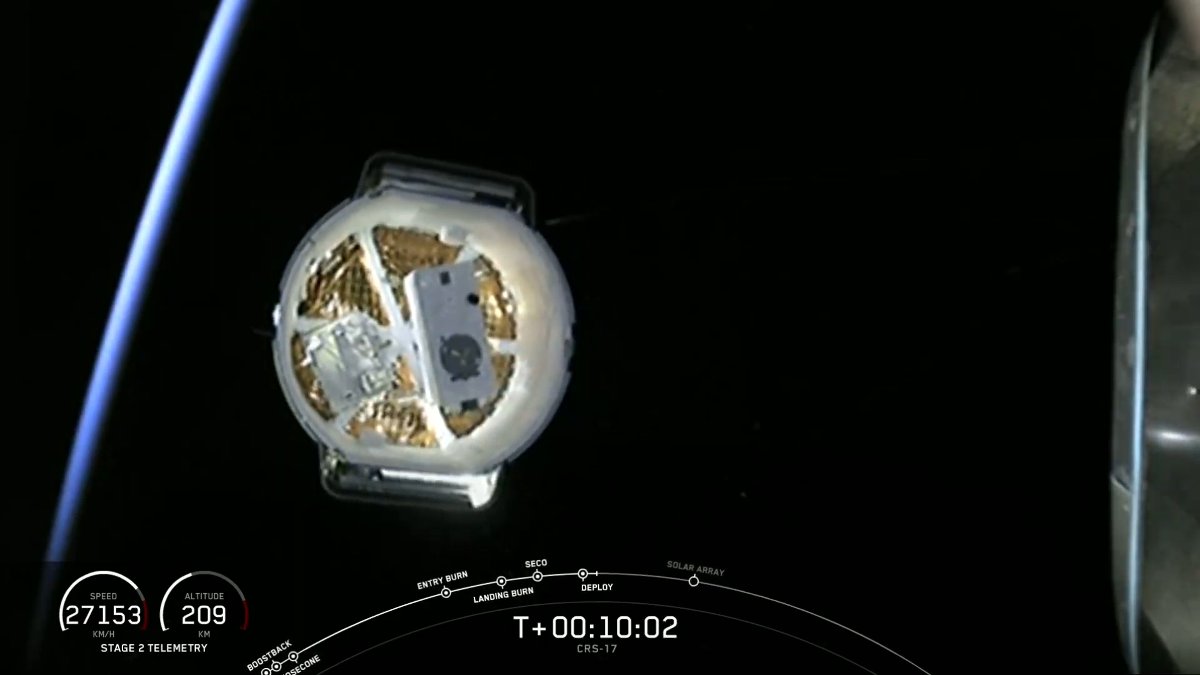 Uwolnienie kapsuły Dragon – misja CRS-17 / Credits – SpaceX
Start został opóźniony z 30 kwietnia wskutek awarii systemu elektrycznego na ISS. Ta awaria dotknęła także ramię robotyczne Stacji (SSRMS), jednak w kilka dni udało się wykonać naprawy bez potrzeby przeprowadzania spaceru kosmicznego. Ramię SSRMS ma za zadanie przechwycić kapsułę Dragon a następnie dzięki niemu możliwe jest przyłączenie kapsuły do modułu ISS.
Zapis startu misji CRS-17 / Credits – SpaceXWarto tu dodać, że 20 kwietnia doszło do
eksplozji załogowej kapsuły Dragon 2 podczas jednego z testów naziemnych. Szybko po tej eksplozji pojawiły się pytania, czy misja CRS-17 nie zostanie opóźniona. Problem z Dragonem 2 (lub infrastrukturą testową) okazuje się jednak nie mieć nic wspólnego z kapsułą Dragon – dlatego jest możliwe przeprowadzenie misji CRS-17.
(SpaceX, PFA)
https://kosmonauta.net/2019/05/udany-poczatek-misji-crs-17/SpaceX launches space station resupply mission, lands rocket on drone shipMay 4, 2019 Stephen Clark
 SpaceX’s Falcon 9 rocket lifted off from Cape Canaveral’s Complex 40 launch pad at 2:48:58 a.m. EDT (0648:58 GMT) Saturday. Credit: SpaceX
(...) The interaction exhaust plumes from the Falcon 9’s first and second stage Merlin engines produced a spectacular lighting effect, giving the appearance of a cosmic nebula high above the Florida spaceport.
 The Falcon 9’s first and second stages, appearing as two bright dots in the night sky, simultaneously fire their engines to return to landing and head into orbit, respectively. Credit: Steven Young/Spaceflight Now
The second stage fired for six minutes to place the Dragon supply ship in a preliminary orbit. Moments later, the automated spaceship deploy from the Falcon 9’s upper stage and unfurled two power-generating solar panels, setting the stage for a sequence of thruster firings over the next two days, culminating in the spacecraft’s approach to the space station early Monday.
Astronauts on the station will use a robotic arm to grapple the Dragon spacecraft, which will be berthed to a port on the Harmony module for a nearly one-month stay.
The Dragon cargo craft, which uses the same pressurized section that previously flew to the space station in August 2017, is carrying crew supplies, spare parts, and a host of experiments, ranging from biological investigations into spaceflight’s effects on the body, to an instrument measuring carbon dioxide in Earth’s atmosphere, to a U.S. military experiment developed in concert with NASA to demonstrate X-ray communications in space for the first time.
The resupply mission is the 17th cargo launch to the station by SpaceX under a $3.04 billion contract for 20 cargo deliveries through early 2020. SpaceX has a separate follow-on contract for at least six more resupply missions to the station through 2024, along with a $2.6 billion contract to build an upgraded Crew Dragon spaceship to ferry astronauts to and from the space station.
The Dragon spacecraft is scheduled to depart the space station June 3 and head for splashdown in the Pacific Ocean, bringing home research specimens and other equipment. (...)
NASA and SpaceX have agreed to use the same first stage that flew Saturday on the next cargo mission, designated SpaceX CRS-18, and possibly on the following CRS-19 launch in December, officials said in a press conference Saturday morning.
The rocket’s first stage, which stands 15 stories tall, made its first trip to the edge of space and back on Saturday’s flight. SpaceX has reused first stage boosters up to three times before, and the company says the latest generation of Falcon 9 boosters can fly up to 10 times before requiring major refurbishment. (...)
https://spaceflightnow.com/2019/05/04/spacex-launches-space-station-resupply-mission-lands-rocket-on-drone-ship/https://spaceflightnow.com/2019/04/30/spacex-resupply-launch-delayed-by-malfunction-on-space-station/https://spaceflightnow.com/2019/05/02/launch-timeline-for-spacexs-17th-space-station-resupply-mission/https://spaceflightnow.com/2019/05/02/spacex-crs-17-mission-status-center/https://spaceflightnow.com/2019/05/02/spacex-clears-cargo-mission-for-launch-confirms-destruction-of-crew-capsule/https://spaceflightnow.com/2019/05/03/falcon-9-launch-scrubbed-by-problem-on-landing-ship/Falcon 9 launches Dragon cargo spacecraft to ISSby Jeff Foust — May 4, 2019
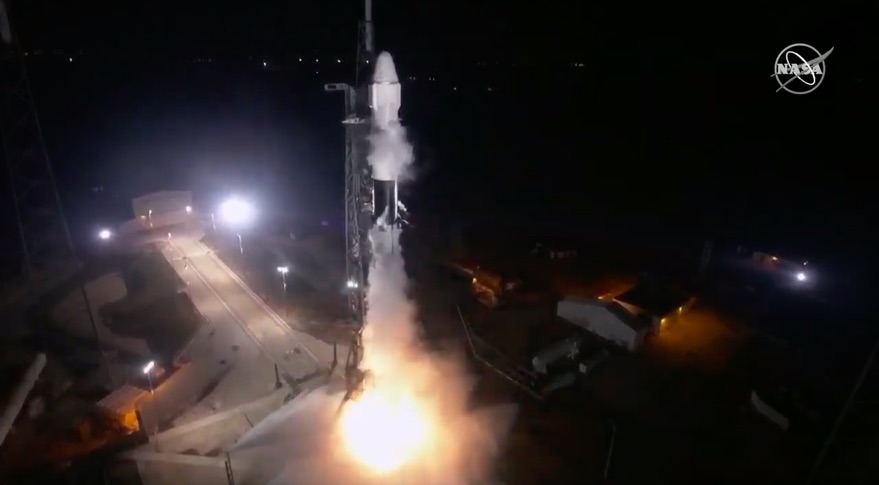 A SpaceX Falcon 9 carrying a Dragon cargo spacecraft lifts off May 4 from Cape Canaveral, Florida. Credit: NASA TV
Updated 8:50 a.m. Eastern.(...) This cargo Dragon, which first flew to the station on the CRS-12 mission in August 2017, is carrying 2,482 kilograms of cargo on this mission, designated CRS-17. That cargo includes about 1,700 kilograms of science payloads, with the rest devoted to crew supplies and vehicle hardware. The Dragon is scheduled to berth with the ISS May 6.
While the Dragon on this mission has previously flown to the station, the Falcon 9 first stage was new, as was the case with the previous Dragon mission, CRS-16, in December 2018. NASA has previously launched Dragon missions on “flight-proven” Falcon 9 rockets, but Todd said at the pre-launch briefing NASA hasn’t deliberately switched back to using new vehicles instead. “From my perspective there’s nothing’s that changed,” he said. At a briefing after the launch May 4, he noted NASA had a “vested interest” in making sure SpaceX could recover this booster since agency plans to use it on the next two Dragon cargo missions.
Koenigsmann cited the change in perception in the last few years as the use of flight-proven boosters has gone from a novelty to a routine part of SpaceX operations. “It’s interesting how the thinking changed overall,” he said prior to launch. As for this mission, he said, “Every once in a while we need new boosters.”
https://spacenews.com/falcon-9-launches-dragon-cargo-spacecraft-to-iss/SpaceX Launches Late-Night Dragon CRS-17 to Space StationBy Ben Evans, on May 4th, 2019
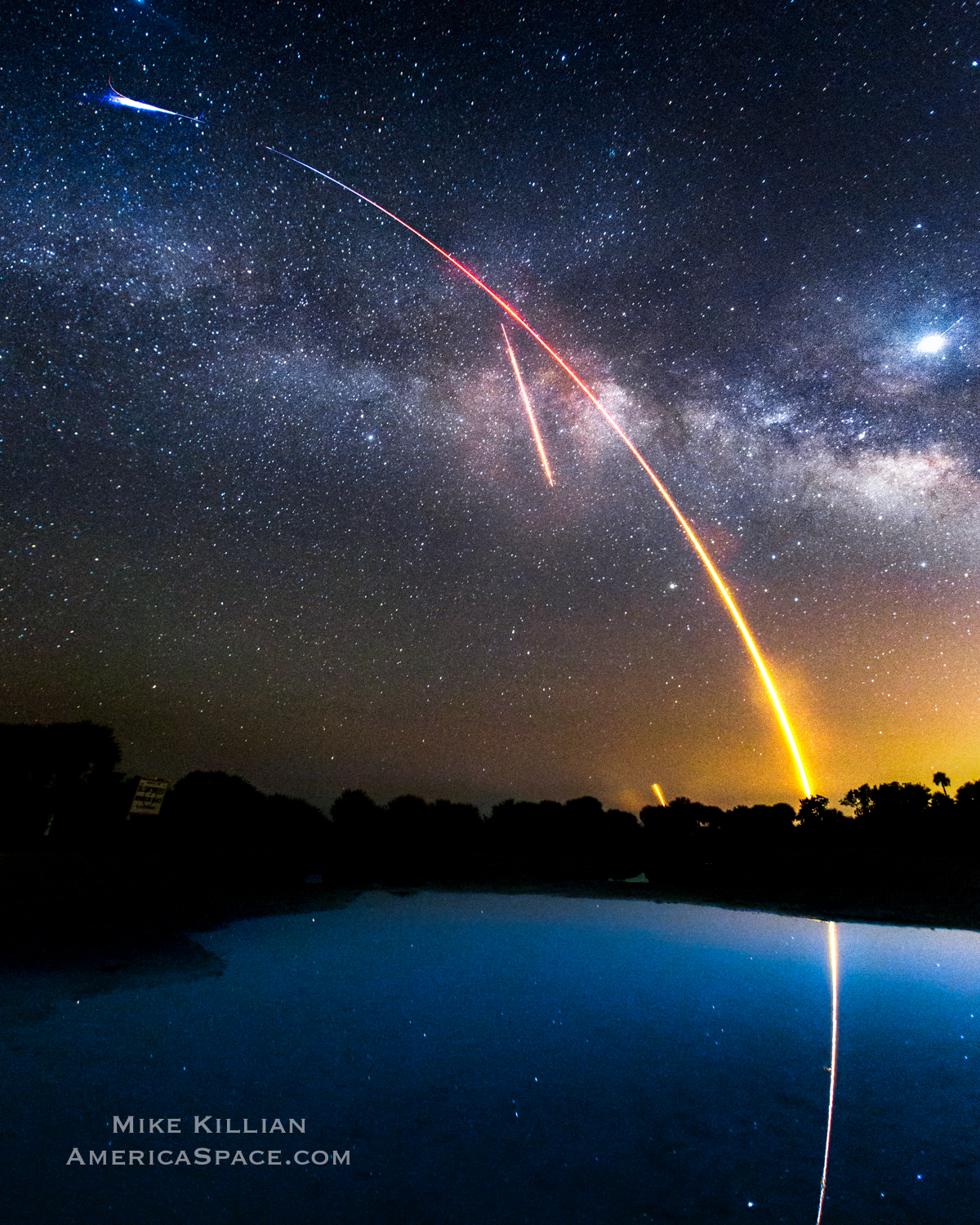 SpaceX launched Dragon CRS-17 to the International Space Station at 2:48am Eastern time on May 4, 2019, under a crystal clear moonless sky from Space Launch Complex-40 at Cape Canaveral AFS, Fla. Photo: Mike Killian / AmericaSpace.com
(...) At the start of 2019’s fifth month, SpaceX has successfully launched its fifth mission of the year, with a spectacular pre-dawn liftoff of an Upgraded Falcon 9 from Space Launch Complex (SLC)-40 at Cape Canaveral Air Force Station, Fla. Lighting up the darkened sky along the shores of the Space Coast, the 230-foot-tall (70-meter) rocket—its Block 5 core tail-numbered “B1056” and making its maiden flight—departed Earth during an “instantaneous” window at 2:48:15 a.m. EDT Saturday and smoothly delivered the CRS-17 Dragon cargo ship into low-Earth orbit to begin a two-day pursuit of the International Space Station (ISS).
This particular Dragon had previously seen service on the CRS-12 mission in August 2017 and marked the sixth occasion in under two years that one of SpaceX’s cargo ships had made a repeat flight to the ISS. Current plans are for Dragon to return to Earth at the end of May and, when combined with the 34 days logged from CRS-12, this particular spacecraft is expected to total around two months off the planet across its two missions. (...)
https://www.americaspace.com/2019/05/04/spacex-launches-late-night-dragon-crs-17-to-space-station/https://space.skyrocket.de/doc_sdat/dragon.htm
 Wątek: Falcon 9 | CRS-17 | 4.05.2019 (Przeczytany 23625 razy)