Kolejny Cygnus podąża do ISS 02.11. o 13:59:46 z Wallops wystrzelona została RN Antares-230+, która wyniosła w T+7' 15" na orbitę statek transportowy
Cygnus NG-12. Jego uchwycenie i przyłączenie do ISS wykonane zostanie 04.11.2019 o 10:45/13:00.
http://lk.astronautilus.pl/n191101.htm#01Start misji NG-12 BY KRZYSZTOF KANAWKA ON 3 LISTOPADA 2019
 Start rakiety Antares 230+ z Cygnusem NG-12 - 2 listopada 2019 / Credits - NASA TV
Drugiego listopada 2019 roku rozpoczęła się misja bezzałogowego pojazdu Cygnus NG-12.
Start misji Cygnus NG-12 nastąpił 2 listopada o godzinie 14:59 CET. Start odbył się z Wallops Flight Facility w stanie Virginia. Do wyniesienia Cygnusa NG-12 wykorzystano rakietę Antares 230+. Był to pierwszy start tej wersji, nieco zmodyfikowanej w porównaniu z wcześniej używanym Antaresem 230. Celem misji NG-12 jest Międzynarodowa Stacja Kosmiczna (ISS).
Start rakiety Antares 230+ z Cygnusem NG-12 / Credits – NASA
Na pokładzie Cygnusa zainstalowano ok 3720 kg ładunku, z czego ok. 3500 kg znajduje się w sekcji ciśnieniowej. Około połowa ładunku tej misji to eksperymenty naukowe i sprzęt pomiarowy.
Cygnus NG-12 dotrze do ISS 4 listopada. Cygnus powinien pozostać przyłączony do Stacji do około połowy stycznia 2020.
Co ciekawe, nadal trwa orbitalna misja NG-11. Ten egzemplarz Cygnusa od szóstego sierpnia wykonuje samodzielne działania na LEO, z dala od ISS. Oznacza to, że firma Northrop Grumman (NG) aktualnie obsługuje dwie misje pojazdów Cygnus jednocześnie.
(NASA, PFA)
https://kosmonauta.net/2019/11/start-misji-ng-12/Space station resupply mission successfully launches from VirginiaNovember 2, 2019 Stephen Clark

(...) The second stage burned out and deployed the 17,660-pound (8,010-kilogram) Cygnus spacecraft into an on-target orbit less than nine minutes after liftoff. Three hours later, the cargo ship’s two fan-shaped power-generating solar panels unfurled as designed, Northrop Grumman said.
“A good launch all the way around,” said Adam Lewis, Northrop Grumman’s launch conductor.
The higher thrust setting on the first stage engines, the lightened rocket structure, and the modified injection orbit gave the Antares 230+ rocket the capability to deliver up to 1,760 pounds (800 kilograms) of additional mass into low Earth orbit, according to Kurt Eberly, Northrop Grumman’s vice president for the Antares program
 This chart illustrates the differences between the Antares 230 configuration and the Antares 230+ configuration. Credit: NASA/Northrop Grumman
Saturday’s launch marked the 11th flight of an Antares rocket since 2013, and sixth to fly with two Russian-made RD-181 main engines, which replaced the AJ26 first stage engines used on first five Antares missions. (...)
The Cygnus spacecraft for the NG-12 mission launched with 10 mid-deck lockers for stowage and experiments, and six of the lockers will be powered throughout the flight to the space station. That’s an improvement from six lockers — and four powered lockers — on the NG-11 mission. (...)
The Cygnus spacecraft, named the S.S. Alan Bean in honor of the late Apollo and Skylab astronaut, is packed with 8,168 pounds (3,705 kilograms) of supplies and experiments heading to the International Space Station. Here’s a breakdown of the cargo manifest provided by NASA:
- 4,372 pounds (1,983 kilograms) of science investigations
- 1,667 pounds (756 kilograms) of vehicle hardware
- 1,499 pounds (680 kilograms) of crew supplies
- 262 pounds (119 kilograms) of unpressurized cargo (NanoRacks CubeSat deployer)
- 229 pounds (104 kilograms) of spacewalk equipment
- 77 pounds (35 kilograms) of Northrop Grumman hardware
- 37 pounds (17 kilograms) of computer resources
- 24 pounds (11 kilograms) of Russian hardware
There were 15 small satellites riding aboard the Cygnus spacecraft for Saturday’s launch.
The biggest of the group is a U.S. Air Force satellite named STPSat 4, which weighs roughly 220 pounds (100 kilograms) and will be transferred into the space station’s Kibo module by astronauts after Cygnus arrives at the orbiting research complex. Sponsored by the military’s Space Test Program, STPSat 4 will be one of the largest satellites ever deployed from the space station.
STPSat 4 carries five experiments from the Air Force Research Laboratory, the U.S. Air Force Academy, and the U.S. Navy. The experiments will test radio frequency module tiles, help develop new solar array technology, collect data with a miniaturized space weather instrument, demonstrate the performance of an advanced U.S.-built star tracker, and assist in nanosatellite tracking.
Craig Technologies, based on Florida’s Space Coast, is providing integration services for the STPSat 4 spacecraft, which will be released from the Space Station Integrated Kinetic Launcher for Orbital Payload Systems, or SSIKLOPS, deployer. The mechanism, which was first used in 2014, is designed to release small satellites with masses between 100 and 200 pounds.
The other CubeSats on-board the NG-12 mission are sponsored by NASA, the Air Force, and the National Reconnaissance Office. NanoRacks, a Houston-based space services company, arranged the launch of most of the CubeSats.
Some will be ejected from the space station after the Cygnus spacecraft’s arrival, and others will be released from the Cygnus itself after the cargo vehicle departs the station in January. (...)
https://spaceflightnow.com/2019/11/02/space-station-resupply-mission-successfully-launches-from-virginia/Antares Launches NG-12 ISS Resupply Mission, Honors Moonwalker Alan BeanBy Ben Evans, on November 2nd, 2019
 Antares seconds after exploding on the Orb-3 launch. Photo Credit: Elliot Severn / AmericaSpace.com
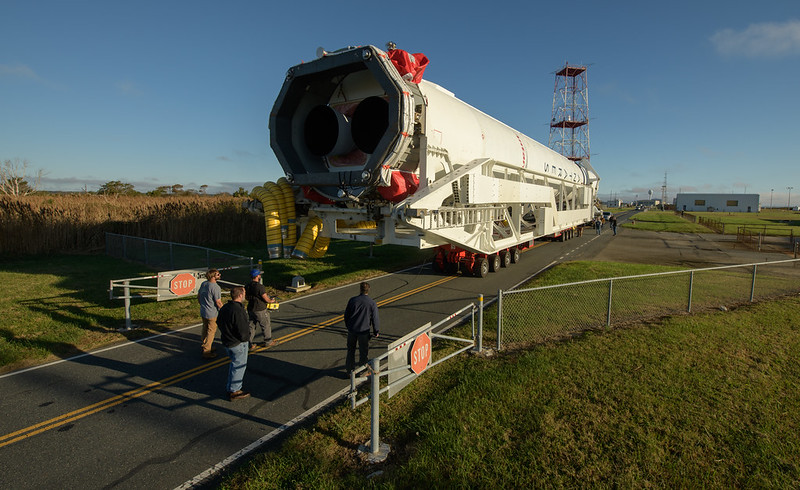 A Northrop Grumman Antares rocket rolls out to Pad-0A, Tuesday, Oct. 29, 2019, at NASA’s Wallops Flight Facility in Virginia. Northrop Grumman’s 12th contracted cargo resupply mission with NASA to the International Space Station to deliver about 8,200 pounds of science and research, crew supplies and vehicle hardware to the ISS. Photo Credit: (NASA/Bill Ingalls)
(...) All told, the first-stage engines burned for a little less than 3.5 minutes, before shutting down at an altitude of 52.3 miles (84.1 km). The first stage was then jettisoned and the solid-fueled Castor-30XL upper stage engine ignited for almost three more minutes to continue the boost to low-Earth orbit. By the time it too burned out and was discarded, the NG-12 Cygnus had attained an altitude of 110.8 miles (178.2 km), inclined 51.64 degrees to the equator.
And just under nine minutes after departing Wallops, at 10:08 a.m., Cygnus separated from the upper stage and entered free flight. At this point, the spacecraft had achieved an initial orbit with an apogee of approximately 170 miles (270 km) and a perigee of 113 miles (182 km). Its fan-like solar arrays were deployed and it settled down for a two-day chasedown of the ISS. (...)
Cygnus is scheduled to arrive at the orbiting laboratory around 4:10 a.m. Monday, Nov. 4, when NASA Expedition 61 astronauts Jessica Meir and Christina Koch will use the space station’s robotic arm to capture Cygnus, while NASA’s Andrew Morgan monitors telemetry. The spacecraft is scheduled to stay until January.
https://www.americaspace.com/2019/11/02/antares-launches-ng-12-iss-resupply-mission-honors-moonwalker-alan-bean/https://www.nasaspaceflight.com/2019/11/upgraded-antares-launch-first-crs2-nasa-cygnus/https://www.nasa.gov/press-release/nasa-science-cargo-heads-to-space-station-on-northrop-grumman-missionArtykuły astronautyczneCygnus CRS-12 (NG 12, SS Alan Bean)
STPSat 4 ↑
https://space.skyrocket.de/doc_sdat/stpsat-4.htmHARP ↑
https://space.skyrocket.de/doc_sdat/harp.htmPhoenix ↑
https://space.skyrocket.de/doc_sdat/phoenix_asu.htmRadSat-u ↑
https://space.skyrocket.de/doc_sdat/radsat-u.htmSOCRATES ↑
https://space.skyrocket.de/doc_sdat/socrates-exact.htmMVP-Argus (Argus 02, MVP A, SLU 05) ↑
https://space.skyrocket.de/doc_sdat/mvp-a.htmHuskySat 1 (HS 1)
https://space.skyrocket.de/doc_sdat/huskysat-1.htmSwampSat 2
https://space.skyrocket.de/doc_sdat/swampsat-2.htmAeroCube 14A
https://space.skyrocket.de/doc_sdat/aerocube-14.htmAeroCube 14B
AeroCube 15A
https://space.skyrocket.de/doc_sdat/aerocube-15.htmAeroCube 15B
Orbital Factory 2 (OF 2)
https://space.skyrocket.de/doc_sdat/orbital-factory-2.htm
 Wątek: Cygnus NG-12 (Przeczytany 8448 razy)