Autor Wątek: Cygnus NG-12  (Przeczytany 8093 razy)

0 użytkowników i 1 Gość przegląda ten wątek.

Offline mss

  • Moderator Globalny
  • *****
  • Wiadomości: 10746
  • he/him
    • Astronauci i ich loty...
Cygnus NG-12
« dnia: Października 24, 2019, 22:22 »
Cygnus-12 dostał miano po astronaucie Alanie Bean.


Więcej o astronaucie Alanie Bean.

« Ostatnia zmiana: Października 26, 2019, 22:31 wysłana przez mss »
"Mathematics is the language in which God has written the universe." - Galileo Galilei (1564 - 1642)

Offline kanarkusmaximus

  • Administrator
  • *****
  • Wiadomości: 24173
  • Ja z tym nie mam nic wspólnego!
    • Kosmonauta.net
Odp: Cygnus NG-12
« Odpowiedź #1 dnia: Października 29, 2019, 09:18 »
Pozwoliłem sobie wydzielić post o Cygnusie do oddzielnego wątku.

Offline mss

  • Moderator Globalny
  • *****
  • Wiadomości: 10746
  • he/him
    • Astronauci i ich loty...
Odp: Cygnus NG-12
« Odpowiedź #2 dnia: Października 29, 2019, 17:15 »
Rakieta Antares wywieziona na wyrzutnię.

Więcej:
Cytuj
Welcome to @NASA_Wallops where we captured the rollout of @NorthropGrumman’s Antares rocket and #Cygnus spacecraft, which will launch on Nov. 2 at 9:59am ET to deliver ~8,200 pounds of cargo & hardware to the @Space_Station. More from @NASAHQPhoto: https://go.nasa.gov/34gGYLr

"Mathematics is the language in which God has written the universe." - Galileo Galilei (1564 - 1642)

Offline Slavin

  • Weteran
  • *****
  • Wiadomości: 976
  • Ciekłym metanem i ciekłym tlenem LCH4/LO2 Methalox
Odp: Cygnus NG-12
« Odpowiedź #3 dnia: Października 31, 2019, 15:23 »
Podczas tej misji wewnątrz Cygnusa został umieszczony ładunek o masie ~3719 kg co stanowi rekord w dotychczasowych misjach statków Cygnus. 

Polskie Forum Astronautyczne

Odp: Cygnus NG-12
« Odpowiedź #3 dnia: Października 31, 2019, 15:23 »

Offline Orionid

  • Weteran
  • *****
  • Wiadomości: 28821
  • Very easy - Harrison Schmitt
Odp: Cygnus NG-12
« Odpowiedź #4 dnia: Października 31, 2019, 21:49 »
Przygotowania do misji Cygnus NG-12
BY KRZYSZTOF KANAWKA ON 31 PAŹDZIERNIKA 2019

(...) Misja Cygnus NG-12 to pierwsza misja zaopatrzeniowa bezzałogowego pojazdu Cygnus w ramach nowej umowy z NASA. Celem tej misji jest Międzynarodowa Stacja Kosmiczna (ISS). Operatorem misji NG-12 jest amerykańska firma Northrop Grumman (NG).

Aktualnie start misji NG-12 jest planowany na 2 listopada 2019 na godzinę 14:59 CET. Cygnus powinien dotrzeć do ISS dwa dni później. Mija NG-12 upamiętni Alana Bean’a – astronautę misji Apollo 12. Alan Bean był czwartym człowiekiem na Księżycu.


Zapowiedź misji Cygnus NG-12 / Credits – Northrop Grumman

Co ciekawe, nadal trwa orbitalna misja NG-11. Ten egzemplarz Cygnusa od szóstego sierpnia wykonuje samodzielne działania na LEO, z dala od ISS. Oznacza to, że firma NG będzie pod koniec 2019 roku obsługiwać dwie misje pojazdów Cygnus jednocześnie.

(PFA)
https://kosmonauta.net/2019/10/przygotowania-do-misji-cygnus-ng-12/

Northrop Grumman names 12th Cygnus ship for Apollo 12 astronaut

October 24, 2019 — Northrop Grumman is honoring an Apollo 12 moonwalker with the naming of its 12th spacecraft to resupply the International Space Station.

The "S.S. Alan Bean," a Cygnus spacecraft, pays tribute to the late astronaut who became the fourth person to walk on the moon on Nov. 19, 1969. The capsule is scheduled to launch atop a Northrop Grumman Antares rocket from the Mid-Atlantic Regional Spaceport (MARS) at NASA's Wallops Flight Facility in Virginia on Nov. 2. (...)
http://www.collectspace.com//news/news-102419a-northrop-grumman-ng12-alan-bean.html

Offline Orionid

  • Weteran
  • *****
  • Wiadomości: 28821
  • Very easy - Harrison Schmitt
Odp: Cygnus NG-12
« Odpowiedź #5 dnia: Października 31, 2019, 22:41 »
Antares Ready for Saturday Launch from Virginia to Resupply ISS (NG-12)
By Ben Evans, on October 31st, 2019


The Northrop Grumman Antares rocket is seen in the early morning on launch Pad-0A, Wednesday, Oct. 30, 2019, at NASA’s Wallops Flight Facility in Virginia. Northrop Grumman’s 12th contracted cargo resupply mission with NASA to the International Space Station will deliver about 8,200 pounds of science and research, crew supplies and vehicle hardware to the orbital laboratory and its crew. Launch is scheduled for 9:59 a.m. EDT Saturday, Nov. 2. Photo Credit: (NASA/Bill Ingalls)


Apollo 12 crewmen (from left) Dick Gordon, Pete Conrad and Alan Bean listen to instructions, ahead of a water egress training exercise in the Gulf of Mexico. Photo Credit: NASA


Alan Bean became one of only four humans to have performed spacewalks and Moonwalks. Photo Credit: NASA


The 133-foot-long (40.5-meter) Antares 230+ booster rolls out to the pad, earlier this week. Photo Credit: NASA/Twitter


The Northrop Grumman Antares rocket is seen a few hours after arriving at launch Pad-0A, Tuesday, Oct. 29, 2019, at NASA’s Wallops Flight Facility in Virginia. Northrop Grumman’s 12th contracted cargo resupply mission with NASA to the International Space Station will deliver about 8,200 pounds of science and research, crew supplies and vehicle hardware to the orbital laboratory and its crew. Launch is scheduled for 9:59 a.m. EDT Saturday, Nov. 2. Photo Credit: (NASA/Bill Ingalls)
https://www.americaspace.com/2019/10/31/antares-ready-for-saturday-launch-from-virginia-to-resupply-iss-ng-12/

Upgraded Antares rocket rolled out for launch on space station resupply mission
October 29, 2019 Stephen Clark


The Antares rocket’s twin RD-181 first stage engines are visible in this photo taken during Tuesday’s rollout at Wallops Island, Virginia. Credit: NASA/Bill Ingalls

(...)The NG-12 mission is set to deliver some 8,200 pounds of supplies and experiments to the space station, nearly 10 percent more than the previous Antares/Cygnus flight. The cargo tally will set a new record for the heaviest payload launched by a commercial U.S. resupply ship. (...)


The 139-foot-tall (42.5-meter) Antares rocket stands vertical on pad 0A Tuesday at the Mid-Atlantic Regional Spaceport in Virginia. Credit: NASA/Bill Ingalls

(...) Under manual control by an astronaut, the space station’s Canadian-built robotic arm will capture the Cygnus spacecraft and berth it to a port on the orbiting lab’s Unity module to begin a stay scheduled to last more than two months.

Like the Antares, the Cygnus spacecraft set for launch Saturday features upgrades, said Frank DeMauro, vice president and general manager of Northrop Grumman’s space systems sector.

“Over time, we’re continually upgrading the system, not only to add more cargo but to add more capability to the spacecraft,” DeMauro told Spaceflight Now. “For CRS-2, I think the best way to describe it is we’re taking a step function up and even further increasing our focus on our ability to support science to the ISS.” (...)
https://spaceflightnow.com/2019/10/29/upgraded-antares-rocket-rolled-out-for-launch-on-space-station-resupply-mission/

Offline wini

  • Weteran
  • *****
  • Wiadomości: 2610
  • LOXem i ropą! ;)
    • Kosmonauta.net
Odp: Cygnus NG-12
« Odpowiedź #6 dnia: Listopada 02, 2019, 07:50 »
Nagranie z prezentacji dla prasy:

Offline kanarkusmaximus

  • Administrator
  • *****
  • Wiadomości: 24173
  • Ja z tym nie mam nic wspólnego!
    • Kosmonauta.net
Odp: Cygnus NG-12
« Odpowiedź #7 dnia: Listopada 02, 2019, 14:00 »
Mniej niż godzina do startu. Pogoda na 100% GO.

Offline Slavin

  • Weteran
  • *****
  • Wiadomości: 976
  • Ciekłym metanem i ciekłym tlenem LCH4/LO2 Methalox
Odp: Cygnus NG-12
« Odpowiedź #8 dnia: Listopada 02, 2019, 15:12 »
Udany start, Cygnus na orbicie  :)

Offline Slavin

  • Weteran
  • *****
  • Wiadomości: 976
  • Ciekłym metanem i ciekłym tlenem LCH4/LO2 Methalox
Odp: Cygnus NG-12
« Odpowiedź #9 dnia: Listopada 02, 2019, 15:27 »
Był to pierwszy start rakiety Antares w wersji 230+ (lżejsza kompozytowa struktura pierwszego członu i parę innych ulepszeń). Wewnątrz Cygnusa umieszczono ładunek o masie ~3719 kg (z czego ponad 3,5 tony w sekcji ciśnieniowej).
Zdjęcia ze startu.


« Ostatnia zmiana: Listopada 02, 2019, 15:39 wysłana przez Slavin »

Offline kanarkusmaximus

  • Administrator
  • *****
  • Wiadomości: 24173
  • Ja z tym nie mam nic wspólnego!
    • Kosmonauta.net
Odp: Cygnus NG-12
« Odpowiedź #10 dnia: Listopada 02, 2019, 18:11 »
Przechwycenie Cygnusa planowane na poniedziałek po godzinie 10:00 CEST, tak?

Offline Slavin

  • Weteran
  • *****
  • Wiadomości: 976
  • Ciekłym metanem i ciekłym tlenem LCH4/LO2 Methalox
Odp: Cygnus NG-12
« Odpowiedź #11 dnia: Listopada 02, 2019, 18:18 »
Tak.
Informacja ze strony NASA:
Cygnus is scheduled to arrive at the orbiting laboratory around 4:10 a.m. Monday, Nov. 4. Coverage of the spacecraft’s approach and arrival will begin at 2:45 a.m. on NASA Television.

Offline Orionid

  • Weteran
  • *****
  • Wiadomości: 28821
  • Very easy - Harrison Schmitt
Odp: Cygnus NG-12
« Odpowiedź #12 dnia: Listopada 03, 2019, 00:12 »
Kolejny Cygnus podąża do ISS
  02.11. o 13:59:46 z Wallops wystrzelona została RN Antares-230+, która wyniosła w T+7' 15" na orbitę statek transportowy
Cygnus NG-12. Jego uchwycenie i przyłączenie do ISS wykonane zostanie 04.11.2019 o 10:45/13:00.
http://lk.astronautilus.pl/n191101.htm#01


Start misji NG-12
BY KRZYSZTOF KANAWKA ON 3 LISTOPADA 2019


Start rakiety Antares 230+ z Cygnusem NG-12 - 2 listopada 2019 / Credits - NASA TV

Drugiego listopada 2019 roku rozpoczęła się misja bezzałogowego pojazdu Cygnus NG-12.

Start misji Cygnus NG-12 nastąpił 2 listopada o godzinie 14:59 CET. Start odbył się z Wallops Flight Facility w stanie Virginia. Do wyniesienia Cygnusa NG-12 wykorzystano rakietę Antares 230+. Był to pierwszy start tej wersji, nieco zmodyfikowanej w porównaniu z wcześniej używanym Antaresem 230. Celem misji NG-12 jest Międzynarodowa Stacja Kosmiczna (ISS).


Start rakiety Antares 230+ z Cygnusem NG-12 / Credits – NASA

Na pokładzie Cygnusa zainstalowano ok 3720 kg ładunku, z czego ok. 3500 kg znajduje się w sekcji ciśnieniowej. Około połowa ładunku tej misji to eksperymenty naukowe i sprzęt pomiarowy.

Cygnus NG-12 dotrze do ISS 4 listopada. Cygnus powinien pozostać przyłączony do Stacji do około połowy stycznia 2020.

Co ciekawe, nadal trwa orbitalna misja NG-11. Ten egzemplarz Cygnusa od szóstego sierpnia wykonuje samodzielne działania na LEO, z dala od ISS. Oznacza to, że firma Northrop Grumman (NG) aktualnie obsługuje dwie misje pojazdów Cygnus jednocześnie.

(NASA, PFA)
https://kosmonauta.net/2019/11/start-misji-ng-12/

Space station resupply mission successfully launches from Virginia
November 2, 2019 Stephen Clark


(...) The second stage burned out and deployed the 17,660-pound (8,010-kilogram) Cygnus spacecraft into an on-target orbit less than nine minutes after liftoff. Three hours later, the cargo ship’s two fan-shaped power-generating solar panels unfurled as designed, Northrop Grumman said.

“A good launch all the way around,” said Adam Lewis, Northrop Grumman’s launch conductor.

The higher thrust setting on the first stage engines, the lightened rocket structure, and the modified injection orbit gave the Antares 230+ rocket the capability to deliver up to 1,760 pounds (800 kilograms) of additional mass into low Earth orbit, according to Kurt Eberly, Northrop Grumman’s vice president for the Antares program


This chart illustrates the differences between the Antares 230 configuration and the Antares 230+ configuration. Credit: NASA/Northrop Grumman

Saturday’s launch marked the 11th flight of an Antares rocket since 2013, and sixth to fly with two Russian-made RD-181 main engines, which replaced the AJ26 first stage engines used on first five Antares missions. (...)

The Cygnus spacecraft for the NG-12 mission launched with 10 mid-deck lockers for stowage and experiments, and six of the lockers will be powered throughout the flight to the space station. That’s an improvement from six lockers — and four powered lockers — on the NG-11 mission. (...)

The Cygnus spacecraft, named the S.S. Alan Bean in honor of the late Apollo and Skylab astronaut, is packed with 8,168 pounds (3,705 kilograms) of supplies and experiments heading to the International Space Station. Here’s a breakdown of the cargo manifest provided by NASA:

- 4,372 pounds (1,983 kilograms) of science investigations
- 1,667 pounds (756 kilograms) of vehicle hardware
- 1,499 pounds (680 kilograms) of crew supplies
- 262 pounds (119 kilograms) of unpressurized cargo (NanoRacks CubeSat deployer)
- 229 pounds (104 kilograms) of spacewalk equipment
- 77 pounds (35 kilograms) of Northrop Grumman hardware
- 37 pounds (17 kilograms) of computer resources
- 24 pounds (11 kilograms) of Russian hardware

There were 15 small satellites riding aboard the Cygnus spacecraft for Saturday’s launch.

The biggest of the group is a U.S. Air Force satellite named STPSat 4, which weighs roughly 220 pounds (100 kilograms) and will be transferred into the space station’s Kibo module by astronauts after Cygnus arrives at the orbiting research complex. Sponsored by the military’s Space Test Program, STPSat 4 will be one of the largest satellites ever deployed from the space station.

STPSat 4 carries five experiments from the Air Force Research Laboratory, the U.S. Air Force Academy, and the U.S. Navy. The experiments will test radio frequency module tiles, help develop new solar array technology, collect data with a miniaturized space weather instrument, demonstrate the performance of an advanced U.S.-built star tracker, and assist in nanosatellite tracking.

Craig Technologies, based on Florida’s Space Coast, is providing integration services for the STPSat 4 spacecraft, which will be released from the Space Station Integrated Kinetic Launcher for Orbital Payload Systems, or SSIKLOPS, deployer. The mechanism, which was first used in 2014, is designed to release small satellites with masses between 100 and 200 pounds.

The other CubeSats on-board the NG-12 mission are sponsored by NASA, the Air Force, and the National Reconnaissance Office. NanoRacks, a Houston-based space services company, arranged the launch of most of the CubeSats.

Some will be ejected from the space station after the Cygnus spacecraft’s arrival, and others will be released from the Cygnus itself after the cargo vehicle departs the station in January. (...)
https://spaceflightnow.com/2019/11/02/space-station-resupply-mission-successfully-launches-from-virginia/

Antares Launches NG-12 ISS Resupply Mission, Honors Moonwalker Alan Bean
By Ben Evans, on November 2nd, 2019


Antares seconds after exploding on the Orb-3 launch. Photo Credit: Elliot Severn / AmericaSpace.com
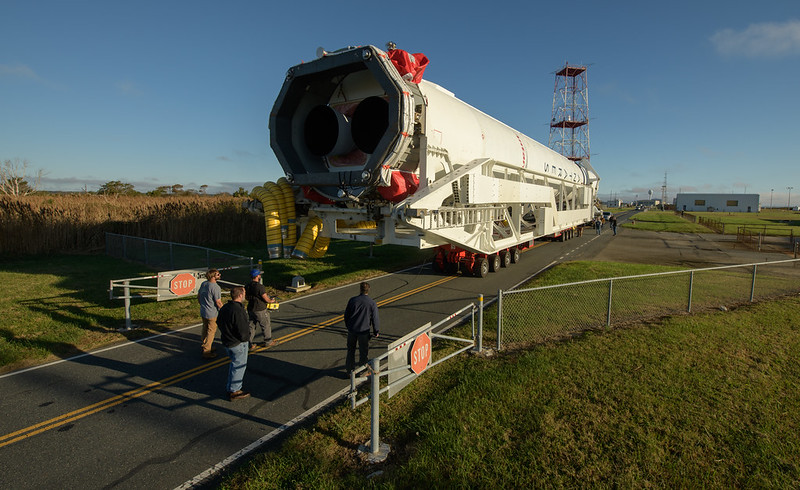

A Northrop Grumman Antares rocket rolls out to Pad-0A, Tuesday, Oct. 29, 2019, at NASA’s Wallops Flight Facility in Virginia. Northrop Grumman’s 12th contracted cargo resupply mission with NASA to the International Space Station to deliver about 8,200 pounds of science and research, crew supplies and vehicle hardware to the ISS. Photo Credit: (NASA/Bill Ingalls)

(...) All told, the first-stage engines burned for a little less than 3.5 minutes, before shutting down at an altitude of 52.3 miles (84.1 km). The first stage was then jettisoned and the solid-fueled Castor-30XL upper stage engine ignited for almost three more minutes to continue the boost to low-Earth orbit. By the time it too burned out and was discarded, the NG-12 Cygnus had attained an altitude of 110.8 miles (178.2 km), inclined 51.64 degrees to the equator.

And just under nine minutes after departing Wallops, at 10:08 a.m., Cygnus separated from the upper stage and entered free flight. At this point, the spacecraft had achieved an initial orbit with an apogee of approximately 170 miles (270 km) and a perigee of 113 miles (182 km). Its fan-like solar arrays were deployed and it settled down for a two-day chasedown of the ISS. (...)

Cygnus is scheduled to arrive at the orbiting laboratory around 4:10 a.m. Monday, Nov. 4, when NASA Expedition 61 astronauts Jessica Meir and Christina Koch will use the space station’s robotic arm to capture Cygnus, while NASA’s Andrew Morgan monitors telemetry. The spacecraft is scheduled to stay until January.
https://www.americaspace.com/2019/11/02/antares-launches-ng-12-iss-resupply-mission-honors-moonwalker-alan-bean/

https://www.nasaspaceflight.com/2019/11/upgraded-antares-launch-first-crs2-nasa-cygnus/
https://www.nasa.gov/press-release/nasa-science-cargo-heads-to-space-station-on-northrop-grumman-mission

Artykuły astronautyczne

Cygnus CRS-12 (NG 12, SS Alan Bean)
STPSat 4 ↑  https://space.skyrocket.de/doc_sdat/stpsat-4.htm
HARP ↑  https://space.skyrocket.de/doc_sdat/harp.htm
Phoenix ↑  https://space.skyrocket.de/doc_sdat/phoenix_asu.htm
RadSat-u ↑  https://space.skyrocket.de/doc_sdat/radsat-u.htm
SOCRATES ↑  https://space.skyrocket.de/doc_sdat/socrates-exact.htm
MVP-Argus (Argus 02, MVP A, SLU 05) ↑  https://space.skyrocket.de/doc_sdat/mvp-a.htm
HuskySat 1 (HS 1)  https://space.skyrocket.de/doc_sdat/huskysat-1.htm
SwampSat 2  https://space.skyrocket.de/doc_sdat/swampsat-2.htm
AeroCube 14A  https://space.skyrocket.de/doc_sdat/aerocube-14.htm
AeroCube 14B
AeroCube 15A  https://space.skyrocket.de/doc_sdat/aerocube-15.htm
AeroCube 15B
Orbital Factory 2 (OF 2)  https://space.skyrocket.de/doc_sdat/orbital-factory-2.htm
« Ostatnia zmiana: Listopada 03, 2019, 12:26 wysłana przez Orionid »

Offline Orionid

  • Weteran
  • *****
  • Wiadomości: 28821
  • Very easy - Harrison Schmitt
Odp: Cygnus NG-12
« Odpowiedź #13 dnia: Listopada 03, 2019, 12:45 »
Air Force, NRO cubesats fly to International Space Station aboard Northrop Grumman resupply mission
by Sandra Erwin — November 2, 2019


Rogue cubesat concept developed for the Air Force by the Aerospace Corp. Credit: Aerospace Corp.

Air Force and NRO cubesats were among many experimental projects encapsulated in the NG-12 Cygnus mission.
Updated Nov. 3 with new information on NRO cubesats


WASHINGTON — Experimental small satellites developed by the Aerospace Corp. for the U.S. Air Force and cubesats for National Reconnaissance Office research projects were aboard a Northrop Grumman Antares rocket that flew a cargo resupply mission Nov. 2 to the International Space Station.

Two identical shoebox-size Air Force cubesats, named Rogue Alpha and Rogue Beta, were among many projects encapsulated in the NG-12 Cygnus mission. The capsule will mate with the International Space Station and the satellites will remain there until they are deployed into their operating orbit in early 2020, said the Air Force Space and Missile Systems Center.

The Rogue cubesats will collect data to support future satellite developments, said SMC. The cubesats also were used to test rapid prototyping techniques as the Air Force seeks to speed up the timeline for building satellites that would be part of a proliferated low Earth orbit (LEO) constellation. Rogue Alpha and Rogue Beta were designed, built and tested by the Aerospace Corp., a nonprofit corporation that operates as a federally funded research and development center.

To compress the development and production schedule to under 18 months, the design uses commercial-off-the-shelf components and sensors, said SMC. The cubesats have a high-speed laser communications system that will enable downlinks of large image files. SMC said the satellites will provide test data for new short-wave infrared band satellites, and will collect data on cloud backgrounds to inform future LEO missions.

“This mission has set a precedent for speed and will also provide us with much needed data for future space development programs,” Col. Dennis Bythewood, program executive officer for space development, said in a statement.

The NG-12 cargo mission also included two National Reconnaissance Office research cubesats. They are part of an , that evaluates new technologies in space.

Manifested as AeroCube 14, the two cubesats use the Aerospace Corp.’s AeroCube bus and host 14 technology demonstrations ranging from new materials, such as structural materials and thermal straps, to solar cells, star tracker experiments and on-board processors, the NRO said Nov. 2 in a news release. The cubesats will deploy in about two months from the ISS to their final orbit.

The NRO said there were four other experiments launched aboard NG-12 that are part of the agency’s new Greenlighting program to evaluate the performance and space survivability of new technologies developed by non-traditional commercial partners.

https://spacenews.com/air-force-cubesats-fly-to-international-space-station-aboard-northrop-grumman-resupply-mission/

Offline Orionid

  • Weteran
  • *****
  • Wiadomości: 28821
  • Very easy - Harrison Schmitt
Odp: Cygnus NG-12
« Odpowiedź #14 dnia: Listopada 03, 2019, 22:35 »
Skoro nie można tam pić, to chociaż na słodko astronauci uczczą sukces misji Apollo 12  ;)

Hilton DoubleTree cookie dough launches with oven for space station


DoubleTree by Hilton's "Cookes in Space" commemorative tin, "Mission: Cookie" cookbook and mission patch. (collectSPACE)

November 2, 2019 — The ingredients to make sweets, space and hotel history are on their way to the International Space Station with the launch of a commercial cargo spacecraft.

The first kitchen-like oven designed for use in microgravity and the dough to bake DoubleTree by Hilton's trademark chocolate chip cookies — which are set to become the first-ever food baked in space — lifted off on Saturday (Nov. 2) aboard Northrop Grumman's 12th Cygnus capsule to resupply the orbiting laboratory. (...)

Space cookies for everyone

In addition to the oven and dough, the S.S. Alan Bean is also bringing to the space station an experimental vest to protect astronauts from radiation exposure, a Lamborghini-sourced set of carbon-fiber composites to be tested in the vacuum of space and a new plastics recycler to produce filament for the station's commercial 3D printer (both of the latter provided by Made in Space).

Also on board is a commemorative tin filled with pre-baked DoubleTree by Hilton chocolate chip cookies.

"We did not want to deprive any of the astronauts from having the opportunity to eat some freshly-baked cookies, so in addition to the dough that they're going to bake in the oven, we are sending a tin of our cookies up as part of the launch as well," Kristen Savoy, senior manager for global brand communications at Hilton, told collectSPACE.

The hospitality company, which is celebrating its 100th year since its founding, has also made the specially-designed Cookies in Space tins available for to the public and has devoted its annual cookie cookbook to space-themed recipes.

"To be able to say we're the first brand ever affiliated with anything hospitality-wise on the International Space Station and being the first ever food item to be baked in space speaks to what we're about, which is being pioneering and innovative. So it's a very big deal for us," said McAteer.
http://www.collectspace.com/news/news-110219a-ng12-launch-doubletree-cookies.html

O kosmicznym jedzeniu: http://www.gctc.ru/main.php?id=4808

Polskie Forum Astronautyczne

Odp: Cygnus NG-12
« Odpowiedź #14 dnia: Listopada 03, 2019, 22:35 »