Autor Wątek: JY'J' Kim - 05.02.1984  (Przeczytany 8634 razy)

0 użytkowników i 1 Gość przegląda ten wątek.

Offline Orionid

  • Weteran
  • *****
  • Wiadomości: 28804
  • Very easy - Harrison Schmitt
JY'J' Kim - 05.02.1984
« dnia: Lutego 12, 2024, 08:28 »
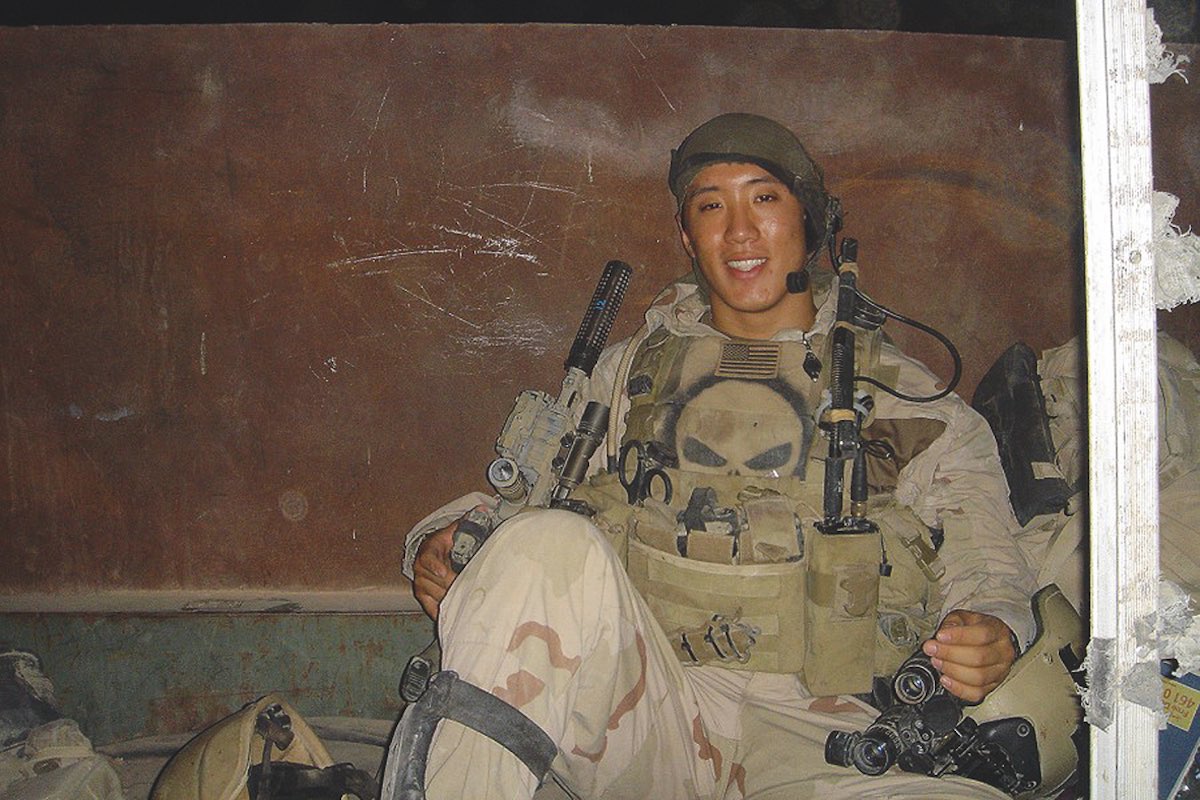
Komandor porucznik U.S. Navy Jonathan Yong 'Jonny' Kim został wyselekcjonowany w ramach NASA grupa 22 (2017).
Jest jednym z dwóch członków tej grupy, który nie ma jeszcze nawet nominacji do załogi (jedynym z amerykańskiej części grupy).

Urodził się i wychował w Los Angeles (Kalifornia) w rodzinie koreańsko-amerykańskiej.
Jest drugim astronautą NASA o pochodzeniu koreańsko-amerykańskim.

Kim służył jako sanitariusz bojowy podczas operacji specjalnych, snajper, nawigator w ponad 100 operacjach bojowych oraz jest weteranem dwóch misji Operation Iraqi Freedom.

Uzyskał dyplom z matematyki na Uniwersytecie w San Diego oraz doktorat z medycyny w Harvard Medical School.

https://www.nasa.gov/people/jonny-kim/

http://www.spacefacts.de/bios/astronauts/english/kim_jonny.htm
https://www.worldspaceflight.com/bios/k/kim-j.php

https://www.kozmo-data.sk/kozmonauti/kim-jonathan-yong.html
https://www.astronaut.ru/index/in_pers3/13_2215.htm

https://en.wikipedia.org/wiki/Jonny_Kim
https://it.wikipedia.org/wiki/Jonathan_Kim

https://valor.militarytimes.com/hero/315824
https://www.nbcsandiego.com/news/local/there-is-no-glass-ceiling-this-usd-alum-is-now-a-navy-seal-harvard-doc-and-nasa-astronaut/2618712/
https://www.businessinsider.com/jonny-kim-career-navy-seal-nasa-astronaut-harvard-doctor-kids-2020-1?IR=T

Meet Artemis Team Member Jonny Kim


Jonny Kim could become 1st Asian American astronaut to fly to the moon l GMA
« Ostatnia zmiana: Lutego 17, 2024, 08:39 wysłana przez Orionid »

Offline Orionid

  • Weteran
  • *****
  • Wiadomości: 28804
  • Very easy - Harrison Schmitt
Odp: JY'J' Kim - 05.02.1984
« Odpowiedź #1 dnia: Lutego 12, 2024, 08:28 »
Niezwykła historia dr. Kima.

STARS, STRIPES AND SACRIFICE: DR. JONNY KIM
Date September 2020 Author  Wei Koh


Cytuj
Kim is a former Navy Seal, a veteran of two combat deployments and more than 100 sorties, for which he was awarded the Silver and Bronze Star medals, with a citation for valour; he won a scholarship to, and graduated from, Harvard medical school; and he is NASA’s first Korean-American astronaut, who at the age of 35 has achieved far more than most of us will ever dream of achieving in our entire lives. But it is his reaction to the abuse he suffered in childhood, and his decision to become a protector of humanity rather than a perpetuator of its often seemingly inevitable cycle of inherited behaviour, that is most admirable.
https://therake.com/stories/stars-stripes-and-sacrifice-dr-jonny-kim
https://whatgotyouthere.com/the-https-whatgotyouthere-com-the-distillation-of-nasa-astronaut-jonny-of-jonny-kim/

The Rise of Jonny Kim | Navy Seal, Doctor, Astronaut


https://spyscape.com/article/johnny-kim-americas-next-lunar-true-superhero

2)
https://twitter.com/ShuttleAlmanac/status/1790928671387361682
Cytuj
Once again leave it to the Russians to break the news on @NASAcrewing. StarCity site says @JonnyKimUSA is backing up @astro_Pettit on Soyuz-MS26 Kim would then be in line for MS27/28 depending on potential of Russian tourist flight on MS27. Congrats @JonnyKimUSA Thanks @marcdrnl


24.03.2023 Kim ukończył zaawansowane szkolenie śmigłowcowe i został mianowany lotnikiem marynarki wojennej.
We wrześniu 2022  Kim rozpoczął zaawansowane szkolenie helikopterowe w 28. Helicopter Training Squadron (HT) na pokładzie NAS Whiting Field na Florydzie.
Astronauta po powrocie do  NASA przygotowuje się do swojej pierwszej misji kosmicznej.

NASA Astronaut and former SEAL completes Navy Flight Training
CORPUS CHRISTI, TX, UNITED STATES 04.17.2023 Courtesy Story Chief of Naval Air Training 
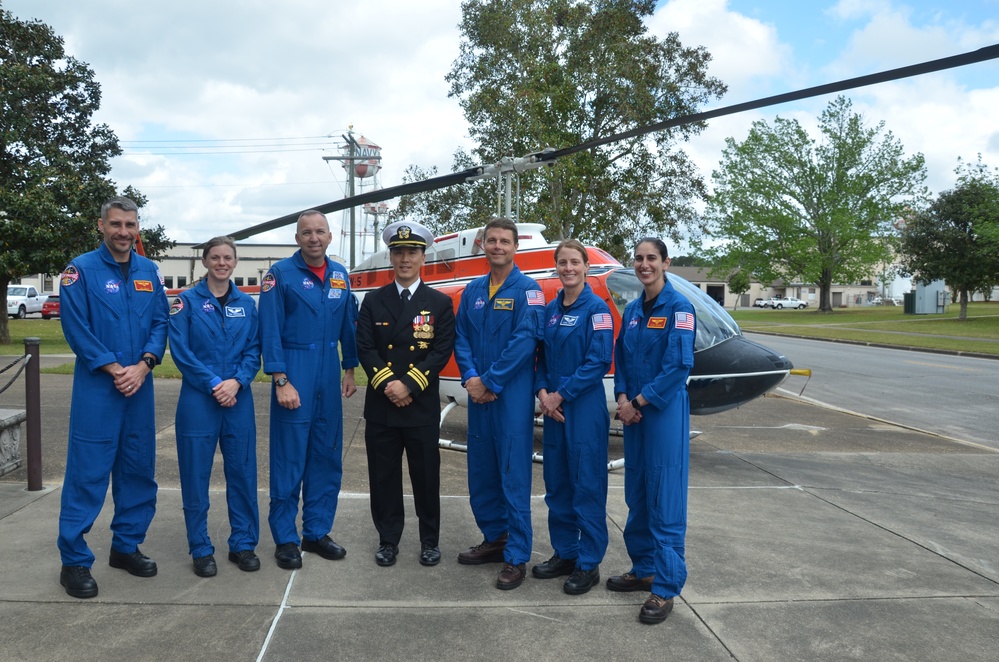

Photo By Jamie Coffey | 230324-N-LW682-002 - Lt. Cmdr. Jonny Kim poses for a photo alongside fellow astronauts...

CORPUS CHRISTI, Texas – Lt. Cmdr. Jonny Kim, NASA astronaut and former Navy SEAL, earned his “Wings of Gold” during a winging ceremony, Friday, March 24, onboard Naval Air Station Whiting Field. Kim, alongside 22 new aviators in his winging class, completed advanced helicopter training resulting in his designation as a Naval Aviator.
https://www.dvidshub.net/news/442730/nasa-astronaut-and-former-seal-completes-navy-flight-training#

Astronauta przemawia przed wystartowaniem załogi Crew-1.
https://twitter.com/NASA/status/1327271857486143489
Cytuj
"You've heard of all the benefits that the @Commercial_Crew Program is bringing to the American people, to humanity. But what I'm most excited about is being able to see 4 of my friends launch on that rocket tomorrow." - Astronaut @JonnyKimUSA on NASA's @SpaceX Crew-1 mission.
« Ostatnia zmiana: Stycznia 10, 2025, 03:38 wysłana przez Orionid »

Offline Orionid

  • Weteran
  • *****
  • Wiadomości: 28804
  • Very easy - Harrison Schmitt
Odp: JY'J' Kim - 05.02.1984
« Odpowiedź #2 dnia: Sierpnia 29, 2024, 00:31 »
Komunikat NASA o przydziale astronauty do misji Sojuz MS-27 ISS-73S Fawor, której start jest planowany na 03.2025.
Z NASA grupa 22 prawie wszyscy aktywni astronauci NASA polecieli już na orbitę z wyjątkiem Kima i Zeny Marii Cardman, która miała w 2024 wystartować w załodze Crew-9.

NASA Assigns Astronaut Jonny Kim to First Space Station Mission
Aug 28, 2024


Official portrait of NASA astronaut Jonny Kim in an EMU suit. Credit: NASA

During his first mission to the International Space Station, NASA astronaut Jonny Kim will serve as a flight engineer and member of the upcoming Expedition 72/73 crew.

Kim will launch on the Roscosmos Soyuz MS-27 spacecraft in March 2025, accompanied by Roscosmos cosmonauts Sergey Ryzhikov and Alexey Zubritsky. The trio will spend approximately eight months at the space station.

While aboard the orbiting laboratory, Kim will conduct scientific investigations and technology demonstrations to help prepare the crew for future space missions and provide benefits to people on Earth. (...)
https://www.nasa.gov/news-release/nasa-assigns-astronaut-jonny-kim-to-first-space-station-mission/

Cytuj
I'm incredibly honored to represent @NASA in our continued commitment to international collaboration and scientific discovery.
Follow along as I attempt to capture the spirit of partnership, explain engineering and operational concepts in the context of space operations, highlight the amazing people who serve behind the scenes, and showcase how teamwork is one of the most important ingredients of success in mission-critical environments such as space.
https://x.com/JonnyKimUSA/status/1829217226181775538
https://www.space.com/nasa-astronaut-jonny-kim-iss-korean-american
« Ostatnia zmiana: Sierpnia 31, 2024, 18:08 wysłana przez Orionid »

Offline Orionid

  • Weteran
  • *****
  • Wiadomości: 28804
  • Very easy - Harrison Schmitt
Odp: JY'J' Kim - 05.02.1984
« Odpowiedź #3 dnia: Listopada 07, 2024, 12:29 »
Od tamtej pory zaszły zmiany w składach załóg (głównej i dublerskiej).
Sojuz MS-27
Cytuj
4:49 PM · Jun 21, 2024
Update - Pics of Soyuz-MS27 US crewman @JonnyKimUSA (with Dubrov & Korsakov) as well as back-up crew @Astro_ChrisW, Kud-Sverchkov & Zubritsky all seen here during Water Survival Training at Star City this week.
https://twitter.com/ShuttleAlmanac/status/1804164647114932294

Polskie Forum Astronautyczne

Odp: JY'J' Kim - 05.02.1984
« Odpowiedź #3 dnia: Listopada 07, 2024, 12:29 »

Offline Orionid

  • Weteran
  • *****
  • Wiadomości: 28804
  • Very easy - Harrison Schmitt
Odp: JY'J' Kim - 05.02.1984
« Odpowiedź #4 dnia: Listopada 27, 2024, 14:41 »
Ćwiczenie na urządzeniu oporowym „ARED”, które wykorzystuje system izolacji wibracji (VIS).
Nauka obsługi sprzętu fotograficznego.

Cytuj
Jonny Kim @JonnyKimUSA
Training Elapsed Time +3d (8.30.23, L-18mo): Extended stays in reduced gravity environments like the ISS dramatically increase the risk for loss of bone density and strength, which can increase the risk of fractures and early-onset osteoporosis unless appropriate countermeasures are taken. Astronauts can lose up to 1-2% of bone density per month in the hip and spine, compared to a bone loss of 0.5-1% per year in older adults.

The ingenious countermeasure to combat this threat to bone health (and muscle atrophy) is the Advanced Resistive Exercise Device, often called "ARED" for short. ARED was flown and installed in 2009 and uses a system of vacuum tubes and flywheel cables to deliver up to 600 pounds of force, which astronauts can use as an axial load to perform compound exercises such as squats, deadlifts, and bench presses through barbell and cable attachments. I'll go into the engineering of this device in a future post.

Training with ARED starts early in the assigned training flow. Here, I have Bob Tweedy, (recently retired) NASA astronaut instructor and exercise physiologist, walking me through the operation of ARED and explaining the vibration isolation system (VIS), which ensures loads impacted by ARED do not transfer to the space station. Without the VIS, if an astronaut did a squat, some of that force generated could transfer to the space station and fatigue structural components as well as ruin science experiments that require a constant micro-g environment. It is amazing what a team can devise to keep astronauts healthy.

Cytuj
TET +4d: Space photography is important for numerous reasons: scientific research, disaster response data collection, environmental awareness, and perhaps most importantly, to share the human elements of space exploration with the public. @dominickmatthew is currently on the ISS, and @astro_Pettit will soon be joining Matt, both are excellent and avid photographers.

I'm not an experienced photographer but I aspire to learn, and to help me is NASA scientific photographer, @NorahMoranPhoto. Norah has taken a lot of astronaut portraits over the years and now teaches astronauts the basics of dSLR operation, what camera settings are optimal for various conditions, and how to set oneself up for success in any light condition. Thanks Norah!
https://twitter.com/JonnyKimUSA/status/1829499247915385122
« Ostatnia zmiana: Grudnia 03, 2024, 17:48 wysłana przez Orionid »

Offline Orionid

  • Weteran
  • *****
  • Wiadomości: 28804
  • Very easy - Harrison Schmitt
Odp: JY'J' Kim - 05.02.1984
« Odpowiedź #5 dnia: Stycznia 02, 2025, 21:36 »
Trening EVA polegał na ćwiczeniu procedur usuwania RFG (Radio Frequency Group).
Astronaucie pomagał Akihiko 'Aki' Hoshide.
Cytuj
Jonny Kim @JonnyKimUSA 2:53 PM · Aug 31, 2024
T+9d (9.5.23, Launch-18mo): Spacewalking is a difficult and high-risk activity astronauts must sometimes perform to install new hardware and make necessary repairs to the @Space_Station that robotics cannot do. For these reasons, astronauts begin spacewalk training in the neutral buoyancy lab (NBL) soon after mission assignment. The training follows a crawl-walk-run flow, with each successive training event being generally more complex than the previous.

On this day, while not specific to the assigned training flow, I worked with @JAXA_en astronaut, @Aki_Hoshide, to develop and test new equipment and procedures for removing a piece of equipment called the Radio Frequency Group, or RFG for short. The RFG is slated to be removed in a future mission, but before we perform the task in real life, we ensure we have the proper tools and procedures, and the NBL provides excellent testing grounds to vet our plan.

Notice the number of divers in the first picture. There are 2 support divers, 1 safety diver, and 1 float camera diver per astronaut. It takes a village to support the mission, and astronauts cannot be successful without the team.
https://twitter.com/JonnyKimUSA/status/1829949363763781720

Offline Orionid

  • Weteran
  • *****
  • Wiadomości: 28804
  • Very easy - Harrison Schmitt
Odp: JY'J' Kim - 05.02.1984
« Odpowiedź #6 dnia: Stycznia 02, 2025, 21:37 »
(2)
Trening koncentrował się na działaniach konserwacyjnych CDRA (Carbon Dioxide Removal Assembly).
CDRA służy do usuwaniu CO2 z ISS.
Są zespoły OOM (On-Orbit Maintenance) specjalizujące się w konserwacji systemów stacji.
Specjaliści od OOM nazywani są OSO (Operations Support Officers).
Cytuj
Jonny Kim @JonnyKimUSA 8:28 PM · Aug 31, 2024
T+10d: I never thought that past years of tinkering with electronics, DIYing around the house, or performing car maintenance would help with being an astronaut, but mechanical aptitude is an essential skill for astronauts. When something breaks on the @Space_Station, one cannot request a specialist, you are the technician, plumber, electrician, etc.

Fortunately, we have teams that specialize in On-Orbit Maintenance (OOM), teaching critical skills to astronauts so they can maintain essential equipment in space. Fun fact, these OOM specialists are called Operations Support Officers (OSO), and because OOM is so common, OSO officers are seated next to CapCom in Mission Control Center Houston to help ease communication between crew members and CapCom.

On this day, we practiced common maintenance tasks on the Carbon Dioxide Removal Assembly (CDRA). CDRA is important because it removes carbon dioxide from the space station's atmosphere. Humans require oxygen because it is an essential metabolic ingredient, in other words, life processes can't occur without oxygen. After we metabolize oxygen (O2), our bodies add a carbon atom to it, creating carbon dioxide (CO2) as a waste product. CO2 is poisonous in high concentrations, thus we need an engineering solution to remove it or reduce it back to oxygen. At a high level, CDRA removes the humidity (water vapor) from the air which is eventually recycled, captures the CO2, and then vents the CO2 overboard to space. Because CO2 is vented overboard, this is not a closed system and over time, the O2 (as part of CO2) that is vented will need to be replaced by cargo space vehicles.

The engineering behind CDRA is pretty cool. It uses a microporous, crystalline material called zeolite, that constantly adsorbs CO2 from the environment. Once the zeolite is saturated with CO2, the CO2 must be removed (called regeneration) in a process called pressure/thermal swing adsorption so that the zeolite can continue to adsorb more CO2. The zeolite is heated which reduces the CO2 adsorption of zeolite, then the zeolite is exposed to vacuum and the resulting pressure gradient drives the CO2 overboard (high pressure to low pressure).


For more information, here is a great article by NASA: https://ntrs.nasa.gov/api/citations/20050210002/downloads/20050210002.pdf

Offline Orionid

  • Weteran
  • *****
  • Wiadomości: 28804
  • Very easy - Harrison Schmitt
Odp: JY'J' Kim - 05.02.1984
« Odpowiedź #7 dnia: Stycznia 09, 2025, 09:40 »
Trening z używania kamery na podczerwień, która  używana jest podczas EVA.
Mogła być ostatnio używana w 2009 podczas misji STS-119, aby sfotografować grzejniki na stacji kosmicznej.
Cytuj
Jonny Kim @JonnyKimUSA 2:23 PM · Sep 1, 2024
T+12 (9.8.23): On this day I learned about the EVA Infrared camera, a piece of equipment I never knew existed. A very cool gadget, it is a specially modified IR camera that can withstand the harsh environment of space. The last time I'm aware it was used was in 2009 for STS-119 to image the radiators on the space station.

Paul and Norah taught me the basics of IR camera usage and the principles of emissivity, which is a measure of how much a surface emits heat. You can see in the 3rd & 4th pictures that the heat signature from a frying pan is different based on whether the teflon (high emissivity) or aluminum side (low emissivity) is presented to the camera. Heat emits thermal radiation, a type of electromagnetic radiation that IR cameras can see, but humans cannot. One way an IR camera can take advantage of this is to locate leaks that a human eye may not be able to detect. Notice in the 2nd picture how the IR camera can detect the two wet spots on the carpet, that are otherwise invisible to the eye. That's because evaporation is a cooling process, and as the water-soaked carpet evaporates, it is cooler than its surroundings, which shows up as a signature on the IR camera. Isn't that cool?
https://twitter.com/JonnyKimUSA/status/1853040736179994795

Offline Orionid

  • Weteran
  • *****
  • Wiadomości: 28804
  • Very easy - Harrison Schmitt
Odp: JY'J' Kim - 05.02.1984
« Odpowiedź #8 dnia: Stycznia 09, 2025, 09:40 »
(2)
Astronauta pracował przy eksperymencie, który NASA ma nadzieję wkrótce przeprowadzić, a który polega na pobraniu próbek z zewnętrznej części ISS.
Cytuj
Jonny Kim @JonnyKimUSA 12:45 PM · Nov 3, 2024
T+19 (9.15.23): There is a lot of work that occurs before performing real operations in space. Meticulous planning, rehearsing, and development are the costs of business. On this day, I got to work with my classmates, @Astro_FarmerBob and @Astro_Raja to aid in the development of an experiment NASA hopes to do soon, which is to sample the exterior of the space station for microorganisms during a spacewalk. The idea is pretty straightforward - swab suspected areas around the space station, namely areas where microbes could have been deposited (e.g., near vents, handrail surfaces, near the airlock) to see if life could survive at vacuum. It's difficult to imagine life could survive in such an environment, but humans have been surprised before by finding life in extreme environments (e.g., hot springs, hydrothermal vents at the bottom of the ocean, etc). These organisms are called extremophiles because they live in extreme environmental conditions that are normally thought impossible for life to adapt to.

One of the coolest parts of this operation is how NASA repurposed an old piece of hardware from Shuttle into a canister caddy to house 6 sterile swabs. Hopefully, we get to see this experiment soon on the @Space_Station.

Offline Orionid

  • Weteran
  • *****
  • Wiadomości: 28804
  • Very easy - Harrison Schmitt
Odp: JY'J' Kim - 05.02.1984
« Odpowiedź #9 dnia: Stycznia 14, 2025, 14:36 »
Trening obejmował ratowanie astronauty wykonującego EVA.
Cytuj
Jonny Kim @JonnyKimUSA 1:10 PM · Nov 3, 2024
T+23 (9.19.23): After rehearsing the sequence of events and familiarizing ourselves with the equipment, the day came for Farmer and I to practice in the NBL. I got to practice my "aseptic technique," employed in medical settings to prevent cross-contamination leading to infection. Except in this setting, it's to ensure we get good science.

In our ear is our "TC" (training conductor), Drew Burr, who is an instrumental member of the EVA team responsible for preparing us for EVA missions during flight.
Cytuj
T+23 (9.19.23): A requirement that all aspiring NASA spacewalkers have is to be able to conduct a rescue of their teammate within a specific time. Our EMU spacesuits offer the means for mobility and work in the vacuum of space and provide our life support. In the rare possibility anything off-nominal occurs to prevent a spacewalker from returning safely to the airlock on their own, they must rely on their partner to bring them safely back to the airlock. It's no different from many other lines of work relying on teammates in emergencies.

To train for this, we rehearse numerous scenarios of incapacitated crew members. We also have a lot of help, such as a cuff checklist of emergency action responses, the memorized portion of which we call "boldface," and dedicated experts in MCC-Houston feeding us data and recommendations on the next steps. The initial steps for a rescue involve assessing the situation and communicating with both the partner and MCC-H as able. Working with MCC, the rescuer develops and executes a rescue plan. The priority is always the crew first, followed by the station and the mission.

On this day, Farmer simulated an "incapacitated" crew member (we switch places throughout the day). After assessment, I translated to my partner, Farmer, quickly and safely completed any remaining action steps to put his spacesuit in as safe a condition as possible, and then safely and methodically translated him back to the airlock, ensuring that he has a safe load-path to station at all times and is not going to bump into anything along the way (especially his visor). Once at the airlock, it's a carefully coordinated ballad of actions to connect the "incapacitated crew member" and myself to the internal airlock tether point and then unhook ourselves to the external tether points (the external airlock hatch will not close if there is a tether line in the way). In some situations, connecting the incapacitated member to a service umbilical for resources (air, water, electrons) may be appropriate. Finally, we close the external airlock hatch and begin repressurizing the airlock to get our crew member the medical attention they may need inside the International Space Station.

Fortunately, we have great trainers, fantastic divers, and ground support to assist us in the rare chance this occurs. NASA is a forward-thinking organization, and we prepare for various outcomes despite numerous fault tolerances. EVA rescue is one of the more fun, challenging, and exhausting things we train for! And it's a significant team effort.
https://twitter.com/JonnyKimUSA/status/1853545405541236889

Offline Orionid

  • Weteran
  • *****
  • Wiadomości: 28804
  • Very easy - Harrison Schmitt
Odp: JY'J' Kim - 05.02.1984
« Odpowiedź #10 dnia: Stycznia 20, 2025, 21:36 »
Zastosowanie VR do treningu astronautów.
Cytuj
Jonny Kim @JonnyKimUSA 8:29 PM · Dec 14, 2024
T+24 (9.20.23): We use different mediums and modalities to aid our study and preparation for a mission. A pretty cool one is our use of VR. We have the entire international space station and its components mapped in a VR environment. Couple this with physical hardware on a system of pulleys and levers to mimic the same mass handling qualities you'd find on orbit and we get a pretty cool "feel" of what it's like to move stuff around on orbit. This can be particularly helpful in building our sense of how a payload will feel in space translating with it or installing it.
https://twitter.com/JonnyKimUSA/status/1869693524557316556

Offline Orionid

  • Weteran
  • *****
  • Wiadomości: 28804
  • Very easy - Harrison Schmitt
Odp: JY'J' Kim - 05.02.1984
« Odpowiedź #11 dnia: Stycznia 20, 2025, 21:36 »
(2)
Trening z zakresu konserwacji toalety, która ma oficjalną nazwę WHC (Waste and Hygiene Compartment).
Cytuj
Jonny Kim@ JonnyKimUSA 11:37 AM · Dec 19, 2024
T+29 (9.25.23): Who do you call when the toilet breaks?
In space, you are the plumber.
That's why @NASA_Astronauts are trained to repair and maintain all vital equipment on the @Space_Station. And the toilet, officially called the Waste and Hygiene Compartment (WHC), is pretty vital on board the space station. It's a vacuum-based system that is comprised of pumps, fans, valves and special chemicals to safely process urine in a multi-step process that converts it to potable water. Thanks to our excellent systems instructors, we're well prepared. Thanks Ryan!

Offline Orionid

  • Weteran
  • *****
  • Wiadomości: 28804
  • Very easy - Harrison Schmitt
Odp: JY'J' Kim - 05.02.1984
« Odpowiedź #12 dnia: Stycznia 29, 2025, 06:40 »
Przyswajanie procedur związanych ze sprzątaniem stacji, które odbywa się przynajmniej raz w tygodniu.
Usuwanie kurzu to poważna sprawa.
Trening dotyczył również zapoznawanie się z narzędziami elektrycznymi i mechanicznymi, które mogą się okazać przydatne przy naprawach.
Cytuj
Jonny Kim @JonnyKimUSA 7:49 PM · Dec 20, 2024
T+31 (9.27.23): Besides being amateur plumbers, we're also the cleaners! Taking care of our home in space means dedicated cleaning from the crew at least once a week. On this day, we reviewed the various cleaning tasks we can expect. As you can imagine, dust becomes a major issue in a closed atmospheric environment like the @Space_Station.

We also reviewed the different electrical and mechanical tools on board that can aid us in repairing things on the station. Some of these tools may already be in your garage.
https://twitter.com/JonnyKimUSA/status/1873791794636370166

Offline Orionid

  • Weteran
  • *****
  • Wiadomości: 28804
  • Very easy - Harrison Schmitt
Odp: JY'J' Kim - 05.02.1984
« Odpowiedź #13 dnia: Stycznia 29, 2025, 06:40 »
(2)
Wykorzystanie AR (augmented reality) w treningu do prac operacyjnych podczas EVA dedykowanych ulepszeniu AMS.
Cytuj
Jonny Kim @JonnyKimUSA 7:02 PM · Dec 30, 2024
T+32 (9.28.23): To prep for mission success, we try to train for our missions with as much fidelity as possible. One relatively new tool is AR (augmented reality). This upcoming mission is slated for 2025 and is part of a series of spacewalks to upgrade the alpha magnetic spectrometer (AMS). NASA engineers constructed a wood platform to replicate much of the surrounding structure of AMS, and we use AR to "overlay" the more intricate details of AMS. Think of it as adding additional virtual layers of detail over existing real but plain structures (e.g. wood) when you put the glasses on. We got to use our friend, @AstroDrewMorgan to play around with different body positions for the best angles.

Offline Orionid

  • Weteran
  • *****
  • Wiadomości: 28804
  • Very easy - Harrison Schmitt
Odp: JY'J' Kim - 05.02.1984
« Odpowiedź #14 dnia: Lutego 05, 2025, 08:07 »
Rozpoznawanie po objawach organizmu niebezpiecznie podwyższonego poziomu  CO2.
Do diagnozowania tej sytuacji potrzebne jest monitorowanie parametry życiowych astronautów (tętno, saturacja krwi tlenem, częstość oddechów i rejestrowanie odczuwanych objawów).
U Kima w takiej sytuacji pojawiają się bóle głowy, twarz staje się gorąca i zaczerwieniona przy umiarkowanym poziomie CO2, a kiedy poziom CO2 jest wysoki, odczuwane jest mrowienie w palcach.
Cytuj
Jonny Kim @JonnyKimUSA 9:19 PM · Jan 31, 2025
T+36 (10.2.23): This particular day was oxygen appreciation day. We take a lot of things for granted on our planet, and one of those is the recycling of the air we breathe. There aren't enough plants in the ISS at any given time to convert the carbon dioxide (CO2) humans produce back into oxygen. We rely on machines to do that. But if anything happens to those machines and the sensors that detect CO2, we must be able to recognize when CO2 levels get high. CO2 in high enough concentrations is poisonous to our bodies. High levels of CO2 in our blood is called hypercapnia, and can be fatal if not addressed.

That is one reason we learn to recognize our symptoms to dangerous levels of CO2. To perform the test, we breathe into a closed system while closely monitoring our vitals like heart rate, oxygen blood saturation, breathing rate, and logging symptoms we feel. For me, I tend to get headaches and feel my face get hot and flushed at moderate CO2 levels, and when my CO2 levels get really high I get tingling sensations in my fingers  (called paresthesias). It is an uncomfortable test, but it can be life-saving to know one's symptoms. Just a note, never try this test without professionals. This is only done under safe and professional circumstances.
https://twitter.com/JonnyKimUSA/status/1885431955275005962

Polskie Forum Astronautyczne

Odp: JY'J' Kim - 05.02.1984
« Odpowiedź #14 dnia: Lutego 05, 2025, 08:07 »