20.06.1944 V-2 po raz pierwszy przekroczyła pułap 100 km.
Devil’s bargain: Remembering MW 18014, 80 years laterBy Ben Evans | Published: June 28, 2024
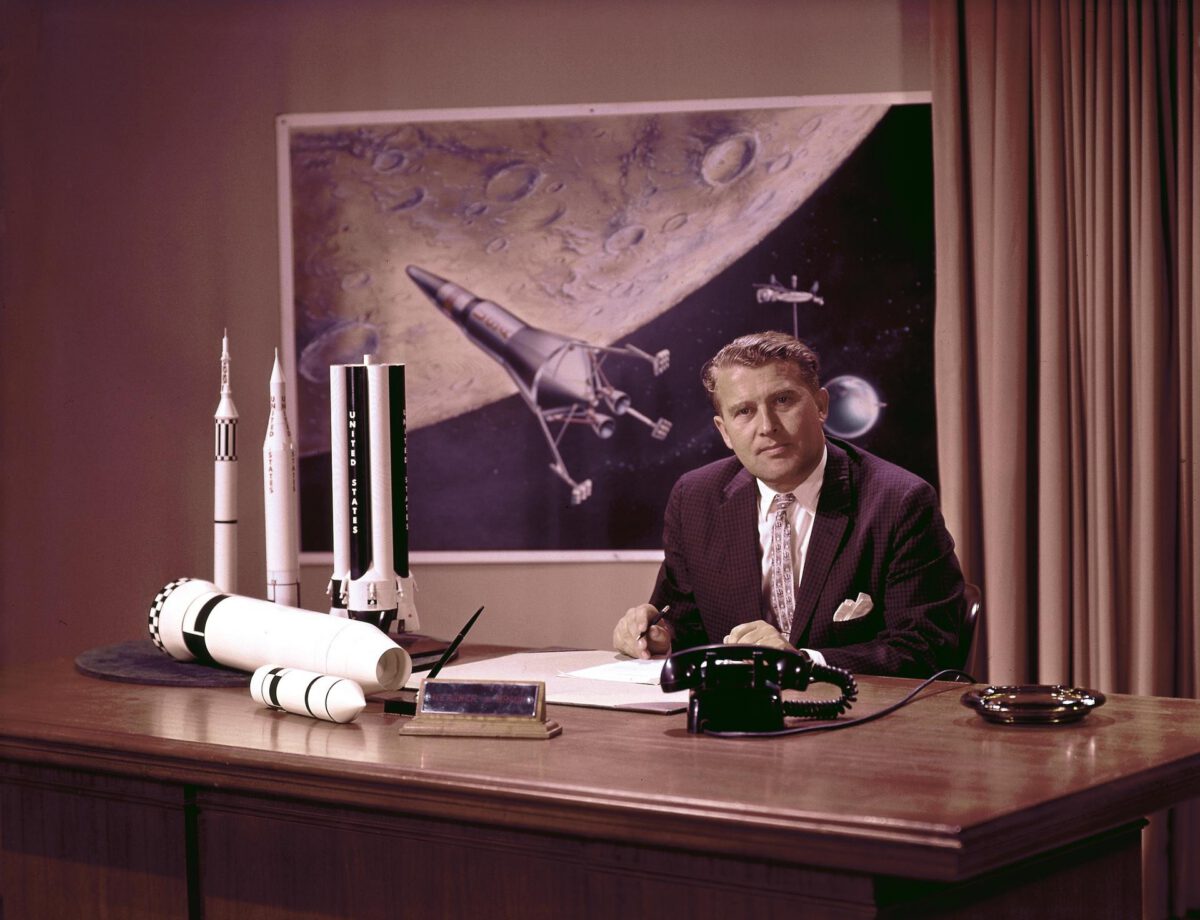 Wernher von Braun poses at his desk at the Marshall Space Flight Center (MSFC). Credit: NASA.The V-2 rocket was a terrible weapon of war that evolved from a tool of death to one that pushed human life into space.
(...) Just off this wave-lashed coast, launching from the tiny island of Greifswalder Oie, an A-4 designated MW 18014 reached space on June 20, 1944. Today, this steep-sided, mile-long isle is a seabird reserve, hosting migratory flocks of songbirds, ravens and hooded crows. Eight decades ago, it also hosted 28 A-4 launches to investigate heating effects as missiles reentered the atmosphere. (...)
As MW 18014 gained altitude, the sky darkened and ambient pressures dropped, increasing the missile’s exhaust impulse to 64,000 pounds (29,000 kg). Guided precisely by four tail-mounted rudders and four internal graphite vanes, it achieved an apogee of 108.5 miles (174.6 km) before falling back to Earth.
By modern standards, MW 18014 reached space. In the U.S., the Federal Aviation Administration (FAA), NASA and the military regard 50 miles (80 km) as space’s lowermost boundary. Much of the rest of the world accepts the 62-mile (100 km) ‘Kármán Line’—named for engineer Theodore von Kármán, who first described it — where ambient air pressures are too weak to support aerodynamic lift.
But neither concept existed in 1944. Over a decade would elapse before the U.S. Air Force started awarding ‘astronaut wings’ to its high-altitude pilots and not until 1960 did the Fédération Aéronautique Internationale (FAI) formally adopt the Kármán Line. As such, MW 18014’s achievement went unnoticed at the time.(...)
https://www.astronomy.com/space-exploration/devils-bargain-remembering-mw-18014-80-years-later/V-2
https://www.forum.kosmonauta.net/index.php?topic=5474.0
 Wątek: First Pictures: The View of Earth from Space – October 24, 1946 - 80 Years Ago (Przeczytany 253 razy)