Wiadomość wysłana przez: Piękny Roman w Lutego 22, 2017, 01:03
 |
| Image credit: Bendix/NASA |
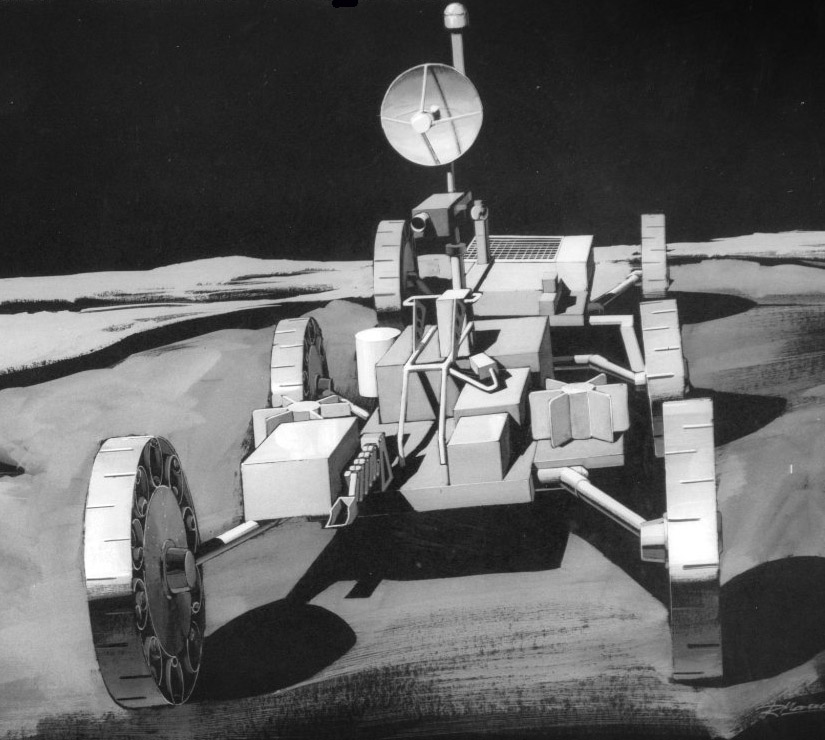
Hinners, El-Baz, and Goetz invoked an Extended Lunar Module (ELM) capable of bearing 750 pounds of payload to the moon's surface. During the crew's first venture outside the ELM, they would rendezvous with a waiting Unmanned Lunar Roving Vehicle (ULRV).
The wheeled ULRV, with a mass of between 1,500 and 3,000 pounds, would have landed some 500 kilometers from the Apennine Front-Hadley Rille ELM site some time earlier. Under guidance from controllers on Earth, it would then have made its way to meet the astronauts, all the while beaming TV images of its surroundings to Earth, charting the moon's gravity and magnetic fields, leaving behind Remote Geophysical Monitor instrument packages, and collecting rock samples. The ELM astronauts would retrieve the ULRV rock samples for return to Earth.
 |
| Image credit: Aeronautical Chart and Information Center |
At the contact between Mare Serenitatis and Mare Imbrium, the rover would turn west, then south, so the Apennines would dominate its eastern horizon. The ULRV would pass through hills made up of rocks of the Fra Mauro Formation, which was widely interpreted as ejecta from the immense ancient impact that excavated Mare Imbrium.
Finally, the route 1 rover would carefully pick its way across steep-sided Hadley Rille (also known as Rima Hadley) and park close to the planned post-Apollo ELM landing site south of the crater Hadley C. The Bellcomm researchers declared 10-kilometer-wide Hadley C to be a "probable maar" - that is, a surface feature produced when rising magma comes into contact with subsurface ice or water, generating a steam explosion.
Route 2 would see the ULRV land south of the crater Alexander in northern Mare Serenitatis. The rover would strike southwest toward the Mare Serenitatis-Mare Imbrium contact through a region of hummocky Highland rock units, including probable examples of the Fra Mauro Formation. The route would cross dark materials (possible young volcanics) and light materials (possible rays from young impact craters) before it turned south to follow the same path to the ELM site as the Route 1 ULRV.
The ULRV for traverse route 3 would land in southern Mare Imbrium west of the "ghost" crater Wallace, an ancient impact crater mostly submerged by flowing lava in the distant past. The rover would trundle eastward across a bright ray from the young large crater Copernicus, than pass through a crater chain to reach Wallace's subdued, ancient rim. Once there, it would strike out northeastward across eastern Mare Imbrium, then over the Apennine Bench (a possible volcanic ash or flow deposit), before crossing Palus Putredinis to Hadley C and the planned ELM site.
Route 4 would begin at a ULRV landing site in central Mare Imbrium, in an area with many fresh-looking wrinkle ridges. The ULRV would surmount one such ridge on its way to the north rim of the large smooth-floored crater Archimedes. After cautiously picking its way through the boulders and crevasses near Archimedes' rim, the ULRV would turn southwest through a region of exposed bedrock, then would cross hummocky Fra Mauro Formation hills and Palus Putredinis before parking near the ELM site.
The Bellcomm planners identified routes 1 and 2 as having the greatest potential for increasing geophysical understanding of the moon. In addition, route 1 would pass through terrain similar to that observed at Littrow, another candidate post-Apollo landing site, possibly freeing the proposed Littrow ELM mission to explore elsewhere on the moon. The Littrow is located on the eastern side of Mare Serenitatis.
 |
| Hadley C landing site and traverses. Image credit: Defense Mapping Agency Topographic Center/NASA/DSFPortree |
Hinners, El-Baz, and Goetz noted other operational challenges of the Apennine Front-Hadley Rille ELM site. The most important involved lighting. The ELM would approach the site from the east with the Sun behind it, pass over the Apennine Mountains, then descend almost vertically on the west side of the range. As it descended, it would plunge suddenly into shadow cast by the mountains. On some landing dates, the astronauts might touch down in darkness lit only by sunlight reflected off the Hadley C rim and other features beyond the shadow; on other dates, they would emerge from shadow into dazzling sunlight just before touchdown.
The scientists were convinced, however, that the scientific benefits of their ELM site would outweigh these difficulties. They wrote that
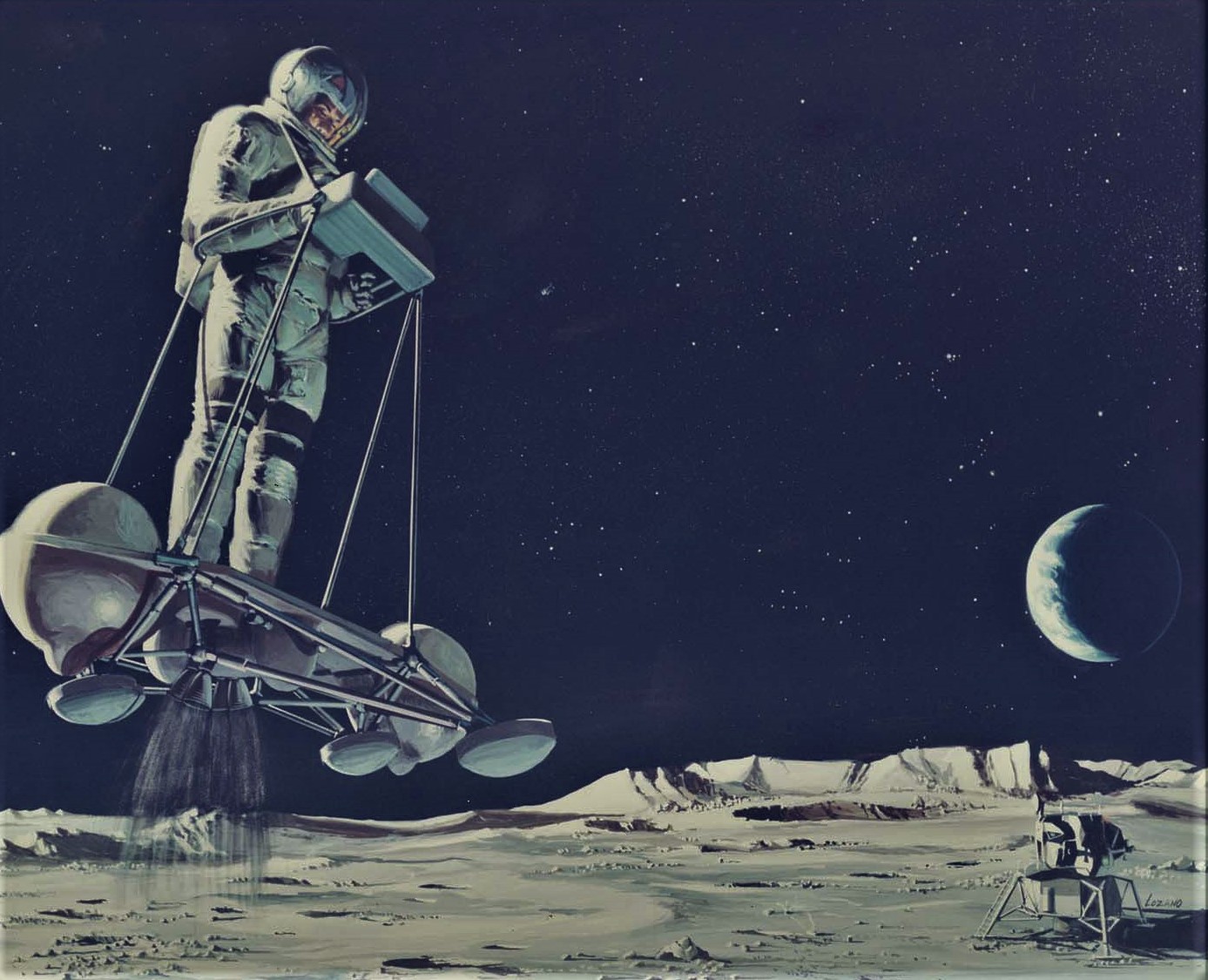
This site is important among those proposed in that it may provide access to a major portion of lunar history. . .Such access comes from over 1 km of vertical relief resulting from the combination of the Apennines Mountains scarp, the rim of the Imbrium Basin[,] and the rille…. This historical sequence may run from materials that constitute original lunar crust to relatively young materials derived from that crust. The oldest crustal materials in the area, possibly exposed in the lower part of the Apennine Front to the east of the proposed landing area, should provide data bearing directly on the problems of the primary physical and chemical composition of the Moon and thus, indirectly, of the Earth.The scientists noted that the Manned Spacecraft Center in Houston, Texas, had established as a ground rule that only a single Extravehicular Activity (EVA) could take place on the first and last days of a lunar landing mission. The first three-hour EVA (purple on Hadley C site map) of the Apennine Front-Hadley Rille mission, on landing day, would see the astronauts walk to the parked ULRV to retrieve the samples it had gathered during its traverse. They would also work together to assemble and point at Earth the umbrella-like S-band antenna, inspect the ELM's exterior for any damage incurred during descent and landing, deploy "staytime extension equipment" (for example, a small solar array for generating supplemental electricity), and unstow the mission's twin 180-pound Lunar Flying Units (LFUs).
 |
| Lunar Flying Unit concept art. Image credit: North American Aviation/NASA |
Astronaut #1 would then fly LFU #1 3.3 kilometers to his first stop, the Apennine Front-mare contact, where he would spend one hour collecting up to 25 pounds of samples, including cores drilled to a depth of 10 feet. He would then fly two kilometers to the top of the Apennine ridge, about 500 meters above the ELM. He would spend an hour there collecting another 25 pounds of samples. The Bellcomm planners explained that materials blasted from "depths of several tens of kilometers in the moon" by the Imbrium impact might be draped over the sites he visited. These would, they argued, "offer our best chances to examine 'primitive' planetary materials which have not been affected by later planetary differentiation processes."
Astronaut #2, meanwhile, would deploy the 280-pound Apollo Lunar Scientific Experiment Package (ALSEP) near the ELM. He would also stand by LFU #2 to rescue Astronaut #1 in the event that LFU #1 failed on top of the ridge, which would lie just beyond the five-kilometer “walk-back limit” of the Apollo space suits. Assuming, however, that LFU #1 gave no trouble, Astronaut #1 would fly it 5.2 kilometers back to the landing site and join Astronaut #2 inside the ELM for lunch and rest.
To begin the second EVA of mission day 2 (blue on the Hadley C site map), Astronaut #1 would board LFU #2 and fly 3.2 kilometers west of the ELM to the bottom of Hadley Rille. Astronaut #2, meanwhile, would walk to a point on the Rille rim within sight of both Astronaut #1 and the ELM. He would collect up to 25 pounds of samples and serve as a radio relay linking Astronaut #1 to the ELM and, through the ELM, to Earth. After 1.5 hours of sampling the shadowed floor of Hadley Rille, Astronaut #1 would fly LFU #2 4.8 kilometers to the Hadley C rim. He would spend 30 minutes sampling, then would fly back to the ELM. At no point would Astronaut #1 pass beyond the Apollo suit walk-back limit, so Astronaut #2 would have no need to stand by LFU #1 to mount a rescue.
The fourth and final EVA of the Apennine Front-Hadley Rille mission (yellow on the Hadley C site map) would occur on departure day. After loading LFU #1 with propellants, Astronaut #1 would fly 2.5 kilometers west of the ELM to two sets of crater pairs. After 30 minutes of sample collection, he would fly 1.5 kilometers to a crater on Hadley Rille’s rim, where he would again sample for 30 minutes. Finally, he would fly three kilometers to a “promontory” on the Rille rim, sample for 30 minutes, and fly 1.4 kilometers back to the ELM.
Astronaut #2, meanwhile, would "conduct local investigations" close by the ELM, "adjust ALSEP experiments," and prepare samples for return to Earth. After returning to the ELM, Astronaut #1 would assist Astronaut #2. After packing up about 100 pounds of samples, they would lift off in the ELM ascent stage, leaving behind the LFUs and other equipment.
They would also leave behind many of the samples they had collected. Hinners, El-Baz, and Goetz noted that, while the ULRV would collect some unspecified (but probably large) quantity of unique samples during its 500-kilometer traverse and the astronauts might collect about 200 pounds of samples, the ELM ascent stage could carry only 100 pounds of payload into lunar orbit. This meant that the sample packing process would mostly involve hurried screening, with the majority of the samples collected during the mission being thrown away. They also noted that their EVA schedule was very tight, so that mission success would depend "on everything going with clockwork precision during the crowded EVA periods."
To solve these problems, they proposed that the ELM for the Apennine Front-Hadley Rille mission be upgraded to permit a 1,000-pound science payload, a four-day surface stay, and 200 pounds of returned samples. This would, among other things, enable addition of a walking traverse to the Apennine Front-mare contact and introduction of a 400-pound Advanced ALSEP. Additional stay-time would permit more care to be taken in selecting samples for return to Earth; at the same time, doubling the returned sample weight would make sample screening less critical.
 |
| Apollo 15 Lunar Roving Vehicle. Image credit: NASA |
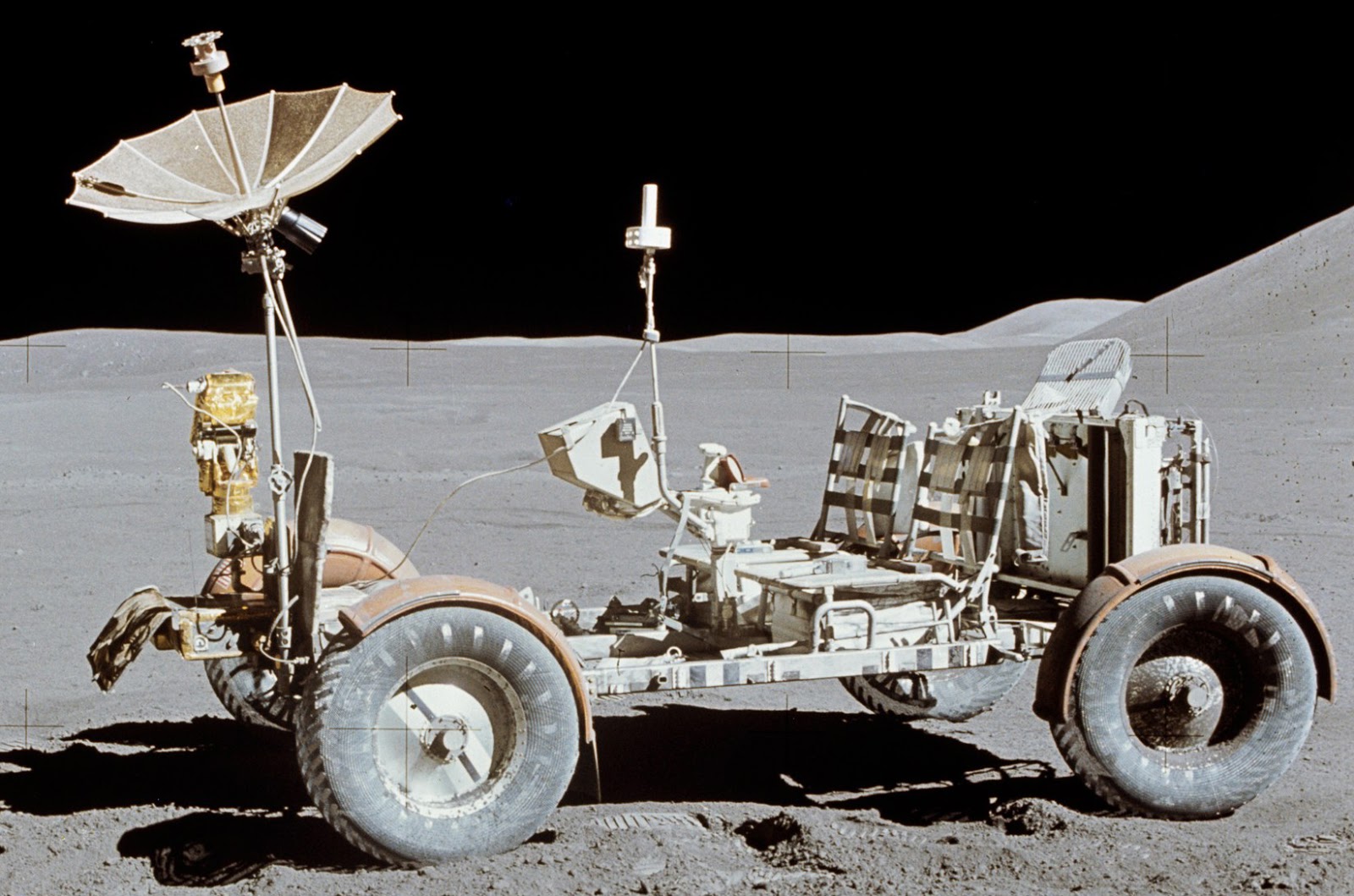
In place of the LFU, Scott and Irwin traversed their landing site using a 460-pound four-wheeled Lunar Roving Vehicle (LRV). They drove almost 50 kilometers during three periods of space-suited surface activity, the longest of which lasted seven hours and 13 minutes. Falcon's ascent stage lifted off from Hadley-Apennine on August 2 with a cargo of about 170 pounds of lunar samples.
Apollo 15 was the fourth of six successful manned lunar landings. By the time it flew, budget cuts and policy changes had caused NASA to truncate Apollo and abandon plans for post-Apollo lunar exploration. In an editorial published the day after Falcon's ascent stage left the moon, The New York Times pointed to the mission's many achievements and reminded its readers that manned lunar exploration was set to end with Apollo 17. A "vast and complex technology developed at a cost of billions of dollars over the last decade is being abandoned even as its vast potentialities are being demonstrated," the paper lamented.
Sources
A Preliminary ELM/Unmanned LRV Mission Plan for the Apennine Front-Hadley Rille Area – Case 340, N. Hinners, F. El-Baz, and A. Goetz, Bellcomm, Inc., 31 May 1968
Astronautics & Aeronautics 1971, NASA SP-4016, NASA, pp. 217-218
More Information
"A Continuing Aspect of Human Endeavor": Bellcomm's January 1968 Lunar Exploration Program
Rocket Belts and Rocket Chairs: Lunar Flying Units
Apollo's End: NASA Cancels Apollo 15 & Apollo 19 to Save Station/Shuttle (1970)
The Spacewalks That Never Were: Gemini Extravehicular Planning Working Group (1965)
Source: Robot Rendezvous at Hadley Rille (1968) (http://)