After a month of artificial-gravity experimentation, the astronauts would halt the Station's rotation using the small thrusters to restore it to a zero-gravity condition. The artificial-gravity module thrusters would carry enough propellants to permit up to four similar experiments.
Dorrenbacher described the 12-man Space Station as "a research facility to accommodate all experiment disciplines. . .a general-purpose laboratory." It would include three lab decks. Deck 2 would at launch from Earth be dedicated to the study of living things in weightlessness. It would include the Station's medical dispensary and isolation ward. Deck 4 would serve both scientific support and engineering experimentation roles. It would include a drum-shaped experiment and test isolation facility, a mechanical lab, an electronics/electrical lab, a hard-data processing facility, an optics facility, and a small experiment airlock. Deck 5 would include a centrifuge with a pair of cabs large enough to accommodate men and experiments.
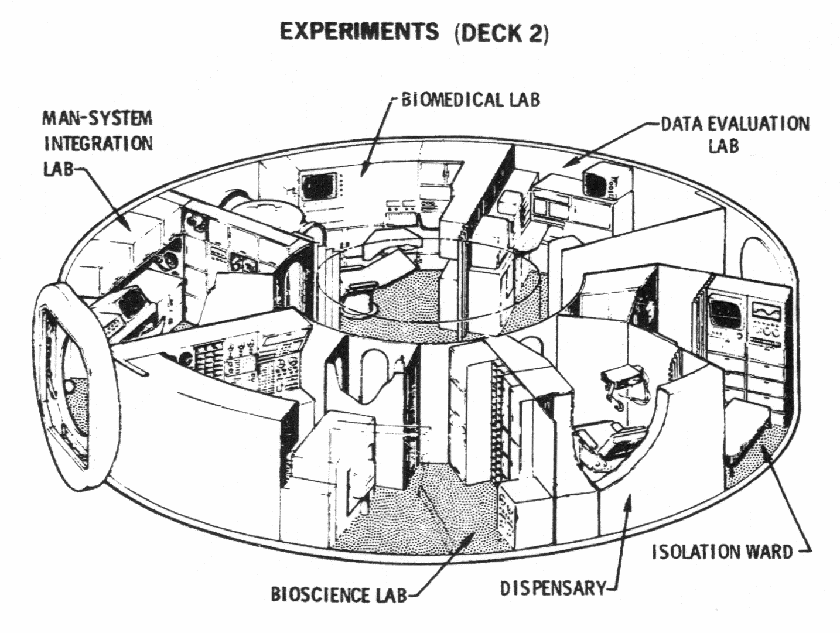 Deck 2: the life sciences laboratory. Image credit: MDAC/NASA
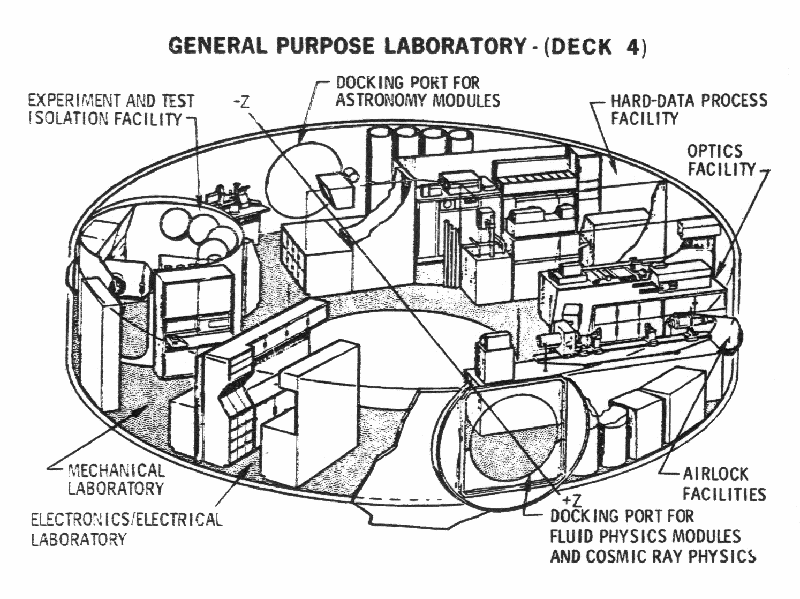 Image credit: MDAC/NASA
Based on NASA input, MDAC defined eight experiment disciplines for its Phase B Station. These were astronomy, space physics, space biology, Earth survey, aerospace medicine, space manufacturing, engineering/operations, and advanced technology. Not all disciplines could be accommodated simultaneously; for example, the artificial-gravity experiment series would preclude experiments that would need a stable platform and weightlessness.
Dorrenbacher then provided a rough schedule of the Station's experiment programs. Biomedical experimentation would begin with the arrival of of the first crew and continue without pause throughout the Station's planned 10-year lifetime, as would "man-system integration" experiments. In general, early research not associated with the artificial-gravity experiment series would focus on Station operations and habitability. "Component test" experiments would end in early 1978, "maintenance and logistic" experiments would conclude in late 1978, and "occupancy and space living," "contamination," and "exposure" research would end in mid-1979.
CCMs would deliver new experiment apparatus to replace and augment that launched with the Station, Dorrenbacher told the Paris meeting. Disused experiment hardware and other unwanted equipment and furnishings would be packed into CCMs for return to Earth. He suggested that, following the conclusion of artificial-gravity experiments in late 1978, furnishings on Deck 6 should be returned to Earth in CCMs so that it could be converted into a physics & chemistry laboratory using new apparatus delivered in CCMs.
By then, the first Attached Modules (AMs) and Free-Flying Modules (FFMs) would arrive at MDAC's Station in Shuttle Orbiter cargo bays. One AM, devoted to Ultraviolet (UV) Stellar Astronomy, would dock with a port on the core module's side linking it to Deck 4. Another AM, devoted to Earth Surveys, would dock either at Deck 4's second port or at a port on Deck 2. Two FFMs, devoted respectively to Solar Astronomy and High-Energy Stellar Astronomy, would dock with the Station's front port on the artificial-gravity module when they needed servicing; for example, after they had expended their photographic film. AMs would rely on the Station for electrical power, while FFMs would each sport a pair of electricity-generating solar arrays.
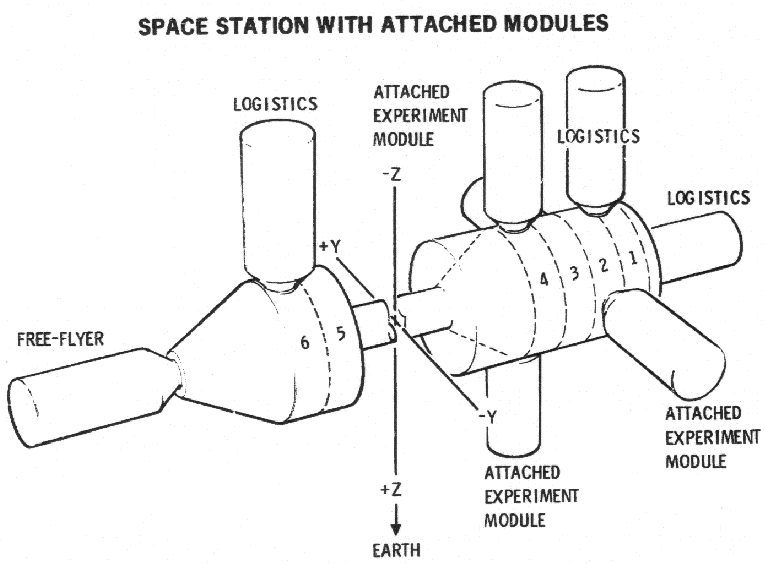 Image credit: MDAC/NASA
CCMs, meanwhile, would deliver non-human biology experiment subjects beginning in early 1979. They would transport to the Station small vertebrates such as rats and invertebrates such as fruit flies. Vascular plants would first reach the Station later that same year.
Also in late 1979, the general Stellar Astronomy FFM would arrive near the Station. MDAC envisioned that UV Stellar Astronomy and High-Energy Stellar Astronomy would conclude at the beginning of 1981, while Solar Astronomy, general Stellar Astronomy, and small vertebrate, invertebrate, and plant studies would continue until the Station reached its planned end-of-life in 1987. Biomedical centrifuge and fluid physics AMs would arrive in late 1981, with the former remaining with the Station until end-of-life and the latter departing in late 1985. Small Vertebrates Centrifuge and Infrared Stellar AMs would arrive in late 1982 and remain docked until Station end-of-life.
Late 1983 would see arrival of the Remote Maneuvering Satellite (RMS), which would take up residence in a "hangar" in the airlock at the Station's front port. Dorrenbacher called the RMS a "subsatellite," but did not otherwise describe its role. RMS operations would cease in late 1986.
Also in late 1983, the X-Ray Telescope FFM and advanced particle and plasma physics experiment apparatus would arrive. The X-Ray Telescope FFM would operate through Station end-of-life. Some advanced physics experiments would cease in early 1985; all would end by late 1986. Late 1985 would see the arrival of materials science experiment apparatus and the Cosmic-Ray Physics FFM, both of which would remain in operation through Station end-of-life.
Dorrenbacher described how the vast quantity of data Station experiments generated would reach Earth. MDAC estimated that 9070 kilograms of magnetic tape, microfilm, exposed photographic and X-ray film, and photographic plates would need to be returned to Earth each year. The Station's four large dish antennas would enable continuous two-way television communication through ground stations or through relay satellites so that Station and Earth researchers could work together continuously in real time. The antennas would be capable of transmitting up to a trillion bits (one terabyte) of data to Earth each day.
The Station's impressive experiment capability would demand careful management of crew time. MDAC assumed that Station crews would work around the clock, with six men on duty and six off duty at all times. Each crew would include eight scientist-engineers and four Station flight-crew crewmembers. Two flight-crew and four scientist-engineers would work during each 12-hour shift.
One scientist-engineer would serve as principal scientist. He would work closely with the flight-crew commander, who would have responsibility for the safety of the entire crew, to ensure that science interests were taken into account during Station operations.
Two scientist-engineers would serve as principal investigator representatives. They would use the Station's considerable communications capabilities to work directly with scientists on Earth.
 Image credit: MDAC/NASA
Off-duty Station crewmembers would spend most of their time on the living decks (Decks 1, 3, and - during the artificial-gravity experiment series - 6). There, Dorrenbacher explained, they would have at their disposal private staterooms with 4.6 meters of floor space for "relaxation, recreation, study, and meditation." Each living deck would include six staterooms, which together would take up about half the deck's volume. Staterooms would each include a small viewport for watching the Earth go by, a folding bunk, a desk, and storage cabinets for personal belongings.
When not in their staterooms, off-duty crewmembers could hang out in their living deck's multipurpose wardroom, which would include portable dining tables with zero-gravity restraints in place of conventional chairs. Dorrenbacher told the Paris meeting that the wardoom could be "quickly and easily" converted into a gym, theater, meeting room, or recreation room.
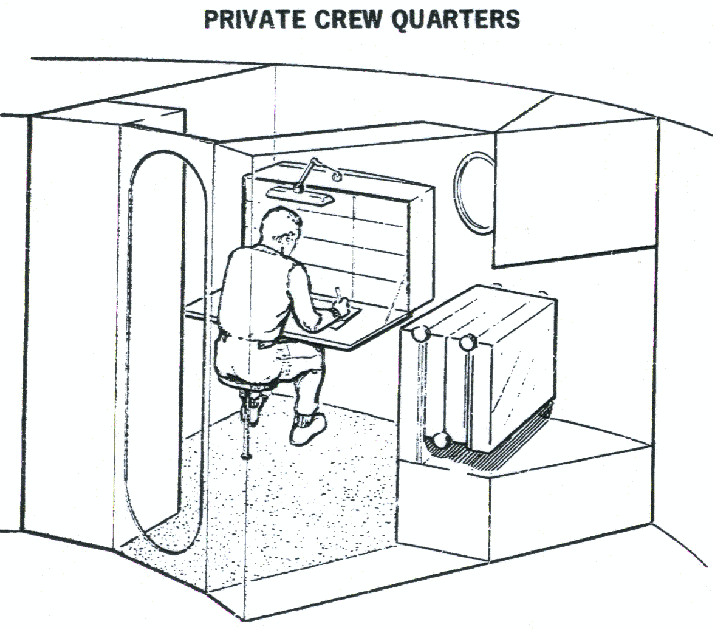 Image credit: MDAC/NASA
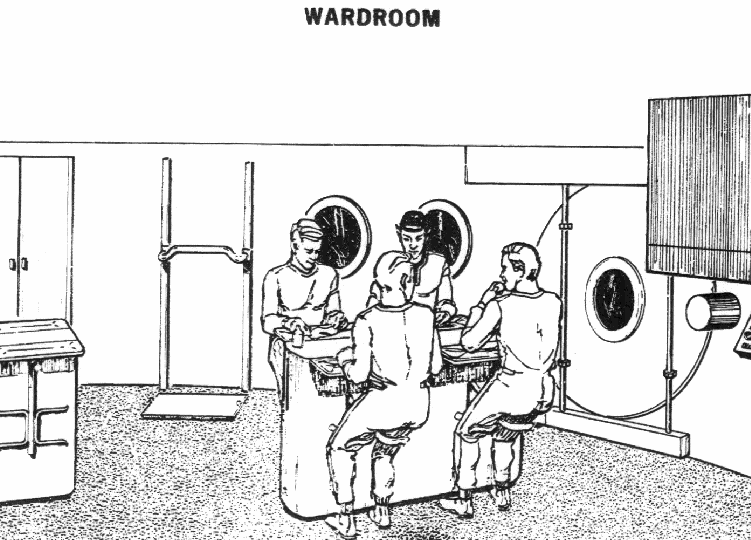 Visible in the wardroom are three large observation windows, an exercise device to simulate weightlifting, zero-gravity "seats" both stowed (left) and in use, a round 1.5-meter hatch to which CCMs can dock (right), and a visiting Vulcan scientist. Image credit: MDAC/NASA
Cabinets in the galley, adjacent to the wardroom, would be kept stocked with enough food for 90 days. Crew-members could choose to serve themselves or could take it in turns to prepare meal trays for their crew-mates. Food would be "selected for maximum palatability with various degrees of wet or even fresh foods."
The three living decks would each include a hygiene facility. Apparently configured for men only, these would include a toilet, two urinals, two hand-washing units, a shower, a clothes-washing machine, and a clothes-dryer. Hygiene facilities would be located next to water-recycling life-support machinery on each living deck.
MDAC proposed a novel approach to station orbit maintenance. Some processed waste water would be electrolyzed (split into oxygen and hydrogen using electricity) and the hydrogen used to fuel low-thrust resistojets on the Station's hull. MDAC calculated that water delivered to the Station in food would be sufficient to maintain its orbital altitude.
MDAC placed core module control consoles on the living decks adjacent to the wardrooms. The artificial-gravity module would include an identical control console on Deck 5. The primary control console - the Station's "bridge" - would be located on Deck 3. The control consoles on Decks 1 and 5 would serve as backups for the Deck 3 primary console, and would also support experiments; they might, for example, be used to monitor data arriving from the FFMs.
Dorrenbacher then described an arbitrarily selected moment in the MDAC Phase B Station's 10-year career to illustrate possible activities of on-duty and off-duty crew-members. At 2030 hours Greenwich Mean Time on 26 March 1985, the flight-crew commander would be at work conducting safety checks on space suits stored in the core module central tunnel. The shift's other on-duty flight-crew astronaut would, meanwhile, sample the Deck 1 water system to ensure that it contained no harmful bacteria.
Two of the on-duty scientist-engineers would work in the Deck 2 labs and two elsewhere. The physician would analyze crew blood and urine samples in the biomedical lab, while the psychologist would analyze data on "crew skill retention in extended zero gravity" in the man/system integration lab. The geologist/photo-optical engineer, meanwhile, would install and align sensors in the Earth Survey AM docked to Deck 2, and the astronomer/systems engineer would monitor data from the X-Ray Telescope FFM at the secondary control console on Deck 5.
The six off-duty crew-members, having just finished their late meal, would all be found on Deck 3. The operations director, a flight-crew crew-member, would take a shower in the hygiene facility while the physician, a scientist-engineer, would watch a videotaped television program in his stateroom before going to sleep.
The other off-duty crew would be in the wardroom. The station controller, a flight-crew astronaut, would compete against the astrophysicist, a scientist/engineer, in a simulated time-distance race on stationary exercise bikes. Nearby, the biologist and the electro-mechanical engineer, both scientist-engineers, would compete in a game of "computer football."
Dorrenbacher concluded his presentation by assuring Paine, Bondi, and the other NASA and ESRO officials that MDAC's 12-man Phase B Space Station would be a "low-cost, flexible, international research facility" built using known technology (that is, mostly adaptations and upgrades of Skylab hardware). Furthermore, its module designs would be readily adaptable to future NASA/ESRO joint missions; specifically, they could serve as building blocks making up the 100-man Space Base of the mid-to-late 1980s.
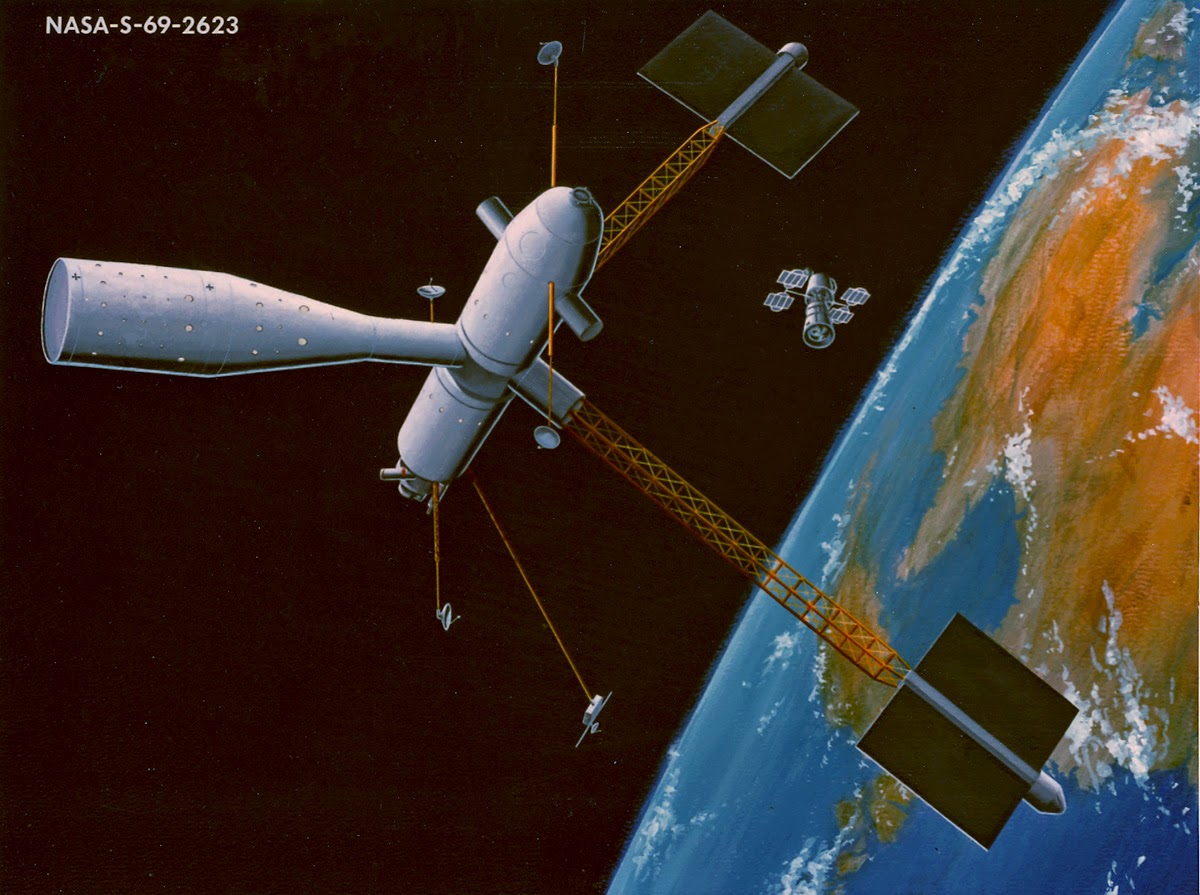 Conceptual art of 100-man Space Base in orbit over Australia and New Guinea. The two truss-work arms hold at their ends nuclear reactors and their rectangular waste heat radiators. A free-flying large space telescope orbits nearby. Image credit: NASA
As noted earlier, NASA had instructed MDAC to design its 12-man Station to be launched on a Saturn V. Dorrenbacher failed to mention in his briefing that NASA Administrator Paine had announced on 13 January 1970, six months before the Paris briefing, that Saturn V production, already on standby, would be permanently ended, and that the last Saturn V, previously assigned to the Apollo 20 moon mission, would instead launch Skylab A. He also neglected to mention that NASA had directed NAR and MDAC in early May to begin considering designs for Space Stations that could be assembled solely from modules launched in the Shuttle Orbiter's cargo bay.
On 30 June 1970, NASA issued Phase B extension contracts to MDAC and NAR. A month later, two highly significant events took place: Paine resigned the post of NASA Administrator effective 15 September (28 July) and NASA directed MDAC and NAR to study only Shuttle-launched modular station designs (29 July).
Following Paine's departure, NASA moved rapidly to toe the line on the Nixon Administration's slowly emerging space policy. That policy gave lukewarm support to the Space Shuttle and left the Space Station it was meant to serve in limbo.
On 5 January 1972, NASA Administrator James Fletcher announced that President Nixon's FY 1973 NASA budget request included modest funds to begin development of a partially reusable Space Shuttle. Though little mention was made of a Space Station, the Phase B studies lingered on until the end of the year.
On 29 November 1972, Fletcher formally abolished NASA's Space Station Task Force and established the Sortie Lab Task Force. The Sortie Lab was intended to ride in the Shuttle Orbiter's cargo bay, providing an interim Space Station-type research capability during Shuttle missions ("sorties") lasting up to 30 days. In August 1973, NASA and ESRO agreed that the latter should develop the Sortie Lab, which became known subsequently as Spacelab.
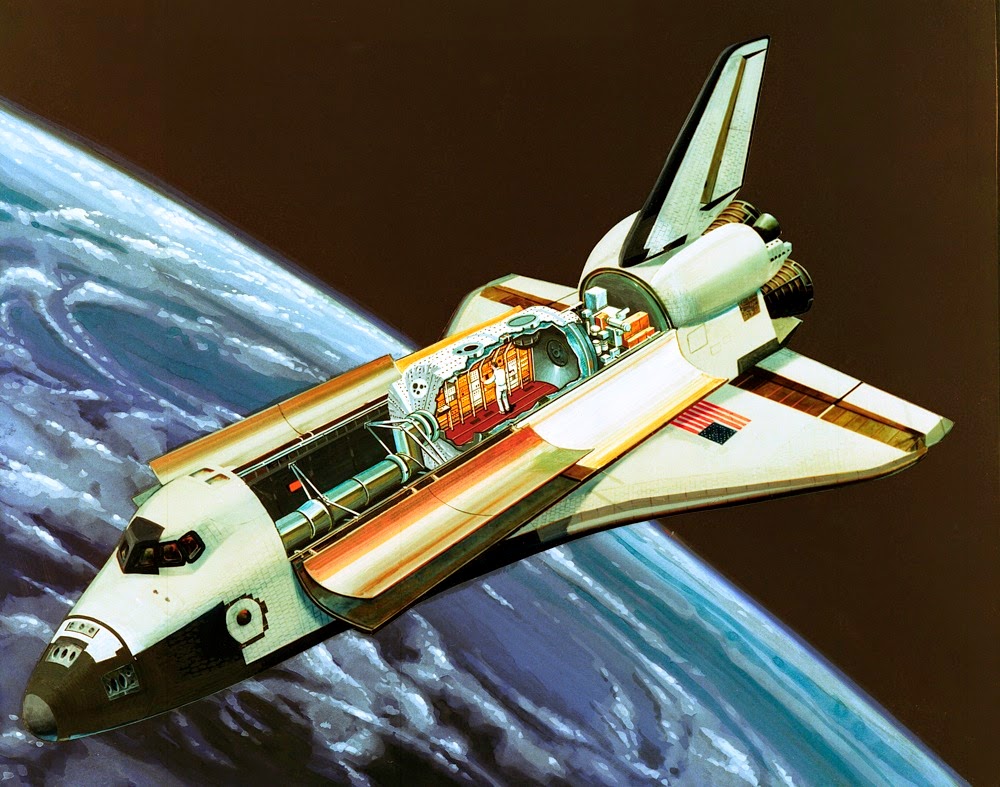 Cutaway art of Spacelab pressurized module in Space Shuttle payload bay. Image credit: NASASources
"NASA Plans Five-Year Fund Rise," W. Normyle, Aviation Week & Space Technology, 14 October 1968, pp. 16-17
"Pace of Post-Apollo Planning Rises," W. Normyle, Aviation Week & Space Technology, 3 February 1969, p. 16
"NASA Aims at 100-Man Station," W. Normyle, Aviation Week & Space Technology, 24 February 1969, pp. 16-17
"Against the Tide," Aviation Week & Space Technology, 17 March 1969, p. 15
"Shuttle Group Readies Proposal Requests," Aviation Week & Space Technology, 19 January 1970, pp. 17-18
Development and Use of a 12-Man Space Station, MDC G0583, C. Dorrenbacher, McDonnell Douglas Astronautics Company, Briefing to the European Space Research Organization on Space Station Plans and Programs in Paris, France, 3-5 June 1970
Astronautics and Aeronautics 1968, NASA SP-4010, pp. 212-213
Astronautics and Aeronautics 1970, NASA SP-4015, pp. 193-194
Space Stations: A Policy History, J. Logsdon, George Washington University, NASA Contract NAS9-16461, NASA Johnson Space Center, no date (1980), pp. I-16, II-1-5, II-8-10, II-13-15, II-18-33
More InformationSpace Station Gemini (1962)"A True Gateway": Robert Gilruth's June 1968 Space Station PresentationReviving & Reusing Skylab in the Shuttle Era: NASA Marshall's November 1977 Pitch to NASA HeadquartersThe 1991 Plan to Turn Space Shuttle Columbia Into a Low-Cost Space StationSource:
McDonnell Douglas Phase B Space Station (1970) Wątek: [Spaceflight History Blog] McDonnell Douglas Phase B Space Station (1970) (Przeczytany 2656 razy)