Flyby's Last Gasp: North American Rockwell's S-IIB Interplanetary Booster (1968)27 July 2017 David S. F. Portree
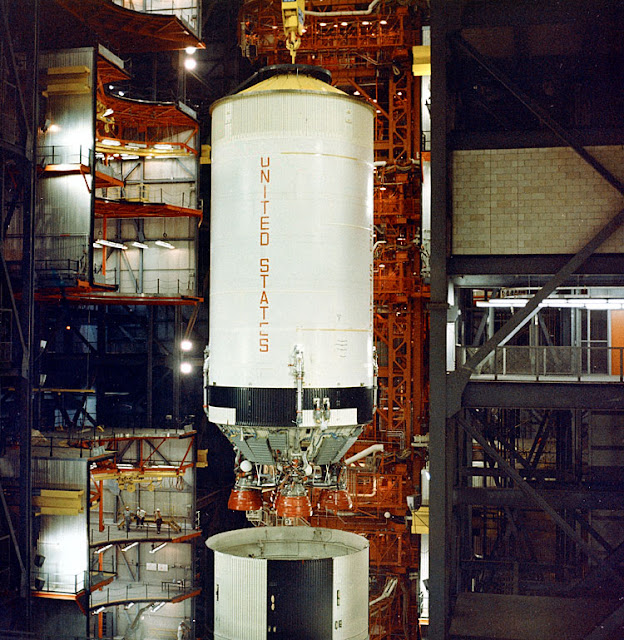 Stacking a Saturn V rocket: inside the Vertical Assembly Building at Kennedy Space Center, a giant crane gingerly lowers an S-II second stage onto an S-IC first stage. Image credit: NASA
NASA abandoned work toward piloted Mars and Venus flyby missions based on hardware developed for Apollo and its planned successor, the Apollo Applications Program, during the final months of the pivotal year 1967. Until August of that year, however, the concept was viewed by many as a plausible interim step between 1960s Apollo moon landings and 1980s piloted Mars landings.
Though NASA awarded no new piloted flyby study contracts, studies performed in 1965, 1966, and 1967 continued to report out at aerospace conferences and in NASA briefings during 1968 and 1969. In March 1968, for example, North American Rockwell (NAR) engineers W. Morita and J. Sandford summed up a study they completed in April 1967 for NASA's Marshall Space Flight Center (MSFC) in Huntsville, Alabama. Their study looked at how a modified NAR-built S-II rocket stage might be used to boost a piloted flyby spacecraft out of Earth orbit (that is, "inject" it onto an interplanetary trajectory). They presented results of their study at the Fifth Space Congress in Cocoa Beach, Florida.
 Image credit: NASA
The 33-foot-diameter, 81.5-foot-long S-II, the second stage of the Apollo Saturn V rocket, weighed about 40 tons empty. A single propellant tank divided by a dome-shaped "common bulkhead" held a total of more than 400 tons of liquid oxygen (LOX) and liquid hydrogen (LH2) propellants. LH2 is of low density, so the LH2 section in the top/front part of the tank measured more than twice as long as the LOX section.
The propellants fed a cluster of five J-2 rocket engines, each producing 200,000 pounds of thrust. Together they consumed more than a ton of propellants per second during their 6.5 minutes (390 seconds) of operation, boosting the Saturn V's speed from 6000 miles per hour at separation from the Saturn V S-IC first stage to 17,400 miles per hour (just short of Earth-orbital velocity) at S-II shutdown.
NAR proposed to launch the S-II interplanetary boost stage, which it designated the S-IIB, into Earth orbit on a two-stage Saturn V. The S-IIB would include two or three improved J-2S engines in place of the S-II's five J-2s. After separation from the spent S-II, the J-2S engines would fire briefly to place the S-IIB into an elliptical Earth orbit. An auxiliary propulsion system made up of three solid-propellant motors would perform orbit circularization, and eight thruster modules based on the Apollo Command and Service Module (CSM) attitude control system would carry out orbit corrections and rendezvous and docking with the piloted flyby spacecraft.
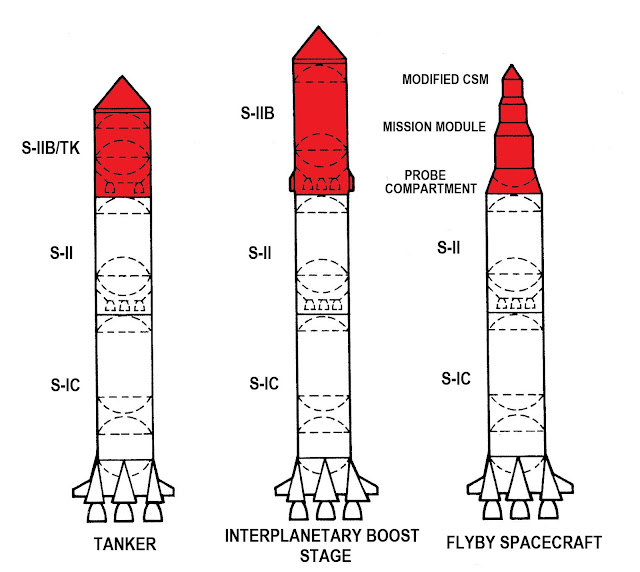 Proposed North American Rockwell-built piloted flyby payloads are shown in red. Image credit: NAR/DSFPortree
The S-IIB would reach orbit with about 76 tons of LH2 fuel on board. NAR's analysis determined that, if only standard S-II thermal insulation were employed, boil-off caused by solar heating in orbit would reduce this to only 25 tons in less than five days. NAR proposed to reduce boil-off by installing a hydrogen gas-filled "vapor barrier" between the LH2 and LOX sections of the propellant tank and by applying "super-insulation" panels to the stage exterior. These modifications would reduce total LH2 boil-off over 10 days - the rated orbital lifetime of the S-IIB - to less than five tons.
The S-IIB would need to lift off with its LOX tank empty if the two-stage Saturn V was to place it in Earth orbit. Separately launched automated LOX tankers would then dock with it to fill the tank. The NAR engineers examined S-II-based tankers, tankers based on the Apollo Saturn S-IVB stage, and a wholly new tanker Lockheed Corporation designed in a separate study for MSFC.
 LOX tankers considered in the North American Rockwell study. Green represents each design's LOX cargo volume. Image credit: NAR/DSFPortree
Morita and Sandford described two S-II-based tankers. The first, the S-IIB/TK, would measure about 25 feet shorter than the standard Saturn V S-II stage. It would separate from the S-II second stage of the two-stage Saturn V that launched it, fire its twin J-2S engines for 3.5 minutes to attain a 100-nautical-mile-by-263.5-nautical-mile orbit, then fire them again at apogee (the high point in its orbit about the Earth) to raise its perigee (the low point in its orbit about the Earth). The circularization burn would leave the S-IIB/TK into a 263.5-nautical-mile-high parking orbit.
The 92 tons of LOX remaining after the circularization burn would constitute the tanker's payload. Solar heating would cause the LOX to boil off over time, so after 163 days - the longest period the tanker would need to loiter in Earth orbit before transferring its payload to the S-IIB injection stage - 75 tons would remain.
NAR's second S-II tanker variant, the S-II/TK, would have a LOX tank four feet longer than that of the standard Saturn V S-II. It would serve double-duty as a Saturn V second stage and a tanker. After it separated from the S-IC first stage, its five J-2S engines would boost it into a 100-nautical-mile-by-263.5-nautical-mile orbit, Earth orbit, then two engines would fire a second time at apogee to circularize its orbit. The S-II/TK would retain about 105 tons of LOX after the circularization burn and about 82 tons after 163 days in orbit.
Sandford and Morita next examined tankers based on the Douglas Aircraft Company-built S-IVB stage. The 22-foot-diameter S-IVB served as the the second stage of the Saturn IB rocket and the third stage of the Saturn V moon rocket.
The first S-IVB tanker design would trim cost by retaining - but leaving empty - the S-IVB stage LH2 tank. The second would delete the LH2 tank, making for a tanker that was shorter and lighter, but more heavily modified and thus more costly. The first design would deliver 110.5 tons of LOX to 263.5-nautical-mile orbit, of which about 99 tons would remain after 163 days. The second S-IVB-based design would deliver 107.5 tons to a 263.5-nautical-mile circular parking orbit. Of this, 92.5 tons would remain after 163 days.
The third tanker Morita and Sandford investigated was Lockheed's Orbital Tanker. Because it would be purpose-built to serve as a tanker, it would be more efficient than the NAR S-II and Douglas S-IVB tankers, but also more costly. Efficiency in this case would be measured in terms of the expected amount of LOX boil-off.
After launch on a two-stage Saturn V, the Orbital Tanker would fire LH2/LOX or solid-propellant rocket motors to place itself into a 263.5-nautical-mile-high parking orbit. The Orbital Tanker would reach orbit bearing 114.9 tons of LOX in an insulated spherical tank. Of this, 110.9 tons would remain after 163 days.
Sandford and Morita looked at Mars and Venus flybys, but emphasized a Mars flyby that would leave Earth orbit in late September 1975. Their proposed Mars flyby launch schedule took into account the narrow range of Earth-orbit departure dates, the planned 10-day lifetime in Earth orbit of the S-IIB injection stage, and the existence of only two Launch Complex 39 Saturn V launch pads at NASA's Kennedy Space Center in Florida.
Assuming an Earth-orbit departure date of 20 September 1975, the piloted Mars flyby mission would begin with three LOX tanker launches in April-May 1975. They would lift off between 153 and 130 days before the scheduled launch to Earth orbit of the S-IIB injection stage. A Saturn V bearing a fourth, backup tanker would be held in reserve.
Following the launch of the third LOX tanker in May 1975, KSC ground teams would refurbish the twin Launch Complex 39 pads for launch of the backup tanker (if necessary), the piloted flyby spacecraft, and the S-IIB injection stage. NAR estimated that KSC workers would need no more than one eight-hour shift per day to ready the pads in time for the piloted flyby spacecraft and S-IIB stage launches in September 1975. More shifts would be added if the backup tanker became necessary; that is, if one of the first three tankers failed to reach orbit or malfunctioned in orbit while awaiting arrival of the spacecraft and S-IIB stage.
On 15 September 1975, the S-IIB injection stage would lift off, followed within 24 hours by the piloted flyby spacecraft. Spacecraft and stage would rendezvous and dock within 12 hours, then the combination would set out in pursuit of the waiting tankers.
The piloted flyby spacecraft/S-IIB combination would dock with the three LOX tankers about 12 hours apart. Each would in turn link up with the aft end of the S-IIB, transfer its LOX cargo, and detach.
The piloted flyby astronauts and mission controllers on Earth would then perform a detailed systems check of the piloted flyby spacecraft/S-IIB stage combination. If all checked out as normal, they would be certified ready to depart Earth orbit on 20 September, just as the launch window opened for a minimum-energy Earth-Mars free-return transfer.
The quantity of propellants required to depart Earth orbit on a Mars flyby trajectory would increase steadily from the moment the launch window opened. At the same time, boil-off would cause the quantity of propellants in the S-IIB stage to steadily decrease. Morita and Sandford calculated that the S-IIB stage would retain sufficient LH2 to boost the Mars flyby spacecraft out of Earth orbit for five days after the launch window opened; that is, until 25 September 1975.
Source "The S-II Injection Stage for the Mars/Venus Flyby Mission," W. H. Morita and J. W. Sandford, Proceedings, Fifth Space Congress: The Challenge of the 1970s, pp. 10.1-1 – 10.1-22; paper presented in Cocoa Beach, Florida, 11-14 March 1968
More Information (...)
Source:
Flyby's Last Gasp: North American Rockwell's S-IIB Interplanetary Booster (1968)
 Wątek: [SHB] Flyby's Last Gasp: North American Rockwell's S-IIB Interplanetary Booster (Przeczytany 1606 razy)