Space Station Gemini (1962) (1)
01 December 2015 David S. F. Portree
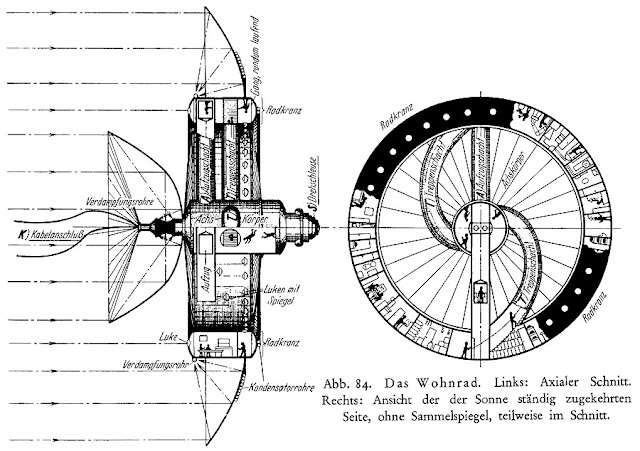 Herman Potočnik's 1928 Wohnrad ("living wheel") space station design. Image credit: NASA
 In 1960, most everyone who cared about such things knew what a space station was supposed to look like: it would take the form of a revolving wheel. The design, first portrayed in detail in 1928 by Austro-Slovenian Herman Potočnik, was popularized in the United States after the Second World War by Wernher von Braun in the pages of the popular Collier's weekly magazine and through a series of Walt Disney "Tomorrowland" television programs.
Wheel-shaped space stations would revolve continuously to produce acceleration - so-called "centrifugal force" - which the astronauts inside would feel as gravity. This "artificial gravity" would pull strongest along the station's outer rim and not at all at its hub. Artificial-gravity station designs tend to be large; this is because a spinning station of small spin radius would generate undesirable effects, such as a noticeable gradient in the pull felt along a standing astronaut's body. The astronaut would feel "light-headed" and "heavy-footed."
 An experimental inflatable artificial-gravity space station under development at NASA Langley Research Center in 1961. Image credit: NASA
Soon after NASA opened for business on 1 October 1958, Langley Research Center (LaRC) took the lead in U.S. civilian space station development. Not surprisingly, the Hampton, Virginia-based NASA laboratory emphasized artificial-gravity designs. For example, LaRC engineers built and ground-tested experimental doughnut-shaped inflatable stationes.
As LaRC labored toward artificial-gravity stations, the Space Task Group (STG), an independent team of engineers based at LaRC, began work on Mercury, NASA's first piloted spacecraft. NASA Headquarters, meanwhile, solicited proposals from industry for an "advanced manned spacecraft." The new three-person spacecraft and the program to build and fly it were named Apollo.
As originally conceived, Project Apollo was to have followed immediately after Project Mercury. The Apollo spacecraft would have included three modules, one of which, the Mission Module, would have provided its crew with added living and working volume. The Mission Module could turn an Apollo spacecraft into a small zero-gravity space station or could transport supplies to a large space station. NASA expected that, before 1970, a piloted Apollo spacecraft would fly around the moon without stopping in lunar orbit (that is, it would carry out a free-return circumlunar mission).
NASA's plans changed dramatically on 25 May 1961, when President John F. Kennedy called upon the young space agency to land a man on the moon by the end of the 1960s decade. Faced with this daunting new challenge, NASA out of necessity put most space station planning on the back burner.
Apollo became NASA's lunar landing program. After NASA opted for the Lunar-Orbit Rendezvous (LOR) moon-landing mode in July 1962, Apollo mission roles were split between two spacecraft: the Command and Service Module (CSM) for conveying three men from Earth to lunar orbit and back again; and the four-legged Lunar Module (LM), which would carry two men from the CSM in lunar orbit to the moon's surface and back. The Mission Module was no longer a part of the Apollo design.
NASA soon recognized the need for a program that could bridge the yawning spaceflight skills gap separating Mercury from the moon. The lone Mercury astronaut could adjust his spacecraft's attitude (basically, the direction its nose pointed), but not the shape or altitude of its orbit; three-man Apollo crews would be called upon to conduct multiple significant orbit-change maneuvers, including capture into and departure from lunar orbit. Project Apollo would also require rendezvous and docking in lunar orbit and, in the event of docking difficulties, a spacewalk between the LM and the CSM.
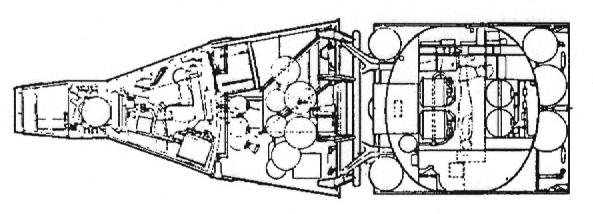
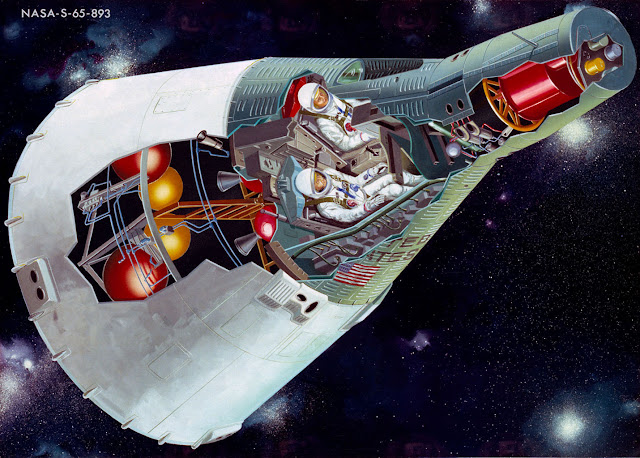 Cutaway illustration of a Gemini spacecraft displaying its forward-facing windows, ejection seats, nose-mounted rendezvous radar and parachutes, retrograde rocket motors for reentry, and propellant tanks for attitude control and orbit-changing maneuvers. Image credit: NASA
Initially dubbed Mercury Mark II, the two-man skill-building spacecraft was formally named Gemini in January 1962. NASA planned to conduct Project Gemini flights in 1963 and 1964; that is, immediately after Project Mercury's planned conclusion.
The space agency tasked St. Louis, Missouri-based McDonnell Aircraft, Mercury spacecraft prime contractor, with building Gemini. The new spacecraft would comprise two main modules: the Reentry Module bearing the crew and the Adapter Module containing maneuvering thrusters and solid-propellant deorbit rockets. The latter would be located in the Retrograde Section, the forward part of the Adapter Module, up against the Reentry Module's bowl-shaped reentry heat shield.
Gemini, like Mercury and Apollo, would provide its crew with a pure oxygen atmosphere. Unlike Mercury and Apollo, Gemini would feature a jet fighter-style cockpit with forward-facing windows and ejection seats for crew escape in the event of emergency during liftoff, ascent, or landing. Fuel cells in the Adapter Module would combine liquid oxygen and liquid hydrogen reactants to produce drinking water and electricity.
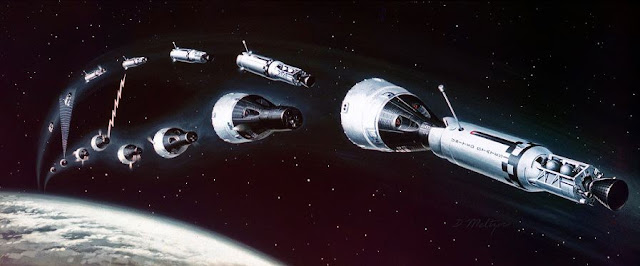 Artist's concept of a Gemini spacecraft performing rendezvous and docking with a modified Agena upper stage. Image credit: NASA
NASA partnered the Gemini spacecraft with Agena, a separately launched upper stage with a docking collar, so that U.S. astronauts could gain rendezvous and docking experience. Project Gemini astronauts would also conduct spacewalks and remain aloft in Earth orbit for up to two weeks to permit physicians to certify that Apollo crews could remain healthy for the duration of a lunar voyage.
Gemini would climb to orbit atop a Gemini Launch Vehicle (GLV), a modified U.S. Air Force (USAF) Titan II missile. At the end of its mission, the Gemini Reentry Module would deploy a triangular Rogallo "parawing" and glide to a controlled land landing on skids.
 The Titan II Inter-Continental Ballistic Missile, progenitor of the Titan family of space launchers. Image credit: U.S. Air Force
23 March 1965: twin engines ignite on a Titan II GLV at Cape Kennedy, Florida, marking the start of Gemini III, the first of ten piloted flights in the Gemini series. Image credit: NASA
In the first half of 1961, McDonnell submitted a proposal as part of the USAF's Military Test Space Station (MTSS) study. The McDonnell MTSS design consisted of a Gemini spacecraft and a pressurized module with a powerful transtage rocket motor attached to it. The module would have added volume and functionality to Gemini, much as the Mission Module would have done for Apollo.
Air Force astronauts would have entered the pressurized module by opening a small hatch in the bulkhead above and behind their ejection seats. The hatch, a carefully engineered breach in the Reentry Module heat shield, would have opened on a narrow bent tunnel leading to the aft end of the Adapter Module, where another hatch would have let the astronauts into the pressurized module.
Continuing high-level uncertainty about the USAF role in piloted spaceflight led McDonnell in December 1962 to attempt to hedge its bets by peddling Gemini-derived spacecraft to NASA. The company proposed that while NASA carried out the Apollo lunar program it should also carry out a low-cost Gemini-based space station program. McDonnell argued that
presently programmed launch vehicles capable of placing 20,000 to 200,000 pounds in near earth orbits will be available [in the late 1960s]. Large space station complexes with elaborate facilities and housing large numbers of crewmen will then be technically feasible. However, before undertaking the development of such stations, it is desirable, if not mandatory, to explore at a modest level some of the fundamental design and cost determining operational factors such as, the need for artificial gravity[,]. . . the physiological and psychological effects of long[-]term space operations[,] and appropriate crew tours of duty. The [Gemini-based] space stations proposed provide. . . [an] early capability to obtain answers to fundamental questions [at] modest cost.
If NASA had taken up McDonnell's proposal - which the company called "Modular Space Station Evolving from Gemini" - then Gemini would have become for a major NASA space station program what it was already for Project Apollo. That is, it would have bridged the knowledge gap separating short, zero-gravity missions in small piloted spacecraft from long missions on board large artificial-gravity stations.
McDonnell's proposal in fact encompassed a series of up to three programs, each building on and more ambitious than the last. The company designated them Program A, Program B, and Program C. Carrying out Program B would be prudent, McDonnell wrote, but optional.
McDonnell proposed five building blocks that could be combined in different ways to accomplish its three Programs. These were: the Gemini Transport, a modified Gemini spacecraft, which would serve as crew carrier and piloted space tug; the Supply Module; the One-Room Space Station, which was structurally similar to the Supply Module; the Electrical Power Module; and the Two-Room Space Station, structurally similar to the Electrical Power Module.
Structural similarity would yield reduced cost, the company explained. NASA would also save money by recovering Gemini Transport Reentry Modules and returning them to the McDonnell plant in St. Louis for refurbishment and reuse.
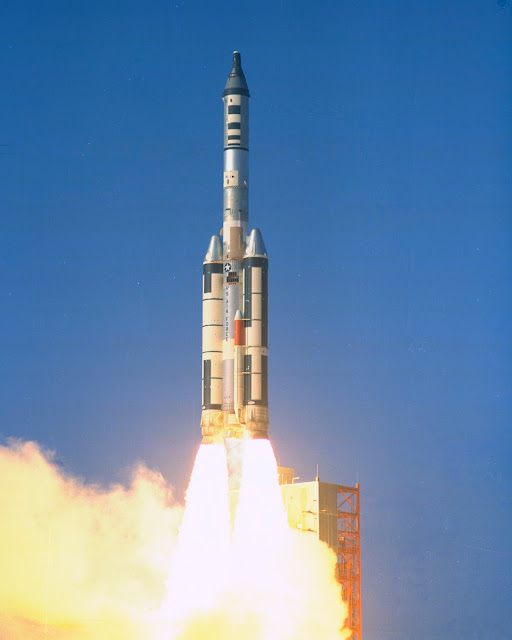 3 November 1966: a Titan III rocket launches a USAF Manned Orbiting Laboratory mockup with the refurbished and modified unmanned Gemini II spacecraft on top. Image credit: U.S. Air Force
All of McDonnell's modules would measure 10 feet in maximum diameter, in keeping with the diameter of the Titan rockets that would boost them to Earth orbit. McDonnell assumed two Titan variants for its proposed program: the two-stage Titan II GLV and the Standard Launch Vehicle 624A-C (Titan III). The Titan III would comprise a modified two-stage Titan II core, twin strap-on solid-propellant boosters, and a restartable upper stage.
The GLV, capable of launching 7390 pounds into an 87-by-200-nautical-mile orbit, would loft the Gemini Transport, the Supply Module, the One-Room Space Station, and a stripped-down version of the Two-Room Space Station. The Titan III would place 25,280 pounds into a 250-nautical-mile-high circular orbit or 26,000 pounds into a 100-by-250-nautical-mile elliptical orbit. This would enable it to launch module combinations, such as the Gemini Supply Transport (Gemini Transport plus loaded Supply Module).
McDonnell expended considerable in-house time and money to develop feasible rendezvous, docking, and crew/cargo transfer methods for its proposal. Because the Gemini Transport would use the nose-mounted Gemini rendezvous radar, it would first approach its orbital target with its nose and twin windows facing forward, just as would the baseline Gemini when it performed rendezvous and docking with an Agena.
About 10,000 feet from the target, the pilot would unstrap from his seat, twist his body around in the close confines of the Gemini Transport cockpit, and open the 27.5-inch-diameter hatch above and behind his and the command pilot's seats. He would squeeze through a 24.5-inch opening in the heat shield to enter a 32-inch-diameter tunnel in the Adapter Module. The bent tunnel would lead to a rear-facing Crew Docking Station.
The command pilot, meanwhile, would turn the Gemini Transport end-for-end to point the flat rear of its Adapter Module at the target. The co-pilot would sight the target through a small window above a docking control console, then would commence a "semi-manual" final approach employing the six docking thrusters. Similar thrusters on the One-Room Space Station would ensure its stability during docking. McDonnell estimated that approach from 10,000 feet would need about 10 minutes, during which time the Gemini Transport would slow from a speed of 100 feet per second to zero relative to its target.
 Gemini Transport (left) docked with a One-Room Space Station. Image credit: McDonnell/NASA
McDonnell proposed a "ring-and-fork" docking interface. The co-pilot would line up a roughly nine-foot-diameter ring on the rear of the Gemini Transport Adapter Module with four equidistantly spaced two-prong forks on the target. The ring would slide along the inner surfaces of the prongs, canceling out any misalignment between spacecraft and target, then would trip latches where the prongs met to form the forks. Tripping the latches would constitute soft docking. Finally, the forks would retract, pulling hatches on the Gemini Transport and its target securely together to accomplish hard docking.
McDonnell proposed that its Program A begin in early 1965, immediately after the baseline Gemini Program supporting Apollo was expected to be completed. It based its development schedule on a February 1963 NASA go-ahead for Program A.
In the first Program A mission, a GLV would launch a 7390-pound One-Room Space Station into an initial 87-by-200-nautical-mile orbit, then another GLV would launch a Gemini Transport. The latter would dock with the former, then would maneuver the combination to a 200-nautical-mile circular orbit. This approach - using the Gemini Transport to circularize the One-Room Space Station's orbit - would help to maximize the weight of useful payload that could be launched in the One-Room Space Station. The two astronauts in the Gemini Transport would then enter the One-Room Space Station and work on board for 30 days.
Astronaut activities on board the One-Room Space Stations would emphasize space medicine and station housekeeping, as well as space sciences, artificial-gravity, and military experiments. The One-Room Space Stations would use improved Gemini-type fuel cells to make electricity and water and would not remain occupied for long enough to need resupply. They would provide their crews with a pure oxygen atmosphere at five pounds per square inch of pressure. With a ceiling height of seven feet, pressurized volume would total 548 cubic feet. The station's 36-square-foot clear floor area would be covered with velcro so that the astronauts, who would wear velcro slippers, could anchor themselves in zero-gravity.
After undocking in their Gemini Transport, the first Program A crew would cast off the aft section of its Adapter Module and fire the solid-propellant rocket motors in its Retrograde Section to decrease its orbital velocity and begin the fall back to Earth. For added redundancy, the Gemini Transport Retrograde Section would include five retrograde motors; that is, one more than the baseline Gemini. Following a fiery atmosphere reentry, the Reentry Module would turn so its nose faced forward, deploy its parawing, and glide to a landing.
The first One-Room Space Station would not be occupied again. McDonnell made no mention of its eventual fate; presumably it would undergo uncontrolled reentry a few years after it was abandoned.
Program A's second One-Room Space Station mission would emphasize artificial-gravity experiments. McDonnell explained that "artificial gravity operations not only constitute new techniques in themselves, but also interrelate with and tend to modify many of the other required space station functions." A GLV would place its own second stage and the second One-Room Space Station into an initial elliptical orbit. The crew would then arrive in a Gemini Transport and boost the combination into its 200-nautical-mile circular operational orbit.
 Wątek: [Spaceflight History Blog] Space Station Gemini (1962) (Przeczytany 2727 razy)