The 1991 Plan to Turn Space Shuttle Columbia Into a Low-Cost Space Station (2)
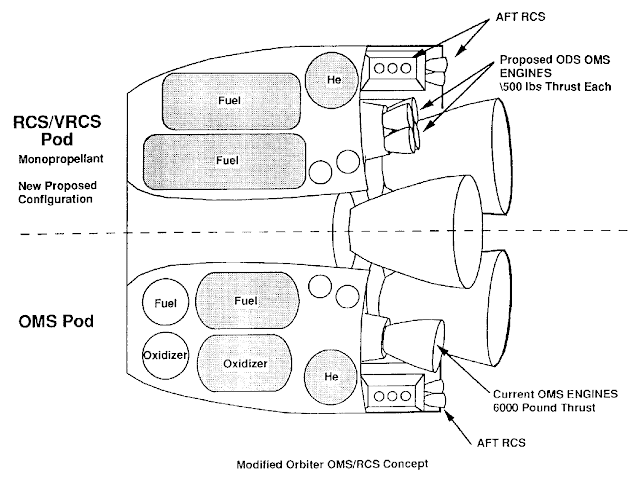 Orbiter Derived Station (top) and Shuttle Orbital Maneuvering System propulsion pod design differences. Image credit: SII/NASA
During a normal Space Shuttle mission, the twin 6,000-pound-thrust Orbital Maneuvering System (OMS) engines would ignite twice to complete orbital insertion after the Orbiter's three Space Shuttle Main Engines (SSMEs) shut down and and its External Tank separated. The OMS-1 burn would put the Orbiter into an elliptical orbit; then, at apogee (the high point of its orbit about the Earth), the OMS-2 burn would raise its perigee (the low point in its Earth orbit) to make its orbit circular. Subsequently, the OMS engines would be used to perform major maneuvers and would slow the Orbiter at the end of its mission so that it would reenter the atmosphere. The OMS engines would burn hypergolic (ignite-on-contact) hydrazine/nitric acid propellants.
SII proposed changes to the stripped-down Orbiter's OMS pods to increase reliability and enable long-duration use. A hydrazine monopropellant system would replace the baseline Orbiter bi-propellant system. The SSMEs would insert the stripped-down Orbiter directly into its initial elliptical orbit, then two sets of four 500-pound-thrust OMS engines – one set per OMS pod – would each draw on a pair of propellant tanks to perform the OMS-2 orbit-circularization burn at apogee. The roughly 13,000 pounds of propellant remaining after the OMS-2 burn would be sufficient to resist atmospheric drag and supply OMS pod attitude-control thrusters for two years.
SII suggested that the OMS tanks be refilled in orbit after they exhausted their initial load of hydrazine, but provided no details as to how this might be accomplished. Alternately, the company suggested, a new propulsion module might be docked with the ODS after the modified OMS pods ran out of propellant.
With MB-1 complete, SII's ODS would provide 11,000 cubic feet of pressurized volume containing 58 standardized payload racks. NASA’s Freedom, by comparison, would have no pressurized volume at all until the addition of the U.S. Lab during MB-6, and would not exceed 10,000 cubic feet of pressurized volume until MB-13. The U.S. Hab and Lab modules would together hold only 48 racks.
In SII's July 1991 ODS design, the large module launched in the stripped-down Orbiter payload bay on MB-1 included only Hab module functions, and MB-2 in 1997 would see a piloted Shuttle Orbiter deliver the U.S. Lab module. In its September 1991 final report, SII combined Lab and Hab in the stripped-down Orbiter payload bay and substituted a 47.5-foot-long "core module" for the Lab on MB-2. The cylindrical core would include eight docking ports on its sides and one at either end.
One of the core module end ports would be docked permanently with the port on the Hab/Lab module. Visiting Shuttle Orbiters would dock with the Earth-facing port at the core module's other end. Addition of the core module would increase ODS pressurized volume to 15,000 cubic feet. NASA's Freedom station would not exceed 15,000 cubic feet of volume until MB-16.
SII envisioned that ODS assembly flights would be interspersed with utilization flights beginning immediately after MB-1. The first ODS utilization mission would occur in 1996, and three would take place in 1997.
In addition to permitting early research on board the ODS, some utilization flights after MB-2 would deliver supplies and equipment in a drum-shaped Logistics/Life Support Module (LLSM). Astronauts would dock the LLSM to a core module side port using the visiting Orbiter's Canada-built Remote Manipulator System (RMS). Spent LLSMs would be returned to Earth for refurbishment and reuse. SII placed the ODS toilet and shower in the LLSM, arguing that servicing waste and water systems on the ground would be preferable to doing so in orbit.
SII noted that its Station would need very few assembly and maintenance spacewalks. It would, nevertheless, include a modified Shuttle Orbiter airlock attached to one of its core module side ports. The airlock would reach the ODS during an unspecified utilization flight after MB-2. Because ODS assembly would be relatively simple and assembly spacewalks minimal, SII assumed that the Station could do without its own Canada-built RMS. The company did not address how deletion of the Station RMS would affect U.S.-Canada relations.
The second assembly mission of 1997, MB-3, would see arrival of an Orbiter bearing in its payload bay an eight-man Assured Crew Return Vehicle (ACRV), a space station lifeboat. With the docking of the ACRV at a core module side port, the ODS could be staffed by eight astronauts with no Orbiter present. NASA called the ability to maintain a full crew with no Orbiter present "Permanent Manned Configuration" (PMC). NASA's Freedom Station would not achieve PMC until MB-16.
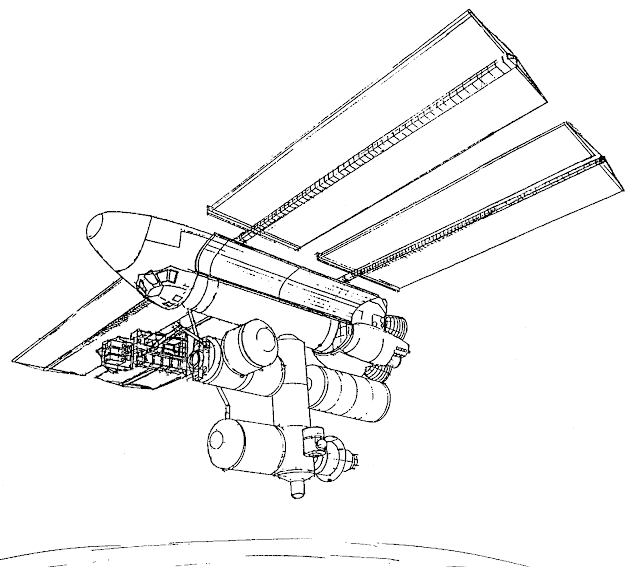 Orbiter Derived Station in Assembly Complete configuration after Mission Build-6 in late 1998. The image displays an RMS robot arm, though SII stated that the stripped-down Orbiter would not carry one. Image credit: SII/NASA
The year 1998 would see three assembly flights, all international in character. In his January 1984 State of the Union speech, Reagan had invited U.S. allies to lend a hand in building NASA's space station in exchange for opportunities to reap its rewards. In addition to Canada, Japan and Europe had answered the call.
MB-4 would see an Orbiter deliver the pressurized part of the Japanese Experiment Module (JEM). Astronauts would use the Orbiter's RMS to dock it to a core module side port. During MB-5, astronauts would use the visiting Orbiter RMS to add the European Space Agency's Columbus laboratory module. With that, the SII's ODS would achieve its maximum pressurized volume: 24,000 cubic feet, or about 8,000 cubic feet more than planned for NASA's Freedom Station. MB-6 would add Logistics and unpressurized Exposure components to complete the JEM.
SII recommended that the core module's Earth-facing port be designed to rotate so that visiting Orbiters could optimally position themselves for assembly missions. During MB-5, for example, the visiting Orbiter's nose would face in the ODS's direction of flight so that its RMS could place the Columbus module at its designated core module side port. During MB-4 and MB-6, it would face in the opposite direction so that JEM components could be added.
MB-6, which would take place near the end of 1998, would mark the end of ODS assembly. By then, SII's station would have hosted seven utilization flights. For comparison, NASA's Freedom Space Station would host no utilization flights until 1998, when three would take place. Freedom would not reach "Assembly Complete" until 2000.
SII proposed ways that the baseline ODS might be upgraded. The company noted that, beginning with MB-10, NASA's Freedom would provide experimenters with more electricity (180 kilowatts) than would the ODS. If this power level were judged to be necessary for ODS operations, then a 60-kilowatt "power kit" could be added during a utilization flight. The company suggested that the kit's rolled solar arrays be attached to a special port installed in the stripped-down Orbiter's nose behind a streamlined faring.
The ODS included no provision for space-facing experiments; all of its modules were expected to be mounted on its Earth-facing payload bay side. This reflected the science and technology community's desire for a microgravity lab and the fact that highly capable automated space-facing satellites (for example, the Hubble Space Telescope) were available. If, however, space-facing experiments were desired on board the ODS, then it could be launched with a docking port on the Orbiter's space-facing belly. A tunnel through the ODS payload bay floor would link the port to the Hab/Lab module.
Probably the company's most controversial proposal was to accelerate ODS assembly by stripping down Columbia, NASA's oldest Orbiter. SII noted that Columbia was the heaviest Orbiter, so had the least payload capacity. It assumed that NASA would want to replace Columbia with a new lighter Orbiter, increasing the Shuttle fleet's capability. SII called this "disposing of the worst and and replacing it with the best." Some components stripped from Columbia could, it suggested, be reused in the new Orbiter to save money.
By the time SII submitted its final report, NASA's latest Freedom configuration had been public for three months. The new design included truss segments launched pre-assembled, smaller U.S. modules, and other changes meant to reduce the number of spacewalks and assembly flights required to build and maintain it. The station would, however, lose yet more capability (notably in the area of electrical power, which was reduced to about 60 kilowatts at PMC). The April 1991 redesign set the stage for Freedom's near-cancellation in June 1993 (it survived by a single vote in the U.S. House of Representatives) and, beginning later that year, its revival as the International Space Station.
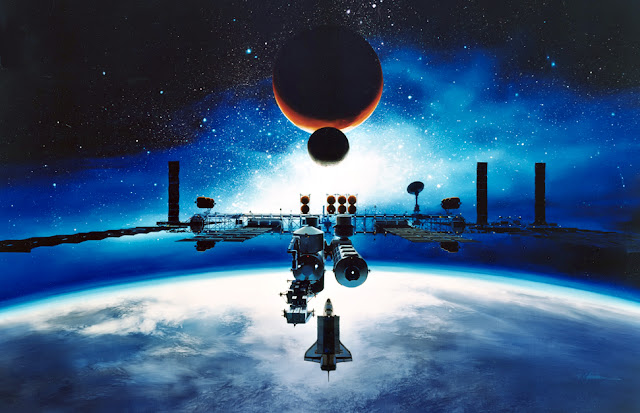 This rendition of Space Station Freedom in its 1991 configuration contains several interesting features. The overall station design is obscured by shadows, denoting the uncertainty surrounding the station's future form. Only the international pressurized modules - the JEM and Columbus labs - are visible. Beginning with the the May 1986 Dual Keel, these modules changed very little in NASA artwork because the International Partners insisted that the U.S. adhere to its agreements. The U.S. modules, in the meantime, decreased in number and shrank to a fraction of their planned former size. A Shuttle Orbiter is displayed, but not attached to Freedom; placing it too close to the station would show plainly the 1991 station's small size relative to earlier designs. The moon and Mars are visible above Freedom; in 1991, NASA still paid lip-service to carrying out President George H. W. Bush's abortive Space Exploration Initiative (SEI), which aimed to launch humans to those worlds. Freedom was meant to play a role in furthering SEI's goals, though the precise nature of that role was not clear. Image credit: NASASources
The Space Shuttle at Work, NASA SP-432/EP-156, H. Allaway, NASA, 1979, pp. 64-72
Aboard the Space Shuttle, NASA EP-169, F. Steinberg, NASA, 1980
Space Station, NASA EP-211, D. Anderton, NASA, no date (1984)
Space Station: The Next Logical Step, NASA EP-213, W. Froehlich, NASA, no date (1985)
Space Station: Leadership for the Future, NASA PAM-509, F. Martin & T. Finn, NASA, August 1987
Space Station: A Step Into the Future, NASA PAM-510, A. Stofan, NASA, November 1987
Space Station Freedom Reference Guide, Boeing, 1988
Space Station Freedom: A Foothold on the Future, NASA NP-107, L. David, NASA, October 1988
"Freedom Spacewalks 'unacceptable': NASA," Flight International, 1-7 August 1990, p. 18
"Freedom failure threatens NASA's future," T. Furniss, Flight International, 29 May-4 June 1991, p. 34
"Operation Scale-Down," T. Furniss, Flight International, 29 May-4 June 1991, pp. 76-78
Shuttle Derived Space Station Freedom, Space Industries International, Inc./Rockwell International Space Systems Division, presentation materials, n.d. (July 1991)
Expanded Orbiter Missions Final Report: Orbiter Derived Space Station Freedom Concept, prepared by Space Industries, Inc. (SII), Webster, Texas, for Rockwell International, Inc., Downey, California, September 1991
"House Retains Space Station in a Close Vote," C. Krauss, International New York Times, 24 June 1993 (
http://www.nytimes.com/1993/06/24/us/house-retains-space-station-in-a-close-vote.html - accessed 16 October 2015)
International Space Station, Boeing, May 1994
More Information(...)
Source:
The 1991 Plan to Turn Space Shuttle Columbia Into a Low-Cost Space Station
 Wątek: [SHB] The 1991 Plan to Turn Space Shuttle Columbia Into a Low-Cost Space Station (Przeczytany 2881 razy)