Riccioli Outpost (1990)on 10/10/2019 David S. F. Portree
 The red oval at left marks Riccioli crater, Paul Lowman's candidate site for a lunar geology/astronomy outpost. The crater is approximately round, but appears foreshortened because it is near the lunar limb. Image credit: NASANASA held a workshop in August 1990 to examine candidate lunar base sites as part of the Space Exploration Initiative (SEI). U.S. President George H. W. Bush had announced SEI on 20 July 1989, the 20th anniversary of the Apollo 11 Moon landing. SEI aimed to return American astronauts to the Moon to stay and to carry out the first piloted Mars expedition. For most of its first year, SEI lacked a timetable, though in November 1989, The 90-Day Study, NASA's initial SEI blueprint, scheduled the return to the Moon for as early as 2001. On 11 May 1990, Bush called for American astronauts on Mars by 2019.
One candidate lunar base site was 156-kilometer-wide Riccioli crater. Riccioli is located southwest of Oceanus Procellarum, near the edge of the Moon's disk as viewed from Earth, just west of prominent dark-floored Grimaldi basin. Named by 17th-century astronomer-priest Giovanni Battista Riccioli for himself, the crater includes slumped crust blocks (graben) overlain with ejecta from the impact that blasted out the nearby multi-ringed Orientale basin, the youngest large basin on the Moon.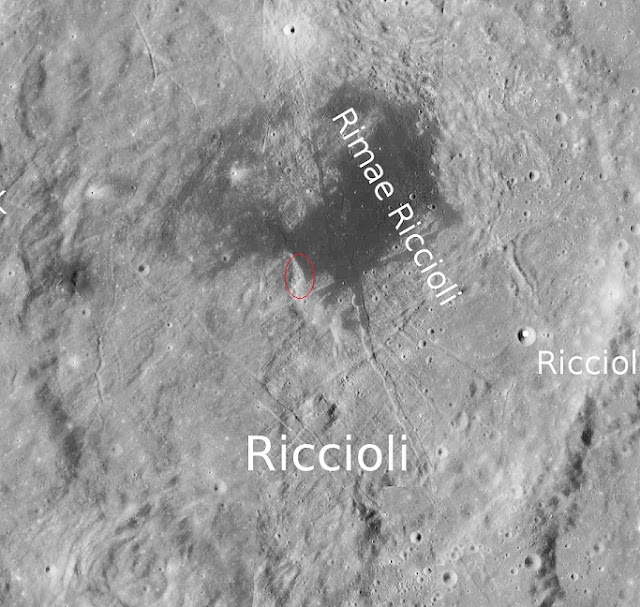 Heavily degraded Riccioli crater. The red oval marks a possible outpost site on the interior uplift. Light-colored ejecta from Mare Orientale (out of shot to the southwest) is discernible over much of the crater. Image credit: NASARiccioli's ancient, complex geology and its position near the Moon's equator and western limb had drawn the gaze of geologist Paul Lowman. At the August 1990 workshop, he advocated for the crater's irregular interior uplift as the site for a geoscience outpost and astronomical observatory. In places, the interior uplift stands more than 800 meters above the crater floor.
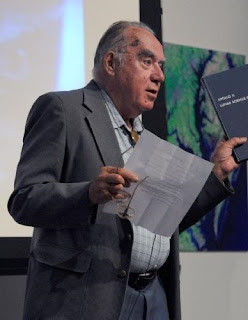 Paul Lowman. Image credit: NASANASA put Lowman on its payroll in 1959. By some accounts, he was the agency's first geologist. He worked at NASA Headquarters in Washington, DC, then moved to the newly built NASA Goddard Space Flight Center in Greenbelt, Maryland, a Washington suburb. He trained Mercury, Gemini, and Apollo astronauts to identify and photograph Earth's geologic features from Earth orbit and participated in the development of Apollo lunar geology experiments. He wrote about future lunar mining as a member of the interagency Working Group on Extraterrestrial Resources; he also took part in an internal NASA study of a temporary lunar outpost based on Lunar Module spacecraft and other Apollo technology.
After Apollo, Lowman participated in Skylab Earth observation experiments and the Landsat Program. The Earth-orbiting Landsat automated satellites sought resources and monitored the environment on Earth.
Lowman assumed that geologist-astronauts at Riccioli outpost would have at their disposal several rovers equipped as campers. He planned three traverses within Riccioli, each about 100 kilometers long with multiple stops. The traverses would each last several days.
Traverse 1 would begin with a sample stop just outside the outpost's front door. Lowman believed that the Riccioli interior uplift might include some of the oldest lunar crust. From there, the geologist-astronauts would drive across the dark mare to sample light plains material — probable ejecta from the Orientale basin — on Riccioli's northeast rim. The Orientale ejecta, he asserted, could contain pieces of mantle material from deep within the Moon.
Lowman's Traverse 2 would explore criss-cross grabens and rilles (canyons) in search of recent volcanism. Lowman hoped that the explorers might uncover water-rich minerals they could mine.
During Traverse 3, they would sample craters with dark haloes along the Riccioli southeast rim about 50 kilometers from the outpost. Lowman believed that the dark haloes could be signs of relatively recent volcanism; that the craters they surround could be volcanic vents and the haloes erupted volcanic material. Alternately, the impacts that blasted out the craters might have exposed ancient dark deposits buried beneath Orientale basin ejecta.
Lowman expected that geologist-astronauts would build on the exploration experience they gained in Riccioli crater to rove beyond its degraded walls. Riccioli is located in the Moon's "wild west," a region of complex geology that even today is in many ways mysterious. Lowman named as geologic exploration targets within a few hundred kilometers of Riccioli the ring mountains and small mare plains of Mare Orientale; the Reiner Gamma swirls, a prominent magnetic anomaly; the Marius Hills volcanic complex, an Apollo candidate landing site; and bright Aristarchus crater.
Astronomers based at near-equatorial Riccioli outpost could, Lowman added, observe nearly the entire celestial sphere every month. He suggested that the generally level Riccioli crater floor could provide a stable platform for groups of sensitive astronomical instruments that had to be kept carefully aligned to function properly. A cluster of carefully aligned small telescopes, for example, could act as a single large telescope.
Riccioli crater's near-limb location meant that Earth would stand low in the eastern sky; low enough that at some locations the crater rim and central uplift could hide the home planet from view. Radio telescopes built out of sight of Earth could, he explained, operate without interference from terrestrial artificial and natural radio sources.
Lowman revealed a playful side when he proposed that Riccioli outpost include a bright strobe light. This could be activated when the Moon was at first-quarter phase, when it stands high and half-lit immediately after sunset for observers on Earth. The Sun would not yet have risen at Riccioli crater, so the blinking strobe would stand out against the dark part of the first-quarter lunar disk.
SEI excited scientists, engineers, and space enthusiasts, but it never gained much traction with Congress and the wider public. Because of this, it ended soon after President Bush left the Oval Office in January 1993. NASA, meanwhile, turned its efforts toward building the International Space Station in low-Earth orbit in cooperation with its long-time International Partners and Russia.
Lowman, for his part, never stopped advocating for a lunar outpost, and Riccioli crater remained his favorite candidate site. In 1996, taking into account new miniaturized space technology and capable robots, he proposed a mostly automated astronomy outpost in Riccioli crater built up using small, cheap automated landers. Lowman passed away a week after his 80th birthday on 29 September 2011.SourcesA Site Selection Strategy for a Lunar Outpost — Science and Operational Parameters: Determining the Impact of Science and Operational Parameters for Six Sites on the Moon by Simulating the Selection Process, Conclusions of a Workshop, 13-14 August 1990, Solar System Exploration Division, NASA Johnson Space Center, Houston, Texas, pp. 31-36
"Remembering Paul Lowman," Landsat Science (Accessed 9 October 2019)
"Paul Lowman: NASA's 76-Year-Old Maverick," NASA Goddard Space Flight Center, 11 September 2007 (Accessed 9 October 2019)
More InformationAs Gemini Was to an Apollo Lunar Landing by 1970, So Apollo Would Be to a Lunar Base By 1980 (1968)
Harold Urey and the Moon (1961)
Mission to the Mantle: Michael Duke's Moonrise
Source:
http://spaceflighthistory.blogspot.com/2019/10/riccioli-outpost-1990.html
 Wątek: [SHB] Riccioli Outpost (1990) (Przeczytany 1436 razy)