‘It’s like doing an Arctic expedition with German scientists in 1943’: life on the International Space Station at a time of war (2)
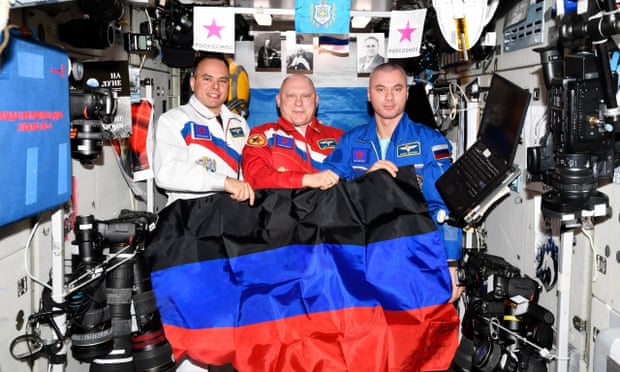 Russian cosmonauts on the ISS take a selfie with the disputed flag of Donetsk last year. Photograph: RoscosmosAt which point, Nasa’s patience finally snapped. The agency deplored the use of the ISS to support the war, reminding Rogozin that it was “fundamentally inconsistent with the station’s primary function”, namely to advance science for peaceful purposes. By Nasa’s usually diplomatic standards this was like lobbing back a nuclear bomb. “In general,” says Gatens, “we’ve been trying not to fan any sort of political flames.” But the statement hit home. Eight days later, Rogozin was fired. “He was leading the Russian space programme into the gutter,” says the American space reporter Eric Berger. And in the process seriously annoying his boss. “Only Putin is allowed to make brushfire statements,” says Cathleen Lewis, curator of international space programmes at the Smithsonian Institution. “And Rogozin out-Putined Putin.”
Rogozin’s replacement was Yury Borisov, a former deputy prime minister and as colourless a figure as Rogozin was not – certainly not one given to making brushfire statements. Things are “much more stable now”, Gatens tells me, with palpable relief. But the really interesting thing is that, for all of Rogozin’s bluster, the relationship held firm. Mission controls in Houston and Moscow still communicated. Nasa maintained staff in Russia and its astronauts would continue to have a seat on the venerable Russian Soyuz, flying to and from the ISS. And, under a new seat-swapping arrangement, Russian cosmonauts would get a ride on one of Elon Musk’s Crew Dragons, a cutting-edge spacecraft that had only begun operations in 2020. It would carry its first Russian, Anna Kikina, to the space station in October 2022, launching from Cape Canaveral.
As for Rogozin, he went on to spend the next few jobless months posing in military uniforms for his Telegram account before a Ukrainian shell exploded on his 59th birthday party in December 2022 at a restaurant in Donetsk, seriously injuring him. He has recently returned to form by casting doubts on the truth of the Apollo moon landings. But the space station has survived.
So much for the partnership: what about relationships between the crews? Take the Russians first. “I do know,” says Berger, “that a lot of cosmonauts are very sympathetic to the war.” Samokutyayev, Virts’ former colleague, is not the only one to have been sanctioned. Many are products of the military, and they only hear one side of the story. “Some of them are completely brainwashed out of their minds. It’s just insane,” claims Scott Kelly, a former Nasa space station commander who returned his Russian space medal in disgust after the invasion.
Here’s one example from last May, when Oleg Novitsky, a former fighter pilot and veteran of three ISS tours between 2012 and 2021, received the Order for Merit of the Fatherland from Putin himself. “At all times,” Novitsky declared, “our enemies, mostly western ones, have tried to seize our land and enslave our people.” He then offered to fight on the frontline, at the age of 51. Also decorated was fellow cosmonaut Pyotr Dubrov, who proclaimed that “today the masks are thrown off and western nazism has shown its true face to the world”.
It might come as a surprise to learn that Novitsky and Dubrov are those same “dear friends” with whom Vande Hei lived on the space station. But what matters is who’s listening. “These incidents are certainly provocative,” says Lewis, “but directed toward their audience on the ground, not their colleagues on the space station.” And there are some cosmonauts who feel very differently about the war; they just won’t tell you because it’s too dangerous. Every one of the eight western astronauts I speak to has essentially stopped communicating with their Russian colleagues or, on the very rare occasions that they do, never about politics. Apart from anything, it could put the Russians at risk. “People are turning each other in,” says Kelly. “I don’t want to compromise anybody’s security.” For the same reason, not a single cosmonaut has openly opposed the war. Only one, Gennady Padalka, who clocked up a record 879 days in space, made a mildly questioning comment in the since-banned newspaper Novaya Gazeta. That was 16 days after the invasion. He has not spoken out since.
But try to discuss the war’s impact on current crew members with space agency insiders and the response is an almost visceral recoil. “This is not an easy call to take, I can tell you,” says De Winne. Choosing his words carefully, he says he hasn’t seen “any deterioration in crew dynamics”. But he acknowledges that “it is extremely stressful for our crews to be there in those circumstances”. Spending long periods in a confined environment is hard, he explains – as a space station commander himself in 2009, he would know – but the war “adds a layer of discomfort”.
Very few serving astronauts will admit publicly what that layer feels like. Vande Hei is one, revealing at his post-flight press conference in April 2022 that the war was “heartbreaking” and had left all his crewmates, Russians included, feeling “powerless”. They discussed it, he said, and then got on with the mission. His German colleague, Matthias Maurer, who returned to Earth a month later, described seeing “huge clouds of smoke over cities like Mariupol” and rocket hits on Kyiv. “We raised the issue very quickly and proactively. All six, seven of us immediately agreed that it’s a horrible situation. We were all shocked, the Russian colleagues, the American colleagues – nobody could understand what was happening down there.”
But Vande Hei and Maurer are exceptions. The rule in press conferences is to focus on the mission, not the war; any questions about “crew dynamics” are briefly dealt with, then swatted away like flies. When I ask De Winne if I can speak to Maurer or another of his astronauts who have been on the ISS recently, I can almost hear the shutters slamming down. Repeated requests over the following weeks draw a blank. At Nasa it is the same story: no astronauts are available. But I keep trying.
Meanwhile, I gather clues from astronauts who have left the job and are less constrained. Patterns of behaviour emerge: inevitably those working on the ISS are bonded by the common purpose, the shared passions. “The war is an elephant on the station,” says Thirsk, “but cosmonauts are very similar to western astronauts in many ways. We’ve all dreamed about flying in space since we were young, we’re all geeks. And after a few days or weeks you sort of lose your sense of national identity – it goes to the back of your brain.”
Those bonds are strengthened by the shared dangers. In July 2015, Kelly and his two Russian crewmates had just 90 minutes’ notice to hunker down in their Soyuz escape capsule as a hail of space debris hurtled past the station. ”You literally rely on each other for your life,” he says. Nor was this an isolated incident. With an ever-increasing amount of space junk and satellites in low orbit, the ISS has to manoeuvre to avoid collisions almost every year. In November 2021, just three months before the invasion, all seven crew members – including two Russians – were forced to take temporary refuge in their escape capsules after 1,500 pieces of trackable debris from a Russian anti-satellite missile test threatened the station. Fortunately, they missed – but the same debris field keeps coming back.
Even Virts, who argues that continuing to allow Russians to fly on American spacecraft and vice versa is an “outrage”, nevertheless accepts that things are different once you’re up there. “Politics is politics. We’re not going to change politics so let’s just try not to die in the vacuum of space. Let’s work together as a crew.”
That capacity is hardwired in the selection process. Out of almost 23,000 astronaut applications the Esa received last year, De Winne reveals, individuals were chosen partly for what he calls their “stress resistance”. To stiffen that resistance further, Nasa has various training tricks up its sleeve. One of them is the NASA Extreme Environment Mission Operations (NEEMO), an underwater habitat on the ocean floor off the coast of Florida, where astronaut trainees spend time learning to cope without tearing each other’s eyes out. Another is the gruelling team expeditions run by the US National Outdoor Leadership School in the wilder parts of America.
Steve Swanson, a former Nasa flight engineer, did one of those and never forgot the lessons it taught him. His 10-day stint on an island in the Pacific north-west was to prove crucial after he docked at the ISS in March 2014 in a Soyuz with two Russian crewmates. They arrived within days of Putin’s annexation of Crimea. Things got awkward when one cosmonaut, Aleksandr Skvortsov, told Swanson his Russian brother had been thrown out of Ukraine. Over and again he insisted that Ukrainians were Nazis and hooligans. “He was really, really upset,” says Swanson. “But I wasn’t going to tell him what I thought about it, because that wasn’t going to help the situation. I let him talk. Because he needed to vent.”
Such voices help illuminate life on the station today. But I keep hoping for an eyewitness who has been there since the invasion. And then I find Mike López-Alegría, who has been an astronaut for longer than the ISS has existed. He first flew there on the space shuttle in 2000 and went back again, in 2002 and 2006-7. By then he had performed 10 spacewalks, more than any other US astronaut at the time. “It is an amazing experience to be a human satellite,” he tells me with awe. “You’re out there, you’ve got this suit that’s protecting you that is a marvel of engineering, that allows you to exist in these unsurvivable conditions … It’s minus 200, it’s plus 200, it’s a vacuum, it’s full of radiation. It’s very exhilarating. I would do it again a hundred times.”
In 2012, López-Alegría left Nasa, but last year, at the age of 63, he was back on the station. By then, he’d joined Axiom, a rising company in today’s brave new world of space commerce whose plan is to build the world’s first commercial space station from 2025, complete with interior designs by Philippe Starck. López-Alegría’s mission was to chaperone three space tourists, Larry Connor, Mark Pathy and Eytan Stibbe, to the ISS. López-Alegría won’t be drawn on the price per seat, but $50m-plus is “in the ballpark”. They arrived on 9 April 2022, just six weeks after the invasion. And since he is retired from Nasa, López-Alegría can talk about it.
He stayed for 15 days. Apart from noticing how much had changed since 2007 – “There seems to be stuff everywhere, it’s just loaded with laptops and cables,” he says – he noted that none of the inhabitants (three Americans, three Russians and Maurer, a German) mentioned the war. “Whatever was going on wasn’t going on,” he says. “It was as if nothing like that was going on on the planet.” As a guest, López-Alegría never brought the subject up. “Why would you disrupt the harmony? I think you just let it go.”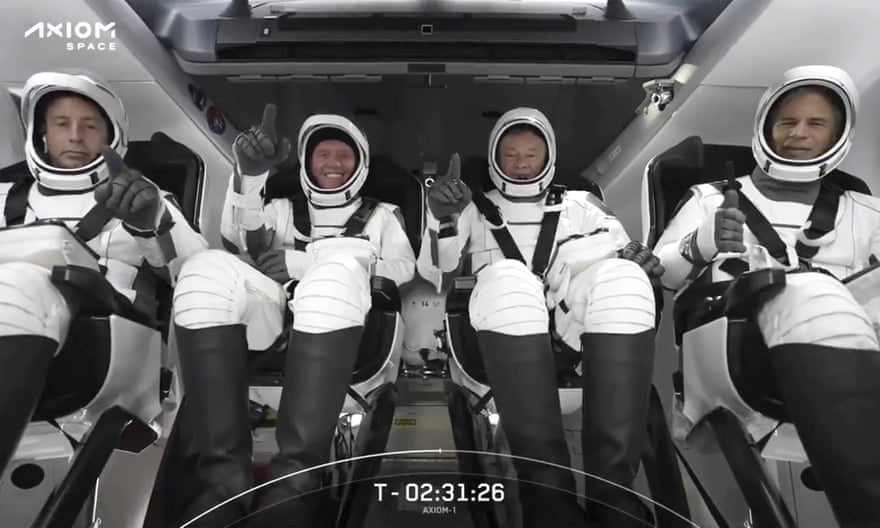 Astronaut Mike López-Alegría (second right) chaperones three space tourists to the ISS last year. Photograph: APEven with your fellow Americans, I ask. López-Alegría pauses. “I think sometimes we talked about not discussing it.” Meanwhile, the Russians “were extraordinarily gracious”. On their two Saturday nights everybody met to watch movies. They saw The Princess Bride and Salyut 7, a Russian film loosely based on reality about a damaged Soviet space station the Americans attempt (and fail) to kidnap during the cold war. Whatever the ironies of that choice, nobody spelled them out. On the Orthodox Easter, the cosmonauts invited them to join the celebrations. They had dessert and Russian tea and one of them, Oleg Artemyev, gave them gifts – special cookies prepared by his wife. “It was lovely,” López-Alegría says. The Russians even let them use their toilet when the American one broke down. In fact, it broke down twice.
Nothing in López-Alegría’s story contradicts the impressions I’ve heard already. But here’s the thing. Just four days after he departed on 24 April, two of those cosmonauts, Denis Matveev and Artemyev of the homemade cookies, went on to unfurl that inflammatory Russian victory banner on their spacewalk. And all three cosmonauts posed that July with the flags of Donetsk and Luhansk. Perhaps again, it is the home audience that counts. “But it made me sad,” López-Alegría says, “because those guys have to do what they’re told.” And then he adds: “I don’t want to speculate as to where they are personally on that topic, but even if they were all for it, I think it’s not lost on them that using that platform for that kind of message is inappropriate.”
I don’t know if the ISS is a symbol or not. But it’s the best example of how we should all behave on the ground
That sadness touches everyone I speak to in this small community. Swanson also flew with Artemyev, remembering him as “just a wonderful person, the nicest guy. But you never know what’s going on there.”
Meanwhile, every attempt I make to reach a Russian cosmonaut for this piece hits brick walls. When I ask one Russian space insider who prefers not to be identified if he can help, he tells me bluntly: “I don’t know any such person in Russia who will talk openly these days. It’s the wrong time. Trust me. The country is busy with other problems.” Russian cosmonaut Alexander Misurkin. Photograph: Anadolu Agency/Getty ImagesThen, finally, through a friend of a friend, I do find someone. Alexander Misurkin has flown three times on the ISS, most recently in 2021, returning just two months before the invasion. I do not know his politics and we keep our Zoom conversation, very likely to be monitored, non-political – indeed, in a slightly surreal twist, some of it revolves around his love of badminton. He talks enthusiastically about his career in space, and his affection for his fellow crew members feels very genuine. And the more we talk, the more it strikes me that our interaction curiously mirrors those of the crews’: chat about sports, family, the job, everything else, but no politics. Then he tells a story that he says still haunts him to this day.
In 2013, the Italian astronaut Luca Parmitano was on a spacewalk when his helmet began to fill with water from a leak. Misurkin was inside as the emergency rapidly unfolded. Out in the void, the water rose up Parmitano’s face. “He almost sank inside his spacesuit.” Somehow he was able to get back through the airlock – “It is still unbelievable for me how he managed it” – and everyone, Russians and Americans, came together to pull off his helmet, get him breathing and save his life. “It was the most dangerous situation in all my space experience,” says Misurkin. “Thank God he lived.” He stops for a moment, reliving the drama. And then, with real feeling, he says: “I don’t know if the International Space Station is a symbol or not. But I do know for sure it’s the best example of how we should all behave on the ground.”
If it is, it’s all Russia has now got. While America and its allies, and China on its own, forge ahead with new space stations, a return to the moon and ultimately Mars, Russia’s only real human space programme today is the 25-year-old ISS. That is one legacy of Putin’s terrible war. Sanctions and isolation have done the rest. The tech is ageing, the money is running out, the equipment sometimes defective. defective. And the blows keep falling. Only last week Luna-25, the first Russian probe to return to the moon in almost half a century, crashed onto the surface just four days before an Indian probe landed there successfully. Within the last year, two Russian spaceships docked at the ISS experienced alarming coolant leaks in identical systems, suggesting serious production deficiencies on the ground. And, as I saw for myself in late 2019, the spaceport at Baikonur in Kazakhstan from where Yuri Gagarin launched into history in 1961 is visibly decaying, with its faded Soviet murals, crumbling buildings and stray dogs running wild.
Once, the world marvelled at the nation that sent the first human being into space. But the world has moved on. The Russians talk about building their own space station or going to the moon or collaborating with China but, as Zak says: “The key word is talking. Russia has nothing. Russia has nowhere to go without the ISS.”
Meanwhile, the station soldiers on, the first and perhaps the last great collaboration of its kind. And barring Putin doing something really stupid – in which case, as Gatens tells me drily, “our leadership would definitely have some conversations” – it will get to live out its final few years, carving elliptical orbits of the planet while the men and women on board continue to perform their experiments, to eat, sleep, watch movies together, celebrate each other’s holidays, take in the views, avoid talking politics and, in the last resort, look out for each other. You may even spot it in the sky one clear night, a brilliant star moving steadily west to east as its acre of solar panels catch the sunlight below the horizon, a moral embarrassment for some, a beacon of hope for others. But undeniably astonishing.@SWalkerBeyond
https://twitter.com/SWalkerBEYOND Beyond – The Astonishing Story of the First Human to Leave Our Planet and Journey into Space by Stephen Walker is published by HarperCollins. To support the Guardian and the Observer, buy your copy from guardianbookshop.com. Delivery charges may apply.
Source:
https://www.theguardian.com/science/2023/aug/26/its-like-doing-an-arctic-expedition-with-german-scientists-in-1943-life-on-the-international-space-station-at-a-time-of-war
 Wątek: [TG] ‘It’s like doing an Arctic expedition with German scientists in 1943’ (Przeczytany 1851 razy)