Visions of Spaceflight: Circa 2001 (1984) (2)
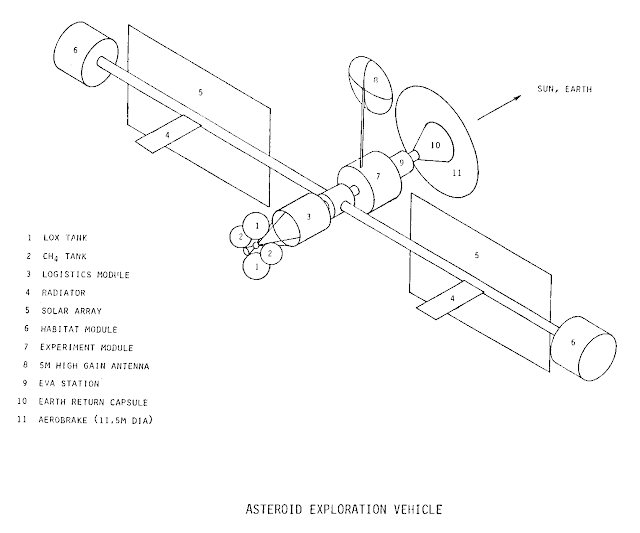 Of the spacecraft SAIC proposed, the asteroid mission spacecraft would venture farthest from the Sun. Please click on the image to enlarge. Image credit: Science Applications International Corporation.The astronauts would each use a Manned Maneuvering Unit (MMU) to transfer from the spacecraft to 1982DB. The asteroid mission MMUs, modeled on the MMU first tested during Space Shuttle mission STS-41B (3-11 February 1984), would use gaseous nitrogen as propellant.
 The exploration of Earth-approaching asteroid 1982 DB. Image credit: Michael Carroll.The SAIC team noted that 1982DB would have "negligible gravitational attraction," so the asteroid mission spacecraft would be unable to orbit it in a conventional sense. Spacecraft and asteroid would instead share nearly the same orbit around the Sun. 1982DB would, meanwhile, rotate at some unknown rate. The asteroid's rotation would mean that astronauts at a site of interest on its surface would tend to be move away from their spacecraft. In fact, if 1982DB rotated quickly enough, astronauts on its surface might pass out of sight of the spacecraft during their four-hour "asteroid-walks."
The SAIC team judged that loss of radio and visual contact with the surface crew would be undesirable, so proposed that the astronaut left behind on the spacecraft perform station-keeping maneuvers to match 1982DB's rotation; that is, that the astronaut keep his or her shipmates in sight by maintaining a "forced circular orbit" around 1982DB. The team budgeted enough secondary propulsion system storable propellants for a velocity change of 32.5 feet (10 meters) per second per surface visit.
If 1982DB were found to rotate slowly, then the velocity change needed to maintain the spacecraft in its forced orbit would be reduced. In that case, only astronaut stamina, the supply of MMU propellant, and the mission's planned 30-day stay-time near 1982DB would limit the number of surface visits. The SAIC team envisioned that the astronauts might explore as many as 10 sites. After each surface excursion, the spacecraft would resume stationkeeping several tens of miles/kilometers away from 1982DB.
The SAIC team assumed that 1982DB would measure 0.62 miles (one kilometer) in diameter. They noted that an asteroid of that size would have roughly the same area as New York City's Central Park (1.32 square miles/3.41 square kilometers). Based on this comparison, they judged that "a 30-day stay time should provide ample time to complete a thorough investigation of the object." (I would argue that 10 four-hour visits to Central Park would be nowhere near sufficient to characterize it, but presumably 1982DB would lack the many unique amenities and diverse population of the iconic urban oasis.)
During their surface visits, the astronauts would deploy four small and three large experiment packages on 1982DB and would collect a total of 330 pounds (150 kilograms) of samples. The 110-pound (50-kilogram) small experiment packages would each include a seismometer and instruments for measuring temperature and determining surface composition. The 220-pound (100-kilogram) large packages would include a "deep core drill," a sensor package for insertion into the core hole, and a mortar.
After the spacecraft resumed station-keeping for the last time, the crew would remotely fire the mortars in succession to send shockwaves through 1982DB. The seismometers would register the shockwaves, enabling scientists to chart the asteroid's interior structure.
On 12 October 2001, the asteroid mission spacecraft would use the primary propulsion system for the last time to depart 1982DB. Using the secondary propulsion system, the crew would bend its trajectory so that it would almost intersect Earth. They would then spin up the spacecraft to restore artificial gravity in the hollow arms and habitats.
Three months later, they would load their samples, film, and other data products into the Earth-return capsule and undock from the spacecraft. On 13 January 2002, almost exactly two years after Earth departure, the crew would aerobrake their capsule in Earth's atmosphere and pilot it to a rendezvous with the Space Station. Meanwhile, the abandoned asteroid mission spacecraft would swing by Earth and enter a disposal orbit around the Sun. Although designated the Mars Exploration Vehicle in this illustration, SAIC designated this three-part spacecraft the Mars Outbound Vehicle (MOV) in its report text. It would become the Mars Exploration Vehicle only after it cast off the Interplanetary Vehicle (lower left). Please click on the image to enlarge. Image credit: Science Applications International Corporation.SAIC's third proposed project, the first piloted Mars landing, would employ a four astronauts and six spacecraft (not counting OTVs). The largest spacecraft combination, the 265,880-pound (120,600-kilogram) Mars Outbound Vehicle (MOV), would comprise the 43,870-pound (19,600-kilogram) Interplanetary Vehicle (spacecraft 1), the 25,130-pound (11,400-kilogram) Mars Orbiter (spacecraft 2), and the conical 83,555-pound (37,900-kilogram) Mars Lander (spacecraft 3). The Mars Orbiter and Mars Lander together would comprise the Mars Exploration Vehicle.
The Interplanetary Vehicle would resemble the SAIC team's asteroid mission spacecraft, though it would lack an Earth-return capsule and would move through space with its logistics module pointed toward the Sun. The Interplanetary Vehicle's hub, twin hollow arms, and twin habitats would revolve three times per minute.
The Interplanetary Vehicle's EVA station would link it to the Mars Orbiter, a bare-bones, non-rotating vehicle made up of a single habitat module and hollow arm, a solar array, a radiator, a radio dish antenna, an EVA station, an unspecified propulsion system, and the conical Mars Departure Vehicle (spacecraft 4). The Mars Orbiter EVA station would link it to the Mars Lander ascent stage. The Mars Lander would include a 175.5-foot-diameter (54-meter-diameter) flattened-cone aerobrake. The Earth Return Vehicle would leave Earth first but reach Mars 30 days after the Mars Outbound Vehicle. Please click on the image to enlarge. Image credit: Science Applications International Corporation.SAIC's second, smaller Mars mission spacecraft combination, the 94,600-pound (43,000-kilogram) Earth Return Vehicle (ERV) (spacecraft 5), would resemble the asteroid mission spacecraft even more closely than would the Mars mission Interplanetary Vehicle. The ERV, which would include the 9750-pound (4430-kilogram) Earth Return Capsule (spacecraft 6), would depart Earth ahead of the MOV, on 5 June 2003, but would follow a Sun-centered path that would cause it to reach Mars after the MOV, on 23 January 2004. It would leave LEO with no crew on board.
A total of five Shuttle launches, each capable of putting into LEO 60,000 pounds (27,270 kilograms), would launch ERV and OTV parts and propellants to the Station. ASE would make up 5000 pounds (2268 kilograms) of each Shuttle Orbiter payload.
Three OTVs (two based permanently at the Station plus one assembled specifically for the Mars mission) would then launch the ERV toward Mars. Each OTV would in succession ignite its engines at perigee to increase the ERV's apogee, then would separate. OTV #1 would use its twin engines to return to the Station after separation, OTV #2 would rely on its aerobrake heat shield, and OTV #3 would expend all of its propellants to place the ERV on course for Mars and be discarded. The ERV's three-orbit Earth-departure sequence would last about six hours.
The MOV with four astronauts on board would leave Earth orbit 10 days later, on 15 June 2003. Thirteen Space Shuttle launches would place MOV and OTV parts and propellants into Earth orbit. Seven OTVs would perform perigee burns over the space of a little more than two days to boost the 265,300-pound (120,600-kilogram) MOV toward Mars. Following separation, OTV #1 would ignite its engines at perigee to return to the Station; OTVs #2 through #6 would return to the Station after aerobraking; and OTV #7 would burn all of its propellants and be discarded.
The MOV would arrive at Mars on 24 December 2003, 30 days ahead of the ERV. Assuming that telemetry from the ERV indicated that it remained able to support a crew, the MOV crew would cast off the Interplanetary Vehicle (this is depicted in the image at the top of this post), strap into the Mars Lander ascent capsule, and aerobrake in the martian atmosphere. The abandoned Interplanetary Vehicle would swing past Mars and enter solar orbit.
Following aerobraking, the two-part Mars Exploration Vehicle would climb to an apoapsis (orbit high point) of 600 miles (1000 kilometers). The Mars Orbiter and Mars Lander would then separate. One astronaut would remain on board the Mars Orbiter. He or she would ignite its propulsion system at apoapsis to raise its periapsis (orbit low point) to 600 miles (1000 kilometers), giving it a circular orbit about the red planet. The three astronauts in the Mars Lander, meanwhile, would fire its engine briefly at apoapsis to raise its periapsis to an altitude just above the martian atmosphere.
As the planet rotated beneath the Mars Lander, the three astronauts would prepare for atmosphere entry and landing. As the target Mars landing site came into range, they would ignite the Mars Lander engine at apoapsis, lowering their periapsis into the atmosphere. They would cast off the aerobrake after atmosphere entry and lower to a soft landing using the Mars Lander descent engine.
Immediately after touchdown, the crew would deploy a teleoperated rover. Trailing power cables, the rover would carry a small nuclear reactor a safe distance away from the Mars Lander and bury it. The crew would then remotely activate the reactor to supply their encampment with electricity.
SAIC's Mars mission would, of course, have a range of cruise, Mars orbital, and Mars surface science objectives. The study team explained that, during the six-month Earth-Mars cruise, the astronauts on board the Interplanetary Vehicle would have at their disposal a cruise science payload identical to that carried on board the asteroid mission spacecraft.
Human physiology studies during the trip to Mars would, in addition to any scientific objectives, have a prosaic operational goal: they would emphasize keeping the Mars landing crew in good shape for strenuous activity on the planet. The astronauts would also observe the Sun for science and to detect solar flares that might cause them harm.
The one-person Mars Orbiter and three-person Mars Lander crews would have many objectives at Mars, some primarily scientific and others primarily operational. The "primary duty" of the lone astronaut on board the Mars Orbiter would be to support the surface crew, the SAIC team explained. Four hundred and forty pounds (200 kilograms) of remote sensors would enable her or him to spot threatening weather conditions near the landing site and generate detailed maps of landing site terrain and surface composition for both the crew on Mars and scientists and mission controllers on Earth.
The surface crew would have as "a major goal" the selection of a future Mars base site, the SAIC team explained. They would have at their disposal 1980 pounds (900 kilograms) of science equipment, including a 220-pound (100-kilogram) Mobile Geophysics Lab rover, 110 pounds (50 kilograms) of high-resolution cameras, four small deployable science packages with a mass of 110 pounds (50 kilograms) each, and three large deployable science packages with a total mass of 880 pounds (400 kilograms) each.
The small packages would measure temperature, detect Marsquakes, and determine surface composition, while the large packages would include a 440-pound (200-kilogram) deep-core drill, a 220-pound (100-kilogram) sensor package for insertion down core holes, and a mortar for generating shock waves that the seismometers in the small packages would register, permitting scientists on Earth to understand the subsurface structure of the landing site. The surface crew would also set up an inflatable "tent" in which they would begin examination of the 550 pounds (250 kilograms) of Mars samples they would collect for return to Earth.
As their stay on Mars reached its end, the surface crew would load their samples, film, and other data products into the Mars Lander ascent stage and blast off to rendezvous and dock with the Mars Orbiter. The nuclear reactor they left behind would power equipment long after they departed. The SAIC team suggested, for example, that it could provide electricity to a device that would extract oxygen from the martian atmosphere and cache it for future Mars base builders.
The ERV, meanwhile, would close in on Mars. Like the asteroid spacecraft, it would move through space with its Earth-return aerobrake pointed toward the Sun.
After docking with the Mars Orbiter, the reunited crew would transfer their surface and orbital Mars data products to the Mars Departure Vehicle, then would undock from the Mars Orbiter and set out in earnest pursuit of their ride home. Because launching it back onto an interplanetary path after crew recovery in Mars orbit would demand considerable quantities of propellants, the ERV would not enter Mars orbit.
Instead, to reduce overall Mars mission mass (and thus the number of Shuttle launches needed to launch it into LEO and and the number of OTVs needed to place it on course for Mars), the crew would rendezvous with the ERV as it raced past the planet on a free-return trajectory that would take it back to Earth after 1.5 orbits around the Sun and 2.5 years of flight time. This approach, which SAIC termed Mars Hyperbolic Rendezvous (MHR), resembled the Flyby Landing Excursion Mode put forward by Republic Aviation engineer R. Titus in 1966. SAIC did not reference his pioneering work.
As might be expected, the SAIC team felt it necessary to study possible contingency modes for crew recovery in the event that MHR failed. If, for example, the unmanned ERV malfunctioned en route to Mars before the crew discarded the Interplanetary Vehicle and aerobraked the Mars Exploration Vehicle into Mars orbit, the astronauts could perform a powered Mars swingby maneuver using the Mars Lander and Mars Orbiter propulsion systems, bending their course so that they would intercept Earth 2.5 years later. The crew would separate in the Mars Lander near Earth and use its aerobrake to capture into Earth orbit.
Assuming, however, that all occurred as planned, the Mars Departure Vehicle would dock with the ERV a few hours after leaving Mars orbit. As Mars shrank behind them, the astronauts would transfer to the ERV with their samples and other data products, cast off the spent Mars Departure Vehicle, and spin the ERV's arms and habitats to create acceleration.
During the 2.5-year cruise home to Earth, the astronauts would study human physiology, the Sun, and astrophysics using a science payload identical to that carried on board the Mars mission Interplanetary Vehicle and the asteroid mission spacecraft. The SAIC team suggested that they might also continue study of the samples they had collected on Mars, though they did not indicate how this would be accomplished in the absence of a sample isolation lab, instruments, and tools.
On 5 June 2006, three years to the day after they left Earth, the crew would undock in the Earth Return Capsule, aerobrake in Earth's atmosphere, and rendezvous with the Space Station. The abandoned ERV, meanwhile, would swing past Earth and enter solar orbit.
SAIC offered preliminary cost estimates for its three projects and compared them with the cost of the Apollo Program, which encompassed 11 piloted missions, six of which landed two-man crews on the Moon. A dispassionate observer might be forgiven for believing that SAIC's cost estimates were unrealistically low. Partly this was the result of Shuttle cost accounting. Taking its lead from NASA, the SAIC team calculated that the 18 Shuttle flights needed for its Mars mission would cost only $2 billion, or about $110 million per flight.
The lunar base site survey would, the SAIC planners calculated, cost only $16.5 billion, or about a quarter of the Apollo Program's $75 billion cost in 1984 dollars. The asteroid mission would be slightly cheaper, coming in at $16.3 billion. The Mars mission, not surprisingly, would be the most costly of the three. Even so, it would only cost about half as much as Apollo; SAIC estimated that it would cost just $38.5 billion. Launch of Space Shuttle Orbiter Challenger on 28 January 1986. Image credit: NASA.Just 15 months after SAIC turned over its study to The Planetary Society, the optimistic era of piloted mission planning that had begun with the first Space Shuttle launch drew to a close. Following the loss of the Shuttle Orbiter Challenger on 28 January 1986, at the start of the 25th Shuttle mission, advance planning did not stop; in fact, it expanded as NASA sought to demonstrate that the Shuttle and Station Programs had worthwhile long-term objectives, and thus should continue in spite of Challenger.
The rules, however, had changed. After Challenger, few planners assumed that the Space Station President Reagan had called for in January 1984 would ever become an LEO spaceport, and even fewer assumed that Shuttle Orbiters alone would suffice to launch the components and propellants needed for piloted missions beyond LEO.
Post-Challenger plans would call for a purpose-built LEO spaceport to augment the Station and Shuttle-derived heavy-lift rockets to augment the Shuttle. Both of these would increase the estimated cost of piloted exploration beyond LEO.The color art in this post are Copyright © Michael Carroll (http://stock-space-images.com/) and are used by kind permission of the artist.SourcesManned Lunar, Asteroid, and Mars Missions - Visions of Space Flight: Circa 2001, A Conceptual Study of Manned Mission Initiatives, Space Sciences Department, Science Applications International Corporation, September 1984.
"Visions of 2010 - Human Missions to Mars, the Moon and the Asteroids," Louis D. Friedman, The Planetary Report, March/April 1985, pp. 4-6, 22.
More InformationNASA Glenn Research Center's 2001 Plan to Land Humans on Mars Three Years Ago
High Noon on the Moon (1991)
Near-Term and Long-Term Goals: Space Station and Lunar Base (1983-1984)
A New Step in Spaceflight Evolution: To Mars by Flyby-Landing Excursion Mode (1966)
Source:
http://spaceflighthistory.blogspot.com/2020/02/visions-of-spaceflight-circa-2001-1984.html
 Wątek: [SHB] Visions of Spaceflight: Circa 2001 (1984) (Przeczytany 1855 razy)