Autor Wątek: Starty rakiet (I kwartał 2021 roku)  (Przeczytany 32769 razy)

0 użytkowników i 2 Gości przegląda ten wątek.

Offline astropl

  • Moderator
  • *****
  • Wiadomości: 5357
  • Zmieściłem się w Sojuzie :)
    • Loty Kosmiczne
Odp: Starty rakiet (I kwartał 2021 roku)
« Odpowiedź #60 dnia: Marca 31, 2021, 05:53 »

STYCZEŃ 2021

08    02:15             Canaveral 40      Falcon-9R            Türksat 5A
17    19:38:51          Mojave 12/30      B-747/LauncherOne    CACTUS 1, CAPE 3, ExoCube 2, MiTEE 1
                                                               PICS 1, PICS 2, PolarCube, Q-PACE,
                                                               RadFxSat 2, TechEdSat 7, Prometheus 2.9
                                                               Prometheus 2.11

19    16:25:05          Xichang           CZ-3B/G3             Tiantong-1 03
20    07:26             Onenui 1A         Electron/Curie       GMS-T
20    13:02             KSC-39A           Falcon-9R            Starlink x 60
24    15:00             Canaveral 40      Falcon-9R            Starlink x 10, ION SCV LAURENTIUS,
                                                               Hawk-2a, 2b, 2c, GHGSat-C2, ICEYE x 3,
                                                               Izanami, SHERPA-FX, Whitney 1, 2, XR-1,
                                                               ARCE-1a, b, c, ASELSAT, Astrocast x 5,
                                                               Aurora Insight's Charlie, Flock 4s x 48,
                                                               Kepler x 8, Lemur x 8, IDEASSat, PIXL-1,
                                                               Prometheus 2.10, PTD-1, SOMP-2b, UVSQ-SAT,
                                                               V-R3x x 3, YUSAT, SpaceBEE x 36

29    04:47             Jiuquan           CZ-4C                Yaogan 31 Group 02 A, B, C

LUTY 2021

01    08:15             Jiuquan           SQX-1                ? x 6
02    20:45:28          Plesieck 43/4     Sojuz-2.1b           Kosmos 2549 (Lotos-S1)
04    06:19             Canaveral 40      Falcon-9R            Starlink x 60
04    15:36:04          Xichang 3         CZ-3B/G2             TJSW-6
15    04:45:05          Bajkonur 31/6     Sojuz-2.1a           Progress MS-16
16    03:59:37          Canaveral 40      Falcon-9R            Starlink x 60
20    17:36:54          Wallops 0A        Antares-230+         Cygnus NG-15
24    02:22             Jiuquan 43/94     CZ-4C                Yaogan-31 Group-03 A, B, C
28    04:54:00          Sriharikota FLP   PSLV                 Amazonia-1, SDSAT, UNITYsat, SindhuNetra,
                                                               SAI-1 NanoConnect-2, SpaceBEE x 12
28    06:55:01          Bajkonur 31/6     Sojuz-2.1b/Fregat    Arktika-M 1

MARZEC 2021

04    08:24:54          KSC-39A           Falcon-9R            Starlink x 60
11    08:13:29          Canaveral 40      Falcon-9R            Starlink x 60
11    17:51:48          Wenchang 201      CZ-7A                Shiyan-9
13    02:19             Jiuquan 43/94     CZ-4C                Yaogan Weixing-31 Group-4 A, B, C
14    10:01:26          KSC 39A           Falcon-9R            Starlink x 60
22    06:07:13          Bajkonur 31/6     Sojuz-2.1a/Fregat    CAS500-1, GRUS-1 1B, 1C, 1D, 1E,
                                                               ELSA-d Target, ELSA-d Chaser, DMSAT-1,
                                                               SAMSON x 3, BeeSat x 4, CubeSX-HSE,
                                                               Challenge One, CubeSX-Sirius-HSE,
                                                               Hiber-3, GRBAlpha, Kepler x 2,
                                                               KSU_CubeSat, KMSL, LacunaSat2-B,
                                                               NANOSATC-BR2, Najm-1, OrbiCraft-Zorkij,
                                                               Timon, Pumbaa, WildTrackCube, 3B5GSAT,
                                                               Unisat-7, BCCSAT-1, FEES, Wormsail,
                                                               DIY-1, SMOG-1, STECCO
22    22:30             Onenui 1A         Electron/Photon      BlackSky Global-9, Centauri 3, Myriota 7,
                                                               Veery Hatchling, RAAF M2, Gunsmoke-J
24    08:28:24          Canaveral 40      Falcon-9R            Starlink x 60
25    02:47:33          Wostocznyj 1S     Sojuz-2.1b/Fregat-M  OneWeb x 36
30    22:45             Jiuquan 43/94     CZ-4C                Gaofen-12 (02)
__________________________________________________________________________________________
Waldemar Zwierzchlejski
http://lk.astronautilus.pl

Offline Orionid

  • Weteran
  • *****
  • Wiadomości: 29413
  • Very easy - Harrison Schmitt
Odp: Starty rakiet (I kwartał 2021 roku)
« Odpowiedź #61 dnia: Marca 31, 2021, 16:35 »
Kolejny Gaofen
  30.03. o 22:45 z Jiuquan wystrzelona została RN CZ-4C, która wyniosła na orbitę o parametrach: hp=594 km, ha=600 km, i=97,84° satelitę teledetekcyjnego Gaofen-12 (02).
http://lk.astronautilus.pl/n210316.htm#06

Long March-4C launches Gaofen-12-02
1213 wyświetleń•31 mar 2021


China launches new Earth observation satellite
Source: Xinhua| 2021-03-31 07:38:10|Editor: huaxia

JIUQUAN, March 31 (Xinhua) -- China sent a new Earth observation satellite into space from the Jiuquan Satellite Launch Center in northwest China at 6:45 a.m. Wednesday (Beijing Time).

The satellite, Gaofen-12 02, was launched aboard a Long March-4C rocket and entered its planned orbit successfully.

The satellite will be used in land surveys, urban planning, road network design and crop yield estimation, as well as disaster relief.

It was the 364th flight mission of the Long March carrier rocket series.
http://www.xinhuanet.com/english/2021-03/31/c_139848078.htm

China launches second Gaofen-12 Earth observation satellite
by Andrew Jones — March 31, 2021


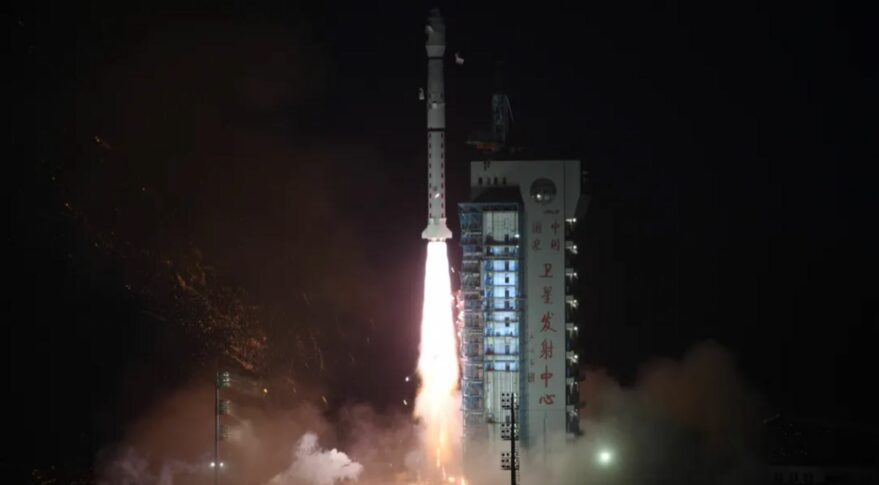
A Long March 4C lifts off carrying the Gaofen-12 (02) satellite from Jiuquan on March 30, 2021. Credit: CASC

HELSINKI — China successfully launched the Gaofen-12 (02) satellite Tuesday, marking latest in a line of high resolution satellites to boost the country’s Earth observation capabilities.

A Long March 4C rocket lifted off from Jiuquan, northwest China at 6:45 p.m. Eastern Tuesday.

The first indication of the upcoming launch came from airspace closure notices, with the type of rocket and mission payload unknown.

The China Aerospace Science and Technology Corp. (CASC) announced launch success within an hour later (Chinese). The release confirmed the Long March 4C rocket and the payload as Gaofen-12 (02).

The Gaofen-12 (02) satellite was sent into 594 x 600 kilometer sun-synchronous orbit, according to U.S. satellite tracking. The first Gaofen-12 was launched into a similar initial orbit in December 2019.

The Gaofen-12 (02) (‘high resolution 12-02’) satellite is nominally part of the civilian China High-resolution Earth Observation System (CHEOS). Chinese media state reports that the satellite will be used in land surveys, urban planning, road network design and crop yield estimation, as well as disaster relief.

The Gaofen-12 (02) satellite was developed by the Shanghai Academy of Spaceflight Technology (SAST), subordinate to CASC, China’s main space contractor. The mission patch includes an eagle with the Atlantic ocean highlighted in a background map.

CHEOS was initiated in 2010 to provide all-weather, all-day coverage with optical and synthetic aperture radar satellites.

Resolution capabilities and other information has been published for lower numbered Gaofen series satellites. However information for Gaofen satellites numbered 8 and above has not been openly released, suggesting the satellites are for national defense purposes.

Renders of the satellite in orbit on shown on state television suggest that satellites such as Gaofen-11 are large (1.5-meter-diameter-plus) aperture optical remote sensing satellites.

An article published by the Chinese Society for Geodesy, Photogrammetry and Cartography (Chinese) states that Gaofen-11 has the capability to return optical imagery at a resolution of around 10 centimeters. The interview-based article claims that this is comparable to the believed capabilities of the U.S. Keyhole classified reconnaissance satellite system.

The Gaofen satellite launch Tuesday was China’s eighth of 2021. CASC states that it plans to launch more than 40 times this year. Other state-owned and commercial companies are also planning launches.

https://spacenews.com/china-launches-second-gaofen-12-earth-observation-satellite/

China launches Gaofen Earth observation satellite
March 30, 2021 Stephen Clark

(...) China says the CHEOS satellite fleet is a civilian-operated program comprising optical and radar imaging spacecraft. Chinese authorities have published high-resolution imagery taken by previous Gaofen satellites, suggesting there is a civilian component to their missions. Other satellites, like the Yaogan series, are for primarily military purposes. (...)

In a post-launch statement, CASC said the Gaofen 12-02 satellite will be used for land surveys, urban planning, road network design, crop yield estimation, and disaster prevention and mitigation.

The CHEOS satellite fleet includes spacecraft with optical and radar imaging instruments. It is not clear whether the Gaofen 12-02 satellite is designed for optical or radar observations.

The first Gaofen 12-type satellite launched on a Long March 4C rocket in November 2019. The Long March 4C rocket can carry a payload of up to 6,600 pounds (3 metric tons) to a 435-mile-high (700-kilometer) polar sun-synchronous orbit, according to CASC.

The Long March 4C launch Tuesday marked China’s eighth orbital launch attempt this year. Seven of the missions have been successful.
https://spaceflightnow.com/2021/03/30/china-launches-gaofen-earth-observation-satellite/

https://www.nasaspaceflight.com/2021/03/gaofen12-2-satellite-launch/

https://space.skyrocket.de/doc_sdat/gf-12.htm
« Ostatnia zmiana: Kwietnia 30, 2021, 15:24 wysłana przez Orionid »

Offline Orionid

  • Weteran
  • *****
  • Wiadomości: 29413
  • Very easy - Harrison Schmitt
Odp: Starty rakiet (I kwartał 2021 roku)
« Odpowiedź #62 dnia: Marca 31, 2021, 16:35 »
Starty kosmiczne w 2021 

Starty wg miesięcy

I  7 (Chiny 2, SpaceX 3, Rocket Lab 1, VO 1)
II 9+1 (16+1) (Chiny 2+1, SpaceX 2, NG 1, Rosja 3, Indie 1)
III  10 (26+1) (Chiny 3, SpaceX 4, Rocket Lab 1, Rosja 2)

W skrócie: ilość startów

Chiny                                             7+1                                                 
USA/Nowa Zelandia (Rocket Lab)      13 (SpaceX 9, ULA 0, NG 1, Virgin Orbit 1, Rocket Lab 2)
Rosja                                             5+0 z Kourou                                                   
Europa (bez europejskich Sojuzów)   0         
Japonia                                          0                                                 
Indie                                              1

__________________________________________________________________________________________

Starty wg ilości wyniesionych satelitów/sond

I  219 (Chiny 4, SpaceX 204, Rocket Lab 1, VO 10)
II 170+6 (Chiny 4+6, SpaceX 120, NG 24, Rosja 3, Indie 19) 389+6
III  327 (Chiny 5, SpaceX 240, Rocket Lab 8, Rosja 74) 716+6


W skrócie: starty wg ilości wyniesionych satelitów/sond (w tym CubeSaty):

Chiny                   13+6                                                 
USA                     607:
     SpaceX           564
     ULA 
     NG                 24
     Virgin Orbit     10
     Astra
     Nowa Zelandia (Rocket Lab)      9
Rosja                                             77+0 z Kourou                                                   
Europa (bez europejskich Sojuzów)   0         
Japonia                                          0                                                 
Indie                                             19

CubSaty

I SpaceX 121  VO 10
II NG ? Indie ?
III Rocket Lab 6 Rosja 19 ?

https://www.forum.kosmonauta.net/index.php?topic=4133.msg146649#msg146649

Polskie Forum Astronautyczne

Odp: Starty rakiet (I kwartał 2021 roku)
« Odpowiedź #62 dnia: Marca 31, 2021, 16:35 »