22/VI 2026 [106-110]106)
The “public” in public space agencyby Alex Li Monday, June 1, 2026
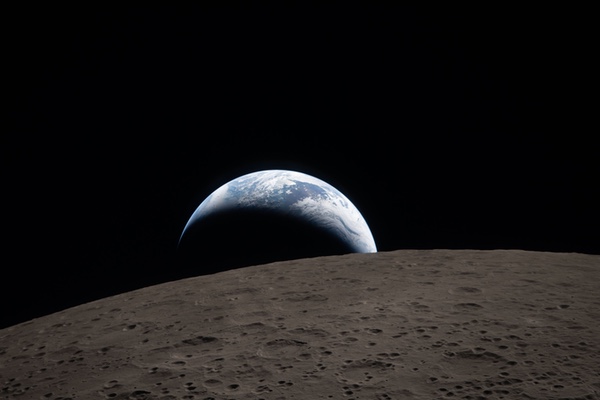 The Earth setting behind the Moon as seen by the Artemis 2 crew. (credit: NASA)“I would suggest to you that when you look up here, you’re not looking at us. We are a mirror reflecting you. And if you like what you see, then just look a little deeper. This is you.”
— Jeremy Hansen, Artemis 2 mission specialist
On April 10, 2026, the Orion spacecraft carrying Reid Wiseman, Victor Glover, Christina Koch, and Jeremy Hansen came home after a nearly ten-day mission around the Moon. The mission took the crew roughly a quarter of a million miles from Earth. At its farthest point, they were farther from home than anyone else had ever gone.
https://www.thespacereview.com/article/5232/1107)
Lost and found on the Pacific floor: the Nimbus SNAP-19 nuclear generatorsby Dwayne A. Day Monday, June 1, 2026
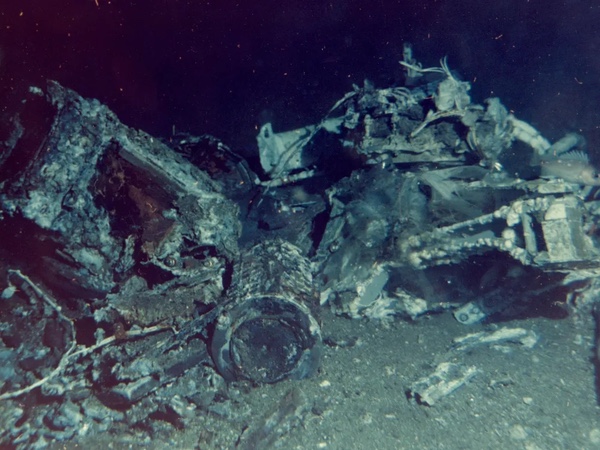 The SNAP-19 debris on the bottom of the Santa Barbara Channel off the California coast. In 1968, several search efforts were mounted to locate the radioactive payload, which proved elusive. (credit: NASA)
On May 18, 1968, a Thorad-Agena rocket carrying the third NASA Nimbus Earth observation satellite lifted off from its pad at Vandenberg Air Force Base on the California coast. As it rose it started to arc out over the Pacific. But within two minutes, as it was over the Santa Barbara Channel, it began straying off course and the flight safety officer blew it to smithereens. Among the debris falling into the water north of San Miguel Island were two SNAP-19 radioisotope thermoelectric generators, or RTGs, carrying plutonium fuel.
The satellite was designated Nimbus B-1. Its RTGs were a new design developed after a 1964 accident involving a Transit satellite equipped with an RTG spread radiation in the atmosphere. They provided about 50 watts of power. The SNAP-19 was designed to contain the radioactive material during an accident. Whereas NASA could have left the rocket and satellite debris where it was, the plutonium had to be recovered.
https://www.thespacereview.com/article/5233/1108)
Debris with telemetry: the cyber pathway to Kesslerby Daniel Morgan Monday, June 1, 2026
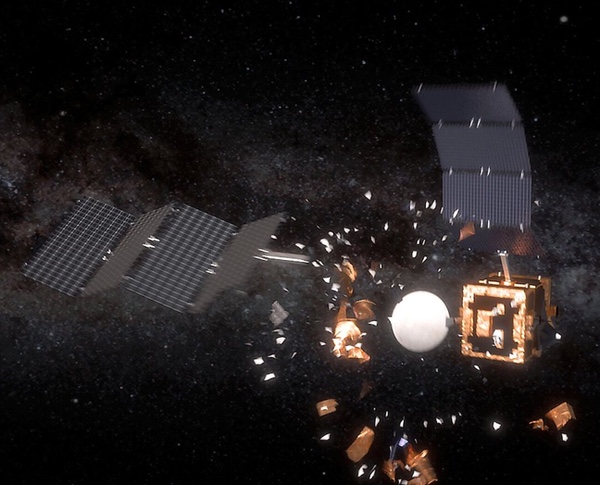 Disabling control of hundreds of megaconstellation satellites could lead to cascading collisions in congested orbits. (credit: ESA/ID&Sense/ONiRiXEL)
It is a Tuesday morning in the late 2020s. At a satellite operations center on the Eastern Seaboard of the United States, a duty controller is halfway through a coffee when the first telemetry anomaly arrives. A spacecraft in the operator’s mid-inclination shell, one of several thousand small satellites at an altitude of roughly 550 kilometers, has failed to acknowledge a routine stationkeeping burn. Ninety seconds later, a second satellite in an adjacent orbital plane reports the same fault. Then a third. In a cascade that takes less than four minutes to develop, 200 satellites across three commercial megaconstellations stop responding to maneuver commands.
https://www.thespacereview.com/article/5234/1109)
Big badaboom: the effects of a Saturn V launch pad explosionby Dwayne A. Day Monday, June 1, 2026
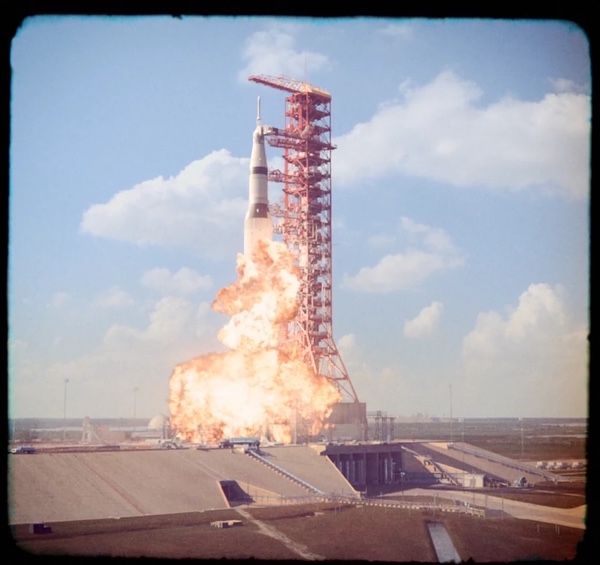 In the AppleTV+ series "For All Mankind," a Saturn V exploded on the launch pad. NASA evaluated this possibility during the Apollo program. (credit: Apple)
On May 28, a New Glenn rocket became the biggest rocket ever to explode on the launch pad. There have been other bigger rocket failures before, most notably a Soviet N1 Moon rocket that blew up above its pad in 1969 and rained fiery hell below—the N1 rocket had more fuel, and made a bigger boom, than the New Glenn. Of course, there have been some innovative Starship failures, a Titan 34D that blew up over its launch pad in 1986, and many smaller missiles and rockets that blew up or over their pads at Cape Canaveral during the 1960s.
Although it was not the biggest, that New Glenn kind of explosion—let’s not call it an “anomaly”—was a concern during the Apollo program of the 1960s. Up until recently, the Saturn V was the largest rocket ever built by the United States. A true monster of a launch vehicle, it generated over 33 million newtons of thrust at liftoff and carried 2.5 million kilograms of fuel and oxidizer. If the Saturn V exploded, it could do so with the force of a small atomic bomb, the equivalent of half a kiloton, or about 1/26th the size of the bomb that destroyed Hiroshima. Naturally, this was a significant concern for Apollo program officials.
https://www.thespacereview.com/article/5235/1110)
Artemis and the blue micromoonby Jeff Foust Monday, June 1, 2026
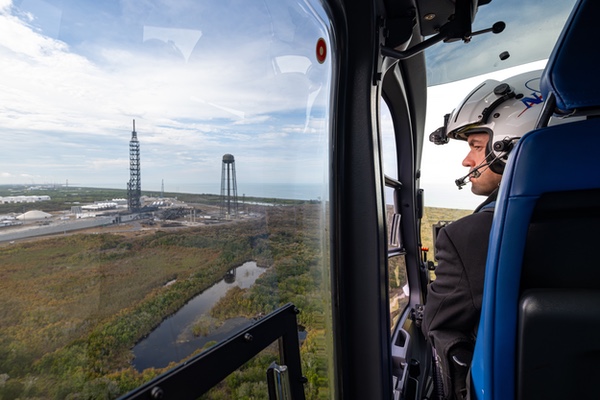 NASA administrator Jared Isaacman surveys the damage to Blue Origin’s Launch Complex 36. (credit: NASA/John Kraus)
The full moon last weekend was called by some a “blue micromoon”. Blue because it was the second full moon of the month, or blue moon. Micromoon came from the fact that the Moon was more distant from the Earth than average, making it appear slightly smaller; the opposite of the “supermoon” hyped in recent years, even though the difference is size is difficult for the unaided eye to notice.
The term might also reflect the mood in the space exploration community over the weekend. Barely 48 hours after NASA provided more details, and nearly $1 billion in contracts, to advance the lunar base plans it announced in March (see “Igniting a new vision for NASA”, The Space Review, March 30, 2026), the agency suffered a serious setback when one of the key vehicles needed for those plans exploded on the launch pad. Just how serious a setback, and how much further away the Moon now seems, is uncertain.
https://www.thespacereview.com/article/5236/123/VI 2026 [111-115]111)
Review: The Ultraview Effectby Jeff Foust Monday, June 8, 2026
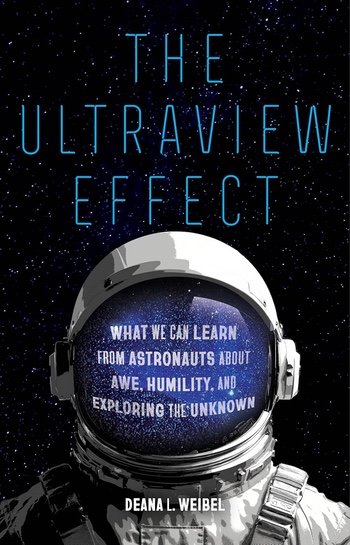 The Ultraview Effect: What We Can Learn from Astronauts about Awe, Humility, and Exploring the Unknown
by Deana L. Weibel
University of California Press, 2026
hardcover, 240 pp., illus.
ISBN 978-0-520-40952-1
US$24.95
https://www.amazon.com/exec/obidos/ASIN/0520409523/spaceviewsThe concept of the “Overview Effect” is widely known in the space community: the change in perspective many people experience when they see the Earth from space. Popularized, and named, by Frank White four decades ago, it is something that today many people anticipate experiencing when going even on suborbital flights, although reactions vary and its significance remains debated (see “The fallacy of the Overview Effect: perception, power, and strategic reality in space,” The Space Review, May 4, 2026, and “Critiquing and defending the Overview Effect,” The Space Review, May 18, 2026.)
https://www.thespacereview.com/article/5237/1112)
The first alien intelligence may not be aliveby David W. Falls Monday, June 8, 2026
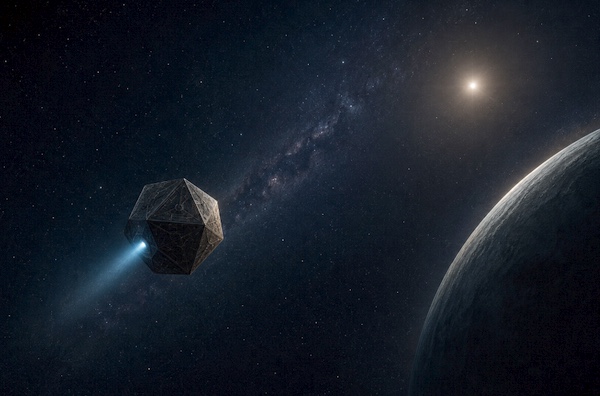 The first sign of extraterrestrial intelligence we discover may not be biological.
If intelligent life exists beyond Earth, we may be picturing the wrong kind of encounter.
Most of us imagine other beings as biological creatures. They may look strange, but we still tend to imagine bodies. Eyes. Limbs. Skin or something like it. A living organism standing on another world, looking back at us. That image is powerful because it keeps alien life close enough to human life for us to understand it.
But the first intelligence we encounter may not be biological at all. It may not breathe, eat, or sleep. It may not reproduce in any ordinary sense. It may not have a face, a voice, or a body shaped by evolution. It may be a machine.
https://www.thespacereview.com/article/5238/1113)
Why the vagueness of the Outer Space Treaty was a strategically calculated moveby Aditya Raj Monday, June 8, 2026
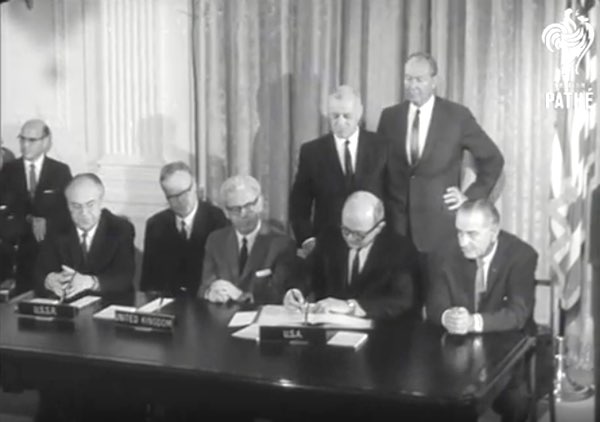 Soviet Ambassador Anatoly F. Dobrynin, UK Ambassador Sir Patrick Dean, US Ambassador Arthur J. Goldberg, US Secretary of State Dean Rusk, and US President Lyndon B. Johnson at the signing of the Outer Space Treaty on January 27, 1967 in Washington. (credit: British Pathé)
The NASA-led Artemis program is ramping up to return humans to the surface of the Moon for the first time since the Apollo 17 mission in 1972. These mission are within the framework of the Artemis Accords.
These accords reaffirm the principles of the 1967 Outer Space Treaty (OST) that are frequently criticized as outdated and geopolitically ambiguous. Yet it’s worth noting that the same criticisms of the treaty’s vague terms helped sustain the primary objective of intergovernmental cooperation and peace. This has occurred even without any major political animosity from the Cold War era to the present. Peaceful relations among spacefaring nation-states are achieved through the stable legal framework for space activities provided by the OST.
https://www.thespacereview.com/article/5239/1114)
America’s most exposed power projection platformsby David G. Hanson Monday, June 8, 2026
Why United States Space Force installations must be treated as warfighting infrastructure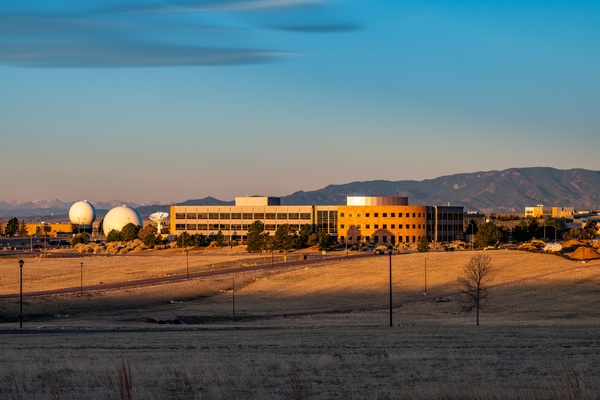 Schriever Space Force Base in Colorado, one of the Space Force facilities that plays key roles in military space operations. (credit: US Space Force photo by Dalton Prejeant)
The United States Space Force (USSF) is unique among the military services not merely because it operates in space, but also because it fights from fixed locations on Earth while delivering effects globally and continuously. Unlike Army brigades, Navy strike groups, Marine Corps expeditionary units, or Air Force wings that deploy into theaters of operation, the Space Force overwhelmingly executes its missions through an employed-in-place operational concept, where combat operations are conducted from permanent installations on U.S. and allied soil. This reality fundamentally alters the strategic importance of Space Force installations.
https://www.thespacereview.com/article/5240/1115)
Yesterday’s Future: space settlement and castles in the skyby Dwayne A. Day Monday, June 8, 2026
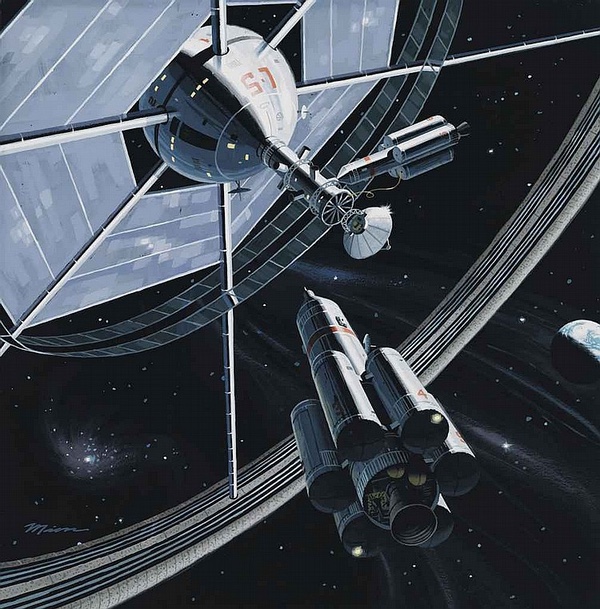 In 1976, Isaac Asimov published an article in National Geographic magazine about a 2026 visit to a giant space station. The article was illustrated by the late Pierre Mion. (credit: Pierre Mion, National Geographic)
Fifty years ago this week, millions of Americans opened up their mailboxes to find the July issue of National Geographic, giving them their first introduction to the idea of cities in space. The issue contained an article by Isaac Asimov about life on a giant space station 50 years in the future—the mysterious and exotic year of 2026.
For most of the 20th century National Geographic was one of the primary ways that Americans learned about the rest of the world, as well as different cultures within the United States. July 1976 was the American bicentennial and National Geographic’s editors chose that issue to include a vision of America’s future 50 years hence.
https://www.thespacereview.com/article/5241/1
 Wątek: The Space Review (Przeczytany 159785 razy)