Apollo Ends at Venus: A 1967 Proposal for Single-Launch Piloted Venus Flybys in 1972, 1973, and 197531 May 2017 David S. F. Portree
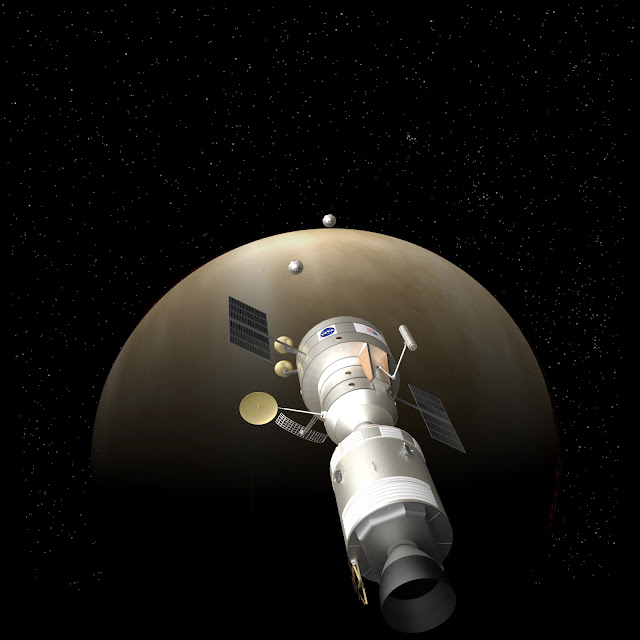 Probe release: the astronauts on board the Apollo Applications Program Venus flyby spacecraft release the last of their atmosphere-entry probes a few hours before closest approach to the cloudy planet. Meanwhile, their optical telescope, scanning radar, and other instruments switch to high-rate data-collection mode. Image credit: William Black.
For many space planners in the early 1960s, piloted Solar System exploration using large "post-Saturn" rockets and nuclear-powered spaceships seemed a natural follow-on to the Apollo lunar program. In November 1964, however, NASA Headquarters announced that its post-Apollo space program would emphasize Earth-orbital space stations based on Saturn/Apollo hardware. Their chief aim: to find space benefits for people on Earth. Agency officials explained that this was in keeping with the wishes of President Lyndon Baines Johnson. NASA critics, meanwhile, derided what they saw as its lack of an overarching goal beyond finding new uses for Apollo hardware.
The Headquarters announcement, the first high-level step on the road to the Apollo Applications Program (AAP), undermined planetary exploration planning. Even before the announcement, however, die-hard Mars planners had begun to study how Saturn/Apollo hardware could be applied to planetary voyages. In February 1965, just three months after the Headquarters announcement, NASA Marshall Space Flight Center's Future Projects Office completed the first study of Apollo-based piloted Mars and Venus flyby missions.
In February 1967, Jack Funk and James Taylor, engineers in the Advanced Mission Design Branch at NASA's Manned Spacecraft Center (MSC) in Houston, Texas, proposed as AAP's "final goal" a series of three Apollo-based piloted Venus flybys. The missions would depart Earth during 30-day launch periods beginning on 4 April 1972, 14 November 1973, and 7 June 1975. Each would require a single unmodified three-stage Saturn V rocket of the type used to launch Apollo missions to the moon, a lightly modified Apollo Command and Service Module (CSM), and a Mission Module (MM) based, perhaps, on the Apollo Orbital Research Laboratory (AORL) under study at the time.
MSC's piloted Venus flyby missions were intended to replace the piloted Mars and Mars/Venus flybys under study by the intercenter NASA Planetary Joint Action Group (JAG). MSC favored a piloted Venus flyby mission followed by a Venus orbiter because they would be of shorter duration and would need less propulsive energy than the Planetary JAG's missions. In MSC's plan, piloted Mars orbiter and piloted Mars landing missions in the late 1970s would follow successful piloted Venus flyby and Venus orbiter missions.
Funk and Taylor's 1972 AAP Venus flyby mission would begin with launch from Cape Kennedy on 2 April 1972. The Saturn V's S-IVB third stage would inject a 66,308-pound CSM with three astronauts on board and a 27,783-pound MM into a 100-nautical-mile circular parking orbit.
The stage would be restarted a few hours later to place itself and its payload into an elliptical orbit with a 70,000-mile apogee (high point above the Earth) and a 48-hour period. Payload injected into the elliptical orbit would total 107,578 pounds, or about 263 pounds beyond expected Apollo Saturn V capacity; Funk and Taylor shrugged off the shortfall, however, saying that it was so small as to be "in the noise level" of their calculations.
 Venus or bust. A = J-2 rocket motor; B = Saturn V S-IVB third stage; C = Spacecraft Launch Adapter (contains Mission Module); D = Apollo Command and Service Module spacecraft. Image credit: NASA
After S-IVB shutdown, the astronauts would detach their CSM from the Spacecraft Launch Adapter (SLA) shroud, turn it end for end, and dock with the MM, which would occupy the volume within the SLA that would contain the Lunar Module during Apollo moon missions. They would use the CSM to pull the MM free of the spent S-IVB stage, then would transfer to the MM to deploy its twin solar arrays, check out its systems, and perform navigational checks during the 24-hour climb to apogee.
The next day, the astronauts would return to their couches in the CSM as the flyby spacecraft neared apogee. They would then fire the Service Propulsion System (SPS) main engine in the CSM's Service Module (SM) to raise the perigee (low point above Earth) of their spacecraft's orbit and tilt its orbital plane relative to Earth's equator. The drum-shaped SM would contain 40,000 pounds of propellants, enabling a total velocity change of 4800 feet per second.
In addition to refining the flyby spacecraft's trajectory for the Venus injection burn, which would occur at perigee, the apogee maneuver would test the SPS. If the engine failed, the astronauts would abort the mission by discarding the MM and lowering the CSM's perigee into Earth's atmosphere by firing special aft-mounted auxiliary attitude control thrusters near apogee. When the CSM approached perigee 24 hours later, they would cast off the SM and reenter in the conical Command Module (CM).
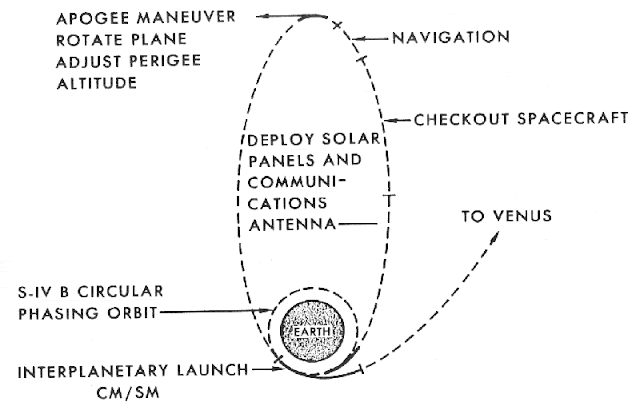 Trans-Venus Injection scenario. See text for explanation. Image credit: NASA
If, on the other hand, the SPS performed the apogee maneuver successfully, the flyby spacecraft would reach perigee outside Earth's atmosphere traveling at 9710 feet per second. The astronauts would then ignite the SPS a second time to add a little more than 3000 feet per second to the flyby spacecraft's velocity and depart Earth orbit for Venus on 5 April 1972. Abort using the SPS would remain possible for six minutes after the completion of the Trans-Venus Injection burn; return to Earth following a post-injection abort could last up to two days.
Immediately after the Trans-Venus Injection burn, the astronauts would shut down the CSM to extend its lifetime and move back to the MM. They would reactivate the CSM three times during the 109-day flight to Venus so that they could perform small course correction burns using the SPS. Course correction navigation would be by Earth-based radar backed up by a hand-held sextant and a navigational computer in the MM.
Funk and Taylor calculated that the CSM would need 2000 pounds of extra meteoroid shielding for a Venus mission. Shielding - probably in the form of a Whipple Bumper (a thin layer of metal or plastic sheeting suspended a few inches from the hull that would break up meteoroids, reducing the damage they could inflict on the spacecraft) - would cover the entire CM and the SM tanks and SPS.
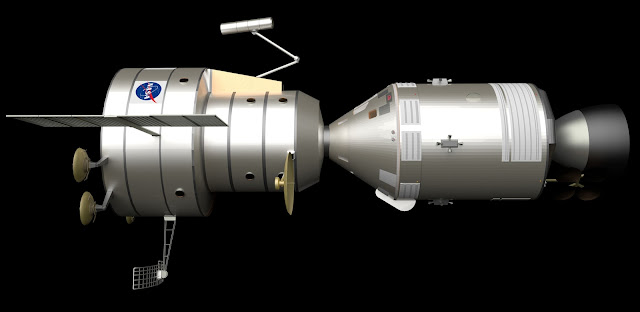 Artist William Black's interpretation of the AAP Venus flyby Mission Module (left) is a clever synthesis and expansion of two candidate designs portrayed in only modest detail in Funk and Taylor's report. The first was a drum-shaped module wasteful of the limited volume within the Spacecraft Launch Adapter (SLA); the second was bell-shaped and thus structurally complex.
  Emphasis on the Mission Module: following detachment from the Saturn V S-IVB stage, the AAP Venus flyby Mission Module would deploy its appendages. These would include four dish antennas for receiving data from atmosphere-entry probes (the probes are shown here arrayed around a circular airlock hatch); a mapping radar antenna (see previous image); twin rectangular solar arrays on booms for making electricity; a tracking optical telescope; and a high-gain radio antenna for communication with Earth. Image credit: William Black
Funk and Taylor based their mission's 3400-pound science experiment package on the Mars flyby science package proposed in the October 1966 Planetary JAG report. It would include impactor probes for obtaining atmosphere measurements during descent, soft landers, cameras, and, if weight growth during its development could be strictly controlled, a 40-inch telescope, but would lack the Mars flyby mission's sample-returner lander. The MIT-built CSM guidance computer would be upgraded and equipped with a tape recorder to allow it to collect and store data from the science instruments for return to Earth.
The astronauts would perform solar, space environmental, and astronomical observations during the Earth-Venus transfer and would begin deploying automated probes a few days before the 23 August 1972 Venus flyby. Closest approach to the planet would occur over the day side.
Using the SPS, the astronauts would perform three small course corrections during the 250-day voyage to Earth. As the homeworld grew in their viewports, the astronauts would transfer to the CSM and undock from the MM. On 30 March 1973, just 359 days after Earth launch, they would carry out a final course correction, then would detach the CM from the SM and re-enter Earth's atmosphere. A beefed-up heat shield would permit the CM to withstand atmosphere reentry at up to 45,000 feet per second (that is, about 9000 feet per second faster than Apollo lunar return speed).
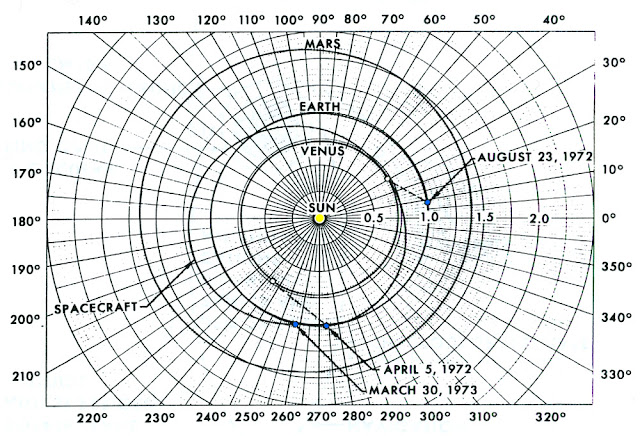 Trajectory and key dates for the Venus flyby mission departing Earth on 5 April 1972. Venus flyby occurs on 23 August 1972; Earth return on 30 March 1973. Image credit: NASA
The second mission in the series would depart Earth on 14 November 1973 and fly past Venus 104 days later. It would reach Earth 252 days after that, for a total mission duration of 356 days. The third mission would leave Earth on 7 June 1975. Passage to Venus would need 115 days and return to Earth 252 days, for a total duration of 367 days.
The 1973 mission Venus flyby spacecraft would need the most propulsive energy to depart Earth orbit for Venus - a total of 12,150 feet per second, or about 70 feet per second more than the 1972 spacecraft and 300 feet per second more than the 1975 spacecraft. The 1972 CM would have the fastest Earth-atmosphere reentry speed (45,000 feet per second), while the 1973 CM would reenter moving at 44,500 feet per second and the 1975 CM at 44,000 feet per second.
Funk and Taylor's AAP Venus flyby plan stands out from the many 1960s plans for piloted flybys because it has been brought to life as fiction. In his 2017 alternate history Island of Clouds: The Great 1972 Venus Flyby, author Gerald Brennan puts narrative meat on the technical skeleton Funk and Taylor presented in their MSC Internal Note.
Told in the first person by a believable fictional Buzz Aldrin, Brennan's tale owes much to the Apollo 11 moon-walker's autobiography Return to Earth (1973). Its focus on exploration far from rescue places Island of Clouds in a class with Hank Searls' classic 1964 adventure The Pilgrim Project (described elsewhere in this blog - click on the last link under "More Information" below).
Six months after Funk and Taylor completed their study, AAP bore the brunt of more than $500 million in Congressional cuts to NASA's Fiscal Year 1968 budget. The program, which for a time in 1966 had been planned to include some 40 Earth-orbital and lunar missions, shrank rapidly during 1968-1969. It was officially renamed the Skylab Program in February 1970. Between May 1973 and February 1974, three three-man crews occupied the Skylab Orbital Workshop in Earth orbit for a total of 173 days.
Robot probes, not astronauts, explored Venus in the 1970s. The Soviet Union's Venera 8 took advantage of the 1972 launch opportunity, leaving Baikonur Cosmodrome in Central Asia on 27 March 1972. The armored probe landed on Venus and transmitted data on its brutal surface conditions for 50 minutes. The U.S. Mariner 10 probe (launched 3 November 1973) flew past Venus en route to Mercury on 5 February 1974.
After skipping the 1973 Venus opportunity to launch Mars probes, the Soviets launched Venera 9 and Venera 10 on 8 and 14 June 1975, respectively. Each consisted of an orbiter and a lander. The Venera 9 lander transmitted the first picture of the Venusian surface on 22 October. Venera 10's lander set a new endurance record on 23 October, returning data from the surface for 65 minutes before its orbiter passed out of radio range.
The first, fourth, and fifth images in this post are Copyright 2017 by William Black (http://william-black.deviantart.com/)
and are used by special arrangement with the artist.SourcePreliminary Mission Study of a Single-Launch Manned Venus Flyby with Extended Apollo Hardware, MSC Internal Note No. 67-FM-25, J. Funk & J. Taylor, Advanced Mission Design Branch, Mission Planning and Analysis Division, NASA Manned Spacecraft Center, Houston, Texas, 13 February 1967
More Information (...)
Source:
Apollo Ends at Venus: A 1967 Proposal for Single-Launch Piloted Venus Flybys in 1972, 1973, and 1975
 Wątek: [SHB] Apollo Ends at Venus: A 1967 Proposal for Single-Launch Piloted Venus Flyb (Przeczytany 2452 razy)