NASA's 1992 Plan to Land Soyuz Space Station Lifeboats in Australia (2)
The landing zone survey team stopped first in Australia's capital, Canberra, to meet with government officials. NASA expected that Australia, a signatory of the 1967 United Nations "Agreement on the Rescue of Astronauts, the Return of Astronauts, and the Return of Objects Launched into Space," would stand ready to assist space travelers forced to land on its territory. The team found tentative support for its plans, though the Australians made it clear that they would approve nothing until the U.S. and Australia signed a nation-to-nation treaty covering responsibility for costs and damages.
On 11 November the team began a whirlwind eight-day, 9800-kilometer tour of the proposed landing zones. Team members flew first to Adelaide, the capital of South Australia. There they met with state police to describe the Soyuz ACRV mission and learn about Search and Rescue (SAR) capabilities in the Coober Pedy-Oodnadatta region. Coober-Pedy, "the Opal Capital of the World," is a town of about 2000 people in the Australian Outback north of Adelaide.
The team learned that the police were responsible for SAR operations throughout Australia, and that Australian SAR personnel and equipment were concentrated in capital cities, not scattered among small Outback communities. In South Australia, the state police had four elite rescue teams and three small airplanes that could reach Coober Pedy's 1400-meter-long asphalt runway in two and a half hours. They leased a single helicopter that could reach the area in four hours.
The next day (12 November), the team flew to Coober Pedy in a small chartered plane. There they learned that the local police and mine rescue service had at their disposal several four-wheel-drive vehicles and an ambulance. They found that much of the area was dry and flat with red, gravel-covered soul of good bearing strength. The hard surface would enable four-wheel-drive vehicles to reach points throughout the area and would help to ensure that the Soyuz ACRV land-landing system would operate properly.
As an aside, the team noted in its report that NASA could learn a great deal by participating in a Soyuz-TM landing. NASA engineers subsequently observed the Soyuz-TM 16 landing in Kazakstan on 22 July 1993. It was an appropriate landing for them to observe, for the spacecraft had been used to test a Russian-built APAS-89 universal docking unit of the type U.S. Shuttle Orbiters would use to dock with the Mir station during Shuttle-Mir missions (1994-1998). The APAS-89 system, which was based on the U.S.-Soviet APAS-75 system developed jointly for ASTP, had been built originally to enable the Soviet Buran shuttle to dock with Mir and its planned successor, Mir-2.
In the south part of the Coober Pedy zone, the survey team gathered data on the "moon plain," a large area where trees - gidgee and acacia - grew along dry watercourses and the soil had "fair to poor" bearing strength. They also noted a field of small sand dunes. NPO Energia's Ovciannikov worried that the Soyuz ACRV Descent Module might roll between two dunes and become stuck with its top-mounted crew hatch buried in the sand. Using a hand-held anemometer and historical weather data from the Australian Bureau of Meteorology, the team determined that wind speeds near Coober Pedy would be acceptable for Soyuz ACRV landings.
The team spent the night in Coober Pedy listening to the distant howls and barks of dingoes, then flew on to Perth, the capital of Western Australia. On 13 November they discussed with state police the SAR capabilities in the area of Meekatharra, about 1240 kilometers to the northeast.
They also learned of the Royal Flying Doctor Service (RFDS), which had one of its 14 bases in Perth. RFDS provided rapid medical response to two-thirds of the Australian continent, including all four of the candidate Soyuz ACRV landing zones. In their report, the team suggested that NASA doctors should begin to coordinate with the RFDS as soon as possible.
The police in Perth made it clear that current local needs had priority over any future NASA needs. They asked to be alerted 24 hours before an expected Soyuz ACRV landing. In its report, the team noted that this would not be possible for a medical or emergency evacuation, though it would be possible for a crew returning from Freedom during a prolonged Shuttle stand-down.
The team flew to Meekatharra on 14 November. Of great interest was a 2180-meter-long, 45-meter-wide asphalt runway at the Meekatherra Airport. In their report, the team suggested that the runway, built originally for emergency Boeing 707 landings, might be used to land cargo planes bearing rescue equipment, four-wheel-drive vehicles, and helicopters.
The team judged that Meekatherra's soil had "excellent" bearing strength. Acacia and munga trees stood over less than 10% of the area, which was very flat. There were, however, scattered bedrock outcrops protruding from the windswept plain. In addition to presenting a minor impact hazard, the outcrops included naturally radioactive "uraniferous" deposits. Ovciannikov expressed concern that these might interfere with the Descent Module's altimeter, which relied on a radioactive source.
Meekatherra is only about 500 kilometers from Australia's west coast, a fact that had both pluses and minuses for Soyuz ACRV landings. On the one hand, it meant that debris from discarded Orbital Modules and Service Modules would not fall on land. On the other hand, the Descent Module might fall short of land if it followed a ballistic reentry path; that is, if it failed to rotate about its center of gravity to generate lift. Following a ballistic reentry, quick crew recovery might be crucial; a ballistic reentry would subject the astronauts, who might be weak after a long stay in weightlessness, to deceleration equal to 10 times Earth's surface gravity.
The team flew on to Darwin, capital of the Northern Territory, on 15 November. There territorial police described their 30-member Police Task Force, which was trained to deal with situations diverse as riot control, bomb disposal, and cliff rescue.
The proposed Soyuz ACRV landing zone in the Northern Territory, the largest of the four candidates, was centered on the town of Tennant Creek (population 3200). The territorial police explained that their SAR resources were based both in Darwin, 970 kilometers from Tennant Creek, and in Alice Springs, 480 kilometers away.
The team visited the Tennant Creek zone on 16 November. They learned that the Tennant Creek police force included 25 officers but only one four-wheel drive vehicle. The police worried that the Soyuz ACRV soft-landing rockets might start brush fires. Ovciannikov assured them through an interpreter that they would not.
The team noted that the proposed landing zone was in the sprawling Barkley Tableland, a region of black-earth raised plains covered with gold-colored Mitchell grass. Ovciannikov observed that the area resembled the Soyuz-TM "landing grounds" around Dzhezkazgan, Kazakstan.
Unlike the other landing zones, Tennant Creek had distinct wet and dry seasons, with the former occurring in the southern-hemisphere summer/early autumn months (December through March). Located just 19.5° south of the equator, it was also the hottest of the four zones, with an average of 22 days per year above 40° Celsius (104° Fahrenheit). Flooding from seasonal rains would not interfere with a Soyuz ACRV landing, Ovciannikov explained, though it might impede surface vehicles dispatched to recover the astronauts.
The team flew to Charleville in Queensland on 17 November without stopping in Brisbane, the state's capital. They found that the local airport included two asphalt runways, the largest of which was more than 1500 meters long and 30 meters wide. Though they met with local police, the team's report on the Charleville zone included no SAR data.
Charleville's rolling plains, or downs, differed from the other zones the team surveyed in that they included many large trees (briglow and sandalwood) interspersed with "square" and "circle" treeless areas used for grazing and farming. Charleville police told the team that local ranchers knocked down and burned the trees to create grazing land; if left alone, however, the trees grew back within a few years.
Ovciannikov compared Charleville to the "wooded steppe" on the north edge of the Soyuz-TM landing zone near Arkalyk, Kazakstan. The open areas would make acceptable landing sites, he judged, though the bearing strength of the black and brown loamy soils could be rated only "fair."
The team returned to Canberra late on 18 November. After another meeting with Australian government officials, during which they signed a document that summarized what the parties had learned and what had been agreed, its members departed Australia on 20 November 1992.
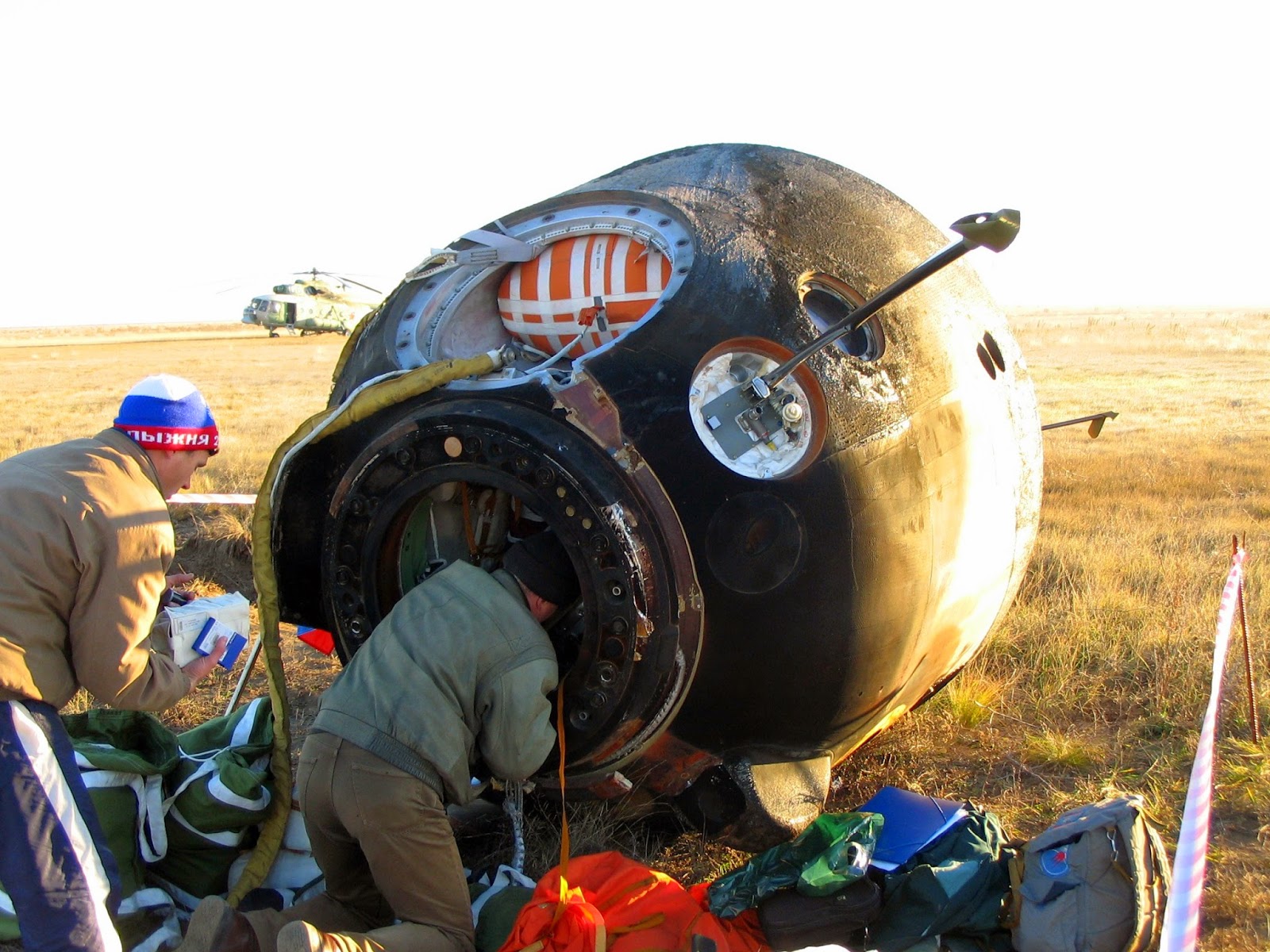 Soyuz-TM Descent Module on the treeless steppe in Kazakstan. Image: NASA
Shortly before the team began its Australian tour, U.S. voters went to the polls, where they favored Democrat William Clinton for President over Republican incumbent George H. W. Bush. Many in NASA feared that, after he took office in January 1993, Clinton would not support Space Station Freedom. With no station, their reasoning went, the Space Shuttle would lose its purpose, and U.S. piloted spaceflight would cease.
Clinton did not in fact support Space Station Freedom; that did not mean, however, that he failed to find value in a space station. On 9 March 1993, he ordered NASA to produce three low-cost station designs in 90 days. Aided by an advisory committee, he would select one design for development.
The new President then handed off supervision of NASA to his Vice President, Al Gore. On 25 March, Gore appointed members to the Advisory Committee on the Redesign of the Space Station. MIT's Charles Vest became its chair.
That same month, in a letter to NASA Administrator Daniel Goldin, Russian Space Agency director Yuri Koptev and NPO Energia director Yuri Semenov proposed what would become the NASA station program's salvation: a merger of the financially strapped, politically troubled Freedom and Mir-2 programs. They proposed that the joint station be assembled in an orbit inclined more than 50° relative to Earth's equator. The following month, the Russians provided NASA with a straw-man assembly sequence for the joint station.
On 11 May 1993, Vest advised the White House that, regardless of the design selected, the U.S. station should be built in what he called a "world orbit" inclined between 45.6° and 51.6° so that Russian - and Chinese and Japanese - rockets could easily reach it. This would, he explained, ensure that redundant means of reaching and returning from the station would exist. He added that "the shuttle will likely be grounded during the operational life of the station."
Vest presented the Advisory Committee's report to the Clinton White House on 10 June 1993. Barely two weeks later, on 23 June 1993, the U.S. station program had a near-death experience: the U.S. House of Representatives approved Fiscal Year 1994 station funding by a margin of a single vote (215-216). The close vote, which showed how politically vulnerable Space Station Freedom had become, clearly conveyed to many in NASA that station program reform was essential.
President Clinton soon approved Option A, or Alpha, the redesign option most like Space Station Freedom. Meanwhile, the proposal to merge the U.S. and Russian station programs gained momentum. Engineers and managers in Moscow, Washington, and Houston began to refer to "Ralpha," which was short for "Russian Alpha."
On 2 September 1993, Vice President Gore and Russian Prime Minister Viktor Chernomyrdin released a joint statement on U.S.-Russian space cooperation. In it, they announced a dramatic expansion of the space cooperation outlined in the June 1992 Bush-Yeltsin agreement. Russia became a full partner in the space station; minus Russian participation, it simply would not fly.
At the same time, however, NASA would pay Russia for its involvement, which put the Russian Space Agency (and through it, NPO Energia) in the role of a NASA contractor. Though ambiguous and controversial in some quarters, the expanded Russian role reinforced the station's geopolitical justification, helping to ensure that the U.S. Congress would support it.
In November 1993, NASA and the Russian Space Agency completed an addendum to NASA's August 1993 Alpha Station Program Plan. It amounted to a blueprint for merging the Alpha and Mir-2 programs. The resulting International Space Station would be assembled in a 51.6° orbit, which meant that Soyuz spacecraft returning from it could land in their long-established recovery zones in central Asia. Soyuz landing zones in Australia were no longer needed.
SourcesMir Hardware Heritage, NASA RP-1357, David S. F. Portree, NASA Lyndon B. Johnson Space Center, March 1995
Alpha Station Addendum to Program Implementation Plan, RSA/NASA, 1 November 1993
Australian Landing Sites Evaluation and Survey, JSC-34045, Assured Crew Return Vehicle (ACRV) Project Office, NASA Lyndon B. Johnson Space Center, 22 June 1993
Assured Crew Return Vehicle (ACRV): Technical Feasibility Study on Use of the Soyuz TM for the Assured Crew Return Vehicle Missions, JSC-34048, Assured Crew Return Vehicle (ACRV) Project Office, NASA Lyndon B. Johnson Space Center, June 1993
Letter with Attachment, C. Vest to J. Gibbons, 11 May 1993
Mir-Freedom Assembly Sequence, NPO Energia, April 1993
Letter, Y. Koptev and Y. Semenov to D. Goldin, 16 March 1993
Assured Crew Return Vehicle (ACRV): Preliminary Feasibility Analysis of Using Soyuz TM for Assured Crew Return Vehicle Missions* *Includes Evaluation of Automated Rendezvous and Docking System, JSC-34023, Assured Crew Return Vehicle Project Office, NASA Lyndon B. Johnson Space Center, April 1992
Source:
NASA's 1992 Plan to Land Soyuz Space Station Lifeboats in Australia
 Wątek: [SHB] NASA's 1992 Plan to Land Soyuz Space Station Lifeboats in Australia (Przeczytany 2035 razy)