Kulisy mianowania załóg są w NASA znaczące.Personality Spotlight;NEWLN:Air Force Col. Richard O. Covey: NASA astronaut
UPI Archives Sept. 25, 1988
Astronaut Richard Covey, co-pilot of the shuttle Discovery and the last man to speak to Challenger's ill-fated crew 2 years ago, says he admires the advances of the Soviet space program but not enough to ever trade seats with a cosmonaut.
'The Soviets, I'm envious of their program,' Covey, 42, said in an interview. 'I mean, they fly a lot, they've been doing a lot, they've been learning a lot. Their space station obviously is the center of their activity now until they get their shuttle flying.
'Both of those things are admirable activities. I'm envious of where they are. At the same time, I'd rather be flying on our space shuttle than on their spacecraft.'
Covey, a thin, angular man who sports a trim mustache, is a veteran of Discovery's last mission, a historic satellite repair flight in August 1985 in which two spacewalkers hot-wired a military satellite stranded in a useless orbit.
Covey served as co-pilot of that flight and will serve as second in command to skipper Frederick Hauck this time around.
It was Covey who served as the mission control communicator for Challenger's doomed flight and as such, he was the last man to speak to the crew when he radioed: 'Challenger, go at throttle up,' seconds before the ship blew up.
While the publicity surrounding the first post-Challenger flight has been intense, Covey said his family has taken it in stride and that the 'most important thing around my house' in recent weeks has been the performance of his daughter's high school soccer team.
As for Covey himself, the excitement started building this summer when he visited the Kennedy Space Center before Discovery was hauled to the launch pad for final preparations.
'I remember when Rick and I went down to KSC. The vehicle was in the VAB (Vehicle Assembly Building) at that time and Rick and I got in there during second shift,' Covey said. 'It was relatively quiet in there. I just kind of wandered around all the different levels by myself and looked at it. I got excited.
'I get real excited when I see it. I started letting myself think that yeah, we're really gonna go do this and it's going to be soon, it's going to be soon.'
As for the danger involved in riding a space shuttle into orbit, Covey smiles and shrugs, saying he does not anticipate any more problems or malfunctions on this flight than on any other.
'In my mind I think of nothing anomalous happening, although at the same time my training has me prepared to expect all those things to happen,' he said. 'No, I don't think about the things that might happen, I just think about the fact that this thing's going to work and go.'
But Covey thinks it is important that Americans realize that space flight remains a risky business and that accidents can be expected down the road.
'I think we can operate the space shuttle safely for the next 10, 15 years, however long we want to. That doesn't mean we won't have an accident sometime. But I think an accident on the next flight would be very devastating.
'I think an accident in 10 years could be accepted in the light of, hey, we're doing something risky and even if we do everything we can sooner or later something's going to happen, just like operating airliners. Every once in a while, one of them crashes.'
Covey was born in Fayetteville, Ark., but he considered Fort Walton Beach, Fla., to be his hometown.
After earning an engineering degree from the Air Force Academy, Covey completed a master's degree in aeronautics and astronautics at Purdue University in 1969.
Between 1970 and 1974, Covey was a fighter pilot, completing 339 combat missions during two tours in Southeast Asia.
For the next three years he served as a weapons system test pilot at Eglin Air Force Base, Fla., and was director and pilot for electronic warfare testing of the F-15 jet. A member of the Society of Experimental Test Pilots, Covey has logged more than 3,000 hours flying more than 20 types of aircraft.
Covey was selected as an astronaut in 1978, a goal he set for himself years before.
'Without a doubt it was always one of the things that I put as a very high goal for my life,' he said. 'I was fortunate.'
Covey is married to the former Kathleen Allbaugh of Emmettsburg, Iowa, and the couple has two children, Sarah Suzanne, and Amy Kathleen.
'I come from a very busy household,' he said at a pre-launch news conference. 'In fact, it's very dynamic from my kids' activities and my wife's activities. I think they reflect very much the confidence that I bring home that what we're doing is the right thing, that we are moving very smoothly and safely toward our re-flight.
'So we don't have a great deal of discussion relative to apprehension about that. I'm sure as we move closer to the flight that there will be more discussions and more reflections upon what's really going to happen as you would expect from any activity as it draws near.'
https://www.upi.com/Archives/1988/09/25/Personality-SpotlightNEWLNAir-Force-Col-Richard-O-Covey-NASA-astronaut/3675591163200/‘Go At Throttle Up’: Remembering Challenger’s Final Flight, OTD in 1986by Ben Evans January 28, 2021
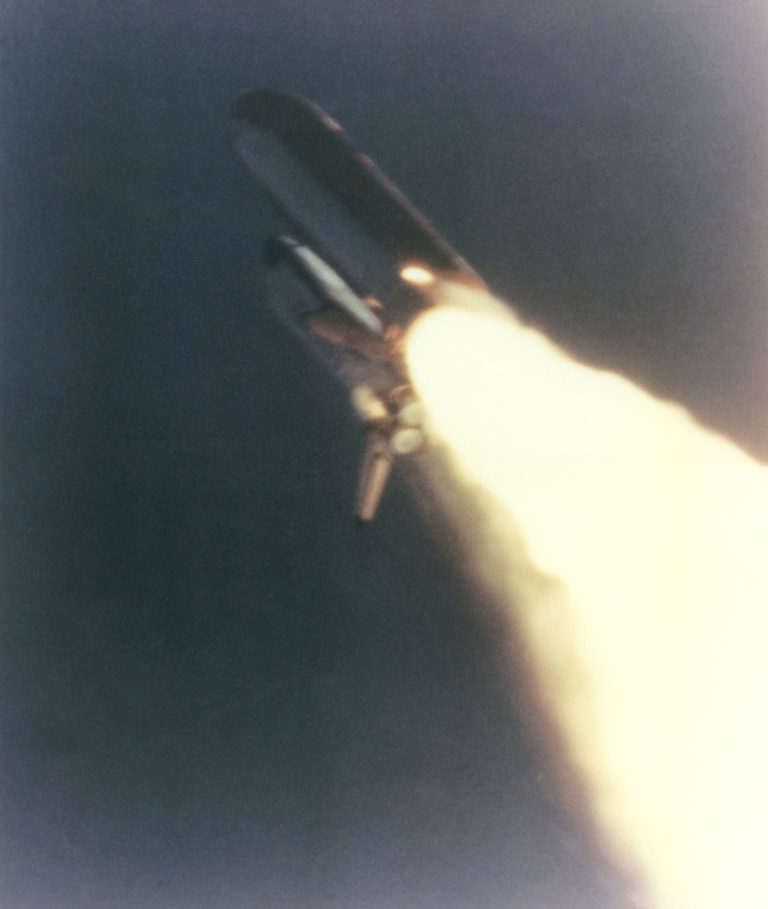 The growing flame from the compromised Solid Rocket Booster (SRB) is clearly visible in this perspective, about a minute into Challenger’s ascent. Photo Credit: NASA
(...) Years later, Morton Thiokol structural engineer Roger Boisjoly would express astonishment that the vehicle did not explode on the pad; by an incredible sequence of events, a chunk of solid fuel temporarily plugged the O-ring hole, and the first minute of ascent proceeded normally. (...)
It is possible that the mission may still have proceeded normally, had the plug of solid fuel remained jammed into the O-ring breach. However, by an incredible stroke of cruel luck, Challenger happened to pass through the most severe wind shear ever encountered by an ascending shuttle stack. The shear dislodged the plug around a minute into the mission.
In Mission Control, astronaut Dick Covey—sitting alongside fellow astronaut Fred Gregory at the Capcom’s console—relayed a standard call: “Challenger, Go at throttle up.”
Commander Dick Scobee came back a second or two later. “Roger,” he replied. “Go at throttle up.” (...)
https://www.americaspace.com/2021/01/28/go-at-throttle-up-remembering-challengers-final-flight-otd-in-1986/Astronaut Richard Covey in the Crew Compartment trainer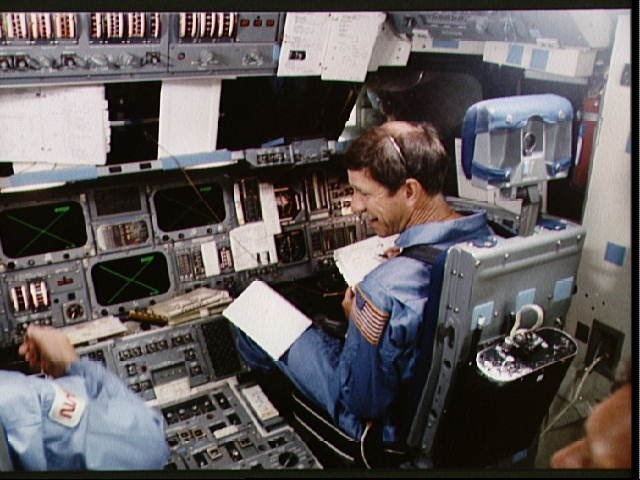 Astronaut Richard O. Covey sits at the pilot's station in the one-G Crew Compartment trainer (CCT) at JSC. Astronaut Frederick H. (Rick) Hauck (almost obscured at left) is in the commander's station. Covey was named as pilot for the STS 26 mission to be flown in 1988.https://www.dvidshub.net/image/701058/astronaut-richard-covey-crew-compartment-trainer
Covey retired from NASA and the Air Force. After the Space Shuttle Columbia disaster, Covey, along with retired Air Force Lieutenant General Thomas Patten Stafford, headed the Stafford-Covey Commission in returning the Space Shuttle fleet to space, starting with the STS-114 mission.
https://www.wcspeakers.com/speaker/richard-oswalt-covey/2)
Boeing Appoints Former Astronaut Dick Covey To Key Consolidated Space Operations PostFormer astronaut Richard Covey has been named deputy program director for Operations for the Boeing team's NASA Consolidated Space Operations Contract (CSOC) Phase 2 program bid, the company announced today. (...)
https://boeing.mediaroom.com/1998-01-20-Boeing-Appoints-Former-Astronaut-Dick-Covey-To-Key-Consolidated-Space-Operations-PostRichard Covey to Succeed McCulley as USA President and CEOAugust 30, 2007
Shuttle Veteran Daniel Brandenstein Named Chief Operating Officer
HOUSTON, Texas (August 30, 2007) – Richard O. Covey has been named to succeed Michael J. McCulley as President and Chief Executive Officer of United Space Alliance, effective September 28, 2007. McCulley has announced his retirement following a distinguished career spanning 38 years as a Naval aviator, NASA astronaut and a highly respected space industry executive. Daniel C. Brandenstein of Lockheed Martin Mission Services has been named to replace Covey as USA’s Chief Operating Officer. (...)
https://spacenews.com/richard-covey-to-succeed-mcculley-as-usa-president-and-ceo/Richard O. Covey to Retire as USA President & CEOMarch 7, 2010
Richard O. Covey today announced his intentions to retire as President and Chief Executive Officer of United Space Alliance, effective March 26, 2010. Covey is retiring following a distinguished career spanning more than 40 years as an Air Force fighter pilot, NASA astronaut and a highly respected space industry executive. (...)
https://spacenews.com/richard-o-covey-to-retire-as-usa-president-ceo/https://www.chron.com/neighborhood/bayarea/news/article/Dick-Covey-retiring-at-USA-9370861.phpProfiles of 5 Astronauts Flying the Space Mission
Nov. 16, 1990
Richard O. Covey Mission Commander
Colonel Covey, 44 years old, of the Air Force, has been an astronaut since 1979 and has logged 267 hours in space. He was the pilot of the space shuttle Discovery in 1985 and 1988.
Born in Fayetteville, Ark., Colonel Covey considers Fort Walton Beach, Fla., his hometown. He graduated from the Air Force Academy in 1968 and received a master's degree in aeronautics and astronautics from Purdue University.
Colonel Covey has flown more than 4,500 hours in 26 types of aircraft and completed 339 combat missions during two tours in Southeast Asia. He and his wife, Kathleen, have two daughters.
Frank L. Culbertson Jr. Pilot
Commander Culbertson, 41, of the Navy, will be making his first space flight since becoming an astronaut in 1985. He considers Holly Hill, S.C., his hometown.
A graduate of the Naval Academy in 1971, Commander Culbertson has logged more than 3,700 hours in 35 types of aircraft and 350 carrier landings.
At the space agency he has helped redesign and test the nosewheel steering, tires and brakes for the space shuttle to provide more safety in landings. After the Challenger accident in 1986, he assisted with the investigations at NASA headquarters in Washington. He has served as the lead capsule communicator at the mission control center for several shuttle flights.
He and his wife, Rebecca, have three daughters.
Charles D. Gemar Mission Specialist
Major Gemar, 35, of the Army, graduated from the Military Academy in 1979. He considers Scotland, S.D., his hometown.
Before being selected as an astronaut candidate in 1985, Major Gemar was based at Fort Stewart/Hunter Army Airfield, where he served as an assistant flight operations officer and flight platoon leader for the 24th Combat Aviation Battalion, Wright Army Airfield commander, and chief of the operations Branch at Hunter Army Airfield.
At NASA his assignments have included flight program testing and launching support activities at the Kennedy Space Center. This will be his first space flight.
He is married to the former Charlene Stringer of Savannah, Ga.
Carl J. Meade Mission Specialist
Lieutenant Colonel Meade of the Air Force is 40 years old today. He was born at Chanute Air Force Base in Illinois.
He graduated from the University of Texas in 1973 and received a master's degree in electronics engineering from the California Institute of Technology in 1975.
Before joining the Air Force, he was a Hughes Fellow at the California Institute of Technology and an electronics design engineer at Hughes Aircraft Company.
Colonel Meade was selected for astronaut training in June 1985. This will be his first space flight.
He and his wife, Cheryl, have a son, David James.
Robert C. Springer Mission Specialist
Colonel Springer, 48, of the Marine Corps, was born in St. Louis, but considers Ashland, Ohio, his hometown.
A 1964 graduate of the Naval Academy, he received a master's degree in operations research and systems analysis from the Naval Postgraduate School in 1971. He has logged more than 3,800 hours flying time, and has received the Distinguished Flying Cross.
Colonel Springer has been an astronaut since 1981. He flew aboard the space shuttle Discovery last year on a five-day mission.
He and his wife, Molly, have three children.
https://www.nytimes.com/1990/11/16/us/profiles-of-5-astronauts-flying-the-space-mission.htmlAstronaut Richard Covey at Commander’s Station in Endeavour during STS-61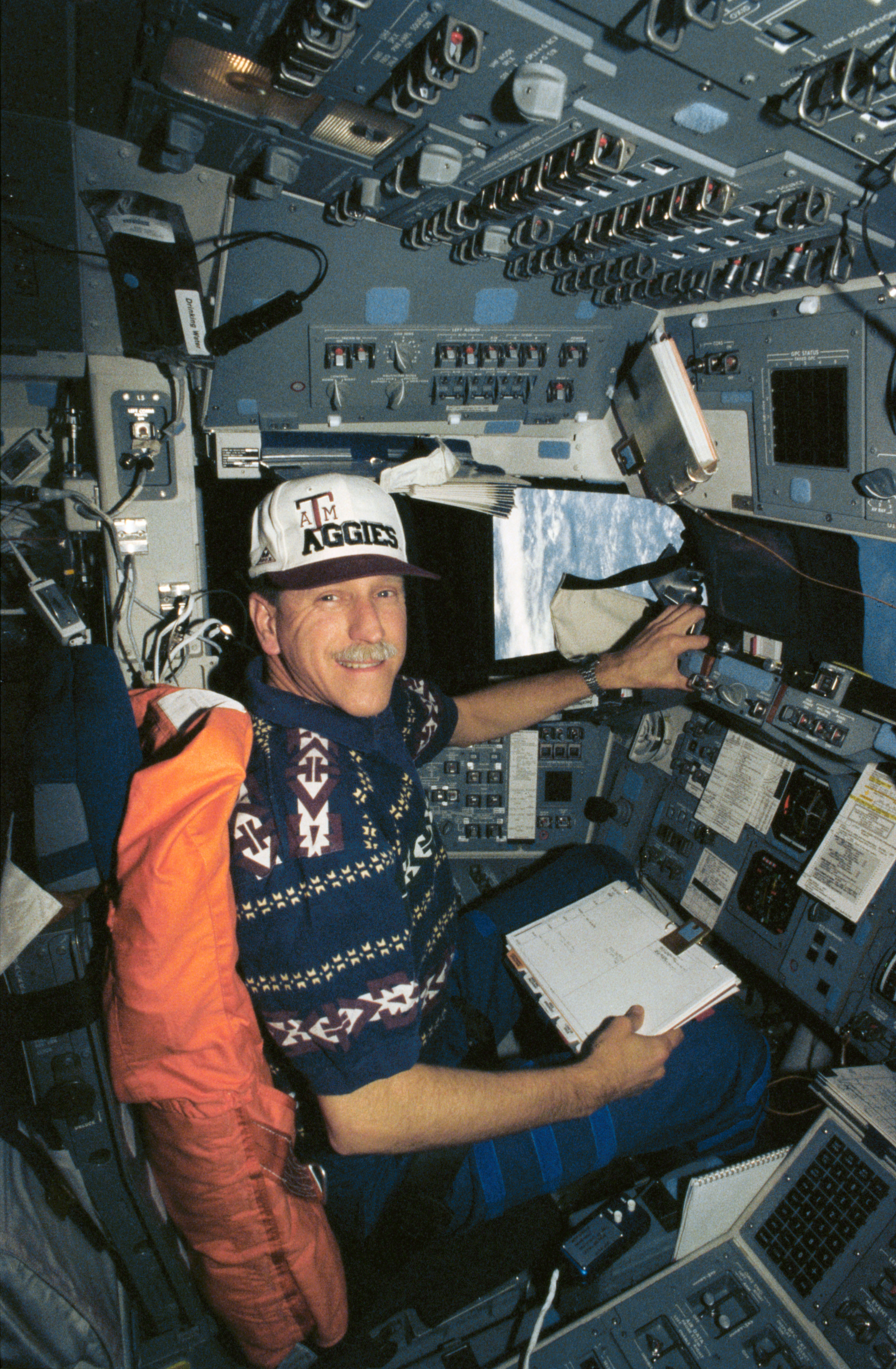
Richard O. Covey mans the commander's station on Space Shuttle Endeavour during Flight Day 3 of the eleven-day STS-61 mission to service the Hubble Space Telescope. Covey wears a Texas A&M University cap as a salute to members of the training staff who have A&M connections. The crew was busy on this day preparing for the approach to and grapple operations with Hubble.
Image Credit: NASA
https://science.nasa.gov/image-detail/27514174534-0ae285d1bf-o/
 Wątek: RO ''Dick'' Covey - 01.08.1946 (Przeczytany 744 razy)