3)
Jej plany lotu w kosmos pozostały niespełnione.Dr. Johnston, a holder of two dozen patents — mostly involving laser-surface modification research — retired from NASA in 1986 to became an university professor and later director of a hydrogen research national center in Florida. During her "astronaut" years at MSFC, she led three science experiments and helped her fellow astronauts to develop techniques to be used on Spacelab. In 1976, Johnston had indicated that she "had planned to work in hopes of going on an orbital mission in the 1980's," but it was not to be.
https://www.collectspace.com/ubb/Forum38/HTML/001202.html2) (3)
Mary Helen Johnston, American NASA Astronaut
American NASA astronaut Mary Helen Johnston, of the Materials and Processes Laboratory, checks a sample container for a 'Dendrite Remelting and Macrosegregation in Zero-Gravity Casting' experiment at the Marshall Space Flight Center (MSFC) in Huntsville, Alabama, 5th November 1975. The clear vial in the centre of the fixture will contain ammonium chloride kept in a liquid state of above 70 degrees Fahrenheit and will be launched aboard a sounding rocket in December 1975, it is hoped that the experiment will lead to better methods of processing alloys. (Photo by Space Frontiers/Archive Photos/Hulton Archive/Getty Images)
https://www.gettyimages.com.au/detail/news-photo/american-nasa-astronaut-mary-helen-johnston-of-the-news-photo/12693349963) (4)
Dr. Mary-Helen Johnston, an astronaut, seated at her desk at Marshall Space Flight Center in Huntsville, Alabama.
Date 1975-07-23
https://digital.archives.alabama.gov/digital/collection/amg/id/100668/4)
Woman Scientists and Engineers Train In Simulated Weightless EnvironmentNASA Mar 27, 2014
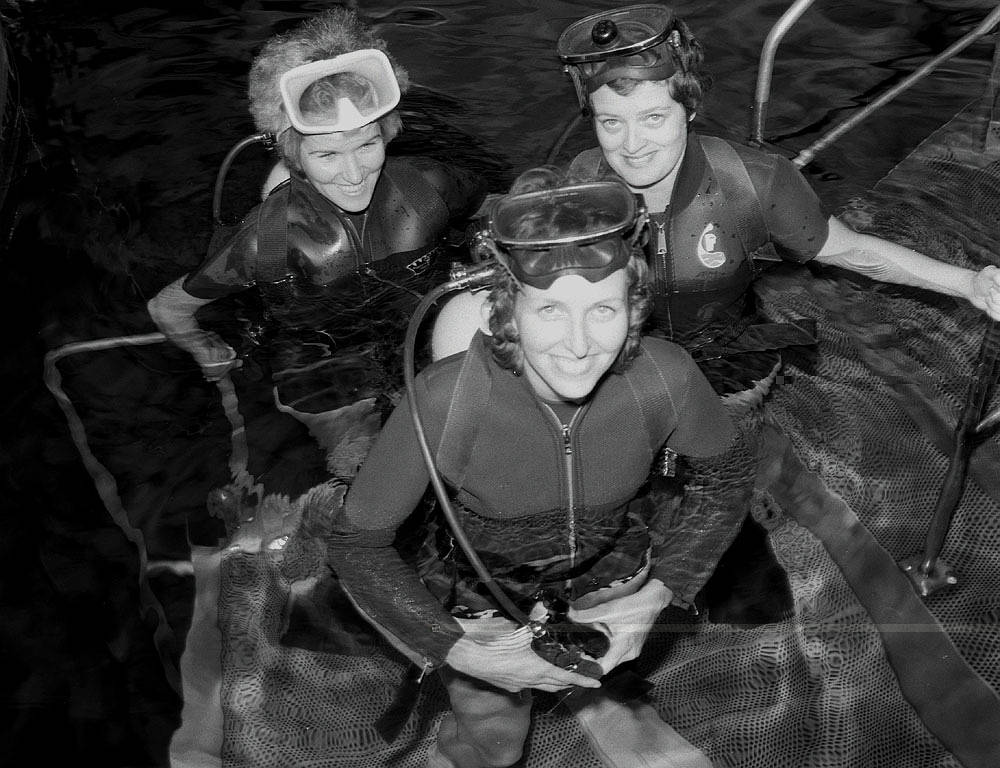 In 1975, Carolyn Griner (front), Dr. Mary-Helen Johnston and Dr. Ann Whitaker (L to R) practiced in Marshall’s Neutral Buoyancy Simulator (NBS), an underwater facility used for training astronauts.
In 1975, no American woman had ever flown in space, but Carolyn Griner (front), Dr. Mary-Helen Johnston and Dr. Ann Whitaker (L to R) dreamed of working in space. To learn about living in space and performing experiments there, they practiced in Marshall’s Neutral Buoyancy Simulator (NBS), an underwater facility used for training astronauts. Although none of the woman ever made it to space, they certainly helped advance space exploration. Griner, who helped design the Saturn V and space experiments, served as the deputy center director at NASA’s Marshall Space Flight Center. Johnston designed and flew experiments inside the Shuttle’s Spacelab and served as an alternate payload specialist directing mission activities from the ground control center at Marshall. Whitaker served as the head of Marshall’s Materials and Processes Laboratory.
Image credit: NASA
https://www.nasa.gov/centers/marshall/history/nbs.html
 Wątek: MH (Johnston) McCay - 17.09.1945 (Przeczytany 210 razy)