Dr. Deborah BarnhartRetired CEO, U.S. Space & Rocket Center
Dr. Deborah Barnhart returned to the Rocket Center as CEO after serving four previous times since 1972 as media, then marketing manager, corporate fundraiser, and Director of Space Camp. She served as CEO from 2010 to 2020 and took the Rocket Center from financial extremis to operational self-sustainment, a condition achieved by fewer than 1% of museums, increasing revenue from $22 million to $42 million annually.
Prior to returning as CEO, she was Vice President of three Dow-30 aerospace and defense companies, serving in manufacturing, business development, program and research management, and congressional lobbying for Honeywell International, McDonnell Douglas (now Boeing), and United Technologies Aerospace (now Raytheon).
A retired Navy Captain (0-6), she was one of the first 10 women assigned to duty aboard ships and commanded five units in her 26-year career. She has served on the Smithsonian Affiliations Advisory Council, the Florida Space Authority, the Alabama Space Authority Task Force, the Board of Managers of the Air Force Museum Foundation, and as a Trustee of the Board of the University of Alabama in Huntsville Foundation.
She is a recipient of NASA’s Distinguished Public Service Medal, the highest form of recognition awarded by NASA to a non‐government individual, and was selected for the Alabama Academy of Honor after nomination by the Governor of Alabama.
Dr. Barnhart earned her doctorate at Vanderbilt University and holds degrees from the University of Maryland, the University of Alabama Huntsville, and Massachusetts Institute of Technology where she was a Sloan Fellow. She resides in the Rocket City where she enjoys metal arts and installed her first public art commission in Westlawn Park in 2025.
https://rocketcenterfoundation.org/team-members/dr-deborah-barnhart/Ex-Navy captain lifts space legacyBy Ms Kari Hawkins ( Redstone) March 7, 2012
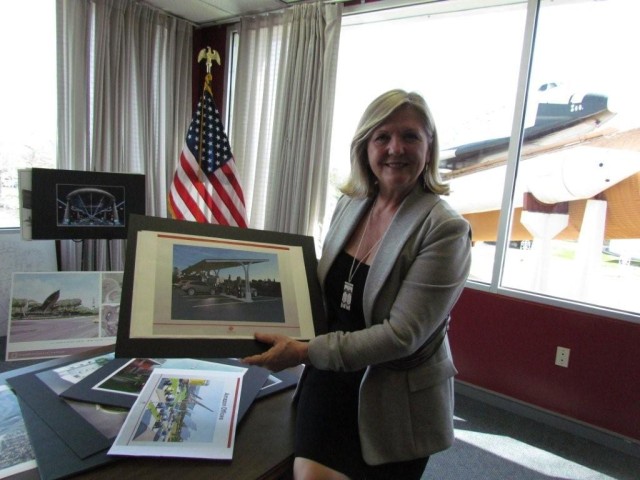
(...)
"I was the seventh woman to be certified to fight on and drive Navy vessels," she said. "I drove ships on the west coast and the east coast. I loved the Navy, and the ability to see the world as a finite place. I've heard it said that everyone joins the military to get away from something, to 'get out of Dodge.' And maybe I did want to get out of Dodge, but I also joined the military to go toward something, to pursue an interest and an opportunity." (...)
https://www.army.mil/article/75152/ex_navy_captain_lifts_space_legacyU.S. Space and Rocket Center begins new year with new leaderUpdated: Jan. 01, 2011, 2:00 p.m.|Published: Jan. 01, 2011, 1:00 p.m.
(...) "It's wonderful to be home in Huntsville," Barnhart said.
Her father moved them here in 1959, in the days when NASA was being formed. She remembers the windows of Madison Pike Elementary - renamed Louis Morris Elementary in 1976 - shaking with the engine tests at nearby Marshall Space Flight Center.
"So I'm a space baby," she said. "I guess that thunder never left me. It's a thrill to be back." (...)
https://www.al.com/breaking/2011/01/new_leader_of_us_space_and_roc.html10 Questions: U.S. Space & Rocket Center CEO Dr. Deborah Barnhart discusses Space Camp futureUpdated: Jun. 03, 2012, 11:25 a.m.|Published: Jun. 03, 2012, 10:25 a.m.
(...) We are also moving into other revenue streams such as expanded international licensing, and traveling exhibitions with "100 Years of von Braun: His American Journey" that will travel for several years in Europe. (...)
https://www.al.com/huntsville-times-business/2012/06/10_questions_us_space_rocket_c.htmlU.S. Secretary of Education Brings Back-To-School Bus Tour To Rocket City, U.S.A.NASA Sep 17, 2014
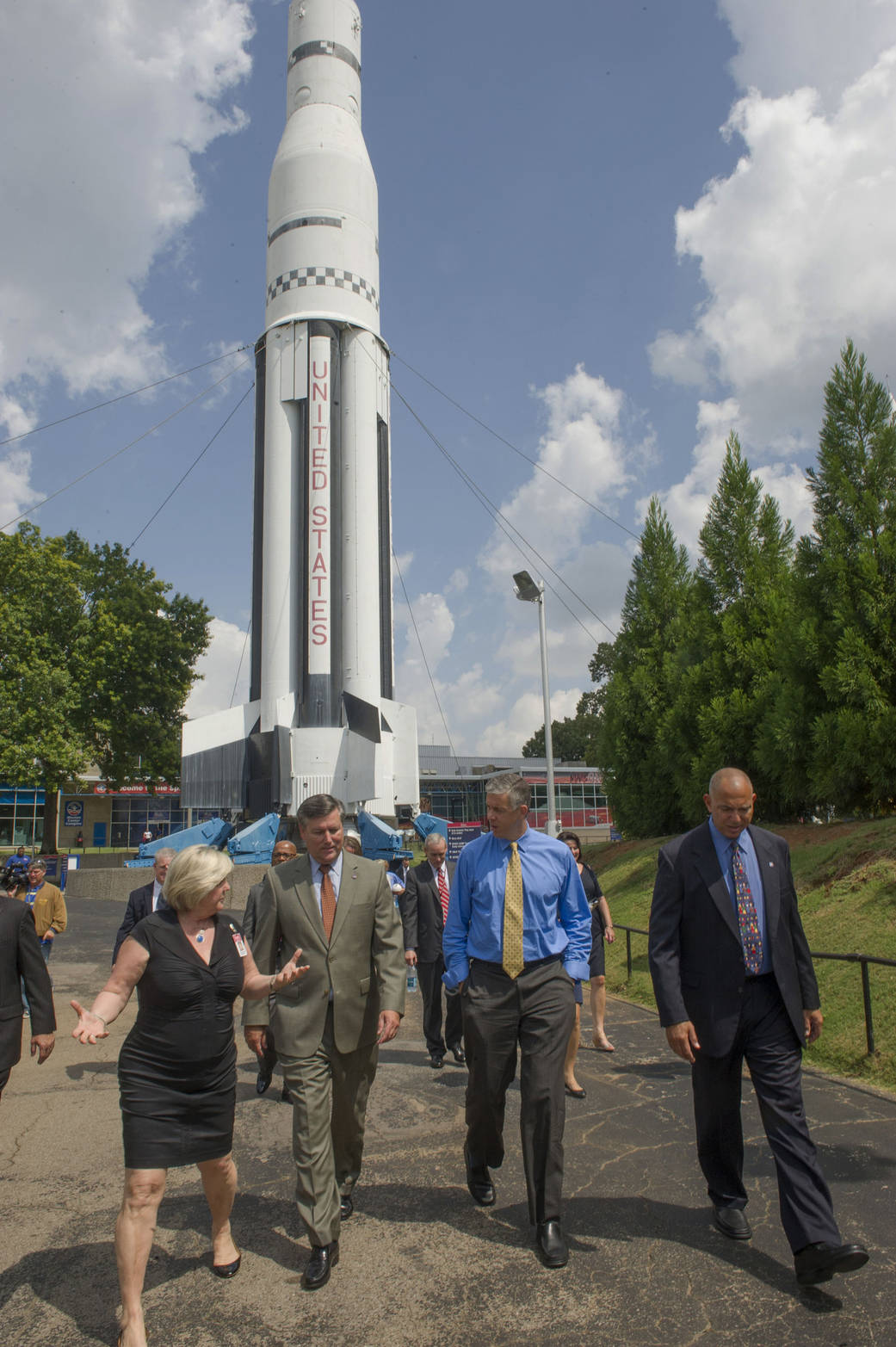 The U.S. Department of Education’s Back-To-School bus tour brought Secretary Arne Duncan to the U.S. Space & Rocket Center in Huntsville, Alabama.
From left, U.S. Space & Rocket Center CEO Dr. Deborah Barnhart and Marshall Center Director Patrick Scheuermann discuss NASA’s high-quality educational activities with U.S. Secretary of Education Arne Duncan and newly appointed NASA Associate Administrator of Education Donald James. The secretary’s visit to the Space & Rocket Center was part of his Back-to-School bus tour that included an educational town hall meeting with local students, teachers and parents.
Image credit: NASA/MSFC/Emmett Given
https://www.nasa.gov/image-article/u-s-secretary-of-education-brings-back-school-bus-tour-rocket-city-u-s-2/Teachers To Participate In Astronaut Training Program At The Honeywell Educators at Space Academy In Huntsville, Ala.October 27, 2017
(...) "Technology is changing exponentially. Things we once held as impossibilities are reality &endash; we are on our Journey to Mars," said Dr. Deborah Barnhart, CEO and Executive Director of the U.S. Space & Rocket Center. "Educating the next generation of leaders and learners is key to global success. Exploration improves quality of life for all humanity through discoveries in science and engineering. The Honeywell Educators at Space Academy program unites teachers with exciting tools and methods to change the lives of students around the globe." (...)
https://www.honeywell.com/us/en/press/2017/06/teachers-to-participate-in-astronaut-training-program-at-the-honeywell-educators-at-space-academy-in-huntsville-alaptRichard Hoover and Deborah BarnhartRecorded February 26, 2025
https://archive.storycorps.org/interviews/richard-hoover-and-deborah-barnhart/US Space & Rocket Center's Barnhart on Commemorating Apollo 11's 50th AnniversaryDefense & Aerospace Report
 Wątek: Deborah Barnhart (1952-2026) (Przeczytany 1195 razy)