Autor Wątek: Misja Apollo-Sojuz - 50 lat  (Przeczytany 20013 razy)

0 użytkowników i 1 Gość przegląda ten wątek.

Offline Matias

  • Moderator Globalny
  • *****
  • Wiadomości: 8033
Misja Apollo-Sojuz - 50 lat
« dnia: Sierpnia 09, 2010, 13:18 »
Warto mieć osobny wątek dla ostatniej misji programu Apollo i pierwszej wspólnej międzynarodowej misji :)

Lata 60. XX wieku to szczyt Zimnej Wojny - rywalizacji pomiędzy dwoma supermocarstwami. Jednym z miejsc, gdzie ta rywalizacja była szczególnie wyraźna to przestrzeń kosmiczna. Tę rywalizację wygrały Stany Zjednoczone w lipcu 1969 roku, gdy Neil Armstrong i Buzz Aldrin postawili pierwsze kroki na Księżycu. W międzyczasie trwały pewne "zakulisowe" rozmowy na temat możliwej wspólnej radziecko-amerykańskiej współpracy. W końcu, po niezliczonej serii idei i propozycji, padł pomysł przeprowadzenia misji Apollo-Sojuz. Inna nazwa tej misji to Apollo Soyuz Test Project (ASTP).

Załogę misji po stronie amerykańskiej stanowili:
- Thomas Stafford
- Vance Brand
- Deke Slayton

Załogę misji po stronie rosyjskiej stanowili:
- Aleksjej Leonow
- Walerij Kubasow


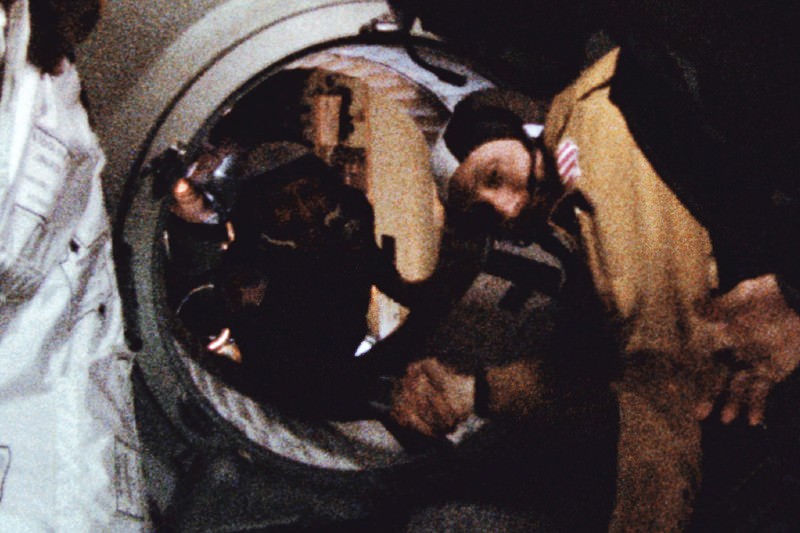
Start statku Apollo nastąpił 15 lipca 1975 roku o godzinie 19:50 UTC. Rosyjska kapsuła Sojuz wystartowała wcześniej tego samego dnia, o godzinie 12:20 UTC. Pierwsze dokowanie pojazdów nastąpiło 17 lipca o godzinie 16:19 UTC. Rozpoczęły się wspólne prace, eksperymenty naukowe oraz czynności dyplomatyczne (takie jak wymiana flag, certyfikatów oraz sadzonek drzew, które później posadzono w obu krajach). Statki wielokrotnie łączyły i odłączały się od siebie - pierwsze rozłączenie nastąpiło 19 lipca 1975 roku o godzinie 12:03 UTC. Wreszcie, ostatnie rozłączenie nastąpiło 19 lipca o godzinie 15:26 UTC. Warto tu dodać, że wewnątrz modułu łącznikowego znajdowała się też śluza powietrzna - atmosfery i ciśnienia panujące na obu statkach były różne.

Misję obwołano wielkim sukcesem - nie tylko naukowym czy inżynieryjnym, ale także dyplomatycznym. Misja Apollo-Sojuz przypadła również w momencie tzw. odprężenia (franc. détente) Zimnej Wojny, kiedy to próbowano realizować dialog, współpracę oraz zrozumienie pomiędzy supermocarstwami.

Jedyny poważniejszy problem, jaki napotkano w trakcie tej misji, to powrót na Ziemię statku Apollo, w trakcie której toksyczne gazy zaczęły wypełniać wnętrze kapsuły. W wyniku tego, amerykańska część załogi misji Apollo-Sojuz musiała być przez pewien czas hospitalizowana.

Misja Apollo-Sojuz była też ostatnią wyprawą w ramach programu Apollo. Po niej nastąpiło prawie sześć lat przerwy w amerykańskich wyprawach kosmicznych - aż do czasu STS-1.


Fragmenty artykułu z kosmonauty z 15 lipca - w 35 rocznicę startu misji Apollo-Sojuz.

W załączniku wizja artystyczna dwóch statków na orbicie oraz załogi Sojuza i Apollo :
« Ostatnia zmiana: Lipca 12, 2025, 08:09 wysłana przez mss »

Offline Radek68

  • Moderator Globalny
  • *****
  • Wiadomości: 2725
  • "Jutro to dziś, tyle że jutro" Sławomir Mrożek
Odp: Misja Apollo-Sojuz - 50 lat
« Odpowiedź #1 dnia: Sierpnia 11, 2010, 09:12 »
Do załączonej przez Matiasa wizji artystycznej dodam autentyczne zdjęcia statków Sojuz 19 - 7K-OK (ОК - Орбитальный Корабль) i Apollo 18 z tej właśnie misji.


« Ostatnia zmiana: Lipca 12, 2025, 08:14 wysłana przez mss »
The Dark Side of the Moon

Offline Matias

  • Moderator Globalny
  • *****
  • Wiadomości: 8033
Odp: Misja Apollo-Sojuz - 50 lat
« Odpowiedź #2 dnia: Sierpnia 11, 2010, 10:33 »
Dzięki Radku :) Żeby nie było, że żadnych zdjęć nie ma z tej misji! ;)

Oszacowanie kosztów powtórzenia misji Apollo-Soyuz (1974)

Korzenie Apollo-Soyuz Test Project sięgają rozmów mających na celu rozwój wspólnego amerykańsko-radzieckiego systemu dokującego na potrzeby ratownictwa kosmicznego. Koncepcja Common Docking System, została po raz pierwszy przedstawiona w 1970 roku. Przyjęto jednak, że system dokowania zostanie zbudowany na potrzeby przyszłych pojazdów kosmicznych, a nie dla istniejących w owym czasie pojazdów Apollo oraz Sojuz. Szybko jednak się okazało, że wspólne radziecko-amerykańskie misje kosmiczne służą celom politycznym obu krajów, dzięki czemu projekt krótkoterminowych misji z dokowaniem szybko nabrał rozpędu. Kolejnym krokiem do jego realizacji stało się moskiewskie spotkanie Prezydenta Nixona z Premierem ZSRR Aleksiejem Kosyginem w maju 1972 roku, na którym podpisano umowę wzywająca oba kraje do wspólnej misji Apollo-Sojuz w lipcu 1975 roku.

Wstęp do innego artykułu dostępnego na kosmonaucie.
« Ostatnia zmiana: Lipca 12, 2025, 08:46 wysłana przez mss »

Offline Hermes

  • Weteran
  • *****
  • Wiadomości: 203
Odp: Misja Apollo-Sojuz - 50 lat
« Odpowiedź #3 dnia: Lipca 15, 2013, 16:43 »
Witam,

  dziś mija kolejna rocznica startu do wspólnego lotu Apollo-Sojuz.
Dołączam jedno ze zdjęć wykonanych podczas tej misji.  Sam oglądałem ich połączenie, a raczej - powitanie - podczas transmisji w polskiej TV (byłem wtedy na wakacjach, a ponieważ w domu w którym mieszkałem, nie było w ogóle prądu (!), musiałem przejść się prawie 2 km. na teren kolonii dla młodzieży i tam to oglądałem. A Leonowa ostatni raz widziałem (i filmowałem) w Warszawie chyba 10 lat temu - podczas uroczystości z okazji 25 rocznicy lotu Hermaszewskiego.
« Ostatnia zmiana: Lipca 12, 2025, 08:46 wysłana przez mss »

Polskie Forum Astronautyczne

Odp: Misja Apollo-Sojuz - 50 lat
« Odpowiedź #3 dnia: Lipca 15, 2013, 16:43 »

Offline kanarkusmaximus

  • Administrator
  • *****
  • Wiadomości: 24185
  • Ja z tym nie mam nic wspólnego!
    • Kosmonauta.net
Odp: Misja Apollo-Sojuz - 50 lat
« Odpowiedź #4 dnia: Lipca 19, 2013, 01:24 »
Hermesie, jakie wówczas było wśród "zwyczajnych Kowalskich" zainteresowanie kosmosem? Były to już czasy "po" księżycowych Apollo i w zasadzie jedynie Rosjanie "zdobywali przestworza", dokonując misji orbitalnych. Czy widać było spadek zainteresowania lotami kosmicznymi?
« Ostatnia zmiana: Lipca 12, 2025, 08:46 wysłana przez mss »

Offline Orionid

  • Weteran
  • *****
  • Wiadomości: 28924
  • Very easy - Harrison Schmitt
Odp: Misja Apollo-Sojuz - 50 lat
« Odpowiedź #5 dnia: Lipca 15, 2018, 16:29 »
Dziś mija 43. rocznica startu Sojuza 19 i Apollo ASTP.
Dziś żyje trzech uczestników wspólnego lotu.

1) 15.07.1975 o 12:20:00,005 z wyrzutni LC-1 kosmodromu Bajkonur wystartowała RN Sojuz-U, która wyniosła załogowy statek kosmiczny Sojuz 19, który  osiągnął orbitę o parametrach: hp=186 km, ha=220 km, i=51,80°, t=88,50 min.
17.07.1975 o 16:09:12 nastąpiło połącznie ze statkiem Apollo.
19.07.1975 o 12:03 rozłączenie statków.
19.07.1975 o 12:40:41 ponowne połączenie.
19.07.1975 o 15:27 definitywne rozłączenie.
21.07.1975 o 10:50:51,6 nastąpiło lądowanie 54 km NE od Arkałyku.
Czas lotu statku : 5d 22h 30m 51,6s.
Cytuj
1975 July 15 - . 12:20 GMT - . Launch Site: Baikonur. Launch Complex: Baikonur LC1. LV Family: R-7. Launch Vehicle: Soyuz-U.

Soyuz 19 (ASTP) - . Call Sign: Soyuz (Union ). Crew: Kubasov, Leonov. Backup Crew: Filipchenko, Rukavishnikov. Support Crew: Andreyev, Dzhanibekov, Ivanchenkov, Romanenko. Payload: Soyuz ASTP s/n 75 (EPSA). Mass: 6,790 kg (14,960 lb). Nation: Russia. Agency: MOM. Program: ASTP. Class: Manned. Type: Manned spacecraft. Flight: Apollo (ASTP), Soyuz 19 (ASTP). Spacecraft Bus: Soyuz. Spacecraft: Soyuz 7K-TM. Duration: 5.94 days. Decay Date: 1975-07-21 . USAF Sat Cat: 8030 . COSPAR: 1975-065A. Apogee: 220 km (130 mi). Perigee: 186 km (115 mi). Inclination: 51.80 deg. Period: 88.50 min.

Soyuz 19 initial orbital parameters were 220.8 by 185.07 kilometres, at the desired inclination of 51.80�, while the period of the first orbit was 88.6 minutes. On 17 July the two spacecraft docked. The crew members rotated between the two spacecraft and conducted various mainly ceremonial activities. Leonov was on the American side for 5 hours, 43 minutes, while Kubasov spent 4:57 in the command and docking modules.
http://www.astronautix.com/a/astp.html
http://www.spacefacts.de/mission/english/soyuz-19.htm

2) 15.07.1975 o 19:50:00,381 z wyrzutni LC-39-B na Cape Canaveral  wystartowała RN Saturn IB, która wyniosła załogowy statek kosmiczny Apollo (ASTP), który  osiągnął orbitę o parametrach: hp=152 km, ha=166 km, i=51,70°, t=87,60 min.
24.07.1975 o 21:18:23 nastąpiło wodowanie na Oceanie Spokojnym, 600 m od planowanego miejsca.
Czas lotu: 9d 01g 28m 23s.
Cytuj
1975 July 15 - . 19:50 GMT - . Launch Site: Cape Canaveral. Launch Complex: Cape Canaveral LC39B. Launch Platform: LUT1. LV Family: Saturn I. Launch Vehicle: Saturn IB.

Apollo (ASTP) - . Call Sign: Apollo. Crew: Brand, Slayton, Stafford. Backup Crew: Bean, Evans, Lousma. Payload: Apollo CSM 111. Mass: 14,768 kg (32,557 lb). Nation: USA. Agency: NASA Houston. Program: ASTP. Class: Moon. Type: Manned lunar spacecraft. Flight: Apollo (ASTP), Soyuz 19 (ASTP). Spacecraft: Apollo CSM. Duration: 9.06 days. Decay Date: 1975-07-24 . USAF Sat Cat: 8032 . COSPAR: 1975-066A. Apogee: 166 km (103 mi). Perigee: 152 km (94 mi). Inclination: 51.70 deg. Period: 87.60 min.
(...)
Saturn S-IVB-210 - . Payload: Saturn S-IVB-210. Nation: USA. Agency: NASA Huntsville. Program: ASTP. Decay Date: 1975-07-16 . USAF Sat Cat: 8033 . COSPAR: 1975-066B. Apogee: 166 km (103 mi). Perigee: 152 km (94 mi). Inclination: 51.70 deg. Period: 87.60 min.

Docking Module 2 - . Payload: Apollo DM-2. Mass: 2,012 kg (4,435 lb). Nation: USA. Agency: NASA Houston. Program: ASTP. Spacecraft Bus: Apollo CSM. Spacecraft: Apollo ASTP Docking Module. Decay Date: 1975-08-02 . USAF Sat Cat: 8042 . COSPAR: 1975-066C. Apogee: 222 km (137 mi). Perigee: 201 km (124 mi). Inclination: 51.70 deg. Period: 88.73 min.
http://www.astronautix.com/a/astp.html
http://www.spacefacts.de/mission/english/astp.htm

http://www.astronautix.com/a/astp.html

Po zadokowaniu wspólny lot trwał prawie 44 godziny, później  Apollo i Sojuz rozdzieliły się po raz pierwszy i utrzymywały dystans 50 metrów.
Stafford spędził 7g 10m na pokładzie Sojuza, Brand 6:30 i Slayton 1:35.
Leonow był po stronie amerykańskiej przez 5g i 43m, podczas gdy Kubasow spędził 4:57 w modułach dowodzenia i dokowania statku Apollo.

Załoga Apollo umieściła swój statek między Sojuzem a Słońcem, tak aby średnica modułu serwisowego utworzyła dysk, który blokował słońce.
To sztuczne zaćmienie Słońca widziane z Sojuza umożliwiło sfotografowanie korony słonecznej.
Po tym eksperymencie Apollo skierował się w stronę Sojuza w celu drugiego dokowania.
Trzy godziny później Apollo i Sojuz nastąpiło ostateczne rozłączenie statków załogowych.

https://pl.wikipedia.org/wiki/Sojuz-Apollo
https://en.wikipedia.org/wiki/Apollo%E2%80%93Soyuz

https://twitter.com/ron_eisele/status/1812554396930277850
Cytuj
15 July 1975. 12.20.00 UTC/GMT. Launch of Soyuz 19 (Soyuz 7K-TM No.75) from Baikonour Site 1/5 atop a Soyuz-U launch vehicle and the final Apollo (CSM -111). First joint U.S./Soviet space flight, the Apollo Soyuz Test Project (ASTP).

https://twitter.com/ron_eisele/status/1812554573657391464
Cytuj
15 July 1975. 19.50.00 UTC/GMT. Launch of Apollo 18 (CSM111) from Kennedy LC-39B atop a Saturn 1B (SA-210). The first joint U.S./Soviet space flight, docking with the Soviet Soyuz 19 spacecraft. The last manned US space mission until the first Space Shuttle flight in 1981.


Cytuj
On this day in 1975, astronauts Tom Stafford, Vance Brand, and Deke Slayton launched on the Apollo-Soyuz Test Project (ASTP) mission, the first cooperative mission in space between the United States and the Soviet Union.
https://twitter.com/airandspace/status/1547954451037556740
Cytuj
On July 15, 1975 the Saturn IB rocket blasted off, marking the beginning of the Apollo-Soyuz mission for @NASA astronauts Thomas Stafford, Deke Slayton, and Vance Brand. Two cosmonauts launched from Kazakhstan the same day, and the two crews met in space two days later.
https://twitter.com/NASAhistory/status/1548032160350621697

Fueling of Apollo to Begin
June 15, 1975

CAPE CANAVERAL, Fla., June 14 (AP)—Engineers at the Kennedy Space Center will begin fueling the Apollo spacecraft Monday for the July 15 launching of the Apollo‐Soyuz mission, according to spokesmen. Officials said yesterday that the loading of self‐igniting fuel ingredients in the Apollo spacecraft and second stage of the rocket will take all week.
https://www.nytimes.com/1975/06/15/archives/fueling-of-apollo-to-begin.html

Meeting in Space
July 15, 1975

In one of those unplanned coincidences, the scheduled launchings today of the Apollo and Soyuz astronauts will take place just one day before the thirtieth anniversary of the first nuclear explosion on this planet. The coincidence underlines the extreme choices before humanity: nuclear devastation or intimate cooperation of the kind required to make the present AmericanSoviet space mission possible. It is a significant and hopeful sign that man' exploration of space, which began on both sides in an atmosphere of fierce cold‐war rhetoric and competition, has now culminated for the moment in the effort to achieve the friendly meeting in orbit planned for later this week.

The best reason to welcome the temporary partnership of the days immediately ahead is the hope that it will lead to broader and more permanent cooperation, and not only in space. Just because of the immensity of the surrounding solar system—let alone of the limitless universe occupied by an uncountable number of other planetary systems around central stars—the task of exploring the heavens will require generations of effort by the united resources of mankind.

* * *

In both Washington and Moscow, unfortunately, it is plain there are still important groups that have not yet accepted the idea of permanent collaboration in space and who look with mistrustful eyes on the adventure that is about to begin. Thus some American observers, noting correctly that the Apollo‐Soyuz mission arrangements have proved a technical and scientific bonanza for the Soviet Union's lagging astronautical program, have compared this mission with the 1972 wheat deal in which the Russians profited enormously at American expense. There has also been criticism of the unequal division of costs, particularly the fact that the United States had to pay for the unique and expensive docking mechanism which will permit the two nations' spacecraft to join. Such costs and inequities, admittedly large, will be worthwhile if they succeed in convincing the Soviet leadership and Soviet people that they have more to gain from cooperation than from rivalry in extraterrestrial projects.

However, the Soviet propaganda campaign about this mission and the secrecy and even rudeness which Soviet officials have exhibited at times toward their American counterparts are highly disquieting. During the next several days of this exciting undertaking the Soviet and American astronauts will be neither Communists nor capitalists; they will simply be brave men whose lives depend upon the closest kind of teamwork independent of ideological differences.

In both the United States and the Soviet Union, fortunately, ordinary citizens in this instance can be indifferent to political quarrels and suspicions—potent relics of the cold war—which darken the background of today's new beginning. Instead, they must wish bon voyage, a successful mission, and a safe return to the astronauts who will represent all humanity as they come together in peace and friendship at the historic rendezvous of their two spaceships.

https://www.nytimes.com/1975/07/15/archives/meeting-in-space.html

https://x.com/NASAhistory/status/1812879806721147311
« Ostatnia zmiana: Lipca 12, 2025, 08:47 wysłana przez mss »

Offline Orionid

  • Weteran
  • *****
  • Wiadomości: 28924
  • Very easy - Harrison Schmitt
Odp: Misja Apollo-Sojuz - 50 lat
« Odpowiedź #6 dnia: Lipca 15, 2018, 16:32 »
Oszacowanie kosztów powtórzenia misji Apollo-Soyuz (1974)
BY ADAM PIECH ON 17 LIPCA 2010


Wizja artystyczna Apollo Soyuz Test Project (NASA - MSFC-75-SA-4105-2C)

Korzenie Apollo-Soyuz Test Project sięgają rozmów mających na celu rozwój wspólnego amerykańsko-radzieckiego systemu dokującego na potrzeby ratownictwa kosmicznego. Koncepcja Common Docking System, została po raz pierwszy przedstawiona w 1970 roku. Przyjęto jednak, że system dokowania zostanie zbudowany na potrzeby przyszłych pojazdów kosmicznych, a nie dla istniejących w owym czasie pojazdów Apollo oraz Sojuz. Szybko jednak się okazało, że wspólne radziecko-amerykańskie misje kosmiczne służą celom politycznym obu krajów, dzięki czemu projekt krótkoterminowych misji z dokowaniem szybko nabrał rozpędu. Kolejnym krokiem do jego realizacji stało się moskiewskie spotkanie Prezydenta Nixona z Premierem ZSRR Aleksiejem Kosyginem w maju 1972 roku, na którym podpisano umowę wzywająca oba kraje do wspólnej misji Apollo-Sojuz w lipcu 1975 roku.

NASA i firmy będące wykonawcami przeprowadzały wiele studiów rozszerzających zakres programu ASTP (Apollo-Soyuz Test Project), nawet zanim został on formalnie zatwierdzony – przykładowo w kwietniu 1972 roku McDonnell Douglas zaproponował koncepcję stacji kosmicznej, będącej międzynarodowym kompleksem orbitalnym złożonym z laboratoriów Skylab oraz Salut. W pierwszych miesiącach 1974 roku, Flight Operations Directorate (FOD), mieszczący się w Centrum Kosmicznym im. Johnsona w Houston (Teksas), zbadał czy istniała możliwość wykonania drugiej misji ASTP w 1977 roku. Propozycja lotu w tym roku miała wypełnić spodziewaną, trzyletnią przerwę w amerykańskich lotach załogowych, która miała nastąpić pomiędzy misją ASTP w 1975 roku, a pierwszym, spodziewanym lotem wahadłowca.

Krótki etap studiów przeprowadzonych w JSC skupił się na wymaganiach misji, nad którą to centrum było bezpośrednio odpowiedzialne. FOD założył, że Apollo CSM-119 będzie służyć jako główny pojazd kosmiczny w misji ASTP 1977, oraz, że Stany Zjednoczone ponownie będą krajem, który dostarczy moduł cumowniczy (Docking Module – DM), do połączenia Apollo CSM wraz z radzieckim pojazdem Sojuz. CSM-119 został skonfigurowany jako pięcioosobowy pojazd ratunkowy dla stacji kosmicznej Skylab – prace nad jej modyfikacjami na potrzeby kapsuły rezerwowej misji ASTP 1975 rozpoczęły się, gdy FOD zakończyło swoje studium, tuż po tym jak trzecia i ostatnia załoga Skylaba powróciła na Ziemię w lutym 1974 roku. FOD zasugerował, że jeśli konieczne będzie powstanie zapasowej kapsuły na potrzeby misji ASTP 1977, zadanie to przypadnie niedokończonemu pojazdowi CSM-115, który został zabezpieczony w magazynie na terenie Kalifornii, po tym jak misja księżycowa Apollo 19 została odwołana.

FOD założył także, że główna załoga ASTP, w której skład wchodzili Thomas Stafford, Vance Brand i Deke Slayton, będzie służyć również jako zapasowa załoga dla misji ASTP 1977, podczas gdy zapasowa załoga misji ASTP 1975 – Alan Bean, Ronald Evans i Jack Lousma – staną się główną załogą ASTP 1977. FOD zauważył jednak, że założenie to było prawdopodobnie mało realne. W razie gdyby istniała potrzeba powołania nowych członków załóg, FOD stwierdził, że ich szkolenie zajęłoby około 20 miesięcy, w którego trakcie przeszliby także intensywną naukę języka rosyjskiego.

FOD ocenił, że wsparcie firmy Rockwell International dla projektu lotu ASTP 1977, wymagałoby funduszy w wysokości około 49.6 miliona dolarów, podczas gdy nowe eksperymenty, dziewięć nowych skafandrów kosmicznych oraz „urządzenia dostarczone przez Rząd” wymagałyby w sumie 40 milionów dolarów. Zakończenie modyfikacji pojazdu kosmicznego Apollo CSM-115 do roli systemu zapasowego – 25 milionów dolarów. Koszty instytucjonalne – na przykład pracy Mission Control oraz Command Module Simulator (CMS), druk podręczników szkoleniowych, dokumentacji lotu, a kosztów działalności kafeterii po godzinach – w sumie wyniosłyby około 15 milionów dolarów. Całkowity koszt wyniósłby zatem około 104.7 miliona dolarów w wariancie bez pojazdu zapasowego CSM, oraz 129.7 miliona dolarów, jeśli jej budowa zostałaby dokończona.

Badania FOD zidentyfikowały „dwa dodatkowe, poważne problemy”, które stanęły na drodze misji ASTP 1977, oba związane z planami JSC, dotyczącymi budowy wahadłowców kosmicznych. Pierwszym z nich było to, że CMS musiałby zostać usunięty, aby można było zrobić miejsce dla planowanych symulatorów promów kosmicznych. Pozostawienie ich na miejscu, aby mogły stanowić wsparcie dla misji ASTP 1977 oznaczałoby przesunięcie dostępności symulatorów wahadłowca.

Poważniejszym problemem był jednak fakt, że do misji ASTP 1977 wymagana by była obecność 75% wszystkich kontrolerów lotu (około 100 osób), przez okres od sześciu miesięcy przed lotem oraz w trakcie misji. W tym samym czasie, NASA planowała przeprowadzić testy „horyzontalne” lotu wahadłowca. Oznaczałyby one lot promu kosmicznego na grzbiecie specjalnie przystosowanego samolotu Boeing 747, następnie samolot uwolniłby orbiter, a ten wykonałby swobodny lot szybowcowy z powrotem na Ziemię. FOD ocenił, że Centrum Kosmiczne im. Johnsona musiałoby zatrudnić nowych kontrolerów, jeśli miałoby stanowić wsparcie zarówno misji ASTP 1977 jaki i testów wahadłowca w locie. Nowi kontrolerzy musieliby także odbyć konieczne szkolenia, aby wspierać próby z wahadłowcem, podczas gdy doświadczeni znaleźliby zajęcie przy misji ASTP 1977.

Pojazd załogowy misji ASTP 1975 – Apollo CSM (CSM-111),  poleciał na orbitę okołoziemską na rakiecie Saturn IB 15 lipca 1975 roku. Rakieta ta, będącą ostatnią z rodziny Saturn, wystartowała z wyrzutni LC-39B – jednej z dwóch, które stanowiły miejsca startów ciężkich rakiet księżycowych Saturn V, zamiast LC-34, czy LC-37 – wyrzutni wykorzystywanych przez loty Saturnów IB w programie księżycowym (obecnie wyrzutnia LC-39A służy jako wyrzutnia wahadłowców, a LC-39B po latach wsparcia programu STS, została już zmodyfikowana na potrzeby programu Constellation). Powodem lotu z tej wyrzutni był fakt, iż w NASA panował pogląd, że utrzymanie kompleksów startowych dla rakiet Saturn IB na potrzeby programu Skylab oraz misji ASTP będzie zbyt kosztowne. Zamiast tego na wyrzutni przeznaczonej dla większych rakiet LC-39A, zainstalowano specjalną konstrukcję, „piedestał”, który umożliwiał start misji Skylab 2, 3 i 4, a także lot Saturna IB w misji ASTP 1975, oraz wykorzystanie istniejących połączeń, oryginalnie przeznaczonych dla Saturna V – wraz z ramieniem, po którym astronauci udawali się do pojazdu.

Po osiągnięciu orbity, pojazd CSM misji ASTP obrócił się o 180 stopni i zacumował do modułu cumowniczego, zamontowanego na szczycie drugiego stopnia rakiety Saturn IB. Następnie wycofał się, wyciągając moduł ze stopnia, a potem rozpoczął manewry, mające zmniejszyć dzielącą go odległość od radzieckiego pojazdu Sojuz 19, który znalazł się na orbicie osiem godzin wcześniej, wynosząc załogę, którą stanowili kosmonauci Aleksiej Leonow oraz Walerij Kubasow. Dwa pojazdy zacumowały 17 lipca, a po raz ostatni rozłączyły się dwa dni później – 19 lipca. Sojuz 19 wylądował 21 lipca, podczas gdy ostatni pojazd Apollo, który odbył lot kosmiczny, wodował w pobliżu Hawajów 24 lipca 1975 roku – dokładnie sześć lat po powrocie misji Apollo 11 z Księżyca.

Propozycja powtórzenia podobnej misji w roku 1977 uzyskała jednak niewielkie zainteresowanie. Choć rozmowy mające na celu umożliwienie cumowania amerykańskiego promu kosmicznego z radziecką stacją kosmiczną Salut wznowiono w maju 1975 roku, to nie istniały plany dodatkowych, wspólnych misji radziecko-amerykańskich, w czasie gdy kapsuła Apollo misji ASTP wodowała na Oceanie Spokojnym. Negocjatorzy w sprawie misji wahadłowiec-stacja Salut uzyskali jednak pewien postęp w latach 1975-1976, choć decyzja o podpisaniu porozumienia została odroczona przez Stany Zjednoczone do czasu zakończenia wyborów w 1976 roku. W maju 1977 roku obie strony formalnie zgodziły się, że misja promu kosmicznego do stacji kosmicznej Salut powinna się odbyć. Jednakże we wrześniu 1978 roku, NASA ogłosiła, że rozmowy na ten temat zakończyły się i trwa opracowywanie szczegółowego raportu podsumowującego rezultaty. Po radzieckiej inwazji na Afganistan w grudniu 1979 roku, wszelkie prace w kierunku międzynarodowej misji amerykańsko-radzieckiej zostały przerwane.

David S.F. Portree
Beyond Apollo blog

Na podstawie:

Memorandum for the Record, “information … developed in estimating the cost of flying a second Apollo-Soyuz Test Project (ASTP) mission in 1977,” NASA Johnson Space Center, April 4, 1974.

Thirty Years Together: A Chronology of U.S.-Soviet Space Cooperation, NASA CR 185707, David S. F. Portree, February 1993.
https://kosmonauta.net/2010/07/astp-1977/
https://kosmonauta.net/2010/07/2010-07-15-astp/

C.I.A. Predicts Success For Apollo and Soyuz
July 15, 1975

WASHINGTON, July 14 (AP) — The Central Intelligence Agency has told Sen. William Proxmire, Democrat of Wisconsin, that prospects are good for a successful Apollo‐Soyuz space mission, even though Soviet space technology is inferior to that of the United States.

A summary of the classified report was made public today by Senator Proxmire, who has long opposed the joint mission on grounds of safety and cost.

Dr. Carl Duckett, the C.I.A.'s director of science and technology, made the assessment in an appearance last month before Senator Proxmire's Space Appropriations subcommittee.

According to the summary, Mr. Duckett said that Soviet preparations, including crew training and equipment testing, have been more extensive and thorough than for any previous Soviet space mission.

https://www.nytimes.com/1975/07/15/archives/cia-predicts-success-for-apollo-and-soyuz.html

A ‘Mature’ Apollo Required No Tests
By Victor K. McElheny Special to The New York Times July 15, 1975

CAPE CANAVERAL, Fla., July 14—The 16‐ton Apollo spacecraft scheduled to rendezvous Thursday with a 7.5‐ton Soviet Soyuz is virtually identical with the 14 previous Apollos that astronauts flew around the earth and the moon starting in 1968.

American space engineers considered the Apollo system so “mature” that no orbital test would be needed on the modifications for the Apollo Soyuz mission. This was in contrast to the Russians, who conducted a rehearsal mission in space for Soyuz 16 last December.

Glynn S. Lunney, United States technical director for the mission, has said, “These modifications are very simple to check out on the ground, and there's absolutely no need for a flight test.” He added, “We have the same confidence in this hardware for this flight as any hardware that we've ever flown.”

The only major new equipment for the Apollo‐Soyuz mission is a two‐ton aluminum cylinder called the docking modtile, which carries the new active‐passive docking mechanism developed jointly by American and Soviet space engineers since 1970.

Routine Use Foreseen

The docking module and docking mechanism are intended to be forerunners of a universal space rescue system to be used in a time, probably starting in the nineteen‐eighties, when space pilots are expected to be in orbit around the earth on a routine basis.

The docking module does not begin the flight in the position —attached to the tip of the Apollo craft—in which it will be placed aloft. The reason for this is that a rocketequipped escape tower, mounted on a conical metal shroud, is attached to the Apollo's nose during the launching from Complex 39‐B at the Kennedy Space Center.

At launching, the docking module is stowed beneath the Apollo, sheltered behind four smooth panels that are jettiBoned in orbit. Late tomorrow afternoon, about two hours after the scheduled launching, the Apollo craft is to separate from the rocket, turn around, and dock with the docking module in the same way that nine previous Apollos joined with lunar landing craft.

With hatches at each end, the tubular docking module is an airlock. An airlock is necessary because the atmospheric pressure in the Soyuz, after docking, is 10 pounds per square inch, twice the pressure of the Apollo cabin, and because the pure oxygen atmosphere of Apollo differs from the oxygen ‐ nitrogen atmosphere in the Soyuz.

Supplies of oxygen and nitrogen in spherical tanks attached to the docking module cylinder are designed to be sufficient for at least four transfers of crewmen between the two craft. The transfers are to start Thursday afternoon.

A less obvious difference in the Apollo craft from its predecessors is a host of scientific experiments, several of them equipped with little doors, dotted around the outside of the craft. The experiments are designed for such purposes as exploring the content of the earth's stratosphere and detecting radiation put out by exploding stars.

Although the Apollo system has had slightly fewer tests than the Soyuz, four unmanned flights compared with 10 and 14 manned flights compared with 17, the Apollo flights have tended to be much longer than those of Soyuz.

Normally the Apollo craft carries supplies of water, oxygen, power and maneuvering fuel sufficient for 10 to 12 days in space. This was the interval needed for the craft's primary mission of carrying astronauts from the earth to orbit around the moon and back.

The Apollo's supplies give it more endurance in space than the Soyuz, which normally can spend five to six days in orbit and has not spent more than nine days aloft without docking with a Salyut space station.

Because of Apollo's larger supplies, including some 2,800 pounds of maneuvering fuel the American craft will play the active role in the joint mission's rendevous and docking exercises, and scientific experiments related to these.

Control by the Pilots

Virtually all the ceilings and forward walls of the Apollo astronauts' cabin, which has about the interior volume of a luxury automobile, are covered with dials, switches and navigational equipment designed to give the pilots control of the craft during critical maneuvers, aided by on‐board computers and teams of computer‐assisted flight controllers on the ground.

Navy Captain Eugene A. Cernan, an astronaut who has been involved in the management of the Apollo‐Soyuz project, noted that a Soyuz craft has “the capability of being completely controlled from the ground” and‐ thus can operate without pilots at all, or with the pilots as passengers.

The Apollo craft, he said, “will not fly without the human being in the system. We're part of the mechanics of the systern,” he added.

For the assigned task of the Soyuz, shuttling astronauts to the Salyut space station, Captain Cernan said, “you've gotta a damn neatly designed, little, simply, efficient spacecraft.”

The different capabilities of Apollo come from its different assignment, he said, “The sophistication is because it had a helluva different job to do.” He noted that Apollo had to be able to survive on its own in lunar orbit, “a quarter of a million miles away from the earth.”

https://www.nytimes.com/1975/07/15/archives/a-mature-apollo-required-no-tests.html
« Ostatnia zmiana: Lipca 12, 2025, 08:47 wysłana przez mss »

Offline Orionid

  • Weteran
  • *****
  • Wiadomości: 28924
  • Very easy - Harrison Schmitt
Odp: Misja Apollo-Sojuz - 50 lat
« Odpowiedź #7 dnia: Lipca 15, 2018, 16:34 »
Apollo-Soyuz: An Orbital Partnership Begins
July 10, 2015

(...)
'Hello, Darlin'

On July 17, 1975, the five explorers and the two craft -launched two days before - approached each other for docking. As Stafford guided the Apollo forward, Soyuz commander Leonov quipped "Tom, please don't forget about your engine." Just after noon on the East Coast in the U.S., with a live TV audience watching, the two craft finally met. "Soyuz and Apollo are shaking hands now."

A few hours later it was the crew members who were literally shaking hands, exchanging hugs and ceremonial gifts, including U.S., Soviet and United Nations flags, commemorative plaques, medallions, certificates and tree seeds.
The crews received a congratulatory message from Soviet premier Leonid Brezhnev and a phone call from U.S. President Gerald Ford, who joked with astronaut Slayton about being the "world's oldest space rookie."

The 51-year old Slayton had been one of the "Original Seven" Mercury astronauts, but was grounded due to a heart condition. Finally cleared to fly on Apollo-Soyuz, Slayton reported, "it's been a great experience. I don't think there's any way anybody can express how beautiful it is up here."


https://www.youtube.com/watch?time_continue=522&v=hM25uYAQWeo

Apollo Commander Stafford had another unique cultural exchange for the cosmonauts. He'd gotten country music star Conway Twitty to record "Privet Radost," a Russian version of his hit "Hello, Darlin'." About an hour before the two craft undocked, the song was played from orbit and heard all over the world. Mission Control quipped that it "sounded like it was from far Western Oklahoma, around Kiev."

The Apollo crew returned to Earth on July 19, their Russian counterparts two days later. It would be two decades until the countries teamed up again with the Shuttle-Mir program, but the seed was planted. As Brand said, "I really believe that we were sort of an example … to the countries. We were a little of a spark or a foot in the door that started better communications."
https://www.nasa.gov/topics/history/features/astp.html

Apollo–Soyuz: A cold war handshake in space, 40 years on

Apollo–Soyuz: A cold war handshake in space, 40 years on
By Mick O'Hare 17 July 2015


One small handshake, one giant leap for future space collaboration, as things turned out (Image: NASA)

Everybody knows the space race was driven by cold war politics: without the Soviet Union and the US battling to outmanoeuvre each other, we wouldn’t have had Sputnik, Vostok or Apollo. But amid all the rhetoric and duplicity, the Apollo-Soyuz Test Project – a mission now almost forgotten – was able to unite the two space programmes via a brief window that opened in a wall of implacable ideological mistrust.

Today is the 40th anniversary of a key moment in the project, when capsules from both superpowers docked in orbit and their crews shook hands, exchanged gifts and then conducted experiments jointly. One of these involved positioning one spacecraft in the line with the sun to create a fake eclipse so they could take photos of the solar corona.

The project, which became known as “the handshake in space”, had seemed unachievable only a few years earlier during the Cuban missile crisis. How did it get off the ground?

“Both nations had lost astronauts and cosmonauts,” says Cathy Lewis, historian of international space programs at the Smithsonian National Air and Space Museum in Washington DC, and the curator of its Apollo-Soyuz permanent exhibit, Space Race. “The death of the crew of Soyuz 11 returning from the Salyut 1 space station in 1971 prompted a consensus that both sides required some sort of rescue feasibility.”

Detente

The idea originated at the UN and received a boost after 1971, when US president Richard Nixon and later his secretary of state Henry Kissinger were looking for projects to build the detente between the two countries. Two crews were selected: the Americans under the command of Thomas P. Stafford, the Russians under Alexei Leonov.

There were obstacles, especially with the proxy war in Vietnam still under way. “Both administrations were entirely mistrustful, with cold warriors on both sides,” says Lewis. “Even the civilian aerospace engineers grew up in a climate of mistrust. But once assigned to Apollo-Soyuz, being engineers, they found they spoke the same languages in many ways.”

There were practical challenges, too. Both sides had less than two decades of experience in space flight, and docking two spacecraft was difficult. Apollo used a pure oxygen atmosphere, whereas Soyuz used standard air. The crews couldn’t move between the two without a period of adjustment.

The solution was something called the androgynous docking adapter. “The adapter was essentially an airlock that would allow the crews to transition from the two atmospheres. And it was supposed to be built jointly,” says Lewis.

But it proved impossible for both sides to work on it simultaneously: they were too far apart geographically and pre-internet communications were too time-consuming. The adapter ended up being built in the US.

Lessons for today

Is there anything the mission can teach us given that relations between the US, European Union, and Russia still have flashpoints?

“Yes,” says Lewis. “There is the pragmatic point that this engineering feat became the basis on which, years down the line, all the signatories knew they could build the International Space Station. If you can do this simple project you can do the more advanced things.

“People from different ideologies worked side by side. It led, perhaps, to more openness. This was the first Soyuz launch televised live and announced in advance.”

The relationships between cosmonauts, astronauts and engineers have endured. At Mission Control in Korolyov, near Moscow, the room where they hosted their American counterparts is preserved as shrine to Apollo-Soyuz. Stafford and Leonov remain friends, and Leonov is godfather to Stafford’s two youngest children.

In fact, there is such respect between the two groups of former cold war enemies that, although a version of the Soyuz spacecraft has been displayed in Washington DC since 1976 as part of the Apollo-Soyuz exhibit, nobody at the museum has ever been inside it.

“Technically it is on loan so we’re not free to do that,” says Lewis. “It is a bit like breaking into somebody’s sarcophagus, or climbing on their artwork. We wouldn’t do it.”
https://www.newscientist.com/article/dn27910-apollosoyuz-a-cold-war-handshake-in-space-40-years-on/

Soyuz Is Mainstay Of Soviet Program
By Theodore Shabad July 15, 1975

The Soyuz spacecraft that is to be launched today is a modernized version of a standard orbital vehicle that has been the mainstay of the Soviet Union's manned space program since 1967.

Unlike the more elaborate Apollo, which was planned for trips to the moon, the Soyuz, whose name means “union”, was designed strictly to take men into orbit around the earth and back again.

This limited purpose has enabled the Soviet Union to produce a relatively simple manned space vehicle at low cost, a key factor in a space exploration effort that is presumably beset with funding and budget problems in the Soviet Union as it is in the United States.

Commenting on the Russians' simple design of the Soyuz, Brig. Gen. Thomas P. Stafford, the Apollo commander in the joint mission, said:

“They can build it very cheaply, they can test it and check it out very cheaply. They can turn 'em out like hotcakes.”

Another fundamental difference between the two spacecraft reflects different philosophic approaches. In the Apollo, designed for space travel at great distances from the earth, the men on board are basically in control, and tell their machines when and where to go.

The Soyuz Is controlled almost entirely from the ground, leaving relatively little initiative to the men aboard. The Soviet astronaut is, in effect. more a passenger than a captain of his ship.

Commenting on this aspect of the Soviet spaceship, Eugene A. Cernan, an American astronaut who has worked in the Soyuz and who commanded the last Apollo moon flight, said:

“To a pilot, someone like me who has been brought up on the philosophy of being part of what's going on and being able to make my own decisions, it's depressing in a way. I don't mean it critically, it's just fact of life.”

The 23‐foot‐long Soviet craft consists of three sections: an orbital module at the forward end; a descent module in midsection, and a service module, with rocket engine, propellant, electric ower and communications systems, in the rear.

The oval‐shaped orbital module, seven feet in diameter and nine feet lang, is used by the crew for work and rest in orbit as well as for scientific experiments. It is connected by a Thatch to the more conically configured descent module, which has the main controls and crew couches and is used during launching and descent. In orbit, power‐producing solar panels deploy to a total wing spread of nearly 28 feet.

Before re ‐ entry into the earth's atmosphere, the descent module jettisons the upper orbital section and the lower service module, exposing the heat shield that protects the crew against the high temperatures generated during return to the earth.

Lands on the Ground

Unlike the Apollo, which splashes down at sea, the Soyuz has been designed to come down on land. It deploys parachute to slow descent and, about eight feet from the ground, fires retro rockets to insure a soft landing.

In view of the different approaches used in the Soviet and American programs since their beginnings in the late nineteen‐fifties, a number of space systems had to be made compatible for the Apollo‐Soyuz project. In the case of the Soyuz, they required modifications of rendezvous and docking systems, cabin atmosphere and communications.

One of the biggest problems was posed by the difference in atmospheres traditionally used on Soviet and American spacecraft. Apollo's orbital atmosphere is pure oxygen at five pounds per square inch, or one–third the earth's atmospheric pressure at sea level, while the Soyuz has been using a normal terrestrial pressure and air mix of one–fifth oxygen and four–fifths nitrogen.

The differences in cabin atmospheres required designing, a docking module, or air lock, carried by Arollo in which crew members become habituated to the other draft's atmosphere during visits.

However, to speed the transfer process, the difference in spacecraft atmospheres has been reduced by lowering the Soyuz air pressure to two– thirds of normal atmospheric pressure and doubling its oxygen content to 40 per cent.

Konstantin D. Bushuyev, the technical director of the ApolloSoyuz project on the Soviet side, has urged the United States to use ordinary air in future spacecraft to facilitate joint experiments, and such an atmosphere will in fact be used in the space shuttle, now under development.

In modifying its rendezvous technique, the Soyuz adopted radar and optical systems used by Apollo, including blinking lights for operations on the dark side of the earth. A compatible docking assembly was jointly designed by American and Soviet engineers for the link‐up between Soyuz and the docking module carried by Apollo.

Communications frequencies used by the Americans were added to the Soyuz as systems to insure voice links both between the two spacecraft and between Soyuz and American ground stations in addition to its regular television, data and voice links to the Soviet control center.

The development of the Soyuz as a multipurpose manned spacecraft followed after the first two types of Soviet manned craft — the Vostok (East), which placed Yuri A. Gagarin in orbit in 1961, and the Voskhod (Sunrise), which carried the first three‐man crew in 1964 and provided the first space walk the following year.

The Soyuz, in contrast to the previous ships, was designed to dock with other spacecraft and to remain in orbit up to a month with as many as three astronauts.

After initial testing of the new craft as part of the unmanned Cosmos series, Soyuz I was launched in April, 1967, with Vladimir M. Komarov aboard. The flight ended tragically when the parachute lines became twisted in the final phase of recovery and the craft fell to earth.

But the ship was perfected and, from 1968 to 1971, performed a continuous series of experiments. In January, 1969, Soyuz 4 and Soyuz 5 linked up in orbit, thus demonstrating the creation of a primitive orbital station. Crew members could move from one Soyuz to another, although they did so by crawling around outside rather than through a hatch between the two craft.

In October, 1969, the Soviet Union launched three ships on successive days with a total of seven astronauts in what was described as the first group flight. And the following June. a two‐man crew set what was then a duration record of nearly 18 days in orbit.

Finally, in 1971, a three‐man crew aboard Soyuz 11 docked with an orbital station, Salyut 1, which had been launched into orbit previously, forming a combination about 60 feet long and weighing 25 tons. The astronauts stayed aboard for a new record of nearly 24 days. But on riding their ferry craft back to earth in shirtsleeves, they were killed by sudden depressurization because of an air leak.

Slowdown Followed Tragedy

This new tragedy caused a noticeable slowdown in Soviet space activity. For safety. Soviet astronauts were henceforth required to wear spacesuits during launching and descent, reducing the seating capacity in the cramped Soyuz craft from three to two. Re‐design of the Soyuz took more than two years, and after unmanned tests, it flew again in September, 1973, with a two‐man crew.

After two unmanned Cosmos flights that tested Soyuz modifications for the joint mission were checked out last December by a two‐man crew aboard Soyuz 16. The two astronauts. Col. Anatoly V, Filipchenko and Nikolai N. Rukavishnikov, made up the first back‐up crew for the joint mission.

Soyuz 16 simulated the entire 142‐hour flight programmed for the Soviet side in the joint project, testing the new docking mechanism and automatic systems to be used during the Apollo‐Soyuz link‐up. The new oxygen‐enriched cabin atmosphere was tested, and American ground stations joined in a tracking exercise.

Mr. Bushuyev, the Soviet project leader, pronounced the test flight a success, and said the entire package of new systems had been checked out for the Soviet‐American mission.

https://www.nytimes.com/1975/07/15/archives/soyuz-is-mainstay-of-soviet-program.html

Russians Are Confident
By Christopher S. Wren Special to The New York Times July 15, 1975

MOSCOW, July 14—Top officials of the Soviet Soyuz space program confidently asserted today that they were ready to loft a two‐man crew into orbit tomorrow on a historic space rendezvous with an American Apollo spaceship.

“Everything I have said suggests that the Soyuz spacecraft will be fully ready for launching,” the Soviet deputy project director, Vladimir A. Timchenko, told Soviet and foreign newsmen as he ran through a list of preparations

“We have every reason to be confident that the flight control will be successful,” reported Aleksei S. Yeliseyev, the Soyuz mission flight director.

Meanwhile, preparations for the joint mission dominated the news today in the Soviet press. For the first time the Soviet Union was publicizing a space shot in advance and the curious Russians were thus being treated to an unusual look at their space program [Page 22.]

As Mr. Timchenko spoke at. the mission press center in a downtown Moscow hotel, 1,400 miles to the southeast two Soyuz spaceships, one of them in reserve, waited atop their launching rockets on the desert launching pad at the Baikonur cosmodrome in Soviet Central Asia.

The astronauts of the Soyuz prime crew, Col. Aleksei A. Leonov and Valeriy N. Kubasov, talked at Baikonur with a group of selected Soviet journalists from behind a glass partition put up on doctors' instructions to protect the astronauts from possible infection.

“Our flight must prove useful not only for our two countries, the U.S.S.R. and the U.S.A., but also for all those who will go into space in the future,” said Colonel Leonov.

This afternoon, the first shift of Soviet technicians began around‐the‐clock staffing of the Soyuz mission control center as the launching countdown advanced. Seven American space technicians from the National Aeronautics and Space Administration also began to work at teh center, which is at Kaliningrad, a suburban town just north of Moscow.

The blast‐off of the spaceship, which is to be designated as Soyuz 19, is scheduled for 3:20 P.M. Moscow time (8:20 A.M. Eastern daylight.) Seven and a half hours later the Apollo ship will be launched from Cape Canaveral, Fla. The flight plan calls for the two ships to meet and dock on Thursday during the Soyuz craft's 36th orbit in space. The Soyuz will return to earth Monday.

Soviet weather forecaster expect the desert temperatures at Baikonur, which have been climbing to well over 100 degrees Farenheit, to ease to about 80 degrees at launching time.

The only Americans being invited to watch the Soyuz blast‐off at Baikonur are the American ambassador to Moscow, Walter J. Stoessel Jr., and his wife. American correspondents here have been refused permission on the ground that the original Soviet‐American agreement did not provide for their presence.

Today, the Soyuz commander, Colonel Leonov, and his flight engineer. Mr. Kubasov, made the traditional preflight pilgrimage to the Baikonur lodgings of the late pioneer astronaut, Yuri Gagarin, and the late space scientist, Sergei P. Korolev.

Colonel Leonov also chatted by telephone with the American Apollo commander, Brig. Gen. Thomas P. Stafford.

“We were gladdened by this call,” Colonel Leonov told the Soviet journalists afterwards, according to the press agency Tass. “I could sense from my conversation with the Apollo commander that his crew, just as ours, is looking forward to the launch and to a rendezvous in orbit.”

At the Moscow press center today,. Mr. Yeliseyev said that the second Soyuz craft, being held in reserve in case the first Soyuz malfunctioned during launching, would not be sent up to rendezvous with the Salyut space station carrying two other Soviet Astronauts.

Mr. Yeliseyev, in response to questions, said that radio communications between the space station and the docked Soyuz‐Apollo spaceships were possible. But he said that the two missions would not interfere with each other since the Apollo and Soyuz craft would be docked in orbit 137 miles above the earth while the salyut would be 217 miles above the earth. He noted that only once would the, Salyut pass directly over the docked ships.

https://www.nytimes.com/1975/07/15/archives/meeting-in-space.html
« Ostatnia zmiana: Lipca 12, 2025, 08:47 wysłana przez mss »

Offline Orionid

  • Weteran
  • *****
  • Wiadomości: 28924
  • Very easy - Harrison Schmitt
Odp: Misja Apollo-Sojuz - 50 lat
« Odpowiedź #8 dnia: Lipca 15, 2018, 16:35 »
Partners in Space: 40 Years Since the Remarkable Voyage of Apollo-Soyuz (Part 1)
By Ben Evans, on July 11th, 2015


Soyuz 19 begins the extraordinary ASTP mission, with a spectacular launch from Baikonur on 15 July 1975. Photo Credit: NASA

For almost two decades, the United States and Russia have collaborated in the grandest scientific, engineering, and human endeavor ever undertaken in human history: the construction of the International Space Station (ISS). Since the days of the shuttle-Mir program, these two former superpowers—which once viewed each other with mistrust through the lens of differing political ideologies—have forged an enduring partnership. It has not been an easy journey and down-to-Earth politics has often strained relations, but it seems likely to continue. Yet the seeds of this partnership were first sown way before shuttle-Mir and the ISS, back in the early 1970s, when America and the then-Soviet Union emerged for the briefest of times from the “deep cold” of the Cold War and staged a manned space mission together, 40 years ago, this month. It was known as the “Apollo-Soyuz Test Project” (ASTP).


Apollo 18 thunders into orbit to meet its Soviet counterpart, Soyuz 19. Photo Credit: NASA

In January 1973, two years before launch, the two crews were identified. Aboard the Soviet Soyuz 19 would be Alexei Leonov—the . At one press conference, when asked about the language barrier by a journalist, Stafford responded in Russian and Leonov translated it into English. Still, a few linguistic problems remained: the English would “maneuver” sounded like “manure,” whilst to the Americans the Russian word for “separate” was similar to “strangulate.” During their final months of training, the five men found themselves speaking the other’s language as often as possible. (...)
http://www.americaspace.com/2015/07/11/partners-in-space-the-first-u-s-russian-manned-space-mission-part-1/

Partners in Space: 40 Years Since the Remarkable Voyage of Apollo-Soyuz (Part 2)
By Ben Evans, on July 12th, 2015


Tom Stafford (left) and Deke Slayton sample some of Alexei Leonov’s “vodka.” Photo Credit: NASA

(...) Aside from the public relations side of the mission, there was “real” work to be done, too, and it took the form of five joint experiments, including an experimental multi-purpose electric furnace, located inside the docking module. It carried a series of experiments, which focused on the melting and mixing of paired alloys to analyse the effects of convection in the weightless environment, observing the behaviour of specific materials (such as aluminum-antimony, known to have promise for high-efficiency solar cells), and melting and re-solidifing magnetic and semi-conducting crystals. Earth studies were also undertaken, with Slayton photographing ocean currents off the Yucatan Peninsula and in the Straits of Florida; likewise, Brand filmed his own travelog, covering part of the United States’ eastern seaboard, although he was hampered by cloud cover for much of the time.

Other work included studies of aerosols in the stratosphere, observations of the effect of cosmic rays on fungi, the effects of weightlessness on small mice and fish and the retina of the human eye, and astronomical and solar physics experiments. They exploited a planned undocking and re-docking exercise, performed on 19 July. After 44 docked hours, the two spacecraft separated at 7:12 a.m. CDT and Slayton performed an almost flawless re-rendezvous and re-docking with Soyuz. During their period in individual flight, the Apollo crew placed their craft directly between Soyuz and the Sun, such that the diameter of the service module created an artificial eclipse. This enabled Leonov and Kubasov to photograph the solar corona, in conjunction with ground-based observations to compare the effects from instruments located both “inside” and “outside” the atmosphere. (...)
http://www.americaspace.com/2015/07/12/partners-in-space-the-first-u-s-russian-manned-space-mission-part-2/

APOLLO AND SOYUZ SHIFT THEIR ORBITS FOR LINK‐UP TODAY
By John Noble Wilford Special to The New York Times July 17, 1975

HOUSTON, July 16—Apollo and Soyuz, two spaceships on separate courses but with one common goal, maneuvered smoothly into new orbits today in preparation for tomorrow's first international rendezvous in space.

The Soviet astronauts, CoI. Aleksei A. Leonov and Valery N. Kubasov, fired the Soyuz propulsion system to settle into an almost circular orbit some 140 miles above the earth. The firing came at 3:43 P.M., Moscow time (8:43 A.M., Eastern daylight time).

This put the Soyuz into its prearranged position where it is to orbit passively while the American astronauts steer the Apollo higher and closer, horning in for the planned link‐up between the two ships at 12:15 P.M., Eastern daylight time, tomorrow.

Apollo Rockets Fired

A brief firing of the Apollo's small maneuvering rockets at 4:18 P.M. altered slightly the plane and altitude of its orbit, which is now ranging from a low of 108 miles to a high of 143 miles.

The American astronauts—Brig. Gen. Thomas P. Stafford of the Air. Force, Vance D. Brand and Donald K. Slayton —plan a series of similar rocket maneuvers tomorrow morning that should bring the two spaceships within direct radio contact over the Pacific Ocean and within sight of each other over Chile.

The docking is to take place about 140 miles over Germany, and will be televised. A short while later, General Stafford and Colonel Leonov are to meet, shake hands and begin two days of joint activities in the linked spacecraft..

No Big Problems Reported

Soviet and American space officials reported that no problems had arisen thus far that would interfere with the rendezvous and docking. The spacecraft were launched yesterday, first the Soyuz from the Baikonur Cosmodrome in Soviet Central Asia and then the Apollo from the Kennedy Space Center in Florida.

At a news conference here, Frank Littleton, the American flight director in charge of maintaining liaison with the Soviet mission control, said:

“We have a good situation going here. Things are going smoothly on both sides.”

M. P. Frank, the chief flight director for Apollo, reported that “everything seems to be going well” and that the American astronauts were “working efficiently and in good spirits.”

Two mechanical problems, one Soviet and one American, turned out to be minor.

A Soyuz television camera, which failed during lift‐off, was restored to service by reconnecting some cables.

Mr. Brand finally succeeded this morning in removing a probe that had become stuck after yesterday's link‐up of the Apollo with its docking module, the 10‐foot‐long unit that will be the connecting passage between the Apollo and Soyuz. The probe had to be removed before the astronauts could enter the docking module and check it out before tomorrow's rendezvous.

Told to Use Screwdriver

Engineers at the Johnson Space Center here instructed Mr. Brand to disassemble and then reassemble the balky, probe with a screwdriver.

After the Soyuz astronauts heard of the problem, they asked their mission control outside Moscow for status reports and were assured:

“The technology seems to be clear and they [the Americans] know what to do and how to do it. So everything is in order.”

One of the Apollo flight controllers, Donald R. Puddy, said that the exchange of information back and forth between Moscow and Houston “has been every good.”

The Russians normally keep us very. well abreast of the problems they think will affect our joint activities,” Mr. Puddy said. “And likewise, we're doing the same thing for them.”

Soon after the Apollo astronauts were awakened today, mission control here informed them of the successful changeof‐orbit maneuver by the Soyuz.

‘All in Good Shape’

“Your friends up there just off their circ [circularization] burn and it's all in good shape, so they're in orbit waiting for you,” said the capsule communicator, Richard Truly.

“Superb, Great,” General Stafford commented.

At that moment, the Apollo commander was trying to clean up after a breakfast accident. A food bag had broken and scattered floating droplets of strawberry juice throughout the cabin, splattering one window of the spacecraft.

“We now have a strawberrycolored spacecraft,” General Stafford told mission control, while wiping the mess.

The trouble with the stuck probe put the Apollo astronauts somewhat behind in their, flight plan for the morning. Much of the time was spent by Mr. Slayton checking out the systems in the docking module. No problems were encountered.

While Mr. Slayton was presparing the docking module for the link‐up, the Soyuz, astronauts reduced the air pressure in their spacecraft from a normal sea‐level pressure of 14.7 pounds per square inch down to 10 pounds. They also increased the amount of oxygen in their nitrogen‐oxygen atmosphere.

Since the Apollo's pressure is only five pounds, and its atmosphere is pure oxygen, the change in the Soyuz atmosphere, was necessary to prevent decompression problems when the astronauts come to visit the Soyuz. The docking module serves as an airlock where astronauts are to adjust to the different spacecraft atmosphere. before transferring from one‐craft to the other. The acclimation and transfer should take about 30 minutes.

https://www.nytimes.com/1975/07/17/archives/apollo-and-soyuz-shift-their-orbits-for-linkup-today-soviet.html

Apollo and Soyuz Blast into Orbit for a Rendezvous
By JOHN NOBLE WILFORD July 16, 1975

CAPE CANAVERAL, Fla. -- Three Americans astronauts rode an Apollo spaceship into orbit today to begin their part in the historic rendezvous in space between the United States and the Soviet Union.

Rising on a tail of fire, filling the air with thunder and causing the ground to shake, the Saturn 1-B rocket thrust the 16-ton Apollo out over the Atlantic Ocean on a northeasterly course, piercing a cloud and disappearing into the blue.

The lift-off occurred on schedule at 3:50 P.M., Eastern daylight time--seven and a half hours after two Soviet astronauts soared into space from the Baikonur Cosmodrome in Soviet Central Asia, 10,000 miles from the Kennedy Space Center here.

Rendezvous and Link-Up

The Apollo astronauts and the Soyuz astronauts are scheduled to rendezvous Thursday morning over South America and then unite their spaceships 140 miles above Germany. The link-up, the first between spacecraft of two nations, is to occur shortly after noon on Thursday.

Soon after they reached orbit, the American astronauts--Brig. Gen. Thomas P. Stafford of the Air Force, Vance D. Brand and Donald K. Slayton--took the first steps leading toward the rendezvous. They linked the nose of the cone-shaped Apollo into a 10-foot-long docking module, which will serve as the linking passage between the Apollo and the Soyuz, and conducted rocket firings to get into position for the rendezvous.

Flight controllers at the Johnson Space Center in Houston reported only one problem with the Apollo spacecraft, a helium bubble in a propellant tank, but said it should be eliminated easily with a purging of the tank.

Dobrynin Views Lift-Off

Among the hundreds of thousands of people watching the launching--the last for an Apollo, the craft that took men to the moon--was the Soviet Ambassador to the United States, Anatoly F. Dobrynin. He viewed the lift-off from the firing room.

"Well done!" Mr. Dobrynin said in a short speech to the American launching team. "Without your magnificent performance here the mission would be impossible. The best of wishes to all of you, and, of course, to both our crews. My heart is with you."

The Soviet Ambassador was applauded warmly.

Dr. James C. Fletcher, administrator of the National Aeronautics and Space Administration, told the launching team:

"You're making history today. This is the first step on a long mission and a first step on a long program with the Soviet Union."

The Apollo-Soyuz Test Project, as the mission is called, was agreed to by the two nations, once fierce rivals in space exploration, in Moscow in May, 1972. NASA officials have said that exploratory talks have already been held with a view to future cooperative space ventures.

Earlier in the day, at 8:20 A.M., the American launching officials paused in their countdown preparations to watch on closed-circuit television the Soyuz lift-off. It was the first time a Soviet launching had ever been televised live.

"It was quite exciting and thrilling," remarked Walter J. Kapryan, the director of launching operations at the Kennedy Space Center. "As soon as the Soyuz was orbited, it put the pressure on our backs."

As the Soviet mission control outside Moscow fed frequent status reports to the Americans during the day, technicians at launch complex 39-B fueled the two-stage, 224-foot-tall Saturn rocket.

Liquid oxygen was pumped into the two stages at a rate of 1,200 gallons a minute. The first stage had already been loaded with a kerosene-type propellant. Later, the second stage was filled with 66,000 gallons of its liquid hydrogen propellant.

The American astronauts were awakened at 10:30 A.M. and shown videotapes of the Soyuz launching while they ate breakfast. They were also given an encouraging weather report.

A Problem Arises

One problem during the otherwise flawless preparations caused Mr. Kapryan "some consternation." Technicians feared that they might have trouble operating the hydraulic controls of the launching tower swing arms, the mighty steel grips that hold the rocket upright until immediately after ignition of all eight Saturn 1-B engines.

Kapryan said that the technicians had "worked around" the problem so that it did not interrupt the countdown. The swing arms retracted without a hitch.

Once, while the astronauts sat in their spacecraft atop the rocket, and checked out guidance systems, General Stafford asked for a report on the Soyuz progress.

"Any word on the guys up there?" the Apollo commander asked.

Paul Donnelly, the launching operations manager, reported that Soyuz astronauts had just completed a maneuver to adjust their orbit and that all was going well.

Then came the suspense of the final seconds of the countdown. The sky was blue with only a few scattered clouds. Oxygen vapors billowed from the side of the Saturn. Computers took over the final check-out of all systems--the countdown was on "automatic sequencer."

Craft Blasts Off

Ignition of all eight first-stage engines sent a burst of red flame to the base of the launching pad, a thrust downward that drove the rocket and spacecraft upward, clearing the red-steel launching tower and gathering speed.

After nearly two and a half minutes, the first stage shut down and was jettisoned. The single engine of the upper stage lighted, creating a momentary spark in the sky.

For a minute after the launching, the trail of the last Apollo Saturn rocket was traced by a series of white clouds, from the launching pad up to a puff of vapor given off when the rocket entered the stratosphere.

For the first time in the American space program, a television camera inside the Apollo cabin transmitted pictures of the astronauts as they lay strapped in their form-fitted couches, monitoring systems as their bodies withstood 4 G's--pressure four times greater than earth gravity normally exerts.

"Right on the money," mission control informed the astronauts as the Apollo eased into orbit nearly 10 minutes after lift-off.

The Apollo's initial orbit ranged from a low of 95 miles to a high of 105.6. This was only slightly higher than had been planned.

While all this was happening, the Soyuz spacecraft had just passed southeast of Florida on its sixth revolution. A carefully planned operation of orbital seek-and-find was under way, the Apollo chasing the Soyuz.

Links With Docking Module

At 5:04 P.M. the Apollo separated from the upper Saturn stage. With General Stafford steering, the spacecraft was pitched 180 degrees and its nose inserted into one end of the docking module. The module had ridden into orbit attached to the upper end of the Saturn rocket.

"We got a real hard dock," General Stafford reported to mission control.

Later, the Apollo extracted the docking module from the trusses that had held it attached to the Saturn. The Apollo now had secured the unit that is to be its connecting link with the Soyuz for two days beginning Thursday.

At 7:35 P.M., Apollo began the first of its maneuvers aimed at the rendezvous. A brief firing of the Apollo's main rockets sent the spacecraft into a near-circular orbit 105 miles above the earth, considerably lower than the Soyuz orbit of 115.8 by 137.6 miles.

A second rocket firing occurred at 9:30 P.M. to help the Apollo begin to close the distance between it and the Soyuz. Flight controllers said that all systems were performing normally.

Tomorrow, the sixth anniversary of the take-off toward the first lunar landing, American astronauts in space will take further steps toward their planned link-up with the Soyuz and will conduct many scientific experiments.

With the Apollo's course shaped for rendezvous by circularization maneuvers carried out tonight, maneuvering tomorrow will be left largely to the Soyuz craft, which is scheduled to circularize its orbital pathway with a rocket firing at 8:46 A.M. (E.D.T.). At 4:42 P.M. (E.D.T.), the Apollo craft has an opportunity to carry out a corrective maneuver if one is required.

The Soyuz maneuver to place itself on a circular pathway 140 miles above the earth is to take place just as the Apollo astronauts wake up.

Hatch to Be Stowed

Slayton, the docking module pilot, will begin his work tomorrow by removing and stowing the Apollo cabin's upper hatch. This hatch will not be used again until late in the flight when the Apollo crew is scheduled to jettison the docking module.

After checking the ability of the docking module to withstand atmospheric pressure, Mr. Slayton is to equalize the pressure within the module and the Apollo cabin, open the module's Apollo-side hatch, activate some of its systems, and set up television cameras to record the first meeting of the American and Soviet astronauts scheduled for Thursday afternoon.

Meanwhile, Brand is scheduled to begin work on an experiment involving hatching the eggs of a common salt water fish in the weightlessness of space. A similar experiment carried out during the Skylab program proved inconclusive when most of the fish that hatched died before splashdown and the rest died before scientists could examine them.

Later in the day, the Apollo is to operate a West German biological experiment and carry out observations of the earth.

https://archive.nytimes.com/www.nytimes.com/library/national/science/nasa/071675sci-nasa-wilford.html
« Ostatnia zmiana: Lipca 12, 2025, 08:48 wysłana przez mss »

Offline Orionid

  • Weteran
  • *****
  • Wiadomości: 28924
  • Very easy - Harrison Schmitt
Odp: Misja Apollo-Sojuz - 50 lat
« Odpowiedź #9 dnia: Lipca 15, 2018, 16:37 »
Apollo-Soyuz spacecraft gets new display at CA Science Center


February 22, 2018 — NASA's last Apollo command module to launch into space has shed its skin to provide a better look at the capsule, which was the first United States spacecraft to fly a joint mission with Russia.

The American space vehicle that made up one half of the historic 1975 Apollo-Soyuz Test Project (ASTP) has traded its Plexiglas cover for a new glass display case at the California Science Center in Los Angeles. The six-sided enclosure not only affords the public a clearer view of the three-seat spacecraft, but also meets new conservation requirements set by the Smithsonian, which owns the artifact. (...)

http://www.collectspace.com/news/news-022218a-apollo-soyuz-spacecraft-display.html
http://www.collectspace.com/ubb/Forum41/HTML/000872.html
« Ostatnia zmiana: Lipca 12, 2025, 08:48 wysłana przez mss »

Offline Neutron

  • Pełny
  • ***
  • Wiadomości: 141
  • We have ignition!
Odp: Misja Apollo-Sojuz - 50 lat
« Odpowiedź #10 dnia: Lipca 15, 2018, 22:56 »
Miałem przyjemność oglądać ten statek kosmiczny w California Science Center jeszcze za czasów starej obudowy pleksi i faktycznie wygląda na to, że teraz widok na kapsułę będzie jeszcze lepszy  :D
« Ostatnia zmiana: Lipca 12, 2025, 08:48 wysłana przez mss »

Offline Orionid

  • Weteran
  • *****
  • Wiadomości: 28924
  • Very easy - Harrison Schmitt
Odp: Misja Apollo-Sojuz - 50 lat
« Odpowiedź #11 dnia: Lipca 22, 2018, 06:38 »
43 года со дня «космического рукопожатия»
17 июля 2018


(...) Корабли «расстались» 19 июля, а спустя два витка вокруг Земли состыковались повторно. За 46 часов 36 минут совместного пребывания на орбите члены экипажей совершили четыре перехода из одного корабля в другой. «Союз-19» провёл в космосе пять суток и приземлился 21 июля, а «Аполлон» – на три дня позже.

Этот полёт стал символом разрядки отношений между сверхдержавами. Даже в период «холодной войны» учёным позволили совместно исследовать космическое пространство, которое, по договору, можно использовать только в мирных целях. Созданные во время этой работы технические агрегаты до сих пор применяются при стыковке российских кораблей с модулями МКС.

http://www.gctc.ru/main.php?id=4287
« Ostatnia zmiana: Lipca 12, 2025, 08:48 wysłana przez mss »

Offline Orionid

  • Weteran
  • *****
  • Wiadomości: 28924
  • Very easy - Harrison Schmitt
Odp: Misja Apollo-Sojuz - 50 lat
« Odpowiedź #12 dnia: Grudnia 08, 2019, 09:54 »
W ramach przygotowań do wspólnej misji 45 lat temu wystartował Sojuz 16

45 Years Ago: Soviet Rehearsal for Apollo-Soyuz
Dec. 2, 2019


Soviet ASTP cosmonauts (left to right) Dzhanibekov, Andreyev, Romanenko, Ivanchenkov, Rukavishnikov, Filipchenko, Kubasov and Leonov.


American ASTP astronauts (left to right) Crippen, Overmyer, Truly, Bobko, Slayton, Stafford, Brand, Lousma, Evans and Bean. Credits: RKK Energiya.

(...) On Dec. 2, 1974, Soyuz 16 blasted off from the Baikonur Cosmodrome in the Soviet Republic of Kazakhstan with Filipchenko and Rukavishnikov aboard. Shortly after the launch, the Soviets notified Lunney and provided him with Soyuz 16’s orbital parameters so that NASA’s Spaceflight Tracking Data Network could begin tracking the spacecraft, as they would during the actual joint flight. For the next six days, Filipchenko and Rukavishnikov and Soviet ground controllers executed the flight plan as if during the actual ASTP mission. All tests of the upgraded life support systems performed very well, with the crew changing the internal pressure of the spacecraft. The Soviets had mounted a docking ring that simulated the Apollo side of the docking interface and all tests of that system, including an emergency pyrotechnic separation, proved successful. Bushuyev briefed Lunney on the progress of the mission during telephone conversations and provided a full report to the American team during the joint meetings in Houston in January 1975. Filipchenko and Rukavishnikov landed on the steppe of Kazakhstan on Dec. 8, wrapping up the six-day dress rehearsal for ASTP. Five days later, the two cosmonauts and Soviet managers including Bushuyev held a press conference in Star City outside of Moscow. In a change from previous Soviet practice, reporters had the opportunity to directly ask the cosmonauts questions, in a successful checkout of public affairs protocols for ASTP. Both Filipchenko and Rukavishnikov, veterans of previous Soyuz missions, praised the improvements made to the spacecraft. The successful flight of Soyuz 16 raised optimism about the outcome of the joint mission, just seven months away. (...)

https://www.nasa.gov/feature/45-years-ago-soviet-rehearsal-for-apollo-soyuz
« Ostatnia zmiana: Lipca 12, 2025, 08:49 wysłana przez mss »

Offline Orionid

  • Weteran
  • *****
  • Wiadomości: 28924
  • Very easy - Harrison Schmitt
Odp: Misja Apollo-Sojuz - 50 lat
« Odpowiedź #13 dnia: Marca 02, 2020, 08:23 »
45 Years Ago: Apollo-Soyuz Test Project Crews Train in the US
Feb. 18, 2020 John Uri NASA Johnson Space Center

In February 1975, American astronauts and Soviet cosmonauts assigned to the Apollo-Soyuz Test Project (ASTP) held their final joint training session in the United States before their historic mission five months later. Delegations of Soviet engineers, scientists, and managers arrived in the United States for joint meetings and technical work with their American counterparts. The joint activities made great progress toward ensuring the success of the historic mission and helped to develop trusting relationships between the two Cold War adversaries.


American and Soviet specialists conduct electronic compatibility tests in the DM.


Left: Engineers prepare the DM for mating with the SLA – the Apollo CSM is in the workstand in the background.
Right: Engineers prepare the CSM for mating with the SLA.


A team of 11 Soviet specialists visited Kennedy Space Center (KSC) between Jan. 28 and Feb. 7 to conduct electronic compatibility tests between the Apollo spacecraft and the Docking Module (DM) in the Manned Spacecraft Operations Building (MSOB). It marked the first time that Soviet specialists worked at KSC and together with their American counterparts, they conducted tests of television and audio equipment to be carried in the Soyuz spacecraft to ensure compatibility with systems in the DM. The Soviet toured KSC facilities and enjoyed recreation time at Disney World and other venues. After completion of these tests, on Feb. 24 engineers at KSC lowered the DM into the Spacecraft Lunar Module (LM) Assembly (SLA) where it rode into space, much like LMs during Apollo lunar missions. Engineers prepared the Command and Service Module (CSM) for mating with the SLA in early March.


Left: ASTP crewmembers (left to right) Kubasov, Leonov, and Slayton examine a US spacesuit along with Shatalov (second from right).
Right: ASTP crewmembers and managers (left to right) American interpreter, Stafford, Brand, Slayton, Soviet interpreter, Shatalov, Leonov, and Kubasov hold a press conference in Firing Room 4 of the LCC.


A team of eight Soviet cosmonauts accompanied by Gen. Vladimir A. Shatalov, Chief of cosmonaut training at the Gagarin Cosmonaut Training Center in Star City, arrived at KSC on Feb. 8 for three days of tours and familiarization sessions. The prime Soviet ASTP crew of Aleksey A. Leonov and Valeri N. Kubasov, along with their backups Anatoli V. Filipchenko and Nikolai N. Rukavishnikov and support cosmonauts Vladimir A. Dzhanibekov, Boris D. Andreyev, Yuri V. Romanenko, and Aleksandr S. Ivanchenko, toured KSC facilities. American ASTP prime crew of Thomas P. Stafford, Vance D. Brand, and Donald K. “Deke” Slayton, along with their backups Alan L. Bean, Ronald E. Evans, and Jack R. Lousma, accompanied them on visits to the MSOB where they inspected the Apollo CSM and DM and an American spacesuit, and to facilities at Launch Complex 39 including one of the launch pads, the Vehicle Assembly Building (VAB), and the Launch Control Center’s Firing Room 4 where they addressed employees and held a press conference. For entertainment, the Soviet delegation visited Disney World.


Soviet and American ASTP crewmembers visit Disney World.


Middle: ASTP crews pose before a mockup of the docked spacecraft in the VAB.
Right: ASTP crew pose in front of a painting by space artist Robert McCall of their docked spacecraft.


A high-ranking delegation of Soviet officials including Academician Boris N. Petrov, Soviet ASTP Director Konstantin D. Bushuyev and cosmonaut and flight director Aleksey S. Yeliseyev also visited KSC, accompanied by American ASTP Director Glynn S. Lunney. In addition to meetings, the Soviets toured KSC facilities including Launch Complex facilities such as the VAB. Following their meetings, they accompanied the ASTP crewmembers to the Johnson Space Center (JSC) for a series of meetings through Feb. 13. The astronauts and cosmonauts held two weeks of joint training sessions at JSC while the managers and other technical specialists held the last round of joint working group meetings in the United Stated prior to the spaceflight.


Left: American and Soviet ASTP managers pose in front of a mockup of the docked Apollo and Soyuz spacecraft in KSC’s VAB.
Right: American ASTP manager Lunney (in light suit) and Soviet ASTP manager Bushuyev (to Lunney’s left) lead their delegations between buildings at JSC.


Left: Joint management meeting at JSC.
Right: Working group members during a technical exchange meeting at JSC.


During their two-week joint training session, the astronauts and cosmonauts conducted exercises in the Apollo Command Module, DM, and Soyuz simulators and mockups, continued training in each other’s languages including spacecraft-to-spacecraft communications, and received briefings on the science experiments planned for their joint mission. For entertainment, the crewmembers made a weekend visit to the King Ranch in south Texas where they enjoyed camaraderie and barbecue and enjoyed the Houston Livestock Show and Rodeo at the Houston Astrodome. They provided an overview of their mission to the media during a press conference and were feted during a farewell reception. The cosmonauts departed Houston on March 1 to return to the Soviet Union. The crews would meet one more time, this time at Star City in late April, before the historic handshake in space in July.


Left: ASTP commanders Stafford (left) and Leonov in a lighthearted moment during training at JSC.
Right: ASTP crews and trainers during a joint CM training session at JSC.


Leonov (left) and Stafford in the CM trainer displaying one of the symbolic artifacts for their mission.


Left: Kubasov (left) and Slayton training in the DM.
Right: Filipchenko gives an OK sign after tasting American space food.


Left: ASTP commanders Stafford (left) and Leonov practice communications protocols during the JSC training session.
Right: ASTP crewmembers (left to right) Stafford, Slayton, Leonov, and Kubasov practice food preparation in a Soyuz spacecraft mockup during the JSC training session.


Scenes from the weekend trip to King Ranch. Target shooting.


Left:  Group photo.
Right: Enjoying a barbecue lunch.


Left: Enjoying the Houston Livestock Show and Rodeo.
Right: A scene from the farewell reception.


To be continued…
https://www.nasa.gov/feature/45-years-ago-apollo-soyuz-test-project-crews-train-in-the-us


50 Years Ago: Preparing the Final Saturn Rocket for Flight
John J. Uri Jan 15, 2025

With the historic first international space docking mission only six months away, preparations on the ground for the Apollo-Soyuz Test Project (ASTP) intensified. At NASA’s Kennedy Space Center (KSC) in Florida, workers in the Vehicle Assembly Building (VAB) stacked the rocket for the mission, the final Saturn rocket assembled for flight. In the nearby Manned Spacecraft Operations Building (MSOB), the Apollo prime crew of Commander Thomas Stafford, Command Module Pilot Vance Brand, and Docking Module Pilot Donald “Deke” Slayton, and their backups Alan Bean, Ronald Evans, and Jack Lousma conducted vacuum chamber tests of the Command Module (CM), the final Apollo spacecraft prepared for flight. 


The Saturn IB rocket, serial number SA-210, used for ASTP had a lengthy history. Contractors originally built its two stages in 1967, at a time when NASA planned many more Saturn IB flights to test Apollo spacecraft components in Earth orbit in preparation for the Moon landing. By 1968, however, after four uncrewed Saturn IB launches, only one launched a crew, Apollo 7. Four more Saturn IBs remained on reserve to launch crews as part of the Apollo Applications Program, renamed Skylab in 1970. Without an immediate mission, the two stages of SA-210 entered long-term storage in 1967. Workers later modified and refurbished the stages for ASTP before shipping them to KSC. The first stage arrived in April 1974 and the second stage in November 1972. (...)
https://www.nasa.gov/centers-and-facilities/johnson/50-years-ago-preparing-the-final-saturn-rocket-for-flight/
« Ostatnia zmiana: Lipca 12, 2025, 08:49 wysłana przez mss »

Offline Orionid

  • Weteran
  • *****
  • Wiadomości: 28924
  • Very easy - Harrison Schmitt
Odp: Misja Apollo-Sojuz - 50 lat
« Odpowiedź #14 dnia: Marca 20, 2020, 22:33 »
45 Years Ago: Apollo-Soyuz Test Project Saturn Rolls to the Pad
March 18, 2020

The last in a long line of super successful Saturn rockets rolled out from the Vehicle Assembly Building (VAB) to Launch Pad 39B at the Kennedy Space Center (KSC) on March 24, 1975. The rocket for the Apollo-Soyuz Test Project (ASTP) was the 19th in the Saturn class to be stacked in the VAB since 1966, beginning with the Saturn V 500F facilities checkout vehicle. Thirteen flight Saturn V rockets followed, 12 to launch Apollo spacecraft and one to place the Skylab space station into orbit. In addition, workers stacked four flight Saturn IB rockets, three to launch crews to Skylab and one for ASTP, plus the Saturn IB for the Skylab Rescue Vehicle that was not needed and never launched. Earlier Saturn I and Saturn IB rockets were stacked on the pads at Launch Complexes 34 and 37. With a successful ASTP liftoff in July 1975, the Saturn family of rockets racked up a 100% success rate of 32 launches.


Left: Workers lower the ASTP CSM onto the SLA.
Right: Workers ready the ASTP spacecraft for the move from the MSOB to the VAB.


Left: Workers in the VAB replace the fins on the ASTP Saturn IB’s first stage.
Right: Workers in the VAB prepare to mate the ASTP spacecraft with its Saturn IB rocket.


Inspections of the ASTP Saturn IB rocket’s first stage fins revealed hairline cracks in several holddown fittings and managers ordered the replacement of all eight fins. While the cracks would not affect the flight of the rocket, they were located in an area that bore the weight of the rocket on the mobile launcher. Workers finished the fin replacement on March 16. Engineers in KSC’s Manned Spacecraft Operations Building (MSOB) prepared the Apollo spacecraft for its historic space mission. In late February, they lowered the Docking Module (DM) into the Spacecraft Lunar Module (LM) Adaptor (SLA), where the LM sat during Apollo Moon missions. In early March, they lowered the Command and Service Module (CSM) onto the SLA to complete the spacecraft assembly and transported it to the VAB on March 17 where engineers mounted it atop the Saturn IB’s second stage. Five days later, they topped off the rocket with the Launch Escape System.


Left: The ASTP Saturn IB begins its rollout from the VAB.
Right: The ASTP Saturn IB passing by the Launch Control Center.


ASTP astronauts (left to right) Stafford, Brand and Slayton pose in front of their Saturn IB during the rollout.

On March 23, workers edged the Mobile Transporter carrying the ASTP Saturn IB just outside the VAB’s High Bay 1, where engineers installed an 80-foot tall lightning mast atop the Launch Tower. The next morning, the stack continued its rollout to Launch Pad 39B with the ASTP prime crew of Thomas P. Stafford, Vance D. Brand and Donald K. “Deke” Slayton and support crewmembers Robert L. Crippen and Richard H. Truly on hand to observe. About 7,500 people, including guests, dependents of KSC employees and NASA Tours patrons, watched as the stack moved slowly out of the VAB on its five-mile journey to the launch pad.


Left: Mission Control in Houston during the joint ASTP simulation with Flight Director Donald R. Puddy in striped shirt and a view of Mission Control in Moscow on the large screen at left.
Right: A group of Soviet flight controllers in a support room in Mission Control in Houston during the joint ASTP simulation.


On March 20, flight controllers and crews began a series of joint simulations for the ASTP mission scheduled for July 1975. For the six days of simulations, the Soviet crew of Aleksei A. Leonov and Valeri N. Kubasov and the American crew of Stafford, Brand and Slayton participated in the activity in spacecraft simulators in their respective countries, with both control centers in Houston and Moscow fully staffed as if for the actual mission. The exercises simulated various phases of the mission, including the respective launches, rendezvous and docking, crew transfers and joint operations, and undocking.


ASTP astronauts (left to right) in a boilerplate Command Module preparing for the water egress training.


ASTP astronauts (left to right) Stafford, Slayton and Brand in the life raft during water egress training.

The ASTP crew of Stafford, Brand and Slayton participated in a water egress training activity on March 8. Normally held in the Gulf of Mexico, they completed the exercise in a water tank in Building 260 at the Johnson Space Center in Houston. The crewmembers practiced egressing from their spacecraft onto a lift raft and being lifted up with the use of a Billy Pugh rescue net. They practiced wearing their flight coveralls as well as their spacesuits.

To be continued…
https://www.nasa.gov/feature/45-years-ago-apollo-soyuz-test-project-saturn-rolls-to-the-pad
« Ostatnia zmiana: Lipca 12, 2025, 08:49 wysłana przez mss »

Polskie Forum Astronautyczne

Odp: Misja Apollo-Sojuz - 50 lat
« Odpowiedź #14 dnia: Marca 20, 2020, 22:33 »