Dreaming A Different Apollo, Part Four: Naming Names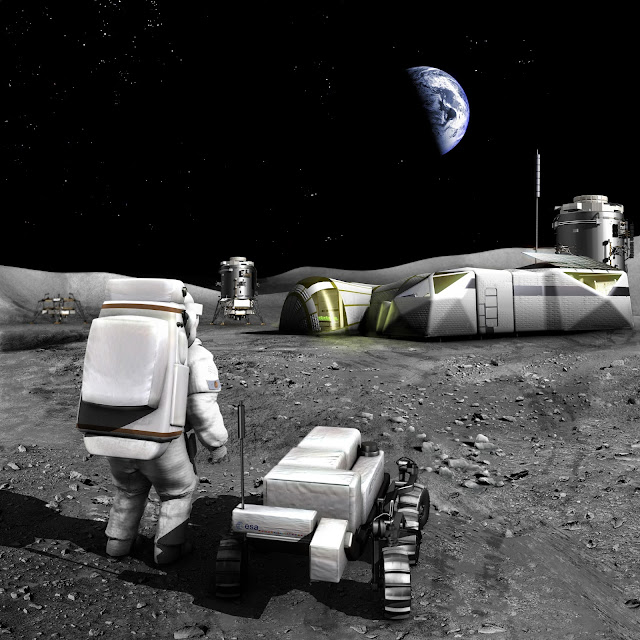 |
| A lunar outpost near an abandoned Apollo Lunar Module descent stage (left). Image credit: European Space Agency |
The names we give to places on and off Earth and to vessels of sea and space have long fascinated me. The moon is one of my favorite places because it is covered with names of scientists and engineers, each of whom has an intriguing biography. At the insistence of Carl Sagan, Mercury bears the names of artists, musicians, poets, and the like, so is also interesting.
Other worlds have other themes assigned to them. The Uranian moon Miranda, for example, draws names from Shakespeare's
The Tempest and locations in Shakespeare's plays.
The Royal Navy in the Age of Fighting Sail is a great source for picturesque ship names, and science fiction seldom disappoints. The late, great Iain M. Banks had a particular talent for irreverent names, which he applied to the intelligent starships of his The Culture setting:
I Blame the Parents is one of my favorites.
In Part One of this series (see link below), I described a world in which Apollo did not die; one in which U.S. taxpayers opted to squeeze our $24-billion Apollo investment for all it was worth instead of (as President Lyndon Baines Johnson put it) pissing it all away. I did not give the Apollo Command and Service Module (CSM) and Lunar Module (LM) spacecraft in that post names for fear of making more confusing an already complicated series of missions. In this post, I mean to rectify that omission.
In Apollo as flown, we saw the following spacecraft names (or, perhaps more properly, call-signs): Apollo 7, none; Apollo 8, none; Apollo 9, CSM
Gumdrop and LM
Spider; Apollo 10, CSM
Charlie Brown and LM
Snoopy; Apollo 11, CSM
Columbia and LM
Eagle; Apollo 12, CSM
Yankee Clipper and LM
Intrepid; Apollo 13, CSM
Odyssey and LM
Aquarius; Apollo 14, CSM
Kitty Hawk and LM
Antares; Apollo 15, CSM
Endeavour and LM
Falcon; Apollo 16, CSM
Casper and LM
Orion; and Apollo 17, CSM
America and LM
Challenger. Apollo 7 and Apollo 8 were CSM-only missions, so their spacecraft did not need names to distinguish them from their LMs in radio communications. Their CSMs were thus known by their mission designations alone.
Part One of this post series continued the Apollo series with the first Saturn V launch of the Olympus 1 space station in late 1971. My alternate-history NASA designated the uncrewed station launch Apollo 18. Olympus is, of course, the name of the lofty home of the Greek Gods. It was a favorite name among 1960s space station planners - for example, Edward Olling - at NASA's Manned Spacecraft Center (since 1973, Johnson Space Center) in Houston.
The first Apollo CSM to reach Olympus 1 was Apollo 19. It was another CSM-only mission, so bore no spacecraft name - much as the Skylab CSMs in our timeline had only numbers (Skylab 2, Skylab 3, and Skylab 4 - Skylab 1 was the launch of the Skylab station). Apollo 20, nearly identical to Apollo 19 apart from its duration (its crew lived on board Olympus 1 for 56 days in early 1972, twice as long as the Apollo 19 crew) also bore no name.
After that, though, NASA had a change of heart. It developed and retroactively applied an alphanumeric designation system for flights and encouraged crews to name their spacecraft, much as it had during Project Mercury (but not Project Gemini). The alphanumeric system pleased NASA bureaucrats; naming piloted spacecraft in single-spacecraft missions was a public-relations ploy meant to point up the distinctive qualities of the individual CSM-only missions to the Olympus stations.
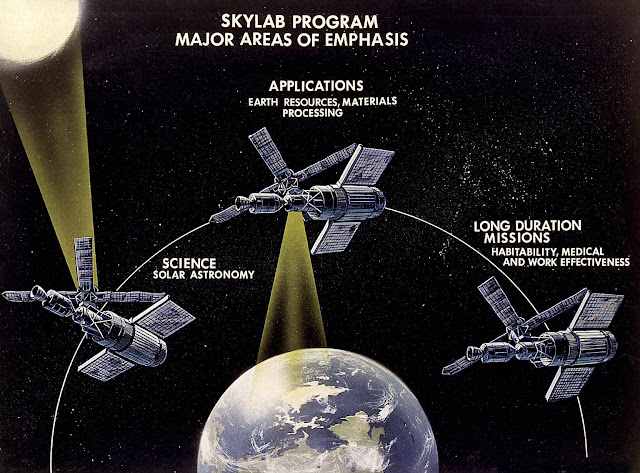 |
| NASA called it Skylab; I call it Olympus. Image credit: NASA |
The Apollo 19 mission, which flew the first K-class CSM with modifications for long-duration space station missions, became O-1/K-1/R1 (Olympus 1/K-class CSM 1/Olympus 1 Resident Crew 1). Apollo 20 became O-1/K-2/R2.
Apollo 21 (I-1), the one and only I-class piloted CSM-only lunar polar orbiter mission, was dubbed
Endurance by its two-man crew, who orbited the moon for 28 days to image potential landing sites for advanced L-class Apollo lunar landing missions planned to begin in late 1974. An automated imaging orbiter was considered for the mission, but was rejected because it would have required costly new development (for example, a complicated Earth-return capsule system for exposed film) as well as a unique Saturn IB upper stage configuration.
The crew of Apollo 22 (O-1/K-3/R3) named their CSM
Discovery. They docked with Olympus 1 in June 1972 for a 112-day stay. Ninety days into their flight, the two-person crew of Apollo 23 (O-1/K-4/V1), the first space station short-stay visitor crew, docked at Olympus 1's radial port to check on the health of the Apollo 22 crew and certify continuation of their mission. In a poetic reference to their short stay of only 10 days, they named their CSM
Hummingbird.
Apollo 24 (J-3), launched in October 1972, was a J-class mission resembling our Apollo 15, Apollo 16, and Apollo 17 missions. In fact, it carried the original Apollo 17 crew of Eugene Cernan, Joseph Engle, and Ronald Evans. In our timeline, Apollo 17 was the last crewed mission to the moon of the 20th century and geologist Harrison Schmitt, the only professional scientist to reach the moon, replaced Engle as LM Pilot. Cernan, Engle, and Evans named their CSM
America and their LM
Challenger, just as Cernan, Schmitt, and Evans did in our timeline.
Schmitt was one of six scientist-astronauts selected as part of Group 4 in June 1965. He would fly Apollo 17, and three others - Joseph Kerwin, Owen Garriott, and Edward Gibson - would fly as Science Pilots on the three Skylab missions. Garriott also flew a Space Shuttle mission. In our timeline, Schmitt was originally assigned to fly Apollo 18; after it was cut, he was moved to Apollo 17.
It would be different in the alternate timeline. Schmitt would not be the first Group 4 scientist-astronaut to fly; several would reach Olympus stations before he set out for the moon. He would become the first Group 4 astronaut to reach the moon, but not (as was the case in our timeline) the only one. He would also fly to the moon a second time and never run for U.S. Senator from New Mexico.
NASA selected the 11 scientist-astronauts of Group 6 in August 1967, just as Congress slashed President Johnson's request for funds to begin major work on the Apollo Applications Program (AAP). AAP shrank rapidly and morphed into Skylab. Of the eleven Group 6 scientists, seven eventually flew Space Shuttle missions. In the alternate timeline, most would fly Apollo missions before 1976.
This is a good place to consider how astronaut selection would unfold in the alternate timeline. Seven refugees from the cancelled U.S. Air Force Manned Orbiting Laboratory would join NASA in August 1969 as Group 7, just as they did in our timeline. In our timeline, they were the last astronauts selected until January 1978, when Group 8 - which included among its 35 members the first minority and women astronauts - was selected to crew Space Shuttles.
In the alternate timeline, NASA would select new astronaut groups of about 10 members every three or four years to bring in new skills and make up for attrition. Group 8 would, as in our timeline, include the first U.S. women and minority spacefarers, but they would join NASA in January 1971, not January 1978.
Older astronauts of our timeline's Group 8 might join Group 9 (1974) and younger ones might join Group 10 (1977) or Group 11 (1981). In general, though, NASA would need fewer astronauts. Because of this, many individuals who flew in space in our timeline would never join the space agency.
Given the "morality" and prejudices of the 1970s, it seems likely that NASA would find excuses not to fly women as members of Resident or lunar crews, though several would reach Olympus 3 as members of Visitor crews. One would serve as Visitor crew Commander. In an era when the proposed Equal Rights Amendment to the Constitution was struck down, however, mixed crews on long-duration and minimal-privacy lunar missions would make many American taxpayers uncomfortable.
In the early 1980s, however, this would change. Once the spaceflight "glass ceiling" was shattered, many women would fly in space in many roles, just as in our timeline.
Apollo 25 (J-4) was an engineering/technology-development mission to the Apollo 24 site meant to prepare NASA for L-class missions and eventual lunar outposts. In addition to accomplishing a precision landing almost exactly one kilometer from the Apollo 24 LM descent stage, which they inspected in considerable detail, the Apollo 25 crew collected materials-exposure cassettes and meteoroid, dust, and solar-particle capture cells the Apollo 24 crew had left behind. They also collected geologic samples scientists studying Apollo 24 photos had determined to be of special interest. They named their CSM
Franklin and their LM
Edison for the famed American inventors.
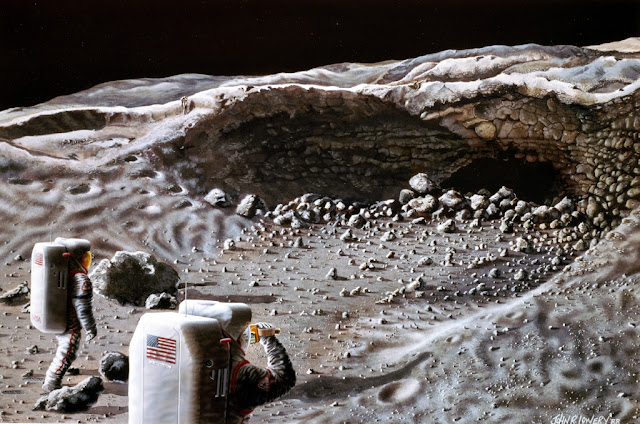 |
| Journey to a lava tube cave. Image credit: NASA |
Apollo 26 (O-2) was the uncrewed launch of the Olympus 2 station. Apollo 27 (O-2/K-5/R1) saw three astronauts live in orbit for 224 days. They named their CSM
Freedom, which led one stand-up comedian to quip that it should have been named "Incarceration."
The crew received the Apollo 28 (0-2/K-6/V1) CSM
Athena, Apollo 29 (O-2/K-7/V2) CSM
Amity, and the Apollo 30 CSM (O-2/K-8/V3)
Liberty. Apollo 28 included the first American woman in space, Apollo 29 the first non-U.S./non-Soviet astronaut in space, and Apollo 30's Visitor crew returned to Earth in the Apollo 27 CSM, leaving their CSM for the Apollo 27 Resident crew.
The uncrewed Apollo 31 Saturn V launched a pair of Radio/TV Relay Satellites to Earth-moon L2 and the uncrewed Apollo 32 (O-3) Saturn V launched Olympus 3, first of the "long-life" stations. The Apollo 33 (O-3/K-9/R1) crew, the first to stay on board a space station for what became the "routine" interval of 180 days, arrived in the CSM
Eos, which was named for the Greek goddess of the dawn.
Apollo 34 (J-5) in February 1974, the last of the J-class missions, landed in dark-floored Tsiolkovskii in the moon's Farside hemisphere. Harrison Schmitt was the mission's LM Pilot and the first geologist on the moon. They named their CSM
Infinity and their LM for the red-golden star
Arcturus, long seen as a harbinger of springtime.
The Apollo 35 (O-3/K-10/V1) CSM
Hermes delivered the first drum-shaped Cargo Carrier (CC-1) to Olympus 3 and the Apollo 36 (O-3/K-11/V2) CSM
Independence caused it to reenter after the Apollo 33 crew unloaded it. Hermes was, among other things, the Greek God of Commerce, The Messenger of the Gods, and the half-brother of Apollo. The Apollo 37 (O-3/K-12/R2) CSM
Celeste (a feminine name meaning "heavenly") delivered the large Argus telescope module to Olympus 3.
The uncrewed Apollo 38 (L-1A) mission saw the LM-derived Lunar Cargo Carrier-1 (LCC-1) launched on a Saturn V on a direct path to the planned landing site of the Apollo 40 (L-1B) mission. Apollo 38 included no CSM. The Apollo 39 (O-3/K-13/V3) CSM
Shenandoah was the first of more than a dozen Earth-orbital CSM spacecraft named for U.S. national parks and monuments.
The Apollo 40 CSM was the first L-class Advanced CSM (ACSM) and its LM was the first L-class Advanced LM (ALM). The Apollo 40 crew named their ACSM
Aquila, for the constellation The Eagle, and their ALM
Altair, for its brightest star. The lunar surface crew used
Aquila as their base camp to explore a complex landing site for one week. This more than doubled the three-day J-class lunar stay-time.
The Apollo 41 (O-3/K-14/R3) CSM
Constitution delivered the Olympus 3 station's third Resident crew while its second Resident crew was still on board, marking the beginning of continuous station occupation. The Apollo 42 (O-3/K-15/V4) CSM was named
Adventure.
The Apollo 43 (O-3/K-16/V5) crew named its CSM
Yosemite, and the Apollo 44 (O-3/K-17/R4) crew named its CSM
Acadia. Yosemite is, of course, a famous national park in California; Acadia, the first eastern national park, is on the other side of the country, in the Mission Commander's home state of Maine.
My first Dreaming a Different Apollo post ended with the launch of Apollo 44 in December 1975. The timeline could, of course, continue (and, I suspect, probably will). One can imagine an ACSM called
Draco paired with an ALM named
Thuban, Draco's rather faint brightest star. I am sure that we will see an
Enterprise at some point.
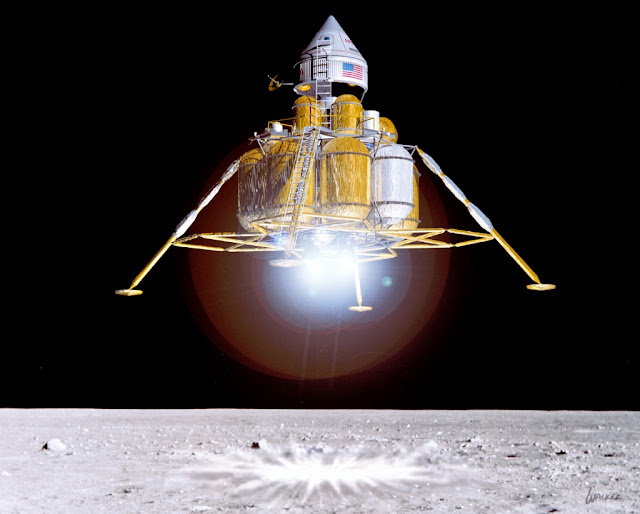 |
| Direct Ascent moon lander with Apollo-style Earth-reentry module (top) from NASA's 1991-1994 First Lunar Outpost (FLO) study. Image credit: NASA |
I expect that the Apollo series would continue into the late 1980s or early 1990s. By the beginning of the 1990s decade, the Lunar-Orbit Rendezvous Apollo mission scheme would give way to Direct-Ascent missions, in which a single spacecraft would launch from Earth and travel directly to a lunar base. Opportunities for naming spacecraft would become fewer, but almost certainly would continue.
More InformationDreaming a Different Apollo, Part OneSpace Station Resupply: The 1963 Plan to Turn the Apollo Spacecraft Into a Space FreighterApollo's End: NASA Cancels Apollo 15 & Apollo 19 to Save Station/Shuttle (1970)Source:
Dreaming A Different Apollo, Part Four: Naming Names
 Wątek: [Spaceflight History Blog] Dreaming A Different Apollo, Part Four: Naming Names (Przeczytany 1511 razy)