"A Continuing Aspect of Human Endeavor": Bellcomm's January 1968 Lunar Exploration Program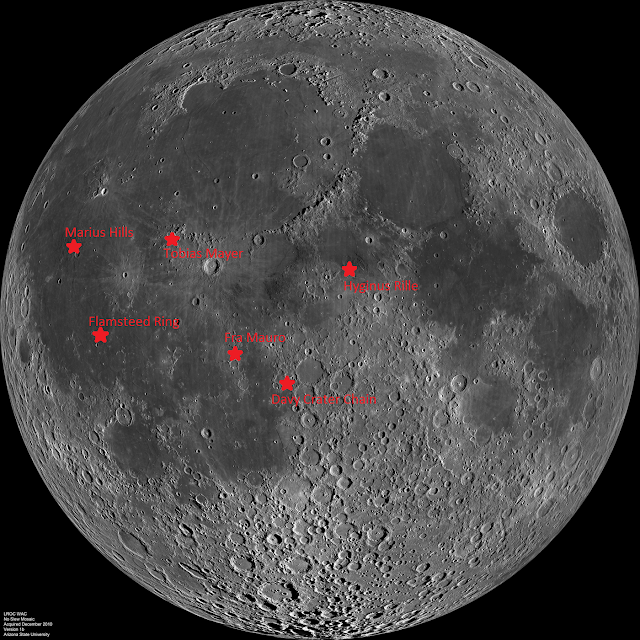 |
| Lunar Exploration Program candidate landing sites. Of these, the Apollo Program would reach only Fra Mauro; Apollo astronauts would, however, visit five other sites not labeled here. Please click on image to enlarge. Image credit: NASA/Arizona State University/DSFPortree |
Bellcomm, Inc., based near NASA Headquarters in Washington, DC, was carved out of Bell Labs in 1962 to provide technical advice to NASA's Apollo Program Director. NASA rapidly expanded Bellcomm's bailiwick to take in nearly all NASA Office of Manned Space Flight planning.
In a January 1968 report, Bellcomm planners N. Hinners, D. James, and F. Schmidt proposed a lunar mission series designed to bridge a gap in NASA plans they believed existed between the first piloted "Early Apollo" moon flights and sophisticated Apollo Applications Program (AAP) lunar expeditions. They declared that their Lunar Exploration Program was "based upon a reasonable set of assumptions regarding hardware capability and evolution, an increase in scientific endeavor, launch rates, budgetary constraints, operational learning, lead times, and interaction with other space programs," as well as "the assumption that lunar exploration will be a continuing aspect of human endeavor."
Hinners, James, and Schmidt envisioned a series of 14 lunar missions in four phases. Phase 1 would span the period from 1969 through 1971. The five Phase 1 missions were approximately equivalent to the Early Apollos. They would launch at least six months apart to give engineers and scientists adequate time to learn from each mission's successes and failures and enable them to apply their new knowledge to subsequent missions. Phase 1 would begin with Lunar Landing Mission (LLM)-1, the historic first Apollo moon landing.
The LLM-1 Lunar Module (LM) would alight on one of the moon's flat, relatively smooth basaltic plains. Called since the 17th century "maria" (Latin for "seas" - the singular is "mare"), they appear as mottled gray areas on the moon's white face. They cover about 20% of the moon's Earth-facing Nearside hemisphere, but are scarce on the hemisphere the moon turns always away from Earth (its Farside). LLM-1 and the other Phase 1 missions would each have several back-up near-equatorial Nearside mare landing sites, enabling them to land in safe places regardless of how their planned launch dates might slip.
Almost any mare would do for LLM-1, Hinners, James, and Schmidt argued, because the first piloted landing mission would emphasize engineering, not science. LLM-1 would test the LM, lunar space suits, and other Apollo systems ahead of more ambitious Phase 1 missions. If all went as planned, the LLM-1 crew would stay on the moon for 22 hours and carry out two short moonwalks.
LLM-1 would follow a "free-return" flight path that would guarantee that the Apollo Command and Service Module (CSM) could loop around the moon and return to Earth without propulsion in the event that its Service Propulsion System (SPS) main engine failed en route to the moon. The SPS was meant to adjust the CSM/LM combination's course during flight to and from the moon, slow the CSM and LM so that the moon's gravity could capture them into lunar orbit, and boost the CSM out of lunar orbit to return to Earth. The Bellcomm planners noted that use of the free-return trajectory would greatly limit the percentage of the moon's surface a lunar mission could reach.
The LMs constructed for Phase 1 missions would each be capable of delivering two astronauts. their space suits, and up to 300 pounds of payload to the lunar surface. This would include geologic tools for collecting up to 50 pounds of lunar rock and dust samples for return to Earth. Missions LLM-2 through LLM-5 would, in addition, each include an Apollo Lunar Scientific Experiment Package (ALSEP) – a cluster of geophysical experiments – for deployment on the moon. The ALSEPs would monitor the moon and return data after the astronauts returned to Earth.
LLM-2 through LLM-5 would see astronauts perform geological traverses on foot to spots up to several kilometers from the LM. Meanwhile, the CSM Pilot, alone in lunar orbit, would photograph the moon's surface through the CSM's small windows.
LLM-2, like LLM-1, would follow a free-return trajectory and remain for 22 hours at a mare landing site. It would, however, add a third moonwalk.
LLM-3 would abandon the free-return trajectory so that it could reach a fresh crater on a mare. The crater, the Bellcomm planners explained, would serve as a natural "drill hole." Studies of both natural and human-made craters on Earth had shown that the LLM-3 astronauts would find the oldest rocks – those excavated from deepest beneath the surface – on the crater's rim. The astronauts would explore the lunar surface for longer than 22 hours but less than 36 hours.
LLM-4 would be similar to LLM-3, but would be targeted to land at one of the many widely scattered mare "wrinkle ridges." In 1968, some scientists (notably, Nobel Laureate Harold Urey) still attributed these sinuous raised features to salty water escaping from reservoirs beneath the moon's surface, but today we know that they formed when lava that filled the mare nearly 4 billion years ago buckled as it cooled. Some may link or follow traces of ancient landscape drowned when the lava welled up from within the moon.
LLM-5, the final Phase 1 flight, would see an LM land at a mare site bordering a Highlands region. The Highlands of the moon, the light-colored areas on the moon's disk, are ancient cratered terrain. The LLM-5 astronauts would squeeze four moonwalks into their 36-hour mission.
The Bellcomm planners' four Lunar Exploration Program Phase 2 missions would commence about two years after LLM-5 and span 1972-1973. Upgrades to Apollo hardware and operations in Phase 2 would permit in-depth exploration of specific unique landing sites selected primarily for scientific interest. Among the upgrades that Hinners, James, and Schmidt proposed was variable Earth-to-moon flight time or time spent in lunar orbit prior to landing. This operational flexibility was intended to permit an Extended LM (ELM) spacecraft to reach its pre-planned target site even if launch from Earth were delayed for several days.
The Phase 2 lunar-surface astronauts would perform six moonwalks at each landing site. The ELM would land 1300 pounds of payload. Phase 2 CSMs would carry prototype remote sensors to test their feasibility ahead of their operational use in Phases 3 and 4.
The first Phase 2 mission, LLM-6, would see an ELM spend three days at Tobias Mayer in the extensive Oceanus Procellarum ("Ocean of Storms") mare region. Its crew would deploy an ALSEP and explore on foot a sinuous rille (canyon), a dome (possible volcano), and a fresh crater with a surrounding dark halo (possible volcanic vent). LLM-7 would be similar to LLM-6, but would land at a linear rille site designated I-P1.
LLM-8 would see the introduction of the Lunar Flying Unit (LFU), a one-person rocket flyer. Bellcomm targeted LLM-8 to the Flamsteed Ring, an ancient crater mostly submerged by lava during the formation of Oceanus Procellarum. At the time Hinners, James, and Schmidt selected it, the Flamsteed Ring was suspected of being an extrusive volcanic feature called a "ring dike."
LLM-9, similar to LLM-8, would visit Fra Mauro, a site known for its domes and rilles, which geologists interpreted as signs of recent volcanism. Fra Mauro would later come to be seen (correctly) as a large geologic unit made up of ejecta from the enormous impact that blasted out Mare Imbrium, the right "eye" of the "Man in the Moon." Cone crater, a natural drill hole in the Fra Mauro Formation, would become the target of Apollo 13 (and, after that mission failed to land on the moon, Apollo 14).
Phase 3 of Bellcomm's Lunar Exploration Program would comprise a single lunar-orbital survey mission in 1974. Because it would include no lunar landing, it received no LLM number. The mission would, for all practical purposes, mark the start of advanced AAP lunar flights. A solar-powered sensor module based on a planned AAP Earth-resources observation module design would replace the LM. By spending 28 days (one lunar day-night period) in lunar polar orbit, the mission's augmented CSM could pass over the entire lunar surface in daylight, enabling the crew to conduct global high-resolution film photography. When time came to return to Earth, the astronauts would load exposed film into their CSM, then undock from the sensor module and leave it behind in lunar orbit to function as an independent satellite.
Hinners, James, and Schmidt explained that Lunar Exploration Program Phases 1 and 2 missions would gather "ground truth" data on the composition and structure of the moon's surface. These data would enable scientists to interpret Phase 3 mission results in preparation for Lunar Exploration Program Phase 4, which would span 1975-1976.
Phase 4 would see two "Dual Launch" Lunar Surface Rendezvous and Exploration Missions. Each Dual Launch mission would require two Saturn V rockets, two augmented CSMs, an LM-derived unmanned Lunar Payload Module (LPM), and an augmented ELM bearing one LFU.
LLM-10 and LLM-11 together would make up the first Dual Launch mission. LLM-10 would deliver an unmanned LPM to either Hyginus Rille or the Davy crater chain. The LLM-10 crew, orbiting the moon in their augmented CSM, would remotely pilot the LPM's final approach to the landing site to help to ensure that it would set down within 100 meters of a predetermined target point. Before returning to Earth, the LLM-10 astronauts would "photo locate" the landed LPM from lunar orbit to aid the follow-on LLM-11 crew in finding it. They would also release a science subsatellite into lunar orbit.
LLM-11 would see two astronauts wearing advanced "hard" (mostly non-fabric) space suits land their augmented ELM near the pre-landed LPM for a two-week stay. They would draw on the LPM's 8000-pound payload to conduct in-depth exploration of their complex landing site.
The LPM payload would include lunar surface transportation systems: specifically, one LFU and a one-man, 2000-pound Local Scientific Survey Module (LSSM) moon rover. Other LPM cargo would include: a spare hard suit; a core drill attached to the LPM for obtaining a 100-foot drill core; an LSSM-transportable core drill for obtaining 10-foot cores at scattered sites; life support consumables for replenishing those on board LLM-11's ELM; and an advanced lunar-surface geophysical station with a 10-year design life.
Hinners, James, and Schmidt selected the Marius Hills as the landing site for LLM-12 and LLM-13, their second Dual Launch mission pair and the final missions of their Lunar Exploration Program. The Marius Hills were popular with planners for their many domes and other features of possible volcanic origin.
The Bellcomm planners anticipated that, after the LLM-13 crew returned to Earth, even more ambitious AAP moon missions would commence. These might lead to establishment of a lunar surface outpost. They were, of course, incorrect; it became clear soon after they completed their report that lunar exploration would not become "a continuing aspect of human endeavor."
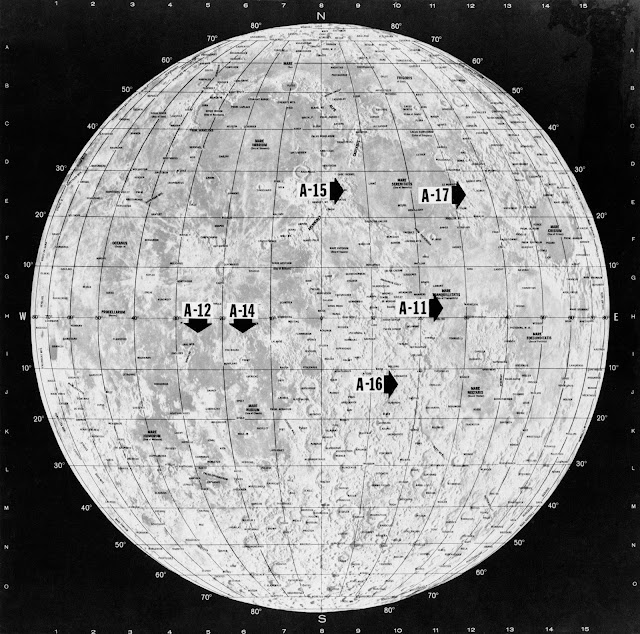 |
| This NASA map, published at the time of the Apollo 17 mission in December 1972, shows the six Apollo landing sites. All landings occurred within an area the size of the western United States between the Mississippi River and the Rocky Mountains (on a world with about as much surface area as Europe and North America combined). If Apollo 17 had landed in St. Louis, Missouri, Apollo 16 would have landed in northeastern Texas; Apollo 15 on the Kansas-Nebraska border; Apollo 14 and Apollo 12 in New Mexico; and Apollo 11 in Oklahoma. |
The earliest Apollo landing missions (Apollo 11, Apollo 12, and Apollo 14) were roughly equivalent to Bellcomm's LLM-1, LLM-2, and LLM-3, though their crews performed fewer moonwalks. Apollos 15, 16, and 17, by contrast, were mainly shaped by the certain knowledge that Apollo lunar exploration would soon conclude. They became unlike any of Bellcomm's proposed missions as NASA sought to accomplish as much lunar exploration as possible at minimal cost before political support for the Apollo Program ran out.
The final Apollo lunar mission, Apollo 17 (December 1972), saw astronauts Eugene Cernan and Harrison Schmitt explore the Highlands-bordering Taurus-Littrow mare site for about three days. They drove an electric-powered Lunar Roving Vehicle (LRV). Meanwhile, Ron Evans, on board the Apollo 17 CSM in lunar orbit, used a suite of sensors to map a broad swath of the moon's surface and released a science subsatellite.
Sources"A Lunar Exploration Program – Case 710," N. Hinners, D. James, and F. Schmidt, TM-68-1012-1, Bellcomm, 5 January 1968
To a Rocky Moon: A Geologist's History of Lunar Exploration, D. Wilhelms, University of Arizona Press, 1993
The Geologic History of the Moon, U.S. Geological Survey Paper 1348, D. Wilhelms, J. McCauley, and N. Trask, USGS, 1987
More InformationApollo's End: NASA Cancels Apollo 15 & Apollo 19 to Save Station/Shuttle (1970)Rocket Belts and Rocket Chairs: Lunar Flying Units"Assuming That Everything Goes Perfectly Well in the Apollo Program. . ." (1967)Harold Urey and the Moon (1961)Source:
"A Continuing Aspect of Human Endeavor": Bellcomm's January 1968 Lunar Exploration Program
 Wątek: [Spaceflight History Blog] "A Continuing Aspect of Human Endeavor": Bellcomm's January 1968 Lunar Exploration Program (Przeczytany 1825 razy)