Astronaut Sally Ride's Mission to Mars (1987) (1)
26 September 2015 David S. F. Portree
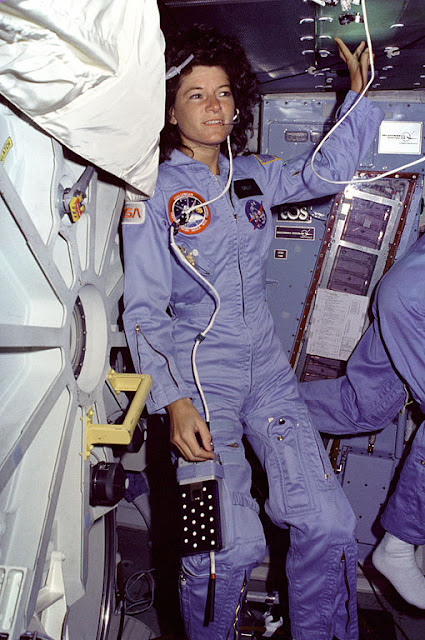 Astronaut Dr. Sally Ride on board the Space Shuttle Orbiter Challenger during STS-7 (June 1983), her first flight into space. Image credit: NASA
Sally Ride was a member of the 1978 astronaut class, the first selected for Space Shuttle flights. During mission STS-7 (18-24 June 1983), she became the first American woman in space. Ride flew one more Shuttle mission - STS-41G (5-13 October 1984) - and served on the Rogers Commission investigating the 28 January 1986 Shuttle Challenger accident before James Fletcher, in his second stint as NASA Administrator, made her his Special Assistant for Strategic Planning on 18 August 1986. Fletcher charged Ride with drafting a new blueprint for NASA's future. She had help from a small staff, a 12-member advisory panel led by Apollo 11 astronaut Michael Collins, and a six-member space mission design team at Science Applications International Corporation (SAIC) in Schaumburg, Illinois. The result of her 11-month study was a slim report called Leadership and America's Future in Space.
On 22 July 1987, Ride testified to the U.S. House of Representatives Subcommittee on Space Science and Applications about her report. She told the Subcommittee that the "civilian space program faces a dilemma, aspiring toward the visions of the National Commission on Space, but faced with the realities of the Rogers Commission Report." The National Commission on Space (NCOS), mandated by Congress and launched by President Ronald Reagan on 29 March 1985, had been meant to blueprint NASA's future until about 2005. Headed by Thomas Paine, NASA Administrator from 1968 to 1970, it had produced instead a wide-ranging 50-year master plan for "free societies on new worlds" that would have been dismissed as unrealistic even had it not been unveiled in the chaotic aftermath of Challenger.
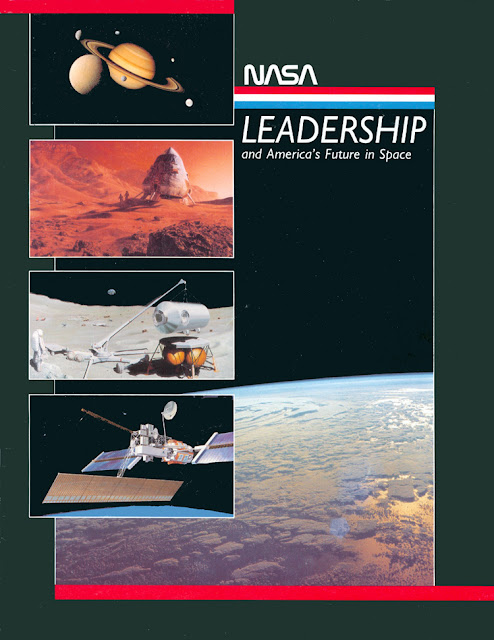 The Ride Report. Image credit: NASA
Whereas the NCOS report urged immediate adoption of its expansive (and expensive) "vision," Ride outlined four much more limited "Leadership Initiatives" "as a basis for discussion." In a partial break from the space station-moon-Mars progression that had dominated advanced planning since the 1950s, none of Ride's proposals necessarily followed from the others, though by Fletcher's order all would rely to some degree on NASA's low-Earth orbit (LEO) Space Station. Her piloted Mars program, for example, could proceed without her permanent piloted lunar outpost, program to study Earth from space ("Mission to Planet Earth"), or robotic Solar System exploration program ("Mission from Planet Earth").
SAIC began to design the Ride Report's piloted Mars program in January 1987. The company presented its final report to the Office of Exploration (nicknamed "Code Z" for its NASA Headquarters mail code) in November of that year. Fletcher created Code Z in June 1987 and placed Ride in charge as his Acting Assistant Administrator for Exploration. By that time, Ride had announced that she would leave NASA in August. John Aaron, who replaced her as Code Z chief, made SAIC's report the basis for Code Z's piloted Mars and Phobos mission "Case Studies" in Fiscal Year 1988.
SAIC employed a split/sprint Mars mission design. The company credited a 1985 joint University of Texas/Texas A & M student design project with originating the split/sprint concept, though in fact similar concepts date back to the 1950s. The split/sprint mission would use a pair of spacecraft: an automated one-way cargo spacecraft "slowboat" launched first followed by a piloted "sprint" spacecraft. Both would burn chemical propellants and rely on aerobraking at Earth and Mars.
The cargo spacecraft would follow a propellant-saving low-energy path to Mars. It would transport to Mars orbit propellants for the piloted spacecraft's return to Earth. The piloted sprint spacecraft would leave LEO only after the cargo spacecraft was confirmed to have arrived safely in Mars orbit.
So that its six-person crew would be exposed to weightlessness, radiation, and isolation for as little time as possible, the piloted spacecraft would follow a roughly six-month path to Mars, remain at the planet for only one month, and then return to Earth in about six months. This would yield a piloted Mars mission duration of no more than 14 months.
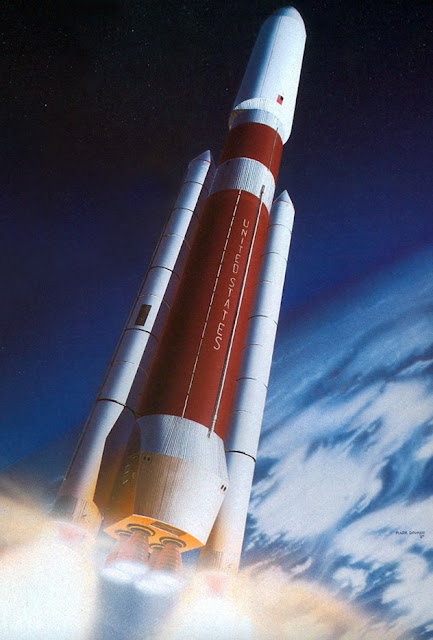 Shuttle-derived heavy-lift launch vehicle. Image credit: M. Dowman/Eagle Engineering
In common with most other post-Challenger piloted Mars plans, the SAIC team abandoned the Space Shuttle as its primary means of launching spacecraft components and propellants to LEO. In the Shuttle's place, it proposed a heavy-lift rocket based in part on Shuttle hardware. The new rocket would debut in 1996 with a launch capability of 36 metric tons to LEO, then would evolve by 2002 to carry 91 metric tons to LEO.
Though it featured a piloted mission of short duration - which in most cases would imply expenditure of large quantities of propellants - the SAIC split/sprint mission design offered substantial propellant savings by refueling the crew spacecraft in Mars orbit. This would in turn slash the number of costly heavy-lift rockets required to launch spacecraft components and propellants to the Space Station for assembly.
A sprint-type mission using a single combined round-trip crew/cargo spacecraft would, SAIC calculated, need 25 heavy-lifters, while the split/sprint design would need only 15. In addition, because the cargo and crew spacecraft would depart Earth more than a year apart, heavy-lift launches could be spread out over a longer period, making launch vehicle, payload, and launch pad preparations less sensitive to delays due to weather constraints or malfunctions.
By the time the heavy-lifter attained its maximum capability in 2002, Phase I of SAIC's three-phase Mars program would be ended and Phase II would have just begun. Phase I, starting in 1992, would include a series of robotic precursor missions. Mars Observer, in 1987 already an approved NASA mission, would map Mars from orbit beginning in 1993; then, in 1995, Mars Observer 2 would establish and act as radio relay for a planet-wide network of hard-landed penetrator sensor stations. Orbital mapping and the seismic/meteorological net would help scientists and engineers select landing sites for automated Mars Sample Return (MSR) and piloted Mars missions.
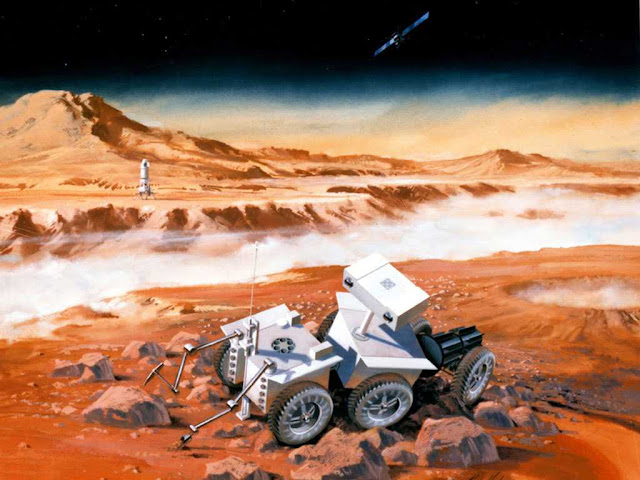 Mars Rover Sample Return concept. Image credit: NASA
A pair of MSR spacecraft would depart Earth in 1996 to collect Mars surface samples and return them to high-Earth orbit (HEO) in 1999. A reusable Orbital Maneuvering Vehicle (OMV) based at the Space Station would retrieve the samples from HEO and deliver them for quarantine and initial study to an "isolation half-module" added to the Space Station in 1998. The samples would enable scientists to identify any hazards in Mars's surface materials and would aid engineers in the design of spacecraft, rovers, habitats, space suits, and tools.
Phase I would also include biomedical research on board the Space Station, which would reach Permanent Manned Configuration (PMC) in 1994. Almost immediately after it achieved PMC, NASA would add a Life Science Module. A six-person crew would then conduct a Mars mission simulation on board the Station that would last for the planned piloted sprint mission duration.
If the astronauts remained healthy after the simulation, then in 1996 NASA would begin development of a Mars sprint spacecraft lacking any provision for artificial gravity (that is, no part of it would rotate to create acceleration which the crew would feel as gravity). A module for housing Mars spacecraft assembly crews would join the Station in 2002, kicking off Phase II of SAIC's Mars program. The cargo spacecraft for the first split/sprint mission would depart LEO during the 2003 low-energy Earth-Mars transfer opportunity.
If, on the other hand, biomedical researchers determined that the simulation crew had suffered harm from their long sojourn in weightlessness, then NASA would add a "variable-gravity module" to the Station in 2001. Crews would conduct simulations in the spinning module to determine the minimum level of artificial gravity required to safeguard astronaut health. Development of an artificial-gravity sprint spacecraft would not commence until after the simulations ended in 2004. If the artificial-gravity sprint spacecraft needed as much development time as its no-gravity counterpart, then the first piloted Mars mission might not leave Earth until 2013. SAIC largely ignored this possibility.
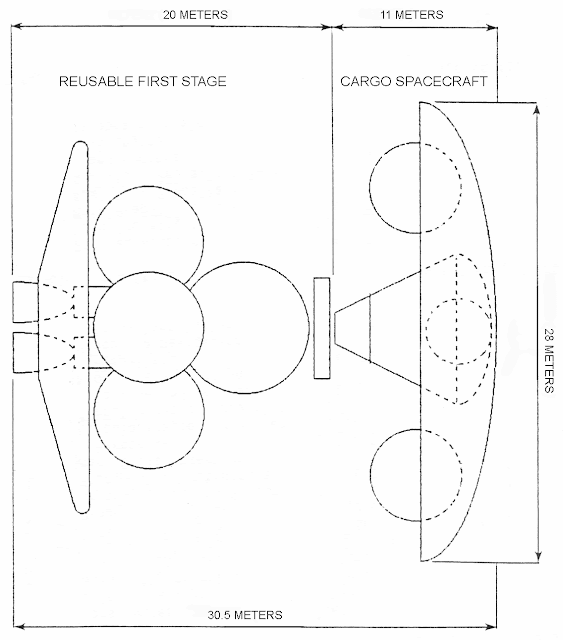 SAIC's automated cargo spacecraft (right) in Earth-orbit launch configuration with large Orbital Transfer Vehicle (OTV). The conical vehicle at the center of the cargo spacecraft's dish-shaped aeroshell is the piloted Mars Lander. Spherical tanks around the Mars Lander contain Earth-return propellants for the piloted sprint spacecraft. Image credit: Science Applications International Corporation
Launching parts and propellants from Earth's surface for the 238.5-metric-ton cargo spacecraft and its single 349.6-metric-ton reusable Orbital Transfer Vehicle (OTV) would require seven heavy-lift rocket launches. The cargo spacecraft would carry at the center of its 28-meter-diameter bowl-shaped Mars Orbit Insertion (MOI) aerobrake heat shield the mission's two-stage, 60-metric-ton Mars Lander.
Spherical tanks surrounding the Lander would hold the 82.5 tons of cryogenic liquid hydrogen and liquid oxygen propellants the piloted sprint spacecraft would need for return to Earth. The cargo spacecraft would also carry 4.2 metric tons of propellants for correcting its course during flight from Earth to Mars and 16.4 metric tons of propellants for circularizing its orbit after it aerobraked in Mars's atmosphere. A 9.1-metric-ton cooling system would prevent the propellants from boiling and escaping.
On 9 June 2003, the 30.5-meter-long cargo spacecraft/OTV stack would move away from the Space Station using small thrusters. The OTV would then ignite its engines to push the cargo spacecraft out of LEO. After sending the cargo spacecraft on its way, the OTV would separate, fire its engines to slow itself, aerobrake in Earth's upper atmosphere, and return to the Station for refurbishment, refueling, and reuse.
The cargo spacecraft's course would intersect Mars on 29 December 2003. It would aerobrake in Mars's upper atmosphere to slow itself so that the planet's gravity could capture it into orbit. The cargo spacecraft would rise to its apoapsis (orbit high point), then fire its rocket engines to raise its periapsis (orbit low point) out of the martian atmosphere and circularize its orbit. Flight controllers would then begin careful checkout and monitoring of the cargo spacecraft and its cargo, paying special attention to the propellants the piloted sprint spacecraft would need for return to Earth.
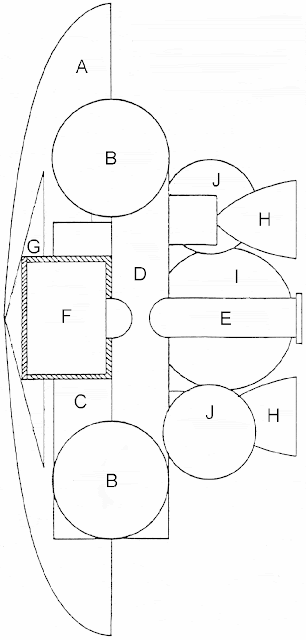 Partial cutaway view of SAIC's piloted sprint Mars spacecraft. A = bowl-shaped Mars Orbit Insertion aerobrake heat shield; B = cylindrical habitat modules (2); C = cylindrical logistics module; D = cylindrical "bridge" tunnel; E = cylindrical tunnel linking docking unit (right), bridge tunnel, and Earth Recovery Vehicle; F = drum-shaped Earth Recovery Vehicle; G = flattened conical aerobrake heat shield; H = engines (2); I = spherical liquid hydrogen tank; J = spherical liquid oxygen tanks (2). Not shown: cylindrical command module, cylindrical airlock module, and one spherical liquid hydrogen tank. Image credit: Science Applications International Corporation/DSFPortree
SAIC offered a piloted spacecraft design with Station-derived pressurized crew modules connected in "race track" formation; that is, in a square with each module linked by short tunnels at or near their ends. A pair of 4.4-meter-diameter, 12.2-meter-long habitat modules, each with a mass of 15.5 metric tons, would form two sides of the square; a 4.4-meter-diameter, 12.2-meter-long, 10.8-metric-ton logistics module would form the third side; and an 8.5-metric ton command module and a 3.2-metric-ton airlock module would together make up the fourth.
A pressurized "bridge" tunnel would cross the inside of the square, linking directly the two habitat modules. Another tunnel would pierce the center of the bridge tunnel vertically. Its forward end would link with the top of the drum-shaped, 11.9-metric-ton Earth Recovery Vehicle (ERV), while its aft end would carry a docking unit. The ERV, situated deep within the spacecraft's structure, would double as the crew's solar flare "storm" shelter. Four spherical tanks holding a total of 91.9 metric tons of cryogenic liquid hydrogen/liquid oxygen propellants and two rocket engines with a combined mass of 4.6 metric tons would be mounted atop the crew modules.
The ERV/storm shelter would be mounted at the center of an 11.4-meter-diameter, one-metric-ton flattened conical aerobrake heat shield. ERV, ERV aerobrake, crew modules, tunnels, propellant tanks, and engines would nestle within a bowl-shaped, 25-meter-diameter, 16.1-metric-ton MOI aerobrake. Except during propulsive maneuvers and aerobraking, four solar arrays capable of generating a total of 35 kilowatts of electricity at the piloted spacecraft's maximum distance from the Sun (that is, in Mars orbit) would extend beyond the edge of the MOI aerobrake. During maneuvers and aerobraking, the arrays would be folded out of harm's way atop the crew modules. Fully assembled and loaded with propellants, the piloted spacecraft's mass would total 193.7 metric tons.
The assembly crew based at the Space Station would link a newly assembled smaller (197.4-metric-ton) OTV to the piloted spacecraft, then would attach the larger OTV used to launch the cargo spacecraft to the new OTV. This would create a 48-meter-long, 738.7-metric-ton Earth-departure stack.
 Wątek: [Spaceflight History Blog] Astronaut Sally Ride's Mission to Mars (1987) (Przeczytany 1838 razy)