A Forgotten Rocket - The Saturn IB11 July 2015 David S. F. Portree
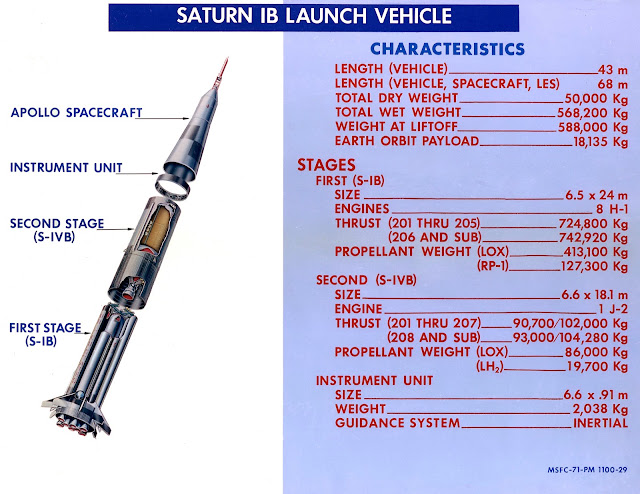 Image credit: NASA
The Saturn V moon rocket, the largest, most powerful launcher ever built, commands much attention, but not everyone knows that the giant had smaller, lesser-known relatives, including one that launched men into space. Had the Apollo Applications Program (AAP) gone ahead as planned in mid-1966, that other piloted Saturn rocket, the Saturn IB, might have become more familiar than the Saturn V. It would have become the AAP workhorse rocket, with more than two dozen flights to its credit. Of all the human spaceflight systems that the U.S. has produced, only the Space Shuttle has flown more missions than that.
The detailed 1971 NASA Marshall Space Flight Center graphic at the top of this post is a good point of departure for describing the Saturn IB. I plan to write a number of posts on AAP. With this post in place, I need not describe the Saturn IB each time I mention it. I need only link to this post.
As the graphic indicates, the Saturn IB was a two-stage rocket. The eight H-1 engines in its Chrysler-built S-IB first stage burned liquid oxygen (LOX) and RP-1, a kind of kerosene used as aviation fuel. The single J-2 engine in the S-IVB second stage burned LOX and liquid hydrogen (LH2). Both stages were expended in launching their payload. The S-IVB stage served also as the Saturn V moon rocket's third stage.
The ring above the second stage, the Instrument Unit (IU), was the Saturn IB's IBM-built electronic brain. It controlled the rocket's flight path and various in-flight events, such as first-stage separation and second-stage ignition. The outwardly similar Apollo Saturn V IU was located in the same position.
The tapering part above the IU, labeled "Apollo spacecraft," was in fact composed of several major systems. The skinny Launch Escape System (LES) tower on top contained a solid-propellant rocket motor designed to pull the conical Apollo Command Module (CM) to which it was attached to safety in the event that the Saturn IB malfunctioned.
The three-man CM was one part of the two-part Apollo Command and Service Module (CSM) spacecraft. The CSM also included the drum-shaped Service Module (SM), which housed propulsion and attitude-control systems, life-support consumables, and electricity-generating fuel cells.
Finally, the Spacecraft Lunar Module Adapter (SLA) was a segmented, streamlined shroud that linked the bottom of the CSM to the top of the IU. Though shown empty in the graphic, it could serve as a cargo volume. The SLA usually housed a Lunar Module moon lander when it formed part of an Apollo Saturn V stack.
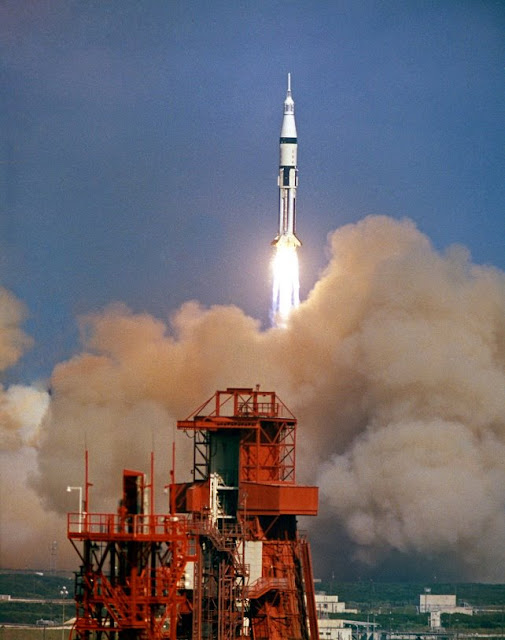 The first piloted Apollo mission: Apollo 7 liftoff from Launch Complex 34 on 11 October 1968. Image credit: NASA
Saturn IB rockets boosted Apollo CSM spacecraft bearing astronauts into low-Earth orbit just five times. The first piloted Saturn IB, designated SA-205, launched Apollo 7 on 11 October 1968. The rocket lifted off from Launch Complex 34, located at Cape Canaveral Air Force Station, just south of NASA's Kennedy Space Center. Astronauts Wally Schirra, Donn Eisele, and Walter Cunningham tested the first piloted CSM in orbit for 11 days and splashed down in the North Atlantic Ocean on 22 October 1968.
The next Saturn IB rocket to fly, SA-206, did not launch until 25 May 1973, nearly five years after Apollo 7. By then, Apollo lunar landings were already a thing of the past and the Space Shuttle was at an early stage in its development. SA-206 launched the Skylab 2 CSM to the Skylab Orbital Workshop. Skylab, a converted S-IVB stage taken from the SA-212 Saturn IB rocket, reached orbit unmanned on 14 May 1973 atop the last Saturn V to fly. Though officially designated Skylab 2, SA-206's crew was the first to visit Skylab. Similarly, Skylab 3 was the second mission to visit the temporary space station and Skylab 4 was the third. The Skylab Program was the shrunken remnant of AAP.
The first Skylab crew, made up of moonwalker Pete Conrad and rookies Paul Weitz and Joseph Kerwin, had to fix Skylab before they could begin their program of scientific research, for it had become damaged during launch. They worked in space for 28 days and returned to Earth on 22 June 1973.
The second crew to visit Skylab lifted off atop Saturn IB SA-207 on 28 July 1973. Moonwalker Alan Bean and rookies Jack Lousma and Owen Garriott lived on board for 59 days and splashed down on 29 September 1973. The all-rookie third crew, made up of Gerald Carr, William Pogue, and Edward Gibson, launched on SA-208 on 16 November 1973 and splashed down on 8 February 1974.
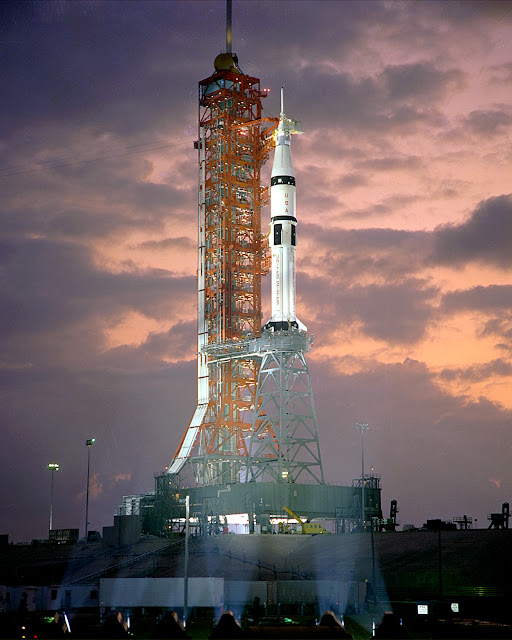 The last piloted Apollo mission: Apollo-Soyuz Test Project Apollo on Pad 39B, July 1975. Image credit: NASA
The last Saturn IB to fly, SA-210, lifted off on 15 July 1975, bearing Gemini and Apollo veteran Thomas Stafford and rookies Vance Brand and Donald Slayton. Their mission, called the Apollo-Soyuz Test Project, was ostensibly an international space rescue test, but was in fact a poster child for President Richard Nixon's policy of detente with the Soviet Union. (By the time SA-210 lifted off, however, Nixon had been out of office for nearly a year.) On 17 July, the three astronauts docked their Apollo CSM, designated simply "Apollo," with the Soviet Soyuz 19 spacecraft.
The Apollo 7 and Skylab 2, 3, and 4 Saturn IBs had carried no cargo in their SLAs; SA-210, on the other hand, carried a Docking Module designed to circumvent incompatible docking units and an airlock that permitted the U.S. and Soviet spacefarers to move safely between the two spacecraft, which had different air mixes. Apollo astronauts breathed pure oxygen at low pressure; Soyuz designers opted for a more Earth-like, higher-pressure oxygen-nitrogen mix. Handshakes, ceremonies, and science experiments with Soyuz 19 cosmonauts Alexei Leonov and Valeri Kubasov followed the docking. Stafford, Brand, and Slayton splashed down in the Pacific Ocean on 24 July 1975, six years to the day after Apollo 11 returned from the moon.
SA-206, -207, -208, and -210 all launched from the Launch Complex 39B Saturn V pad at NASA’s Kennedy Space Center. NASA planning contractor Bellcomm realized in late 1968 that launching AAP missions from Launch Complex 39 would allow Launch Complex 34 and its twin, Launch Complex 37, to be abandoned, thus saving NASA a considerable sum of money.
The decision to launch Saturn IB rockets from a Saturn V pad led to what was probably the most unusual launch pad arrangement of the Space Age. Called the "milk stool," it was a platform that raised the Saturn IB so that its S-IVB stage and CSM were at the same height as their Saturn V counterparts. This enabled the Skylab and Apollo-Soyuz Saturn IBs to use the existing Launch Complex 39B S-IVB and CSM umbilicals and crew access arm.
A total of 14 Saturn IB rockets were at least partly constructed. Besides four unmanned Saturn IB test missions that flew before Apollo 7 and the five Saturn IB-launched missions described above, there were SA-209, SA-211, SA-212, SA-213, and SA-214. SA-209 was actually prepared for a possible launch – for a short time in July 1973, it appeared that it would launch a two-man rescue CSM to recover the Skylab 3 crew, whose CSM had developed attitude-control system leaks soon after launch. It also stood by to launch the Apollo-Soyuz backup CSM. SA-209 is now on display at the Kennedy Space Center visitor center. As mentioned above, the SA-212 S-IVB stage became Skylab. The other Saturn IB rockets were turned into displays of various kinds or scrapped.
More Information(...)
Source:
A Forgotten Rocket - The Saturn IB
 Wątek: [Spaceflight History Blog] A Forgotten Rocket - The Saturn IB (Przeczytany 3345 razy)