"Assuming That Everything Goes Perfectly Well in the Apollo Program. . ." (1967) (1)
05 July 2015 David S. F. Portree
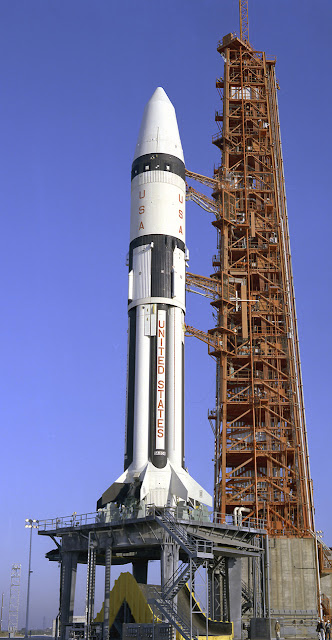 The AS-204 Saturn IB launch vehicle - the rocket originally intended to launch Apollo 1, the first piloted Apollo mission in February 1967 - configured to launch Apollo 5, the first unmanned Lunar Module test flight, in January 1968. Image credit: NASA
Usually in this blog I devote my attention to technical documents and their historical context. I do not normally focus on press conference transcripts. The 26 January 1967 NASA Headquarters press conference led by George Mueller, Associate Administrator for Manned Space Flight, and Charles Mathews, Apollo Applications Program (AAP) Director, is, however, significant enough to be given its own post.
AAP's main stated aim was to gather scientific knowledge in space for the benefit of people on Earth. The program mainly sought to modify Apollo spacecraft and Saturn rockets to do things other than reach for the moon, but also aimed to enhance NASA's lunar exploration capability. The Command and Service Module (CSM) spacecraft and the two-stage Saturn IB rocket were envisioned as the AAP workhorse vehicles, though the Lunar Module (LM) and the giant Saturn V rocket would also play important roles.
Though Mueller did not say as much, AAP's conceptual roots went back nearly to the Apollo Program’s birth. In April 1963, for example, less than two years after President John F. Kennedy made landing a man on the moon a national priority, NASA's Manned Spacecraft Center (MSC) in Houston, Texas, contracted with CSM spacecraft prime contractor North American Aviation (NAA) to study how the spacecraft might be converted into a six-man transport for Earth-orbital space station crew rotation and logistics resupply.
The AAP press conference followed NASA's Fiscal Year (FY) 1968 budget briefing on 23 January, during which NASA Administrator James Webb and Deputy Administrator Robert Seamans told reporters that President Lyndon Baines Johnson had authorized NASA to seek a total of $454.7 million for AAP in FY 1968. Despite the fact that it had existed for nearly two years as a formal program, most reporters present at the budget briefing knew little of AAP, so they prevailed upon the space agency to provide more information. The 26 January press conference was NASA's response.
Among the few space-savvy members of the press corps, the Johnson Administration's evident enthusiasm for AAP piqued interest. The White House had, after all, sought $270 million for AAP in FY 1967, only to see Congress appropriate just $80 million. Leaders in Congress had cited the escalating cost of war in Indochina when they slashed the President's FY 1967 AAP request. That President Johnson would expend political capital on the program for a second year in a row – and ask for almost double the sum he had been refused the previous year – indicated strong Executive Branch support for AAP.
When reporters arrived at NASA Headquarters for the press conference late in the afternoon on 26 January, they found on their seats a 10-page packet of detailed information on AAP. In this post, I have fleshed out some of Mueller's generalizations by referring to the AAP press packet.
Mueller told the assembled reporters that the time was ripe for starting AAP. "By the end of this year," he declared, "we will have flown men on at least two of the Saturn V launch vehicles, and we will have tested both the [LM] and the [CSM]." He did not need to tell the reporters that the first piloted flight of the Apollo Program, designated Apollo 1 or AS-204, was scheduled for launch on 21 February, a little more than three weeks after the AAP press conference. Apollo 1 was planned as a 14-day Earth-orbital test of the Apollo CSM launched on a Saturn IB rocket.
 June 1966: Artist concept of Apollo Program launch vehicles and spacecraft. The Saturn V (left) included the S-IC first stage, the S-II second stage, the S-IVB third stage, and the Apollo spacecraft depicted in the center of the illustration. The "Uprated Saturn I" (right) was by January 1967 renamed the Saturn IB, which included the S-IB first stage, the S-IVB second stage, and the Apollo spacecraft. The Saturn V and Saturn IB S-IVB stages were essentially identical. The Command Module and Service Module together formed the Command and Service Module (CSM) spacecraft. The Lunar Module (LM) rode into space inside the tapered Spacecraft Launch Adapter (SLA) shroud (not labeled), which could also fly empty or with payloads other than the LM inside. Image credit: NASA
Mueller reminded his audience that NASA had ordered 12 Saturn IB rockets and 15 Saturn Vs for the Apollo lunar program. He expected that fewer than that would be needed to reach the goal of a man on the moon before the end of the 1960s decade. It was from the surplus that the two-stage Saturn IB rockets needed for the first AAP missions would be drawn. As soon as the Apollo Program was finished with Earth-orbital test missions launched on Saturn IBs, AAP missions could begin. In fact, Mueller saw no reason why AAP Saturn IB-launched Earth-orbital missions and Apollo Saturn V-launched moon missions could not occur simultaneously.
"Assuming that everything goes perfectly well in the Apollo Program," Mueller told the reporters, by late 1968 or early 1969 NASA could have in 275-nautical-mile-high Earth orbit "an embryonic space station or the first step toward a space station. . .with the capability of reuse and resupply." The station might operate for more than three years before Earth's thin upper atmosphere dragged it down from orbit.
NASA did not have firm plans for staffing the AAP station throughout its time in orbit, Mueller explained. He declared, however, that the four missions required to establish the planned initial AAP capability constituted "a program that is firm, and is proceeding."
The first of the four "firm" missions, designated AAP-1, would begin with the launch of a Saturn IB rocket with a piloted CSM on top. Upon attaining orbit, the three-man crew would turn their spacecraft end-for-end and dock with a prototype Mapping & Survey System (M & SS) module stored in the Saturn Launch Adapter (SLA), the segmented, streamlined shroud that during ascent to orbit linked the bottom of the CSM with the top of the Saturn IB's S-IVB second stage. During an independent flight period lasting about a week, the AAP-1 crew would use the M & SS to record data on the oceans, landmasses, and atmosphere for the benefit of people on Earth.
Four or five days after the AAP-1 astronauts began their program of Earth observations, NASA would launch the unmanned AAP-2 Saturn IB with an SLA with a conical aerodynamic shroud on top in place of a CSM. The rocket would resemble the one in the image at the top of this post. The SLA and conical shroud would cover an airlock and a docking adapter with five ports. Charles Mathews, who had headed up MSC's Gemini Program Office before becoming NASA Headquarters AAP Director, added that the airlock would include a Gemini spacecraft hatch for exiting the station to perform spacewalks.
The AAP-2 S-IVB stage would inject itself, the SLA, the airlock, and the docking adapter into its 275-nautical-mile-high operational orbit using its single J-2 engine, then flight controllers would command the spent stage to "passivate" itself. Their command would open vents in the S-IVB stage tanks and engine to exhaust into space all liquid hydrogen fuel and liquid oxygen oxidizer remaining on board. In answer to a reporter's request for more detail, Mueller added that small spherical helium tanks bolted to the lining of the 21-foot-diameter, 10,000-cubic-foot liquid hydrogen tank would also be vented – the inert helium was on board to pressurize the liquid hydrogen tank, forcing propellants into the J-2 engine – and that the stage would automatically "disconnect the various electrical things that might cause a problem."
The S-IVB stage would also deploy electricity-generating solar arrays from two of its four folded-back SLA shroud segments and a meteoroid shield that would stand several inches off the skin of the two-thirds of the S-IVB stage that contained the liquid hydrogen tank. The shield, a thin layer of metal, would break up any micrometeoroids that might hit it, preventing them from penetrating the stage skin and liquid hydrogen tank within.
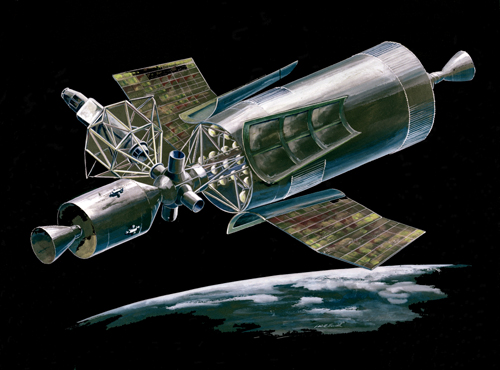 Artist concept of AAP-2 spent-stage station with AAP-1 Apollo CSM docked at axial port and AAP-1 Mapping & Survey System docked at radial port. Image credit: NASA
The AAP-1 CSM would rendezvous with the AAP-2 spent-stage station and dock the M & SS with one of the docking adapter's four radial ("side") ports. It would then undock from the M & SS and dock with the docking adapter's axial ("front") docking port.
The AAP-1 astronauts would enter the 65-inch-diameter, 1000-cubic-foot docking module, where would be packed furnishings for outfitting the interior of the liquid hydrogen tank. Before they could deploy the furnishings (a process that would need three or four days), they would use controls in the airlock to close the vents in the liquid hydrogen tank and fill it with a mixture of three-fifths oxygen and two-fifths nitrogen at five pounds per square inch of pressure. Gaseous oxygen and nitrogen for pressurizing the liquid hydrogen tank would reach orbit in tanks bolted to the outside of the airlock module.
Mueller likened putting the furnishings packed in the docking adapter into the liquid hydrogen tank to "building a ship in a bottle." The astronauts would open a 43-inch-diameter hatch leading into the tank. The tank's interior would be modified during manufacture to include tie-downs and attachment points for installation of galley, hygiene, exercise, sleep, and experiment equipment, as well as lights and ventilation ducts and fans.
Though illustrations he displayed during the press conference showed pre-installed walls and grillwork floors, Mueller told a reporter that "I don't know that we will want to put additional things [besides the tie-downs and attachment points] inside" the liquid hydrogen tank. If the decision were taken to minimize tank modifications, then the astronauts would string fabric floors and walls within the tank, he explained. A "rope" running the length of the tank would aid mobility. He added that he was "sure that we will use liberal amounts of velcro."
Mueller was quick to note that few experiments had been officially manifested for any AAP flight; some of the $454.7 million the White House had requested for AAP in FY 1968 would go toward new experiment development. There were, for example, no biology experiments yet approved, though seven medical experiments were on track for flight. NASA also expected to include Defense Department experiments that would focus on "how to work in space" and test "jet shoes." Mueller likened them to "roller skates with gas jets on them."
He explained that experiment packages scheduled specifically for the AAP-1/AAP-2 mission would, among other things, aim to "find out what happens to the flammability of materials, how they actually burn when you have a combination of oxygen and nitrogen and. . .zero gravity." In addition, the astronauts would continue to use the M & SS for Earth observations, and would test a combination sleep/space suit-donning station.
The AAP-1 astronauts' stay on board the AAP-2 spent-stage station was scheduled to last for about 28 days, or twice as long as Gemini 7 (4-18 December 1965), which at the time of the 26 January press conference was the world record-holder for piloted space mission duration. As the AAP-1/AAP-2 mission drew to a close, the crew would shut off experiments and station systems and undock in their CSM. They would then ignite the CSM's Service Propulsion System main engine to deorbit, cast off the Service Module (SM), reenter the atmosphere, deploy parachutes, and splash down at sea in the conical Command Module (CM).
Between three and six months later – no later than mid-1969 – NASA would launch the AAP-3 mission to the AAP-2 station. A piloted CSM loaded up with supplies would ride a Saturn IB to orbit. Mueller told his audience that he favored putting supplies in a special module that would ride to orbit in the SLA, much as had the M & SS; however, the illustrations he showed to the press did not depict such a module.
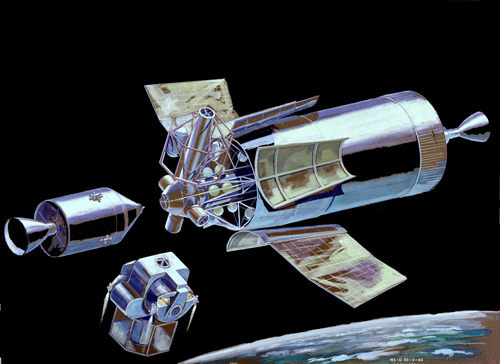 The LM-derived AAP-4 Apollo Telescope Mount maneuvers to a docking at the AAP-2 radial port opposite the AAP-1 Mapping & Survey System while the AAP-3 CSM stands by. Image credit: NASA/David S.F. Portree
One day after the AAP-3 launch, NASA would launch the unmanned AAP-4 Saturn IB bearing beneath its SLA and conical shroud the Apollo Telescope Mount (ATM). The ATM was envisioned as a modified Apollo LM with solar arrays and solar observatory instruments in place of descent and ascent engines and landing legs.
The AAP-3 CSM would dock with the ATM, withdraw it from the top of the AAP-4 Saturn IB S-IVB stage, and transport it to the AAP-2 station. An astronaut would then board the ATM, undock from the CSM, and, using the ascent stage attitude control thruster quads for propulsion, pilot it to a docking at one of the station's docking module radial ports. The CSM would stand by until ATM docking was successfully completed, then would dock at the station's axial port. The ATM would then deploy solar arrays, which would provide it with electricity.
Mueller explained that the ATM was scheduled for launch in 1969 because the Sun's 11-year cycle of activity would peak in that year. The ATM would, he told the reporters, carry "the most comprehensive array of instruments that has ever been assembled for observing the Sun." An astronaut at the ATM control panels in the modified LM ascent stage would keep a constant vigil on the Sun, and would rapidly direct the instruments toward interesting phenomena as they appeared. The ATM might operate at the end of a tether attached to the docking adapter to minimize the effects on the quality of the data it collected of astronaut movements inside the spent-stage station.
Of course, the chief benefit of the ATM would be scientifically important but essentially abstract knowledge about the structure and behavior of the Sun. AAP was, however, meant to bring benefits of space to people on Earth, so Mueller opined that a better understanding of the Sun would "have marked benefits on our own understanding of how to generate and control energy here on Earth."
The AAP-3 crew would seek to double the AAP-1 crew's stay-time in space, setting a new record for space endurance of 56 days. In addition to operating the ATM, they would continue many of the experiments begun by the AAP-1 astronauts.
Mueller then described APP payloads, missions, and capabilities that would begin to be developed if Congress voted to provide the funding for AAP that the White House had requested for FY 1968. In answer to a reporter's question, he explained that the AAP-2 spent-stage station would remain at the center of the program's Earth-orbital activity "until something fails," at which time NASA would launch a fresh spent-stage station.
Reusability would be a hallmark of AAP, Mueller explained. The term “reusability” had at least two meanings in the program. On the one hand, it meant that for as long as they could function, the AAP stations would host new crews and instrument payloads. On the other, it meant that certain hardware elements – in particular the Apollo CM – would be redesigned for refurbishment and multiple flights. Both approaches to reusability aimed to cut costs.
Mueller called the Apollo CM "one of the most expensive elements of the space vehicle." He described for reporters an uprated CM for later AAP flights that would touch down on land, not splash down at sea. "Since we don't dunk it in salt water at the end of the flight," he explained, "we don't then have quite the same corrosion problem. . .that we do with those [CM]s that are water landed."
Landing the CM on solid ground would, Mueller noted, also help NASA to double its normal three-person crew complement. Steerable parachutes and view screens would enable the crew to pilot their CM to a predetermined landing zone; then, five or 10 feet above the ground, retrorockets behind the heat shield would ignite, slowing the CM to a touchdown speed of three or four feet per second. Normal Apollo splashdown speed was, Mueller explained, 10 or 20 feet per second; reducing that velocity meant that shock-absorbing struts supporting the CM crew couches would not stroke very much to absorb landing shock, so would not need as much empty space behind them as in the baseline CM. This would enable NAA contractor engineers to install a new row of three couches behind the existing three Apollo CM couches.
Mueller then described three "payload packages" that might be added to AAP stations if funding allowed. AAP-A was a "Meteorology Payload Package" with 14 experiments which would, it was hoped, reach orbit on a Saturn IB in mid-1969. AAP-B, the "Earth Resources Payload Package" with 12 experiments on board, would follow in mid-1970. By then, Mueller told his audience, a three-man crew might live on board an AAP station for an entire year.
The "Manned Photographic Telescope," an ultraviolet telescope with a meter-wide aperture, might be docked to an AAP station in a high-Earth orbit, Mueller explained, in order to permit observation periods longer than were possible in the AAP-2 station's low orbit. A station high above Earth would need more time to complete an orbit, thus potentially permitting continuous observation of an astronomical target over the space of hours. The AAP-2 station, by contrast, would circle Earth in about 90 minutes, enabling less than 45 minutes of observation before the target dropped out of sight below Earth's horizon.
Placing an AAP station in high-Earth orbit would demand a more powerful launcher than the Saturn IB; specifically, the Saturn V. The S-IVB stage that formed the second stage of the Saturn IB served also as the Saturn V third stage, so could be put to use as an AAP spent-stage station in high-Earth orbit with only modest modifications.
 Wątek: [SHB] "Assuming That Everything Goes Perfectly Well in the Apollo Program. . ." (Przeczytany 1914 razy)