WHAT IS THE SPACE AGE? (1)
Article written: 27 Jun , 2015, Updated: 24 Jul , 2016 by Matt Williams
With the end of World War II, the Allies and the Soviet Bloc found themselves locked in a state of anatgonism. As they poured over the remains of the Nazi war machine, they discovered incredible advances in rocketry and aerospace engineering, and began scrambling to procure all they could. For many the many decades that followed, this state would continue as both sides struggled to make advancements in the field of space exploration ahead of the other.
This was what is popularly known as the “Space Age”, an era that was born of the advent of nuclear power, advances in rocketry, and the desire to be the first to put men into space and on the Moon. This era would come to be defined by rapid advances in technology, and a number of historic firsts being accomplished before winding down and giving way to en era of cooperation.
Beginning:The Space Age is thought to have officially begun on October 4th, 1957, with the launch of
Sputnik 1 by the Soviet Union – the first artificial satellite to be launched into orbit. News of the launch triggered a great deal of fear in the United States, as many worried that Sputnik could represent a threat to national security, not to mention America’s technological leadership.
As a result, Congress urged then-President Dwight D. Eisenhower to take immediate action, which resulted in the signing of the
National Aeronautics and Space Act on July 29th, 1958, officially establishing NASA. Immediately, NASA became dedicated to researching hypersonic flight and taking the necessary steps towards creating manned spacecraft.
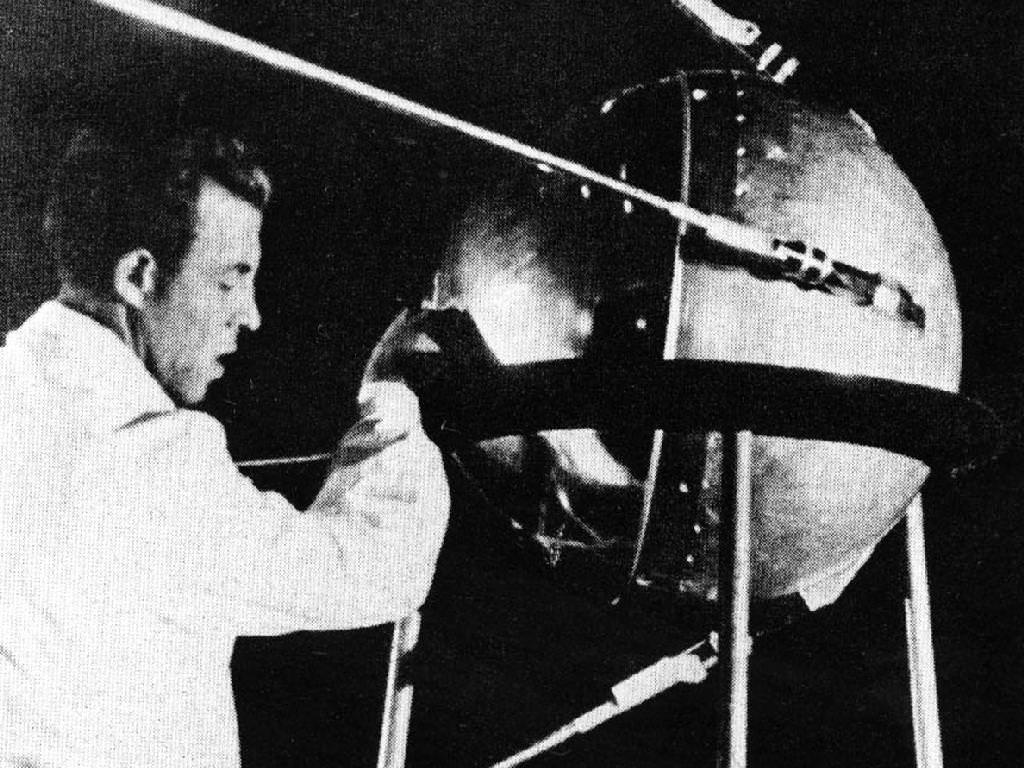 Photograph of a Russian technician putting the finishing touches on Sputnik 1, humanity’s first artificial satellite. Credit: NASA/Asif A. SiddiqiVostok and Mercury:
After Sputnik, the Soviets and United States began to work on developing the necessary spacecraft to send humans into orbit. This began in January of 1959 in both Russia and the US with the Vostok and Mercury programs.
In the case of Vostok, this consisted of developing a space capsule that could be launched aboard an expendable carrier rocket. Along with numerous unmanned tests, and a few using dogs, six Soviet pilots were selected by 1960 to be the first men to go into space. Known as
The Vanguard Six, this group consisted of
Yuri Gagarin, Valery Bykovsky, Grigori Nelyubov, Andrian Nikolayev, Pavel Popovich, and Gherman Titov.
On April 12th, 1961, Gagarin was launched aboard the
Vostok 1 spacecraft from the Baikonur Cosmodrome, and thus became the fist man to go into space (beating American
Alan Shepard by just a few weeks). On June 16th, 1963,
Valentina Tereshkova was sent into orbit aboard the
Vostok 6 craft (which was the final Vostok mission), and thus became the first woman to go into space.
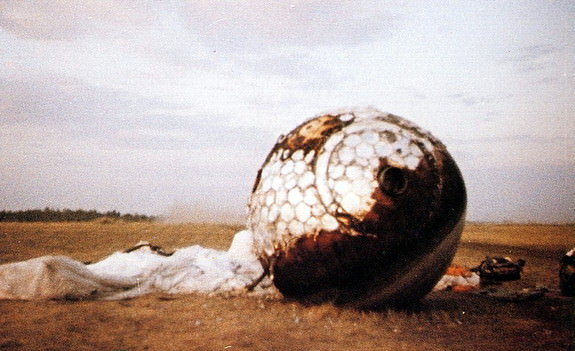 The re-entry capsule of the Vostok 3KA-3 (also known as Vostok 1) spacecraft after landing south west of Engels in southern Russia. Credit: space.com
Meanwhile, NASA began work on
Project Mercury, a program taken over from the US Air Force which ran from 1959 until 1963. Designed to send a man into space using existing rockets, the program quickly adopted the concept of launching ballistic capsules into orbit. The first seven astronauts, nicknamed the “
Mercury Seven“, were selected from from the Navy, Air Force and Marine test pilot programs.
On May 5th, 1961, astronaut Alan Shepard became the first American in space aboard the
Freedom 7 mission. Then, on February 20th, 1962, astronaut John Glenn became the first American to be launched into orbit by an
Atlas launch vehicle as part of
Friendship 7. Glenn completed three orbits of planet Earth, and three more orbital flights were made, culminating in L. Gordon Cooper’s 22-orbit flight aboard
Faith 7, which flew on May 15th and 16th, 1963.
Having put an artificial satellite and the first man and woman into space, the Soviets maintained their edge during the early years of the Space Age (late 50s and early 60s). After Vostok and Mercury programs were completed, the focus of both nations and space programs shifted towards the development of two and three-man spacecraft, as well as the development of long-duration spaceflights and extra-vehicular activity (EVA).
[img wdth=750]https://www.universetoday.com/wp-content/uploads/2011/04/mercury_orbiter.jpg[/img]
Cutaway of a Mercury orbiter spacecraft. Credit: spacecollection.infoVoskhod and Gemini:After having tested their first-generation Vostok and Mercury capsules and demonstrated the technical feasibility of manned spaceflight, both NASA and the Soviet space program proceeded to build their second-generation spacecraft. For NASA, this involved the development of the
Gemini capsule, a two-person spacecraft that was a completely new design over the Mercury capsule.
While the new design retained the conical, nickel-alloy walls and fiberglass ablative heat shield of Mercury, it also made use of new features – such as translations control thrusters to alter orbit, hydrogen/oxygen fuel cells to generate electricity, a radar system to allow rendezvous with other craft, and avionics that could withstand depressurization (thus facilitating EVAs).
Project Gemini ran from 1961 to 1966. The first flight (
Gemini 3) went up on March 23rd, 1965, with astronauts Gus Grissom and John Young aboard. Nine missions followed in 1965 and 1966, with spaceflights lasting for nearly fourteen days at a time.
During these missions, crews conducted docking and rendezvous operations, EVAs, and gathered medical data on the effects of weightlessness on humans. These operations and the new features aboard the Gemini spacecraft were intended to develop support for
Project Apollo (which also began in 1961).
 The Agena Target Vehicle as seen from Gemini 8 during rendezvous. Credit: NASA
In comparison, the Soviet
Voskhod capsules were simply modified Vostok craft, with no provisions made for translation control, rendezvous or docking. However, like the Gemini capsule, the new
Voskhod design allowed for a crew of two to three and permitted EVAs. In the end, the
Voskhod program was abandoned after only two manned missions – which took place in 1964 and 1965 – and was replaced by the more advanced
Soyuz spacecraft.
Soyuz and Apollo:In the early 60s, both the Russian and American space programs began to contemplate sending astronauts to the Moon. For NASA, this began in 1961 with the launch of the Apollo program and culminated in 1972 with multiple manned missions reaching the Moon.
The program relied on the use of
Saturn rockets as launch vehicles and a spacecraft that consisted of a command and service module (CSM) and a lunar landing module (LM). The project began with a terrible tragedy when on January 27th, 1967, the
Apollo 1 craft experienced an electrical fire during a test run, destroying the capsule and killing the crew of three (Virgil I. “Gus” Grissom, Edward H. White II, Roger B. Chaffee).
The second manned mission,
Apollo 8, brought astronauts for the first time in a flight around the Moon in December of 1968. On the next two missions, docking maneuvers that were needed for the Moon landing were practiced. And finally, the long-awaited Moon landing was made with the
Apollo 11 mission on July 20th, 1969, where astronauts Neil Armstrong and Buzz Aldrin became the first men to walk on the Moon.
Five subsequent Apollo missions also landed astronauts on the Moon, the last in December 1972. Throughout these six Apollo spaceflights, a total of twelve men walked on the Moon. This was considered the height of the Space Age, with the historic achievement of placing astronauts on another celestial body finally being made.
Meanwhile, the Soyuz program called for the development of a three-stage expendable
launch rocket and a spacecraft that consisted of three modules (orbital, descent, and an instrumentation and propulsion). In time, many iterations of the Soyuz craft were created, including the
Soyuz 7K-L1 (Zond) capsule. Paired with the
N1 rocket, this craft was the backbone of the Soviet manned lunar program.
Unfortunately, budget constraints, technical failures and shifting priorities resulted in no manned lunar missions ever being made. As the American space program successfully reached the Moon, Russia began to focus instead on developing expertise in long-duration space flight and in the deployment of a space station.
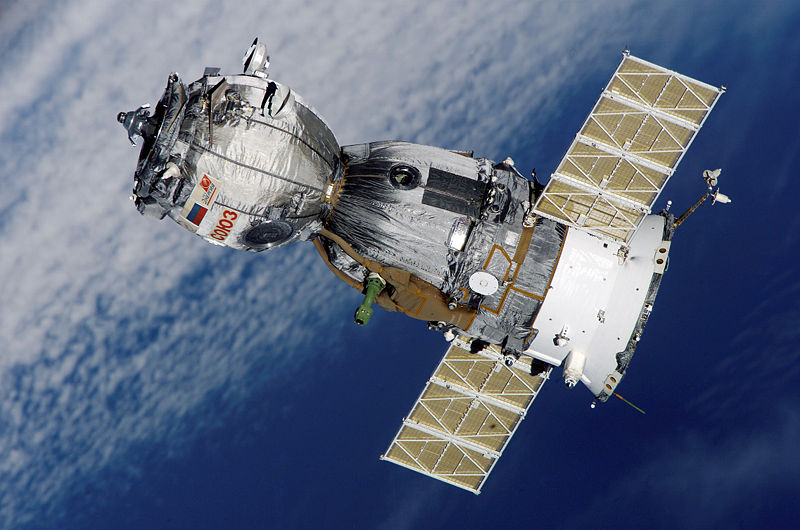 The highly successful Russian Soyuz spacecraft. Credit: NASA
As a result, during the late 1960s and early 1970s, multiple manned missions were made as part of the Soyuz program into Earth’s orbit. These included docking maneuvers made with other craft in orbit, and orbital rendezvous’ with the
Salyut 1 station, which was also deployed.
Space Stations and Space Shuttles:With NASA having made it to the Moon, the pace of competition in the “space race” began to wind down. From this point onwards, both Russia and the US began to shift their focuses to address dwindling budgets and other long-term goals.
For the Russians, this led to the continued development space station technology as part of the Salyut program. Between 1972 and 1991, they attempted to orbit seven separate stations. However, technical failures and a failure in one rocket’s second stage boosters caused the first three attempts to orbit a station after Salyut 1 to fail or result in the station’s orbits decaying after a short period.
However, by 1974, the Russians managed to successfully deploy
Salyut 4, followed by three more stations that would remain in orbit for periods of between one and nine years. While all of the Salyuts were presented to the public as non-military scientific laboratories, some of them were actually covers for the military
Almaz reconnaissance stations.
 Skylab, America’s First manned Space Station. Photo taken by departing Skylab 4 crew in Feb. 1974. Credit: NASA
NASA meanwhile pursued the development of space station technology as well. This culminated in May of 1973 with the launch of
Skylab, which would remain America’s first and only independently-built space station. During deployment, Skylab suffered severe damage, losing its thermal protection and one of its electricity-generating solar panels.
This necessitated the first crew to rendezvous with the station to conduct repairs. Two more crews followed, and the station was occupied for a total of 171 days during its history of service. This ended in 1979 with the downing of the station over the Indian Ocean and parts of southern Australia.
By 1986, the Soviets once again took the lead in the creation of space stations with the deployment of
Mir. Authorized in February 1976 by a government decree, the station was originally intended to be an improved model of the Salyut space stations. In time, it evolved into a station consisting of multiple modules and several ports for crewed Soyuz spacecraft and
Progress cargo spaceships.
The core module was launched into orbit on February 19th, 1986; and between 1987 and 1996, all of the other modules would be deployed and attached. During its 15-years of service, Mir was visited by a total of 28 long-duration crews. Through a series of collaborative programs with other nations, the station would also be visited by crews from other Eastern Bloc nations, the European Space Agency (ESA), and NASA.
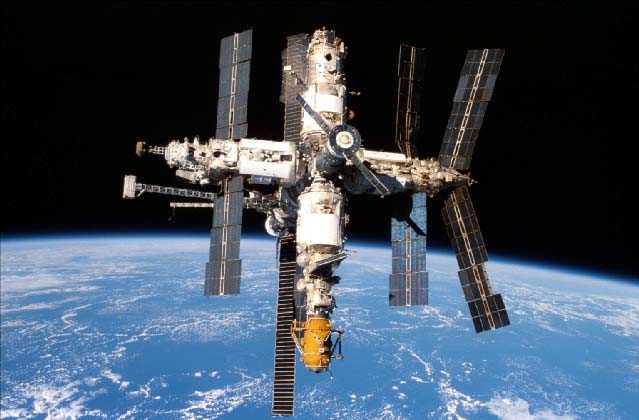 The Mir Space Station and Earth limb observed from the Orbiter Endeavour during NASA's STS-89 mission in 1998. Credit: NASA
After a series of technical and structural problems caught up with the station, the Russian government announced in 2000 that it would decommission the space station. This began on Jan. 24th, 2001, when a Russian
Progress cargo ship docked with the station and pushed it out of orbit. The station then entered the atmosphere and crashed into the South Pacific.
 Wątek: [Universe Today] WHAT IS THE SPACE AGE? (Przeczytany 2065 razy)