Should We End Our ISS Partnership With Russia?18 February 2018 David S. F. Portree
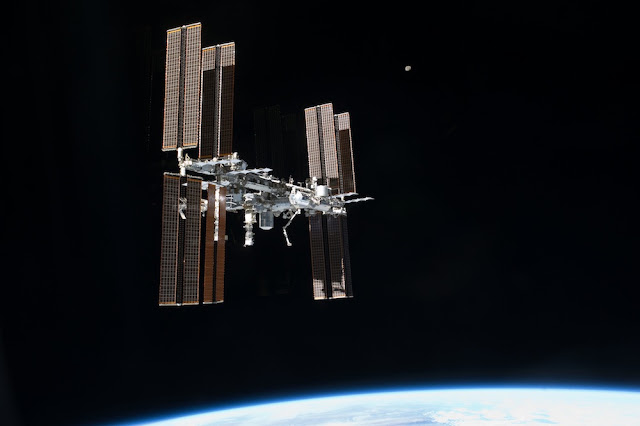 ISS, Earth, and Moon. Image credit: NASA
In August 1992, I was a new contractor employee at NASA's Johnson Space Center (JSC) in Houston, Texas. NASA JSC was at that time reeling from cuts in the Space Station Freedom (SSF) Program. At the same time, JSC engineers were trying to reconcile themselves to the agreement U.S. President George H. W. Bush and Russian President Boris Yeltsin had concluded in Moscow on 17 June 1992. The agreement called for a U.S. astronaut to live and work on board Russia's Mir space station, a Russian cosmonaut to fly on a U.S. Space Shuttle Orbiter, and a Shuttle Orbiter to dock with the Russian Space Station Mir, the first element of which had been launched by the Soviet Union in 1986.
In addition, NASA had paid Russia $1 million to assess use of a series of three-person Soyuz spacecraft as SSF lifeboats until a U.S. lifeboat could be built, and to look at possible U.S. purchase of other Russian-developed space technology (for example, the docking unit built for the Soviet Buran Shuttle, which was based on a U.S. design developed for the 1975 Apollo-Soyuz Program and the Soviet design proposed for the abortive Shuttle-Salyut Program).
The Soyuz lifeboat was not intended to transport a crew to SSF. Instead, it would launch to SSF, which would circle Earth in an orbit inclined 28.5 degrees to Earth's equator, from U.S. soil in a Shuttle Orbiter payload bay or atop an expendable U.S. rocket. In November 1992, a NASA-Russia team traveled to Australia to assess its wide open spaces as possible emergency landing sites for Soyuz lifeboats.
Just before the joint team toured Australia, voters in the U.S. went to the polls to elect William Clinton as their President. NASA JSC trembled - many employed there as Federal civil servants and contractors felt sure that President Clinton would end SSF. In fact, he did just that, but he did not end the Space Station Program. Clinton also retained NASA Administrator Dan Goldin, an appointee of President Bush.
In March 1993 - 25 years ago next month - Clinton ordered NASA to provide three new, lower-cost designs for a U.S. space Station and tasked his Vice President, Al Gore, with overseeing the redesign. Gore appointed a committee to assess the three redesign options NASA would develop.
Also in March 1993, Yuri Koptev, director of the newly formed Russian Space Agency, and Yuri Semenov, director of Russia's chief piloted spaceflight design bureau, NPO Energia, wrote to NASA Administrator Goldin to formally propose the merger of the U.S. station with Russia's planned Mir-2 station. The Russian Federation was broke, so unless it could find a new funding source, Mir-2 would never fly.
In addition, Russian space engineers were going unpaid. It seemed likely that, if they could not work on Russian space hardware, they would sell their expertise abroad to the highest bidder. This could lead to world-wide missile proliferation at a time when the Russian nuclear arsenal was judged by many to be poorly supervised.
The U.S. House of Representatives nearly killed NASA's space station on 23 June 1993; by a single vote it survived in the NASA Fiscal Year 1994 budget. Meanwhile, the proposal to merge the U.S. station and Mir-2 gained momentum. A major sticking point was the orbit in which the station would be assembled. Nevertheless, as I celebrated a year of work at NASA JSC, I became increasingly confident that the joint station would be built. Space science arguments seemed not to move the Congress; Russian involvement, on the other hand, gave the station a geopolitical purpose Congress seemed ready to endorse. The U.S.-Russian space station plan became a reality in November 1993; at the same time, NASA and Russia expanded the Bush-Yeltsin agreement to include multiple U.S. Shuttle flights to Mir.
The International Space Station (ISS) would be built with contributions from the U.S., Russia, Canada, the European Space Agency, and Japan in an orbit inclined 51.6 degrees relative to the equator - close to the latitude of Baikonur Cosmodrome. This enabled Soyuz to default to its role as a space station crew transport. It would carry international crews to ISS, where it would remain docked for up to six months. If it became necessary to abandon ISS, Soyuz would land in long-established landing zones on Russian soil. The U.S. Space Shuttle could reach that orbit bearing U.S., Canadian, European, and Japanese station components, but with a diminished payload weight.
I need not go into the history of the Shuttle-Mir Program and ISS Program in great detail. Suffice it to say that the U.S.-Russian relationship was rocky at times. NASA, of course, had no choice but to make it work.
In March 1995, I left NASA JSC to edit Star Date magazine, but NASA was not through with me; I was hired to write a series of publications for NASA JSC and NASA Headquarters. I quit Star Date after editing two issues and in effect became my own company, just like Lockheed Martin, SpaceX, or Boeing. I retained a NASA JSC badge until 2001 and even worked for several months as a short-term Federal civil servant with an office in Building 2, which houses NASA JSC Public Affairs. I was offered a permanent job - editing the employee newspaper, The Space News Roundup - but ran away screaming for reasons I will not go into here.
In April 1996, on my own dime, I toured Russian space facilities and met Russian space engineering students, space engineers, cosmonauts, and Russian Space Agency officials as part of the first Friends and Partners in Space Workshop. I wrote about it for Astronomy magazine. Almost all the Russians I met were cordial, welcoming, and open.
At this moment, when the U.S. teeters on the edge of crisis, one detail in particular stands out in my memory. At the close of the workshop, we had dinner in the revolving restaurant high above Moscow on the Ostankino TV Tower. As the restaurant turned, we could see different parts of the city spread out below us. A closed-off neighborhood of mansions came into view. It stood out against the more ramshackle buildings of Soviet-era Moscow. I asked one of our student guides about it. He hesitated, looking nervous, but also a little disgusted. "Those are the mansions of the oligarchs," he said. "We do not talk about those."
In the mid-1990s, many hoped that Russia might become a functioning democracy, but that hope faded in the first decade of the present century. The corrupt oligarchs finished building their mansions and took power, led by Vladimir Putin. They began to "meddle" in the affairs of other nations, starting with countries that had been part of the old Soviet Union. As the years passed, their methods became more sophisticated and were expanded beyond the old Soviet sphere. Meddling became outright attack on democratic institutions.
At some point, many histories will be written about this period. I do not propose to attempt that here. Suffice it to say that the U.S. has been attacked and remains under attack. It will win through, but doing so will likely require drastic (though lawful) measures.
Among these could be the end of the U.S.-Russian partnership in space. So far, little has emerged to suggest that NASA and Russia might be in conflict (at least, they appear to be in no greater state of conflict than they have been before); however, if they are not in conflict, perhaps they should be.
I believe it is time to consider closing the hatches between the Russian Service Module and the U.S.-owned FGB and cutting all the connections that bind the U.S. and Russian segments together. Russia has attacked our most fundamental institutions; how can we continue to work with them off the Earth? Discarding the Russian segment would be a highly visible sign that the U.S. and its partners are not prepared to tolerate Putin's actions.
I am, of course, aware that U.S. piloted spaceflight is highly dependent on Russia. Russian Soyuz spacecraft transport Station crews, and Russian propellants and rocket motors keep ISS in orbit. I am also aware that, in the past, the U.S. has been able to respond with remarkable rapidity to attacks waged against it. I think we could do so again.
For example, SpaceX and Boeing could be required to accelerate their piloted spaceflight efforts - to put on hold, for the good of the nation and as a sign of their patriotism, other work until their piloted Earth-orbital spacecraft can be certified as flightworthy.
Modifications to one or all of the various commercial logistics vehicles that visit ISS might enable them to raise its orbit. The U.S. Air Force X-37 spacecraft might also be modified.
I expect there are other options as well. Perhaps Europe, Canada, and Japan could draw upon their technology and experience to provide options; for example, NASA might pay ESA to revive the ATV cargo vehicle. Perhaps ESA would do so for free; after all, among its members are nations that have also been subjected to Russian attack.
Protest and punishment mean nothing unless they inconvenience those they are directed against. The Russian segment would suffer an acute electricity shortage. Losing power from the U.S. arrays might, in fact, kill Russia's part of ISS, and with it, perhaps, its piloted space program.
There was a time when that knowledge would have led me to reconsider what I propose here. For me, however, that time is now over.
Source:
Should We End Our ISS Partnership With Russia?
 Wątek: [Spaceflight History Blog] Should We End Our ISS Partnership With Russia? (Przeczytany 2257 razy)