Lunar Viking (1970) (2)
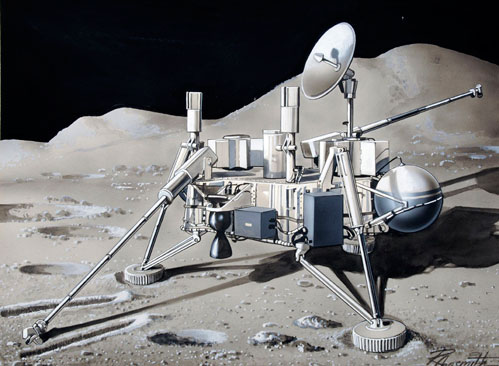 Lunar Viking Lander. Image credit: NASA/Russell Arasmith
The most obvious modification to the Mars Viking design for lunar missions would be replacement of the Lander aeroshell, heat shield, and parachutes with a solid-propellant landing rocket. The Lunar Viking Orbiter would expend liquid propellants to slow itself and the Lunar Viking Lander so that the Moon's gravity could capture the combination into lunar orbit, then would perform maneuvers to adjust its orbit ahead of Lander release. The Lander would then detach and, at the proper time for a landing at its target site, ignite the solid-propellant rocket. After its propellant was expended, the motor casing would fall away. The Lunar Viking Lander would then complete descent and soft-landing using liquid-propellant vernier rockets.
The Bellcomm team outlined six basic Lunar Viking missions; some included several variants. For example, the first Lunar Viking mission, the Orbital Survey Mission, would have three variants. None would include a Lander and all would use only instruments planned for the Mars Viking Orbiter. All three would complete their main objectives a month after capture into lunar orbit.
The Orbital Survey Mission variant #1 would see a Viking Lunar Orbiter map the entire Moon in visual wavelengths at eight-meter resolution from 460-kilometer-high lunar polar orbit. Variant #2 would map the entire lunar surface in stereo at 12-meter resolution. For variant #3, a Lunar Viking Orbiter would operate in 100-kilometer orbit. This, the Bellcomm planners explained, would enable it to image potential Lunar Viking Lander and Space Tug landing sites at two-meter resolution.
The Mars Viking Orbiter was meant to transmit data at a rate of just 1000 bits per second over a distance ranging from tens of millions to hundreds of millions of kilometers (that is, from Mars to Earth). The Lunar Viking Orbiter, on the other hand, would transmit from only about 380,000 kilometers (that is, from the Moon), so in theory could transmit about 75,000 bits per second. The Viking Orbiter data recorder could, Bellcomm estimated, store up to 100 images. The Lunar Viking Orbiter would use these capabilities to image the Moon while it was out of radio contact over the Farside hemisphere and transmit the Farside images to Earth while it passed over the Nearside hemisphere.
A Titan III-C rocket would be sufficient to place the Lunar Viking Orbiter into a 100-kilometer circular lunar polar orbit with plenty of propellant remaining on board for additional maneuvers. An Atlas-Centaur SLV-3C rocket would suffice if after lunar-orbit capture no other maneuvers were planned.
The second type of Orbiter-only Lunar Viking mission would use a Titan III-C-launched Orbiter outfitted with a scientific instrument suite tailored specifically for lunar investigations. The Bellcomm team modeled their specialized Lunar Viking Orbiter science payload on instruments expected to be mounted in the Service Module of the advanced Apollo 16, Apollo 17, Apollo 18, and Apollo 19 CSMs.
The Bellcomm team's third Lunar Viking mission would establish twin Farside Geophysical Observatories. A Titan III-D/Centaur rocket - the rocket intended in 1970 to launch the 1975 Mars Vikings - could, they calculated, place a stripped-down Lunar Viking Orbiter with two Lunar Viking Landers attached into a 600-kilometer circular equatorial orbit. The twin Landers would then detach and land at two different Farside sites, out of direct radio contact with Earth. The Orbiter would serve as a communications satellite for retransmitting radio signals from the twin Landers. Landing site selection would be based on Orbital Survey Mission images.
The Farside Geophysical Observatory payload on the twin Landers would comprise instruments similar to those in the Apollo Lunar Scientific Experiment Package (ALSEP) the Apollo astronauts first deployed during Apollo 12. This would extend the exclusively Nearside Apollo seismic monitoring network to the Farside hemisphere.
Unfortunately, a Lunar Viking Orbiter in 600-kilometer equatorial orbit could receive signals from each Lunar Viking Lander only about 10% of the time. The Bellcomm planners noted that an Orbiter in a 5000-kilometer circular equatorial orbit could communicate with a Lander at Tsiolkovskii crater (23° south latitude) 26% of the time. Launching on the Titan III-D/Centaur would, they explained, enable the stripped-down Lunar Viking Orbiter to carry enough propellants to capture into 600-kilometer orbit and, after it released the Landers, maneuver to a 5000-kilometer communications orbit for the remainder of the mission.
Bellcomm's fourth Lunar Viking mission, the Farside Geochemical Mission, would see a Lunar Viking Orbiter/augmented Lunar Viking Lander combination leave Earth atop a Titan III-D/Centaur and capture into a 2000-kilometer circular equatorial orbit. The augmented Lunar Viking Lander would detach and ignite its chemical-propellant motors to place itself into a 2000-kilometer-by-100-kilometer elliptical orbit, then would ignite them again to reach a 100-kilometer circular equatorial orbit.
Finally, it would use its solid-propellant motor to deorbit and chemical-propellant verniers to soft-land at a geologically interesting Farside site. The Bellcomm team proposed that it transport to the surface a rover weighing up to 2000 pounds. Neither the augmented Lunar Viking Lander nor the rover was described. The Orbiter, again stripped down to serve mainly as a communications satellite, would remain in its initial 2000-kilometer orbit throughout the mission.
The Polar Mission, fifth on Bellcomm's list, would see the Lunar Viking Orbiter and Lander perform science together much as the Mars Viking Orbiter and Lander were meant to do. The Orbiter would again serve as a relay, but would also carry a suite of scientific instruments. The Lunar Viking Orbiter would capture into a 100-kilometer lunar polar orbit. As it passed over the Moon's poles, it would search permanently shadowed polar craters for ice deposits.
If ice were found, the Orbiter would release the Lander and maneuver to a higher orbit to improve communications. The Lander, meanwhile, would touch down in cold darkness and use an arm-mounted scoop or perhaps a drill to collect surface material for analysis in an on-board automated lab.
The sixth and most complex Lunar Viking mission, the Transient Event Mission, would aim to find and study Transient Lunar Phenomena (TLP). The Bellcomm team, which devoted an entire appendix of their report to TLP studies, noted that TLP had been recorded for decades at many sites on the Moon by telescopic observers. Appearing as bright spots, color changes, and hazes, TLP were generally interpreted as volcanic gas releases tied, perhaps, to the tides Earth raises in the solid crust of the Moon.
According to the Bellcomm planners, about half of all TLP recorded by 1970 had occurred in and around 40-kilometer-wide Aristarchus crater, located just west of Mare Imbrium in one of the most geologically diverse areas of the Moon. The Lunar Viking Orbiter would thus spend as much time as possible within sight of Aristarchus. This requirement would, along with the need for good image resolution, dictate Lunar Viking Orbiter altitude and maneuvers.
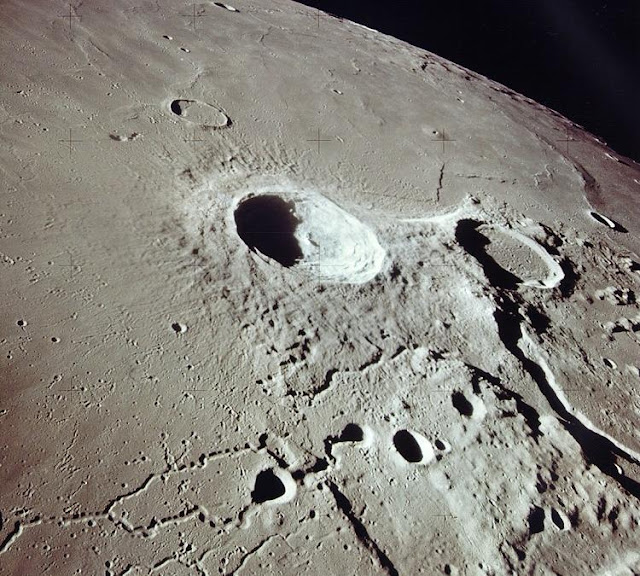 Aristarchus is the largest and brightest crater in this Apollo 15 image. Image credit: NASA
In June 1970, the Mars Viking Orbiter was expected to operate during a six-month Earth-Mars cruise and then for at least three months in Mars orbit. This meant that - in theory - the Lunar Viking Orbiter could be expected to seek TLP for nine months in lunar orbit. In practice, the spacecraft would pass in and out of night several times each day as it orbited the Moon from very near the beginning of its mission, placing added stress on its solar arrays, batteries, and temperature-sensitive systems.
The Bellcomm team expected that the Lunar Viking Orbiter might not last for nine months, but that it would last long enough to detect a pattern in the occurrence of TLP events. Based on this pattern, the Lunar Viking Lander would be directed to a site where it would be likely to witness a TLP event up close.
If the Lunar Viking Orbiter could not spot enough TLP events to enable scientists to detect a pattern, the Lander would be dispatched to Aristarchus. There it would seek evidence of past TLP and stand by in the hope that it might witness a TLP event.
The Bellcomm planners lamented an expected six-year gap in U.S. lunar landings. One wonders how they would have greeted the news that NASA would soft-land no spacecraft on the Moon after Apollo 17 in December 1972 - that after almost 50 years, Apollo 17 remains the last U.S. lunar soft-lander. Three automated soft-landers followed Apollo 17: the Soviet Union's Luna 21, which delivered the eight-wheeled Lunokhod 2 rover (1973); Luna 24, which collected and launched to Earth a small sample of lunar surface material (1976); and China's Chang'e 3 lander (2015), which delivered the small Yutu rover.
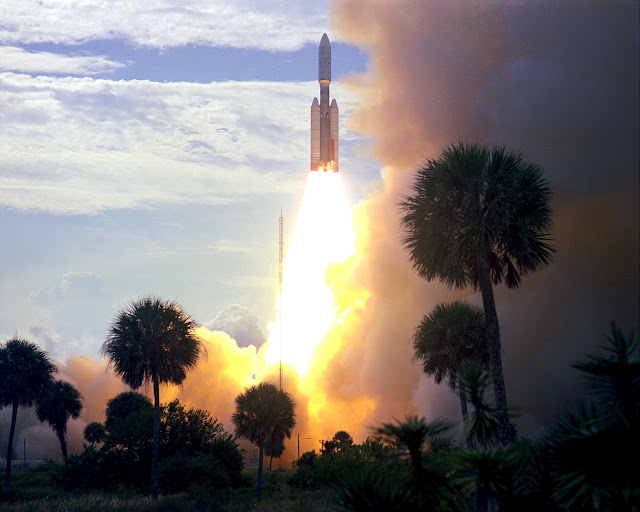 20 August 1975: Viking 1 launch atop a Titan III-E/Centaur rocket. Image credit: NASA
The Viking 1 and Viking 2 spacecraft exceeded all expectations. Viking 1 reached Mars orbit on 19 June 1976. The Viking 1 Lander separated from its Orbiter and soft-landed on 20 July 1976. The Viking 1 Orbiter depleted its attitude-control gas supply and was turned off on 17 August 1980. Though designed to operate on Mars for 90 martian days (Sols), the Viking 1 Lander transmitted from Mars until 13 November 1982 - a total of 2245 Sols. It might have lasted longer, but a faulty command caused it to break contact with Earth.
Viking 2 reached Mars on 7 August 1976, and its Lander touched down on 3 September 1976. The Viking 2 Orbiter suffered a propulsion system leak and was turned off on 25 July 1978; the Viking 2 Lander suffered battery failure and was switched off on 11 April 1980.
The Viking landers perform multiple life-detection experiments (with equivocal results). Together, the four spacecraft of Viking 1 and Viking 2 transmitted to Earth more than 100,000 images.
NASA and its contractors proposed Viking-derived missions in the late 1970s and early 1980s. These included rover and dual-rover missions, sample-returners, and landers and rovers for the martian moons Phobos and Deimos. Their planning efforts in some ways resembled those of Apollo planners in the Apollo Applications Program, which led ultimately to the Skylab Orbital Workshop. Earth-orbiting Skylab was staffed three times in 1973-1974. There was, however, no Viking Applications Program: despite Viking's success, its spacecraft saw no further application.
 Mariner-based Viking Orbiter with attached Viking Lander capsule. Image credit: NASA
 Schematic of Viking Lander as it would appear on Mars with all appendages deployed. Image credit: NASASources
The Post-Apollo Space Program: Directions for the Future, Space Task Group Report to the President, September 1969
America's Next Decades in Space: A Report for the Space Task Group, NASA, September 1969
Internal Note: Integrated Space Program - 1970-1990, IN-PD-SA-69-4, T. Sharpe & G. von Tiesenhausen, Advanced Systems Analysis Office, Program Development, NASA Marshall Space Flight Center, 10 December 1969
"U. S. Space Pace Slowed Severely," W. Normyle, Aviation Week & Space Technology, 19 January 1970, p. 16
"Presentation Outline [Space Tug]," NASA Manned Spacecraft Center, 20 January 1970
"NASA Budget Hits 7-Year Low," W. Normyle, Aviation Week & Space Technology, 2 February 1970, pp. 16-18
"Viking Spacecraft for Lunar Exploration - Case 340," R. Kostoff, M. Liwshitz, S. Shapiro, W. Sill, and A. Sinclair, Bellcomm, Inc., 30 June 1970
On Mars: Exploration of the Red Planet, 1958-1978, NASA SP-4212, E. Ezell and L. Ezell, NASA, 1984, pp. 128-153, pp. 185-201, pp. 245-284
More Information (...)
Source:
Lunar Viking (1970)
 Wątek: [Spaceflight History Blog] Lunar Viking (1970) (Przeczytany 2153 razy)