Autor Wątek: Starty rakiet (IV kwartał 2018 roku)  (Przeczytany 99395 razy)

0 użytkowników i 1 Gość przegląda ten wątek.

Online Adam.Przybyla

  • Weteran
  • *****
  • Wiadomości: 6544
  • Realista do bólu;-)
Odp: Starty rakiet (IV kwartał 2018 roku)
« Odpowiedź #105 dnia: Listopada 10, 2018, 11:57 »
Apropos startu Cygnusa 15.11 - leci kolejna drukarka 3d tym razem z wbudowanym odzyskiwaniem materialu do drukowania
- opcja nieskonczonego druku;-)
https://www.geekwire.com/2018/tethers-unlimiteds-3-d-printer-recycler-set-delivery-space-station/
Z powazaniem
                                                          Adam Przybyla
https://twitter.com/AdamPrzybyla
JID: adam.przybyla@gmail.com

Online Orionid

  • Weteran
  • *****
  • Wiadomości: 28823
  • Very easy - Harrison Schmitt
Odp: Starty rakiet (IV kwartał 2018 roku)
« Odpowiedź #106 dnia: Listopada 11, 2018, 08:12 »
Udany start Electrona
  11.11. o 03:50 z Onenui Station wystrzelona została RN Electron/Curie, która wyniosła w T+52' 45" na orbitę
o parametrach: hp=500 km, ha=500 km, i=85° satelity: CICERO, dwa Lemur-2, IRVINE01, NABEO i dwa Proxima.
http://lk.astronautilus.pl/n181101.htm#05


Drugi udany lot Electrona (11.11.2018)
BY MICHAŁ MOROZ ON 14 LISTOPADA 2018

Rocket Lab przeprowadziła drugi udany lot rakiety Electron. Była to pierwsza operacyjna misja nowej rakiety nowozelandzkiej spółki.

Lot Electrona rozpoczął się 11 listopada o godzinie 4:50 CET. W 52 minuty i 45 sekund po starcie na kołowej orbicie na wysokości 500 kilometrów i nachyleniu 85 stopni umieszczonych zostało sześć satelitów: CICERO 10, 2x Lemur-2, IRVINE01, NABEO oraz 2x Proxima.

CICERO numer 10 wchodzi wkład konstelacji składającej się z 24 satelitów, wykonującej pomiary atmosfery ziemskiej przy pomocy zjawisk okultacji radiowej GNSS oraz reflektometrii. Operatorem konstelacji jest spółka GeoOptics Inc.

Dwa satelity Lemur-2 (oznaczone numerami 82 i 83) należą do spółki Spire, która również wykonuje pomiary przy pomocy okultacji radiowej GNSS. Satelity Lemur śledzą również ruch morski przy pomocy sygnału AIS.

IRVINE01 to szkolny CubeSat 1U zbudowany przez uczniów szkół średnich ze wsparciem grup akademickich oraz przemysłu. Budowa satelity ma na celu nauczyć przyszłych inżynierów pracy przy większych projektach kosmicznych.

NABEO to bawarski ładunek, który pozostanie przymocowany do górnego stopnia rakiety. Przetestuje on użycie żagla słonecznego na potrzeby deorbitacyjne.

Satelity Proxima to dwa demonstratory przyszłej konstelacji Centauri, mającej oferować usługi komunikacyjne dla sprzętu podłączonego do Internetu Rzeczy.

Ponieważ był to pierwszy operacyjny lot dla spółki, to otrzymał on nazwę It’s Business Time (czas robić interesy). Wcześniejsze loty oznaczony były jako It’s a Test (to tylko test), oraz Still Testing (testujemy dalej). Dopiero drugi lot testowy był udany.

Cele firmy Rocket Lab

Celem spółki jest obsługa rosnącego rynku małych satelitów. Rakieta Electron w jednym locie będzie mogła wynieść ładunek o masie do 150 kg na orbitę synchronizowaną słonecznie (SSO) o wysokości 500 km. Przy obecnie realizowanych lotach może być możliwe wyniesienie kilkudziesięciu najmniejszych satelitów taką rakietą.

Spółka otrzymała również szereg inwestycji. Ostatnia Runda D zakończyła się pozyskaniem łącznie 148 mln dolarów kapitału, przy wycenie spółki na ponad 1 mld dolarów. Nieznane są wartości uzbieranego kapitału w Rundzie B (2015 rok) oraz Rundzie C.

Uzyskany kapitał przeznaczony zostanie na zwiększenie mocy produkcyjnej przy rakiecie Electron. W nowej siedzibie głównej firmy w Huntington Beach (Kalifornia, USA) zbudowana została hala montażowa, w której składane będą silniki rakiety Electron oraz systemy elektroniczne.

Same rakiety będą dalej montowane w Nowej Zelandii, chociaż nie wyklucza się, że w przyszłości na potrzeby realizacji startów z portów kosmicznych w Stanach Zjednoczonych, rakiety Electron będą składane również w Kalifornii. Rocket Lab ma przeprowadzać loty kosmiczne również z nowego kosmodromu budowanego w Szkocji.

(PFA, XL)
https://kosmonauta.net/2018/11/drugi-udany-lot-electrona-11-11-2018/
http://www.forum.kosmonauta.net/index.php?topic=2210.msg124402#msg124402

Rocket Lab performs first commercial launch
by Jeff Foust — November 10, 2018. Updated 9:20 a.m. Eastern Nov. 11 with post-launch statement.
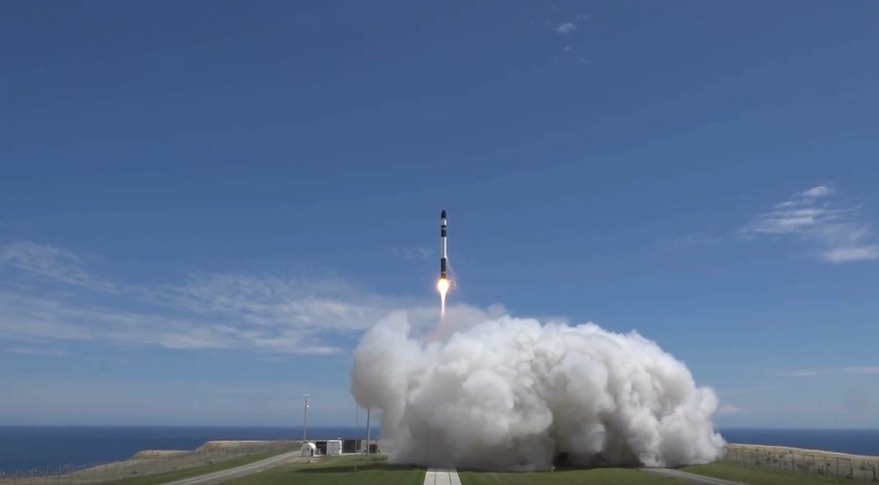

Rocket Lab's Electron rocket lifts off from its New Zealand launch site on the "It's Business Time" mission. Credit: Rocket Lab

WASHINGTON — Rocket Lab successfully launched its Electron rocket Nov. 10 on a long-delayed first commercial mission for the small launch vehicle.

The Electron lifted off from the company’s Launch Complex 1 on New Zealand’s Mahia Peninsula at 10:50 p.m. Eastern (4:50 p.m. local time Nov. 11) after a trouble-free countdown. The two-stage rocket released an upper stage, called Curie, into orbit nine minutes after liftoff.

Curie ignited its engines 51 minutes after liftoff to go into a circular 500-kilometer orbit at an inclination of 85 degrees. Three minutes later it released its payload of six small satellites.

“We’re thrilled to be leading the small satellite launch industry by reaching orbit a second time and deploying more payloads,” Peter Beck, chief executive of Rocket Lab, said in a post-launch statement. “The team carried out a flawless flight with incredibly precise orbital insertion.”

Those satellites included two Lemur-2 cubesats for Spire, which operates a constellation of such spacecraft to collect weather data as well as track vessels and aircraft. The Cicero-10 small satellite built by Tyvak Nano-Satellite Systems for weather satellite constellation company GeoOptics was also on the launch, as was IRVINE01, a cubesat built by high school students in Southern California. IRVINE01 features an electric propulsion system developed by Accion Systems, marking the first flight of that company’s technology.

Fleet, an Australian company developing a constellation of smallsats for Internet of Things services, added two 1.5-unit Proxima cubesats to the mission in October. The satellites are the first to be launched by the company, ahead of larger 3-unit cubesats that are part of a SpaceX Falcon 9 dedicated rideshare mission scheduled to launch later in November.

An additional payload, called NABEO and developed by High Performance Space Structure Systems GmBH, will remain attached to Curie. It will deploy a sail after the release of the other satellites to test its use as a means of deorbiting satellites. That payload was installed in cooperation with Ecliptic Enterprises Corporation, which announced an agreement with Rocket Lab in August to arrange similar hosted payloads on future Electron missions.

The launch was the third mission for the Electron, and the first since a January test flight that was the first to reach orbit. This mission, dubbed “It’s Business Time” by Rocket Lab, marked the beginning of routine commercial operations.

That mission was originally scheduled for launch in April but postponed because of a motor controller problem in one of the rocket’s first stage engines. The company corrected the problem and rescheduled the launch for late June, only to have the problem reappear.

In an August interview, Beck said the company decided to make changes to the design of the controller to address the problem. “We made the decision to bite the bullet,” he said then. “We’ll go in there and make some changes to the hardware, some components of the motor controller.”

With this success the company plans to step up the pace of launches. Rocket Lab’s next Electron mission is expected to take place in December, carrying a collection of cubesats from NASA’s CubeSat Launch Initiative under a contract awarded by NASA’s Venture Class Launch Services program in 2015. That launch will take place “within a few weeks,” Beck said in the statememt.
https://spacenews.com/rocket-lab-performs-first-commercial-launch/

Rocket Lab delivers seven payloads to orbit, plans next launch in December
November 11, 2018 Stephen Clark


Rocket Lab’s Electron rocket lifts off Sunday from Launch Complex 1 on Mahia Peninsula, located on the east coast of New Zealand’s North Island. Credit: Kieran Fanning & Sam Toms

Rocket Lab’s Electron booster launched six small satellites and a drag sail demonstrator to orbit Sunday from New Zealand, a success on the company’s first commercial mission that officials said should pave the way for a launch carrying NASA CubeSats next month and up to 16 flights of the light-class rocket next year. (...)

Peter Beck, Rocket Lab’s founder and CEO, said the Electron rocket’s orbital accuracy was “exquisite” on Sunday’s mission, setting the stage for another Electron launch in December carrying around a dozen scientific and research CubeSats sponsored by NASA and developed at U.S. institutions and universities.

The launch window for the next Electron flight is currently expected to open around Dec. 10 and extend to Dec. 18, according to two sources with payloads flying on the NASA-funded mission.

Sunday’s launch was the third flight of Rocket Lab’s Electron rocket, following a pair of test flights in May 2017 and in January the company named “It’s a Test” and “Still Testing.” Last year’s inaugural Electron mission fell short of orbit, but the Electron launch in January delivered several small spacecraft to orbit, including a geodesic sphere dubbed “Humanity Star” covered in reflective panels designed to make it visible from Earth.

The Electron rocket is capable of placing up to 330 pounds (150 kilograms) of payload in a polar orbit around 310 miles (500 kilometers) above Earth. The rocket’s capacity to a lower-altitude orbit is up to 500 pounds (225 kilograms).

Founded in New Zealand and headquartered in the United States, Rocket Lab says it can launch an Electron rocket for $5.7 million per flight, offering small satellite owners a more affordable, dedicated ride to orbit than larger, more expensive rockets, which often launch large clusters of smallsats at a time.

The success of the January launch gave Rocket Lab officials confidence to press ahead with the company’s first operational flight, which was named “It’s Business Time.”

Rocket Lab planned to launch the “It’s Business Time” mission in April, but engineers discovered a problem with a motor controller during a fueling test. The controller woes continued during a launch attempt in June, and Rocket Lab stood down from the launch campaign to resolve the issue. (...)

Two the satellites launched on the Electron rocket Sunday are owned by Spire Global, a San Francisco-based company which builds and operates a fleet of CubeSats collecting weather data and tracking maritime traffic. The Lemur-2 satellites are about the size of a shoebox, and also carry instrumentation to track aircraft in flight.

Another California-based company, GeoOptics, also launched a small satellite for its own commercial weather monitoring constellation, which monitors GPS navigation signals passed through the atmosphere to measure temperature and moisture profiles. The GeoOptics CICERO 10 spacecraft was the biggest of the bunch launched Sunday, weighing in at around 22 pounds (10 kilograms).

A CubeSat named IRVINE01 built by Southern California high school students also lifted off on the Electron rocket.

Fleet Space Technologies, an Australian company with plans to build a network of tiny tracking and data relay satellites designed to connect with devices in remote locations on Earth, also launched its first two test CubeSats on Sunday’s mission — named Proxima 1 and 2.

A German-built payload from High Performance Space Structure Systems also rode into orbit Sunday to test an aerodynamic drag sail that could be used to de-orbit future satellites and help clear space junk out of orbit. The drag sail was to remain attached to the Curie kick stage and unfurl after the separation of the other satellites.


A model of the drag sail to be demonstrated on the NABEO tech demo payload. Credit: Rocket Lab

(...) “Our goal by the end of next year is to be launching once every two weeks, and as we move into 2020, launching once a week,” Beck said. “We’re tracking a pretty big pipeline of customers, and we’ve been very fortunate that people have put their trust in us.” (...)
https://spaceflightnow.com/2018/11/11/rocket-lab-delivers-seven-payloads-to-orbit-plans-next-launch-in-december/

First deployed from the Curie kick stage was the IRVINE01 CubeSat built by students in Southern California, followed by two ship-tracking and weather data collection craft for Spire Global, two data relay satellites from Fleet Space Technologies, and the CICERO 10 commercial weather satellite for GeoOptics.

The German-built NABEO drag sail will remain on the Curie kick stage and is scheduled to unfurl in around one hour, Rocket Lab says.
https://spaceflightnow.com/2018/11/10/rocket-lab-its-business-time-mission-status-center/

https://spaceflightnow.com/2018/10/22/rocket-lab-breaks-ground-on-new-virginia-launch-pad/
https://spaceflightnow.com/2018/10/31/rocket-lab-sets-new-target-date-for-first-operational-launch/
https://www.nasaspaceflight.com/2018/11/rocketlab-operational-electron-launch-five-payload/
https://spacenews.com/rocket-lab-performs-first-commercial-launch/
https://www.rocketlabusa.com/news/updates/

https://space.skyrocket.de/doc_sdat/cicero.htm
https://space.skyrocket.de/doc_sdat/lemur-2.htm
https://space.skyrocket.de/doc_sdat/proxima-1.htm
https://space.skyrocket.de/doc_sdat/irvine-01.htm
https://space.skyrocket.de/doc_sdat/nabeo.htm
« Ostatnia zmiana: Września 04, 2021, 18:09 wysłana przez Orionid »

Offline astropl

  • Moderator
  • *****
  • Wiadomości: 5357
  • Zmieściłem się w Sojuzie :)
    • Loty Kosmiczne
Odp: Starty rakiet (IV kwartał 2018 roku)
« Odpowiedź #107 dnia: Listopada 14, 2018, 21:02 »

PAŹDZIERNIK 2018

08    02:21:28          Vandenberg 4E     Falcon-9R           SAOCOM-1A
09    02:43:04          Jiuquan 43/94     CZ-2C/YZ-1S         Yaogan-32 Grupa 1 A, B
11    08:40:15          Bajkonur 1/5      Sojuz-FG            Sojuz MS-10
15    04:23:04          Xichang           CZ-3B/YZ-1          Beidou-3 M15, M16
17    04:15:00          Canaveral 41      Atlas-5/551         AEHF-4
20    01:45:35          Kourou 3          Ariane-5ECA         BepiColombo
24    22:57             Taiyuan 9         CZ-4B               Haiyang-2B
25    00:15             Plesieck 43/4     Sojuz-2.1b          Kosmos 2528 (Lotos-S1 No.3)
27    08:00             Jiuquan           Zhuque-1            Weilai-1
29    00:43:13          Jiuquan 43/94     CZ-2C               CFOSAT,  Zhaojin-1, Tiange-1, Hongyan-1,
                                                              Tianfuguoxing-1, Changshagaoxin,
                                                              Xiaoxiang-1 (02), CubeBel-1
29    04:08:01          Tanegashima Y/1   H-2A/202            Ibuki-2 (GOSAT-2), KhalifaSat, DIWATA-2B,
                                                              PROITERES-2, Tenkou, Stars-AO, AUTcube2
LISTOPAD 2018

01    15:57:05          Xichang           CZ-3B/G2            Beidou-3 GEO-1
03    20:17:53          Plesieck 43/4     Sojuz-2.1/Fregat-M  Kosmos 2529 (Uragan-M)
07    00:47:28          Kourou ELS        Sojuz-STB/Fregat-M  MetOp-C
11    03:50             Onenui 1          Electron/Curie      CICERO, Lemur-2 x 2, IRVINE01, NABEO,
                                                              Proxima x 2
14    11:38:00          Sriharikota S     GSLV Mk3            GSat-29
__________________________________________________________________________________________
15    20:46-22:29       KSC 39A           Falcon-9R           Es'hail 2
16    09:23:55          Wallops 0A        Antares-230         Cygnus-10
16    18:14:08          Bajkonur 1/5      Sojuz-FG            Progress MS-10
19    18:32             Vandenberg 4E     Falcon-9R           ORS 7A, ORS 7B, MinXSS 2, Audacy 0, Eu:CROPIS,
                                                              BlackSky Global 2, STPSat-5, SkySat 14,
                                                              SkySat 15, NEXTSat 1, Hawk A, B, C, Fox 1C,
                                                              KNACKSAT, Elysium-Star 2, JY1-Sat, KazSTSAT,
                                                              KazSciSat, ROSE-1, ICEYE X2, CSIM-FD, Hiber 2,
                                                              Orbital Reflector, PW-Sat 2, Hamilton 1,
                                                              Centauri 2, Eaglet 1, SpaceBEE 9-11, ENOCH,
                                                              AISTECHSAT 2, Al-Farabi 2, Astrocast 0.1,
                                                              BeeSat 5-7, BlackHawk, BRIO, Capella 1, ESEO,
                                                              eXCITe, ExseedSat 1, FalconSat 6, ICE-Cap,
                                                              Irvine 02, ITASAT-1,K2SAT, Landmapper-BC 4 v2,
                                                              ORS 1, RAAF M1, RANGE A, RANGE B, SeaHawk 1,
                                                              SeeMe, SIRION Pathfinder 2, SNUGLITE,
                                                              SNUSAT 2, Suomi-100, THEA, VESTA, VisionCube,
                                                              WeissSat 1, Flock-3s 1-3, MOVE 2
19    ??:??             Xichang           CZ-3B/YZ-1          Beidou-3 M17, M18
??    08:05-09:30       Canaveral 13/31   L-1011/Pegasus-XL   ICON
20    ??:??             Jiuquan 43/94     CZ-2D?              SaudiSAT-5A, SaudiSAT-5B, Tianzhi No.1,
                                                              Jiading No.1, ?, ?
21    01:42             Kourou Z          Vega                Mohammed VI-B
25    ??:??             Jiuquan           KZ-1A               Jilin-1 09
26    ??:??             Sriharikota       PSLV-CA             HySIS, ? x 30
29    ??:??             Vandenberg 6      Delta-4H            NRO L-71 (Imp. Crystal Block 5 #1)
??    ??:??             Jiuquan LA4       CZ-11               Lingque x 2
??    ??:??             Plesieck 133/3    Rokot/Briz-KM       Kosmos x 3 (Rodnik-S x 3)

GRUDZIEŃ 2018

03    11:31             Bajkonur 1/5      Sojuz-FG            Sojuz MS-11
04    18:38             Canaveral 40      Falcon-9R           Dragon-16
04    21:34             Kourou 3          Ariane-5ECA         GSAT-11, GEO-KOMPSAT-2A
07   ~17:30             Xichang           CZ-3B/G2            Chang'e-4
14    ??:??             Sriharikota S     GSLV Mk 2           GSat-7
15    14:24-14:50       Canaveral 40      Falcon-9R           GPS-3 F1
15    ??:??             Taiyuan 9         CZ-4B               Ziyuan-2D, Tianyi MV-1, BNU-1
18    ??:??             Kourou S          Sojuz-STA/Fregat-MT CSO-1
25    02:07             Wostocznyj 1S     Sojuz-2.1a/Fregat-M Kanopus-W No. 5, 6, [Iran], SAMSON x 3,
                                                              Flock x 12
25    22:12             Bajkonur          Proton-M/Briz-M     Kosmos (Błagowiest 3)
27    ??:??             Bajkonur 31/6     Sojuz-2.1b          EgyptSat-A
30    16:38             Vandenberg 4E     Falcon-9R           Iridium-NEXT x 10
??    ??:??             Onenui 1          Electron/Curie      CeREs, CHOMPTT, Da Vinci, ISX, TomSat R3,
                                                              NMTSat, RSat-P, Shields 1, STF 1, CubeSail 1,
                                                              CubeSail 2, GeoStare, TomSat Eagle Scout,
                                                              SHFT 1
Waldemar Zwierzchlejski
http://lk.astronautilus.pl

Online Orionid

  • Weteran
  • *****
  • Wiadomości: 28823
  • Very easy - Harrison Schmitt
Odp: Starty rakiet (IV kwartał 2018 roku)
« Odpowiedź #108 dnia: Listopada 15, 2018, 07:53 »
Drugi start ciężkiej GSLV
  14.11. o 11:38 z wyrzutni SLP w Sriharikota wystrzelona zostałą RN GSLV Mk 3, która wyniosła w T+16' 28,5"
na orbitę o parametrach: hp=190 km, ha=35975 km, i=21,5° geostacjonarnego satelitę telekomunikacyjnego GSat-29.
http://lk.astronautilus.pl/n181101.htm#06


Drugi start największej indyjskiej rakiety
BY MICHAŁ MOROZ ON 15 LISTOPADA 2018


Kadr ze startu GSLV Mk3 / ISRO

14 listopada o godzinie 12.38 CET z kosmodromu Sriharikota wystartowała ciężka rakieta nośna GSLV Mark 3. Na jej pokładzie znajdował się satelita telekomunikacyjny GSat-29.

Był to już drugi lot testowy wysokiej na 43,5 metra rakiety nośnej, której debiutancki i udany lot orbitalny odbył się w 2017 roku.

Satelita GSat-29 waży 3423 kg. Przez następne 10 lat ma wykonywać usługi telekomunikacyjne w pasmach Ka i Ku. Satelita wyposażony jest również w testowy system komunikacji laserowej oraz kamerę GHRC do prowadzenia obserwacji Ziemi. Satelita został zbudowany przez Indyjską Agencję Kosmiczną ISRO dla operatora Insat. Został on umieszczony na orbicie transferowej (GTO), skąd “o własnych siłach” dotrze do wyznaczonego punktu na orbicie geostacjonarnej (GEO).


Profil misji Chandrayaan-2 / Credits - ISRO

Dwa udane loty GSLV Mark 3 oznaczają, że Indie mogą przeprowadzić kolejny, znacznie trudniejszy lot w kierunku Księżyca. Misja Chandrayaan 2, w której skład wchodzą orbiter, lądownik oraz łazik księżycowy zostanie wystrzelona w styczniu 2019 roku właśnie za pomocą rakiety GSLv Mark 3. Łazik i lądownik mają wylądować w pobliżu bieguna południowego na Księżycu i pracować na powierzchni przynajmniej przez 14-15 dni.


Nagranie startu GSLV Mk 3 z 14 listopada 2018 / Credits – Indian Space Research Organisation (ISRO)

Był to już piąty start indyjskiej rakiety nośnej w 2018 roku. Łącznie był to już 89 udany lot kosmiczny przeprowadzony w tym roku.

(SFN, GSP)
https://kosmonauta.net/2018/11/drugi-start-najwiekszej-indyjskiej-rakiety/

India’s GSLV Mk.3 aces test launch, clearing way for lunar mission
November 14, 2018 Stephen Clark


The GSLV Mk.3 launcher is prepared for liftoff from the Second Launch Pad at the Satish Dhawan Space Center on India’s east coast. Credit: ISRO

(...) It was the third test flight of the GSLV Mk.3, India’s most powerful rocket, following a suborbital demonstration in 2014 and an orbital launch in 2017. Both missions were successful, and with Wednesday’s successful launch, Indian officials declared the rocket ready for operational flights, beginning with the launch of the the Chandrayaan 2 lunar lander as soon as January. (...)

“The payload for GSLV Mk.3-D2 is the very advanced high-throughput satellite GSAT 29. It is a multi-band, multi-beam communications satellite with a liftoff mass of 3.4 tonnes (about 7,500 pounds),” Sivan said. “GSAT 29 payloads are catered to the communications requirements of users from Jammu and Kashmir and northeastern regions of India. Apart from these operational requirements, the satellite will be demonstrating several new and critical technologies also.”

One of the satellite’s tech demo payloads will investigate laser communications links between the ground and geostationary orbit. Laser, or optical, data links provide a significantly faster way to relay information than conventional radio communications. (...)

GSAT 29 carries Ku-band and Ka-band spot beams aimed at remote parts of northwest and northeast India, beaming signals to a large population, particularly in hilly and geographically inaccessible regions, according to ISRO.

The satellite’s technology demonstration function focuses on the testing of a new optical communications capability, a Q-band and V-band communications payload, and a high-resolution camera.

The GSLV Mk.3 rocket can lift up to 4 metric tons — about 8,800 pounds — to a geostationary transfer orbit, the drop-off orbit for most large telecom satellites heading for perches more than 22,000 miles over the equator.

For a mission to low Earth orbit a few hundred miles above the planet, ISRO says the GSLV Mk.3 can carry 10 metric tons, or about 22,000 pounds. The GSLV Mk.3 can haul about twice the payload as the GSLV Mk.2, India’s second-most powerful rocket.

With the introduction of a future upgrade to switch the core stage to kerosene-fueled engines, the GSLV Mk.3 could haul up to 6 metric tons — more than 13,000 pounds — to geostationary transfer orbit.

That is more than the lift capability of United Launch Alliance’s basic Atlas 5 rocket configuration without strap-on boosters, but well short of the capacity of the Atlas 5’s more powerful versions, the Ariane 5, and SpaceX
’s Falcon 9 rocket.

“GSLV Mk.3 is slated for launching the Chandrayaan 2, as well as the future Gaganyaan program,” said S. Somanath director of ISRO’s Vikram Sarabhai Space Center, which is charged with developing Indian launcher technology. “(On) this mission, its perfection established that this is is the vehicle of the future.”

Wednesday’s mission was the fifth space launch of the year from India, all successful. (...)
https://spaceflightnow.com/2018/11/14/gslv-mk3-d2-gsat-29/

https://www.nasaspaceflight.com/2018/11/indian-gslv-rocket-gsat-29-launch/
https://timesofindia.indiatimes.com/isro-gslv-mk-iii-gsat-29-launch-live-updates/liveblog/66619076.cms

https://space.skyrocket.de/doc_sdat/gsat-29.htm
« Ostatnia zmiana: Listopada 15, 2018, 14:23 wysłana przez Orionid »

Polskie Forum Astronautyczne

Odp: Starty rakiet (IV kwartał 2018 roku)
« Odpowiedź #108 dnia: Listopada 15, 2018, 07:53 »

Online Orionid

  • Weteran
  • *****
  • Wiadomości: 28823
  • Very easy - Harrison Schmitt
Odp: Starty rakiet (IV kwartał 2018 roku)
« Odpowiedź #109 dnia: Listopada 15, 2018, 14:38 »
Cytuj
Był to już drugi lot testowy wysokiej na 43,5 metra rakiety nośnej, której debiutancki i udany lot orbitalny odbył się w 2017 roku.
https://kosmonauta.net/2018/11/drugi-start-najwiekszej-indyjskiej-rakiety/#prettyPhoto

Właściwie to trzeci test , gdy uwzględnić suborbitalny lot sprzed 4. lat.

India Tests GSLV-3 Rocket and Crew Capsule with Suborbital Launch
by K.S. Jayaraman — December 18, 2014


ISRO's prototype crew module floating in the Andaman Sea after splash down. Credit: ISRO

BANGALORE, India  — In a two-in-one mission, the Indian Space Research Organisation (ISRO) successfully conducted the first experimental flight of its next-generation launch vehicle and demonstrated the re-entry and recovery of a prototype crew capsule.

The Dec. 18 maiden flight of the Geosynchronous Satellite Launch Vehicle Mark 3 (GSLV-3) began with a liftoff at 9:30 a.m local time from the Satish Dhawan Space Center on the southeastern coast of India and was over in 20 minutes.


India’s GSLV-Mark 3 rocket lifting off on Dec. 18, 2014 suborbital test flight. Credit: ISRO

ISRO said in a statement that this “suborbital” experimental mission was intended to test the vehicle performance during the critical atmospheric phase of its flight. The vehicle carried a passive, or nonfunctional, cryogenic upper stage.

The rocket carried a 3,775-kilogram  unmanned crew module built by Indian industry. The module, designed to accommodate three astronauts, separated from the rocket at an altitude of 127 kilometers and, after being  slowed by parachutes, splashed down in the Bay of Bengal.

The 42.4-meter tall GSLV-3 is a three-stage vehicle with  a liftoff weight of 630 metric tons. The first stage consists of  two solid-rocket motors, each with 200 tons of propellant. Its  second stage uses two restartable  engines, with 110 tons of liquid propellant. (...)
https://spacenews.com/india-tests-gslv-3-rocket-and-crew-capsule-with-suborbital-launch/

Offline astropl

  • Moderator
  • *****
  • Wiadomości: 5357
  • Zmieściłem się w Sojuzie :)
    • Loty Kosmiczne
Odp: Starty rakiet (IV kwartał 2018 roku)
« Odpowiedź #110 dnia: Listopada 15, 2018, 22:08 »
Samolot L-1011, nosiciel Pegasusa, powrócił do bazy macierzystej w Vandenberg. Oznacza to, że na start ICON-a poczekamy dłużej, niż się wydawało.
Waldemar Zwierzchlejski
http://lk.astronautilus.pl

Offline astropl

  • Moderator
  • *****
  • Wiadomości: 5357
  • Zmieściłem się w Sojuzie :)
    • Loty Kosmiczne
Odp: Starty rakiet (IV kwartał 2018 roku)
« Odpowiedź #111 dnia: Listopada 16, 2018, 17:23 »

PAŹDZIERNIK 2018

08    02:21:28          Vandenberg 4E     Falcon-9R           SAOCOM-1A
09    02:43:04          Jiuquan 43/94     CZ-2C/YZ-1S         Yaogan-32 Grupa 1 A, B
11    08:40:15          Bajkonur 1/5      Sojuz-FG            Sojuz MS-10
15    04:23:04          Xichang           CZ-3B/YZ-1          Beidou-3 M15, M16
17    04:15:00          Canaveral 41      Atlas-5/551         AEHF-4
20    01:45:35          Kourou 3          Ariane-5ECA         BepiColombo
24    22:57             Taiyuan 9         CZ-4B               Haiyang-2B
25    00:15             Plesieck 43/4     Sojuz-2.1b          Kosmos 2528 (Lotos-S1 No.3)
27    08:00             Jiuquan           Zhuque-1            Weilai-1
29    00:43:13          Jiuquan 43/94     CZ-2C               CFOSAT,  Zhaojin-1, Tiange-1, Hongyan-1,
                                                              Tianfuguoxing-1, Changshagaoxin,
                                                              Xiaoxiang-1 (02), CubeBel-1
29    04:08:01          Tanegashima Y/1   H-2A/202            Ibuki-2 (GOSAT-2), KhalifaSat, DIWATA-2B,
                                                              PROITERES-2, Tenkou, Stars-AO, AUTcube2
LISTOPAD 2018

01    15:57:05          Xichang           CZ-3B/G2            Beidou-3 GEO-1
03    20:17:53          Plesieck 43/4     Sojuz-2.1/Fregat-M  Kosmos 2529 (Uragan-M)
07    00:47:28          Kourou ELS        Sojuz-STB/Fregat-M  MetOp-C
11    03:50             Onenui 1          Electron/Curie      CICERO, Lemur-2 x 2, IRVINE01, NABEO,
                                                              Proxima x 2
14    11:38:00          Sriharikota S     GSLV Mk3            GSat-29
15    20:46             KSC 39A           Falcon-9R           Es'hail 2
16    18:14:09          Bajkonur 1/5      Sojuz-FG            Progress MS-10
__________________________________________________________________________________________
17    09:01:22          Wallops 0A        Antares-230         Cygnus-10
18    17:48             Xichang           CZ-3B/YZ-1          Beidou-3 M17, M18
19    18:32             Vandenberg 4E     Falcon-9R           ORS 7A, ORS 7B, MinXSS 2, Audacy 0, Eu:CROPIS,
                                                              BlackSky Global 2, STPSat-5, SkySat 14,
                                                              SkySat 15, NEXTSat 1, Hawk A, B, C, Fox 1C,
                                                              KNACKSAT, Elysium-Star 2, JY1-Sat, KazSTSAT,
                                                              KazSciSat, ROSE-1, ICEYE X2, CSIM-FD, Hiber 2,
                                                              Orbital Reflector, PW-Sat 2, Hamilton 1,
                                                              Centauri 2, Eaglet 1, SpaceBEE 9-11, ENOCH,
                                                              AISTECHSAT 2, Al-Farabi 2, Astrocast 0.1,
                                                              BeeSat 5-7, BlackHawk, BRIO, Capella 1, ESEO,
                                                              eXCITe, ExseedSat 1, FalconSat 6, ICE-Cap,
                                                              Irvine 02, ITASAT-1,K2SAT, Landmapper-BC 4 v2,
                                                              ORS 1, RAAF M1, RANGE A, RANGE B, SeaHawk 1,
                                                              SeeMe, SIRION Pathfinder 2, SNUGLITE,
                                                              SNUSAT 2, Suomi-100, THEA, VESTA, VisionCube,
                                                              WeissSat 1, Flock-3s 1-3, MOVE 2
19   ~23:40             Jiuquan 43/94     CZ-2D               SaudiSAT-5A, SaudiSAT-5B, Tianzhi No.1,
                                                              Jiading No.1, ?, ?
21    01:42:31          Kourou Z          Vega                Mohammed VI-B
25    ??:??             Jiuquan           KZ-1A               Jilin-1 09
29    04:00-08:00       Sriharikota F     PSLV-CA             HySIS, ? x 30
29    ??:??             Vandenberg 6      Delta-4H            NRO L-71 (Imp. Crystal Block 5 #1)
??    ??:??             Jiuquan LA4       CZ-11               Lingque x 2
??    ??:??             Plesieck 133/3    Rokot/Briz-KM       Kosmos x 3 (Rodnik-S x 3)

GRUDZIEŃ 2018

03    11:31             Bajkonur 1/5      Sojuz-FG            Sojuz MS-11
04    18:38             Canaveral 40      Falcon-9R           Dragon-16
04    21:34             Kourou 3          Ariane-5ECA         GSAT-11, GEO-KOMPSAT-2A
07   ~17:30             Xichang           CZ-3B/G2            Chang'e-4
10    ??:??             Onenui 1          Electron/Curie      CeREs, CHOMPTT, Da Vinci, ISX, TomSat R3,
                                                              NMTSat, RSat-P, Shields 1, STF 1, CubeSail 1,
                                                              CubeSail 2, GeoStare, TomSat Eagle Scout,
                                                              SHFT 1
14    ??:??             Sriharikota S     GSLV Mk 2           GSat-7
15    14:24-14:50       Canaveral 40      Falcon-9R           GPS-3 F1
15    ??:??             Taiyuan 9         CZ-4B               Ziyuan-2D, Tianyi MV-1, BNU-1
18    ??:??             Kourou S          Sojuz-STA/Fregat-MT CSO-1
25    02:07             Wostocznyj 1S     Sojuz-2.1a/Fregat-M Kanopus-W No. 5, 6, [Iran], SAMSON x 3,
                                                              Flock x 12
25    22:12             Bajkonur          Proton-M/Briz-M     Kosmos (Błagowiest 3)
27    ??:??             Bajkonur 31/6     Sojuz-2.1b          EgyptSat-A
30    16:38             Vandenberg 4E     Falcon-9R           Iridium-NEXT x 10
??    08:05-09:30 ?     Canaveral 13/31 ? L-1011/Pegasus-XL   ICON
« Ostatnia zmiana: Listopada 16, 2018, 19:57 wysłana przez astropl »
Waldemar Zwierzchlejski
http://lk.astronautilus.pl

Offline JSz

  • Weteran
  • *****
  • Wiadomości: 6854
Odp: Starty rakiet (IV kwartał 2018 roku)
« Odpowiedź #112 dnia: Listopada 16, 2018, 19:16 »
Progres wystartował. Na razie wygląda na to, że wszystko jest OK.

Offline Slavin

  • Weteran
  • *****
  • Wiadomości: 976
  • Ciekłym metanem i ciekłym tlenem LCH4/LO2 Methalox
Odp: Starty rakiet (IV kwartał 2018 roku)
« Odpowiedź #113 dnia: Listopada 16, 2018, 20:53 »
Start Progressa MS-10


Online Orionid

  • Weteran
  • *****
  • Wiadomości: 28823
  • Very easy - Harrison Schmitt
Odp: Starty rakiet (IV kwartał 2018 roku)
« Odpowiedź #114 dnia: Listopada 16, 2018, 22:02 »
Wystrzelono rosyjski transportowiec
  16.11. o 18:14:08,754 z Bajkonuru wystrzelona została RN Sojuz-FG, która wyniosła w T+9' na orbitę LEO
statek transportowy Progress MS-10. Jego połączenie z ISS ma być wykonane 18.11.2018 o 19:30:01.
http://lk.astronautilus.pl/n181116.htm#01


Cytuj
Film niedostępny
https://www.youtube.com/watch?v=NgrNLGCTqOA
Cytuj
Ten film jest prywatny
https://www.youtube.com/watch?v=aUUk9UPYtic

Nagranie startu RN Sojuz-FG z Progressem MS-10 wykonane z pokładu ISS
https://twitter.com/Kosmo_Michal/status/1700943924620103725

Dwie misje logistyczne dotarły do ISS
BY MICHAŁ MOROZ ON 20 LISTOPADA 2018

16 i 17 listopada ku Międzynarodowej Stacji Kosmicznej wystartowały dwie misje logistyczne. Rosyjski Progress oraz amerykański Cygnus dotarły do ISS w niedziele i poniedziałek.

Pierwszy z obu startów rozpoczął się 16 listopada o 19:14 (CET) z kosmodromu Bajkonur. Pojazd Progress MS-10 został wyniesiony na orbitę okołoziemską na pokładzie rakiety Sojuz-FG. Udany lot tego wariantu rakiety Sojuz pokazuje, że Rosjanie zidentyfikowali przyczynę, która doprowadziła do awarii podczas startu załogowego lotu Sojuza MS-10. Na szczęście Aleksiej Owczynin i Tyler Hague przeżyli tamten feralny lot.

Progress-MS 10 dotarł do ISS 18 listopada o 20:28 CET. Pojazd przycumował do tylnego węzła modułu Zwiezda. Dostarczył on 2564 kg ładunku, z czego około 750 kg paliwa, 75 kg powietrza oraz 440 kg wody. Wznowienie lotów załogowych do ISS ma nastąpić 3 grudnia. Wówczas ma wystartować Sojuz MS-11 z załogą: Oleg Kononienko (Rosja), David Saint-Jacques (Kanada) oraz Anne McClain (USA).


Start pojazdu Progress MS-10 / Credits – Roskosmos


Cumowanie Progressa MS-10 do ISS / Credits – Roskosmos
https://kosmonauta.net/2018/11/dwie-misje-logistyczne-do-iss/

Роскосмос. РН «Союз-ФГ» с ТГК «Прогресс МС-10» запущена с космодрома Байконур
16.11.2018 21:23

16 ноября 2018 года в 21:14 мск с космодрома Байконур успешно осуществлен запуск ракеты космического назначения «Союз-ФГ» по программе Международной космической станции (МКС). Ракета-носитель вывела на околоземную орбиту транспортный грузовой корабль (ТГК) «Прогресс МС-10».

После отделения космического корабля от третьей ступени ракеты-носителя ТГК приступил к выполнению программы полета к МКС.

Сближение транспортного корабля «Прогресс МС-10» со станцией и причаливание к стыковочному узлу модуля «Звезда» российского сегмента МКС планируется проводить в автоматическом режиме под контролем специалистов ЦУП, а также российского космонавта Сергея Прокопьева. Стыковка запланирована 18 ноября в 22:30 мск.

Кораблю «Прогресс МС-10» предстоит доставить на Международную космическую станцию около 2,5 тонн различных грузов: более 1,3 тонны сухих грузов, 725 кг топлива в баках системы дозаправки, 420 кг воды в баках системы «Родник», а также 50 кг сжатого воздуха и кислорода в баллонах. В укладке грузового отсека — научное оборудование, комплектующие для системы жизнеобеспечения, а также контейнеры с продуктами питания, предметы одежды, медикаменты и средства личной гигиены для членов экипажа.

После запуска грузового корабля на космодроме Байконур состоялось заседание Государственной комиссии, на котором Генеральный директор Госкорпорации «Роскосмос» Дмитрий Рогозин поблагодарил боевые расчеты за проведение успешного пуска.
https://www.roscosmos.ru/25739/
http://www.russianspaceweb.com/progress-ms-10.html

РКК «Энергия». Ракета с кораблем «Прогресс МС-10» готова к установке на старте
13.11.2018 16:49


https://www.roscosmos.ru/25717/

РКК «Энергия». Ракета-носитель с грузовым кораблем «Прогресс МС-10» установлена на старте
14.11.2018 08:30


https://www.roscosmos.ru/25719/

ЦУП. Завершены плановые работы по подготовке к управлению полётом грузового корабля «Прогресс МС-10»
16.11.2018 08:00

(...) Сближение транспортного корабля «Прогресс МС-10» с МКС и причаливание к стыковочному узлу модуля «Звезда» планируется проводить в автоматическом режиме под контролем специалистов ГОГУ РС МКС в ЦУП и российского космонавта Сергея Прокопьева. (...)
https://www.roscosmos.ru/25734/

Progress resupply craft lifts off from Kazakhstan, heads for space station
November 16, 2018 Stephen Clark


A Soyuz rocket lifts off Friday with the Progress MS-10 supply ship heading to the International Space Station. Credit: Roscosmos

(...) The Soyuz launcher that lifted off Friday flew in the Soyuz-FG configuration, the same variant of Russian’s most famous rocket used for liftoffs with crews heading for the space station. (...)

With the successful launch Friday carrying the Progress cargo mission, the Russian space agency is expected to give the green light for the next station crew launch Dec. 3, also using the Soyuz-FG rocket. (...)

The Progress MS-10 supply ship is scheduled to dock with the space station’s Zvezda service module at 1929 GMT (2:29 p.m. EST) Sunday, delivering more than 2.8 tons (2.5 metric tons) of equipment and commodities for the station crew.

The spacecraft’s pressurized compartment is packed with around 2,866 pounds (1,300 pounds) of dry cargo — food, clothing, provisions, experiments and spare parts. Those items will be manually unloaded by the station crew.

The Progress also carries tanks containing around 1,653 pounds (750 kilograms) of propellant for transfer into the Zvezda module’s propulsion system, 970 pounds (440 kilograms) of water, 112 pounds (50 kilograms) of oxygen, and 53 pounds (24 kilograms) of air. (...)
https://spaceflightnow.com/2018/11/16/progress-ms-10-launch/
« Ostatnia zmiana: Września 13, 2023, 09:02 wysłana przez Orionid »

Offline alnitak

  • Weteran
  • *****
  • Wiadomości: 952
  • LOXem i ropą! ;)
Odp: Starty rakiet (IV kwartał 2018 roku)
« Odpowiedź #115 dnia: Listopada 17, 2018, 12:49 »
Dlaczego grudniowy start F9 z GPS III nie będzie z odzyskiem boostera?Tak jest w artykule na NSF https://www.nasaspaceflight.com/2018/11/spacex-return-action-lsp-status-upgrade/

Offline astropl

  • Moderator
  • *****
  • Wiadomości: 5357
  • Zmieściłem się w Sojuzie :)
    • Loty Kosmiczne
Odp: Starty rakiet (IV kwartał 2018 roku)
« Odpowiedź #116 dnia: Listopada 18, 2018, 19:48 »

PAŹDZIERNIK 2018

08    02:21:28          Vandenberg 4E     Falcon-9R           SAOCOM-1A
09    02:43:04          Jiuquan 43/94     CZ-2C/YZ-1S         Yaogan-32 Grupa 1 A, B
11    08:40:15          Bajkonur 1/5      Sojuz-FG            Sojuz MS-10
15    04:23:04          Xichang           CZ-3B/YZ-1          Beidou-3 M15, M16
17    04:15:00          Canaveral 41      Atlas-5/551         AEHF-4
20    01:45:35          Kourou 3          Ariane-5ECA         BepiColombo
24    22:57             Taiyuan 9         CZ-4B               Haiyang-2B
25    00:15             Plesieck 43/4     Sojuz-2.1b          Kosmos 2528 (Lotos-S1 No.3)
27    08:00             Jiuquan           Zhuque-1            Weilai-1
29    00:43:13          Jiuquan 43/94     CZ-2C               CFOSAT,  Zhaojin-1, Tiange-1, Hongyan-1,
                                                              Tianfuguoxing-1, Changshagaoxin,
                                                              Xiaoxiang-1 (02), CubeBel-1
29    04:08:01          Tanegashima Y/1   H-2A/202            Ibuki-2 (GOSAT-2), KhalifaSat, DIWATA-2B,
                                                              PROITERES-2, Tenkou, Stars-AO, AUTcube2
LISTOPAD 2018

01    15:57:05          Xichang           CZ-3B/G2            Beidou-3 GEO-1
03    20:17:53          Plesieck 43/4     Sojuz-2.1/Fregat-M  Kosmos 2529 (Uragan-M)
07    00:47:28          Kourou ELS        Sojuz-STB/Fregat-M  MetOp-C
11    03:50             Onenui 1          Electron/Curie      CICERO, Lemur-2 x 2, IRVINE01, NABEO,
                                                              Proxima x 2
14    11:38:00          Sriharikota S     GSLV Mk3            GSat-29
15    20:46             KSC 39A           Falcon-9R           Es'hail 2
16    18:14:09          Bajkonur 1/5      Sojuz-FG            Progress MS-10
17    09:01:32          Wallops 0A        Antares-230         Cygnus-10
18    18:07:04          Xichang           CZ-3B/YZ-1          Beidou-3 M17, M18
__________________________________________________________________________________________
19   ~23:40             Jiuquan 43/94     CZ-2D               SaudiSAT-5A, SaudiSAT-5B, Tianzhi No.1,
                                                              Jiading No.1, ?, ?
21    01:42:31          Kourou Z          Vega                Mohammed VI-B
24-25 18:32             Vandenberg 4E     Falcon-9R           ORS 7A, ORS 7B, MinXSS 2, Audacy 0, Eu:CROPIS,
                                                              BlackSky Global 2, STPSat-5, SkySat 14,
                                                              SkySat 15, NEXTSat 1, Hawk A, B, C, Fox 1C,
                                                              KNACKSAT, Elysium-Star 2, JY1-Sat, KazSTSAT,
                                                              KazSciSat, ROSE-1, ICEYE X2, CSIM-FD, Hiber 2,
                                                              Orbital Reflector, PW-Sat 2, Hamilton 1,
                                                              Centauri 2, Eaglet 1, SpaceBEE 9-11, ENOCH,
                                                              AISTECHSAT 2, Al-Farabi 2, Astrocast 0.1,
                                                              BeeSat 5-7, BlackHawk, BRIO, Capella 1, ESEO,
                                                              eXCITe, ExseedSat 1, FalconSat 6, ICE-Cap,
                                                              Irvine 02, ITASAT-1,K2SAT, Landmapper-BC 4 v2,
                                                              ORS 1, RAAF M1, RANGE A, RANGE B, SeaHawk 1,
                                                              SeeMe, SIRION Pathfinder 2, SNUGLITE,
                                                              SNUSAT 2, Suomi-100, THEA, VESTA, VisionCube,
                                                              WeissSat 1, Flock-3s 1-3, MOVE 2
25    ??:??             Jiuquan           KZ-1A               Jilin-1 09
29    04:00-08:00       Sriharikota F     PSLV-CA             HySIS, ? x 30
29    ??:??             Vandenberg 6      Delta-4H            NRO L-71 (Imp. Crystal Block 5 #1)
??    ??:??             Jiuquan LA4       CZ-11               Lingque x 2
??    ??:??             Plesieck 133/3    Rokot/Briz-KM       Kosmos x 3 (Rodnik-S x 3)

GRUDZIEŃ 2018

03    11:31             Bajkonur 1/5      Sojuz-FG            Sojuz MS-11
04    18:38             Canaveral 40      Falcon-9R           Dragon-16
04    21:34             Kourou 3          Ariane-5ECA         GSAT-11, GEO-KOMPSAT-2A
07   ~17:30             Xichang           CZ-3B/G2            Chang'e-4
10    ??:??             Onenui 1          Electron/Curie      CeREs, CHOMPTT, Da Vinci, ISX, TomSat R3,
                                                              NMTSat, RSat-P, Shields 1, STF 1, CubeSail 1,
                                                              CubeSail 2, GeoStare, TomSat Eagle Scout,
                                                              SHFT 1
14    ??:??             Sriharikota S     GSLV Mk 2           GSat-7
15    14:24-14:50       Canaveral 40      Falcon-9R           GPS-3 F1
15    ??:??             Taiyuan 9         CZ-4B               Ziyuan-2D, Tianyi MV-1, BNU-1
18    ??:??             Kourou S          Sojuz-STA/Fregat-MT CSO-1
25    02:07             Wostocznyj 1S     Sojuz-2.1a/Fregat-M Kanopus-W No. 5, 6, [Iran], SAMSON x 3,
                                                              Flock x 12
25    22:12             Bajkonur          Proton-M/Briz-M     Kosmos (Błagowiest 3)
27    ??:??             Bajkonur 31/6     Sojuz-2.1b          EgyptSat-A
30    16:38             Vandenberg 4E     Falcon-9R           Iridium-NEXT x 10
??    08:05-09:30 ?     Canaveral 13/31 ? L-1011/Pegasus-XL   ICON
« Ostatnia zmiana: Listopada 19, 2018, 07:12 wysłana przez astropl »
Waldemar Zwierzchlejski
http://lk.astronautilus.pl

Online Orionid

  • Weteran
  • *****
  • Wiadomości: 28823
  • Very easy - Harrison Schmitt
Odp: Starty rakiet (IV kwartał 2018 roku)
« Odpowiedź #117 dnia: Listopada 18, 2018, 21:32 »
Jeszcze dwa Beidou
  18.11. o 17:48 z Xichang wystrzelona została RN CZ-3B/YZ-1, która wyniosła na orbitę o parametrach: hp=21507 km,
ha=22189 km, i=55,00° satelity nawigacyjne Beidou-3 M17 i 3M18.
http://lk.astronautilus.pl/n181116.htm#03


Kolejne dwa Beidou na orbicie
BY MICHAŁ MOROZ ON 19 LISTOPADA 2018


Start CZ-3B/YZ-1 z satelitami Beidou z 18 listopada 2018 / News.cn

18 listopada z kosmodromu Xichang rakieta CZ-3B wyniosła dwa satelity systemu nawigacyjnego Beidou.

Chińska rakieta nośna Długi Marsz 3B z górnym stopniem Yuanzheng-1 wystartowała 18 listopada o godzinie 19:07 CET ze stanowiska LC2 z kosmodromu Xichang. Satelity o oznaczeniach Beidou-3 M17 oraz Beidou-3 M18 po czterech godzinach lotu zostały umieszczone na orbicie o parametrach: 21507 km na 22189 km oraz inklinacji 55,00°.

Beidou (chiń. Wielka Niedźwiedzica) jest systemem nawigacji i pozycjonowania (GNSS), nad którym Państwo Środka pracuje od 1993 roku. Docelowo system chińskiej nawigacji ma mieć 35 satelitów: 27 na średniej orbicie okołoziemskiej, 5 na geostacjonarnej oraz pozostałe 3 na geosynchronicznych o nachyleniu do płaszczyzny równikowej równym 55 stopni. Podobnie jak Galileo lub GPS w nowej formule, Beidou ma operować w dwóch standardach – otwartym o dokładności pozycjonowania 2,5m i zamkniętym, który oferował będzie namierzanie o precyzji rzędu kilku milimetrów (to dziesięciokrotnie dokładniej niż jest w stanie osiągnąć GPS). Jak dotąd dostęp do zastrzeżonych usług systemu uzyskały jedynie Chińska Armia Ludowo-Wyzwoleńcza i Pakistańskie Siły Zbrojne.

Rozwój Beidou można odczytać jako odpowiedź na europejski system Galileo. W 2004 roku ChRL dołączyła do projektu, ale jak donosił w 2008 roku hongkoński South China Morning Post, nie była zadowolona ze swojej roli w nim i postanowiła konkurować z europejskim systemem na rynku azjatyckim.

Był to już 33 lot orbitalny przeprowadzony przez Państwo Środka w 2018 roku.

(NSF, LK)
https://kosmonauta.net/2018/11/kolejne-dwa-beidou-na-orbicie/

From compass to BeiDou: Chinese wisdom helps navigate Belt & Road
Source: Xinhua| 2018-11-19 11:00:34|Editor: Lu Hui


China sends two new satellites of the BeiDou Navigation Satellite System (BDS) into space on a Long March-3B carrier rocket from the Xichang Satellite Launch Center in Sichuan Province at 2:07 a.m. on Nov. 19, 2018. (Xinhua/Ju Zhenhua)

XICHANG, Nov. 19 (Xinhua) -- When the Chinese invented the compass, humanity steered into uncharted waters. Now China is navigating the world in the new era of global exchange with a new option -- its fledging BeiDou Navigation Satellite System (BDS).

With the launch of two new BDS-3 satellites on Monday, China will complete the basic navigation system and start to provide services for countries participating in the Belt and Road initiative by the end of this year.

"This is a key step for BDS developing from a domestic Chinese system to a regional and then a global navigation system," said Yang Changfeng, chief designer of the BeiDou system.

China plans to launch another 11 BDS-3 satellites in the coming two years. By the end of 2020, the BeiDou system, named after the Chinese term for the Big Dipper constellation, will become global, and provide high-precision, reliable positioning, navigation and timing services anywhere in the world.

"China develops BDS through a unique technological approach, contributing Chinese wisdom to the theory and construction of international satellite navigation systems," said Xie Jun, deputy chief designer of the Beidou system.

In 2018, altogether 18 BDS satellites were sent into space from the Xichang Satellite Launch Center in southwest China's Sichuan Province.

"This year has seen the most intensive launch of the BDS satellites. We improved our work efficiency by reforming the management process. The number of satellite staff at the launch center has been reduced by nearly half, and the testing time before launch has been shortened by nearly a third," said Chi Jun, head of the BDS-3 satellite team from the China Academy of Space Technology (CAST).

Chi has been in the valley of the launch center for more than six months. But he has never seen a BDS satellite launch, as he has to monitor data on a computer each time.

In the CAST production base in Beijing, several BDS satellites are being manufactured at the same time.

"We try to improve intelligent manufacturing capability, and cut down production times. Construction of the BDS-3 system has accelerated," Chi said.

Wang Jingang, deputy chief designer of the BDS-3 satellites, has participated in the development of BDS-1, BDS-2 and BDS-3 systems. "It's a rare chance to devote my intelligence to a symbolic national project."

Experience of failure has left a deep impression on him. A BDS-2 satellite failed in orbit in 2009. To identify the fault, the whole team of the satellite developers stayed in their office building for more than a month, working till midnight every day.

"It was an unforgettable experience, and if the fault were not found, we would be punished by failure again." Wang said.

Eventually, they found the cause of the breakdown and the solution. Since then, all Chinese satellites have avoided similar problems.

"When friends or relatives learn that I am working on the development of the BDS satellites, they often show me the BDS signals on their mobile phones. People still mainly depend on navigation by GPS, supplemented by BDS. I hope that in a few years, people can be navigated mainly by BDS," Wang said.

China decided to build its own satellite navigation system in 1994, and the BDS-1 system was completed in 2000. Although its service area was limited and its accuracy was not high, China had created its own navigation system with only two satellites.

Then it took China eight years to construct the BDS-2 system with over a dozen satellites, which began to service the Asia-Pacific region in 2012.

China started to build the BDS-3 system in 2009 with greatly improved technologies. Communication, data transmission and ranging among satellites can be achieved through inter-satellite links. The design life of the BDS-3 satellites has been extended from BDS-2's eight years to more than 10 years.

The system's signals and positioning accuracy have improved significantly. The BDS-3 satellites are equipped with high-precision rubidium and hydrogen atomic clocks independently developed by China. These are only a second off time every 3 million years.

The positioning accuracy of the BDS-3 system has been improved to 2.5 meters to 5 meters, up to twice as high as the BDS-2 system, according to Yang Changfeng.
http://www.xinhuanet.com/english/2018-11/19/c_137617014.htm

Chinese Long March 3B launches another two Beidou satellites
written by Rui C. Barbosa November 18, 2018

China successfully launched a new pair of navigation satellites on Sunday marking China’s 33rd launch of the year. The launch of Beidou-3M17 and Beidou-3M18 took place from the LC2 Launch Complex of the Xichang Satellite Launch Center, Sichuan province, using a Long March-3B/YZ-1 (Chang Zheng-3B/YZ-1) launch vehicle. Launch time was 18:00UTC and it took over four hours to complete the mission.

Also designated Beidou-42 and Beidou-43, the MEO satellites are the Medium Earth Orbit component of the third phase of the Chinese Beidou (Compass) satellite navigation system. The satellites are part of a fleet that will expand the system to a global navigation coverage.

The satellites are using a bus that features a phased array antenna for navigation signals and a laser retroreflector, with a launch mass 1,014 kg. Spacecraft dimensions are noted to be 2.25 by 1.0 by 1.22 meters. Usually, the satellites reside in a 21,500 – 21,400 km nominal orbit at 55.5 degrees.

This was the ninth launch dedicated to the replenishment of the Beidou Navigation Satellite System in 2018. Launch activities started on January 11th with the launch of Beidou-3M7 (Beidou-26) and Beidou-3M8 (Beidou-27) satellites from the LC2 Launch Complex of the Xichang Satellite Launch Center using the Long March (Y45/Y5). The second launch took place on February 12 with the Long March (Y47/Y6) orbiting the Beidou-3M3 (Beidou-28) and Beidou-3M4 (Beidou-29) satellites also from the LC2 Launch Complex from Xichang. Beidou-3MEO9 (Beidou-30) and Beidou-3M10 (Beidou-31) were launched on March 29 using the Long March-3B/YZ-1 (Y48/Y7) from the LC2 Launch Complex, being followed by the Beidou-2I7 (Beidou-32) satellite launched on July 9 using the Long March-3A (Y27) launched from the LC2 Launch Complex.

A new pair of Beidou-3MEO satellites was launched on August 24 from the LC3 Launch Complex. The Long March-3B/YZ-1 (Y50/Y9) orbited the Beidou-3M11 (Beidou-35) and the Beidou-3M12 (Beidou-36). These were followed by the Beidou-3M13 (Beidou-37) and Beidou-3M14 (Beidou-38) satellites launched on September 19 by the Long March-3B/YZ-1 (Y51/Y10) rocket. On October 15, another Long March-3B/YZ-1 was launched from Xichang’s LC3 Launch Complex orbiting the Beidou-3M15 (Beidou-39) and Beidou-3M16 (Beidou-40) pair. Launch vehicle was (Y52/Y11).

Finally, the Beidou-3 GEO-1 (Beidou-41) satellite was launched on November 1 using the Long March-3B/G2 (Y41) rocket from the LC2 Launch Complex from the Xichang Satellite Launch Center.

Launch activity for the Beidou Navigation Satellite System will continue on 2019 with China orbiting at least six navigation satellites. (...)
https://www.nasaspaceflight.com/2018/11/chinese-long-march-3b-launches-beidou4243-satellites/

China to launch latest Beidou navigation satellite pair on Sunday
by Andrew Jones Nov 16, 2018 11:41

It will also be the 10th Beidou-related launch of 2018 as China makes a push to complete its system of 35 active Beidou navigation satellites, which takes its name from the Chinese asterism equivalent to the Plough or Big Dipper, by the first half of 2020.

The Jiuquan Satellite Launch Centre in northwest China will then be in action late on November 19, around 23:40 UTC, with a Long March 2D launch. It will possibly carry the SaudiSat-5A and 5B Earth observation satellites into low Earth orbit along with smaller passengers including the Jiading-1 satellite developed by the Shanghai-based private company Space OK.

The main contractor for the Chinese space programme, CASC, appears on course to reach its stated target of around 35 launches in 2018—well above the national record of 22 launches set in 2016—with private companies possibly swelling numbers to close to 40 orbital missions. (...)
https://gbtimes.com/china-to-launch-latest-beidou-navigation-satellite-pair-on-sunday?cat=chinas-space-program
https://www.nasaspaceflight.com/2018/11/chinese-long-march-3b-launches-beidou4243-satellites/

China’s latest Beidou satellite launch clears way for Chang’e-4 lunar far side mission
by Andrew Jones — November 19, 2018

(...) Mission success was confirmed by the China Aerospace Science and Technology Corporation (CASC), the main contractor for the space program, just over four hours after launch.

The launch means China is now able proceed with its pioneering Chang’e-4 lunar mission, which will attempt the first ever soft-landing on the far side of the moon, with launch expected Dec. 7.

With the lunar mission to use the same launch site and launch carrier rocket as the Beidou launch, an issue Dec. 28 would have delayed Chang’e-4. (...)
https://spacenews.com/chinas-latest-beidou-satellite-launch-clears-way-for-change-4-lunar-far-side-mission/

https://space.skyrocket.de/doc_sdat/bd-3m.htm
« Ostatnia zmiana: Września 02, 2021, 16:02 wysłana przez Orionid »

Offline mss

  • Moderator Globalny
  • *****
  • Wiadomości: 10746
  • he/him
    • Astronauci i ich loty...
Odp: Starty rakiet (IV kwartał 2018 roku)
« Odpowiedź #118 dnia: Listopada 18, 2018, 21:42 »
Film z piątkowego startu Progressa MS-10 (16.11.2018):


Link do materiału:
"Mathematics is the language in which God has written the universe." - Galileo Galilei (1564 - 1642)

Online Orionid

  • Weteran
  • *****
  • Wiadomości: 28823
  • Very easy - Harrison Schmitt
Odp: Starty rakiet (IV kwartał 2018 roku)
« Odpowiedź #119 dnia: Listopada 18, 2018, 23:08 »
Film z piątkowego startu Progressa MS-10 (16.11.2018):

Link do materiału:

Ten lot oznacza ustanowienie nowego  rekordu w ilości startów kosmicznych (choć nie wszystkie się udały) w tym stuleciu  :)

Polskie Forum Astronautyczne

Odp: Starty rakiet (IV kwartał 2018 roku)
« Odpowiedź #119 dnia: Listopada 18, 2018, 23:08 »