Jerry Creel Bostick (1939-21.12.2025) [86]
Jerry Bostick był jedną z niewielu osób pracujących w
Mission Control podczas programów Mercury, Gemini i Apollo.
Zakończył pracę w NASA jako szef
Flight Dynamics Branch, przechodząc na emeryturę w 1984.
JERRY BOSTICK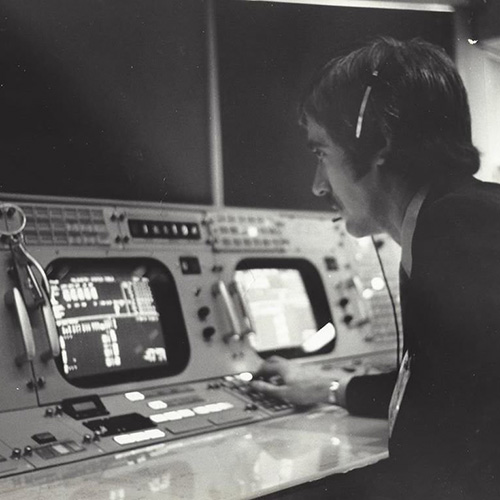
Birthday: 1939
Hometown: Golden, Mississippi
Mission Control Position: FIDO/Retro
https://missioncontrol.movie/cast---flight-controllersNASA legend and flight dynamics officer passes away
Emily Carney 11 godz.
A NASA legend has left us. Jerry Bostick, one of the iconic retrofire officers and flight dynamics officers during the Mercury, Gemini, Apollo, and Skylab programs, died this morning at the age of 86.
Bostick grew up in Golden, Mississippi, and earned a civil engineering degree from Mississippi State University before joining the fledgling NASA in 1962, as the Mercury program was underway. By December 1968, 57 years ago this week, the space agency took its most significant risk yet – the circumlunar Apollo 8 mission, crewed by astronauts Frank Borman, Jim Lovell, and William Anders. A crewed lunar mission was brand new territory for the space program, and no one was perhaps more aware of that than Bostick. In a 2000 Johnson Space Center oral history, he related, “Yes, I remember probably as much or more about Apollo 8 as any other mission, just because it left such a lasting impression on me...Translunar injection is kind of like duck hunting. You don't shoot at the duck; you shoot way out in front and let the duck fly into it. So we're aiming at this point up in the sky, and we're depending on things we've never done before, tracking data, computing maneuvers, relaying the information to the crew, loading it in their computers, and doing all this. A lot of miracles and magical things, almost, have to fall into place to make it all successful.”
This “duck hunt” was wholly successful in no small part thanks to Bostick, and by Christmas Eve 1968, television audiences worldwide experienced an entirely new world for the first time, as seen by humans. While Bostick himself was not on console during Apollo 11, the first crewed lunar landing and “moonwalk,” he was still in Mission Control supervising his team. “...I have to admit that during the descent, and I was not on console at the time, I was there as a supervisor for all my guys who were doing it, as an observer. I think every team that ever worked in the control center was there for the descent, and at least every astronaut who ever flew or wanted to fly...That has to go down in one's mind also as a fairly good day,” he stated, with considerable understatement.
The unexpected drama of April 1970’s Apollo 13 challenged Bostick like nothing else prior. “Well, from a flight controller's standpoint, Apollo 13 was probably the most at the same time frustrating and satisfying mission that we ever flew. By that I mean it was a disaster that we had to overcome, but we overcame it, and that's why it was satisfying and rewarding. More than any other mission, it put the flight control team to a test, and it wasn't a systems test or a trajectory test or a communications test, it tested everybody in the control center, and we pulled it off. Talk about something impossible.” He added, “...[Apollo 13] was probably the greatest example of teamwork that I've seen in my life. All of the systems guys, the LM and the CSM guys and the trajectory guys are all working hand in hand in an extremely well-integrated fashion to make it all come out. It was give and take the whole time.”
Bostick also served as a technical adviser for the 1995 blockbuster Apollo 13 starring Tom Hanks, Bill Paxton, and Kevin Bacon, and was responsible for coming up with the iconic “Failure is not an option” line said by the film’s Gene Kranz, played by Ed Harris. In a Magnolia State Live article, Bostick discussed how this popular catchphrase was born:
“As far as the expression ‘Failure is not an option,’ you are correct that Kranz never used that term. In preparation for the movie, the script writers, Al Reinert and Bill Broyles, came down to Clear Lake [Texas] to interview me on ‘What are the people in Mission Control really like?’ One of their questions was ‘Weren’t there times when everybody, or at least a few people, just panicked?’ My answer was ‘No, when bad things happened, we just calmly laid out all the options, and failure was not one of them. We never panicked, and we never gave up on finding a solution.’...Only months later did I learn that when they got in their car to leave, he started screaming, ‘That’s it! That’s the tagline for the whole movie, Failure is not an option. Now we just have to figure out who to have say it.’”
By 1973, the Apollo lunar missions had wrapped up, and Skylab was underway, which was not as exciting for Bostick: “Skylab, although an interesting program, for me especially, I think, and most of the flight controllers, was not that exciting. It was pretty boring. In fact, that's what we were doing, was boring holes in the sky, just going around and around in Earth orbit. So it made me think about what I wanted to do for the rest of my life.” Bostick moved on to management roles within NASA until his 1984 retirement; he then worked at Grumman Aerospace, which also boasted leadership such as Apollo 13’s Fred Haise.
Bostick also figured prominently in the 2017 documentary Mission Control: The Unsung Heroes of Apollo, based on the book Go, Flight!: The Unsung Heroes of Mission Control, 1965–1992 by Rick Houston and Milt Heflin, part of the acclaimed Outward Odyssey series published by the University of Nebraska. He was a fixture at many space events, including ones at the Kansas Cosmosphere and Spacefest in Tucson, Arizona, where he regaled space enthusiasts with stories about his time as FIDO.
Space Hipsters sends its deepest condolences to Bostick’s family, friends, and former colleagues, and we will especially remember his incredible career during this year’s Apollo 8 celebrations, and beyond. We will miss our Space Hipster friend.
Photo credits: InspireSPACE, Lois Huneycutt, and Burke Burnett
https://www.facebook.com/groups/spacehipsters/posts/25719790400972500/The Scene Vault Podcast @TheSceneVault 3:36 AM · Dec 22, 2025
Jerry Bostick, one of the best friends and wise mentors I’ve ever known, died this morning in his beloved Texas hill country.
Jerry was chief of NASA’s Flight Dynamics Branch, the section in mission control that determined spacecraft trajectory. He was a constant source of help and encouragement during work on the book and documentary.
His induction of me as an honorary member of The Trench is THE greatest achievement of my professional life.
One of my fondest memories of Jerry was sitting in his downtown Dallas hotel suite during a tornado warning, sirens blaring outside, me with one eye on my Weather Channel app and the other on the room’s large plate-glass windows and him holding court as he always did, with nary a care in the world.
Steely-eyed missile man? You bet your sweet a** he was. (Sorry … that’s a NASA thing.)
And … yeah. He was a NASCAR fan. He considered driving a race car the number-one item on his bucket list, and when he and his men’s group from church did one of the schools at Texas Motor Speedway, he talked about the experience like a giddy teenager.
I loved that man. I always will.
https://x.com/TheSceneVault/status/2002931146976342340Keith Haviland @KeithHaviland 17:19 · 22 grudnia 2025
Sad news. Jerry Bostick, one of the greats of Apollo-era Mission Control has passed away. He was enormously helpful to our Mission Control film. A warm and generous soul and a great American. Love and blessings to his family and friends.
https://twitter.com/KeithHaviland/status/2003138233685975315ORAL HISTORY TRANSCRIPT
JERRY C. BOSTICK INTERVIEWED BY CAROL BUTLER MARBLE FALLS, TEXAS – 23 FEBRUARY 2000
https://www.nasa.gov/wp-content/uploads/2025/07/bostickjc-2-23-00.pdfORAL HISTORY 2 TRANSCRIPT
JERRY C. BOSTICK INTERVIEWED BY CAROL BUTLER HOUSTON, TEXAS – 24 JUNE 2000
https://www.nasa.gov/wp-content/uploads/2025/07/bostickjc-6-24-00.pdfhttps://en.wikipedia.org/wiki/Failure_is_not_an_option
 Wątek: Osobistości - wątek zbiorczy (Przeczytany 195061 razy)