Autor Wątek: [SpaceNews] NASA delays SpaceX commercial crew test flight to February  (Przeczytany 24365 razy)

0 użytkowników i 1 Gość przegląda ten wątek.

Online Orionid

  • Weteran
  • *****
  • Wiadomości: 28849
  • Very easy - Harrison Schmitt
Odp: [SpaceNews] NASA delays SpaceX commercial crew test flight to February
« Odpowiedź #30 dnia: Lutego 25, 2020, 17:21 »
NASA preparing for long-duration SpaceX commercial crew test flight
by Jeff Foust — February 24, 2020 [SN]


The crewed test flight of SpaceX's Crew Dragon spacecraft increasingly appears will be a long-duration mission in order to bolster the station's crew. Credit: NASA

WASHINGTON — NASA is leaning increasingly towards making SpaceX’s crewed test flight to the International Space Station a long-duration mission, a move that could alleviate concerns about a lack of crew on the station later this year.

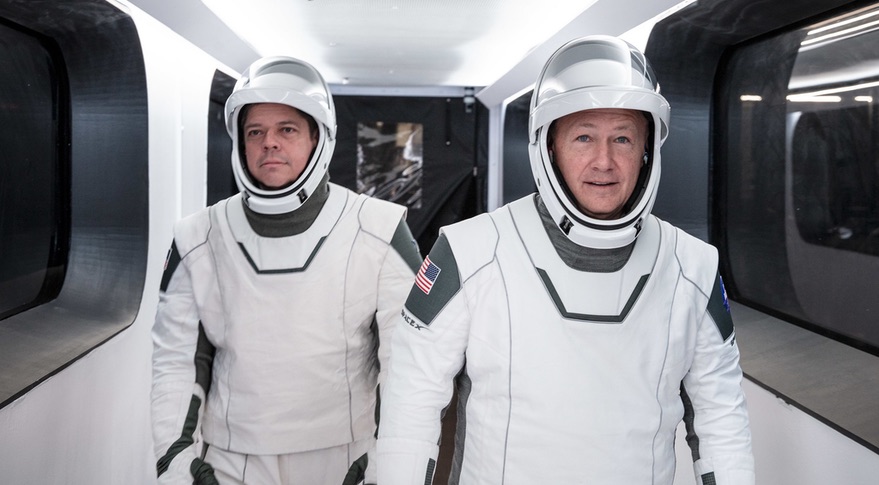
NASA’s Johnson Space Center released Feb. 22 images of NASA astronauts Bob Behnken and Doug Hurley training for their upcoming Demo-2 mission to the station on SpaceX’s Crew Dragon spacecraft. That included Behnken in a spacesuit, training for spacewalks in the center’s Neutral Buoyancy Laboratory, while Hurley worked on robotics training.


Cytuj
Johnson Space Center@NASA_Johnson 7:00 PM - Feb 22, 2020
The big day is on the way: We're launching astronauts to space from American soil once again. @Astro_Doug Hurley & @AstroBehnken continued @space_station & spacewalk training this week for their upcoming flight on NASA's @SpaceX DM-2 @Commercial_Crew mission. 🚀 #LaunchAmerica
View image on TwitterView image on TwitterView image on TwitterView image on Twitter
Twitter

“The last week NASA Johnson included EVA and robotics training as well as medical testing and training,” said Hurley in a tweet referencing one from JSC. “We also had a day of SpaceX lessons here in Houston. Headed back to California next week. More Crew Dragon training!”

The original plans for the Demo-2, also known as DM-2, mission called for the flight to be a relatively short one, spending no more than a couple weeks at the station. In recent months, though, agency officials have suggested that they might extend the mission for months in order to have more astronauts on the station. The station’s crew will be at just three people, including one NASA astronaut, Chris Cassidy, starting in roughly mid-April.

“We might look at making that first crew be a longer duration crew for the purpose of getting the maximum amount of capability out of the International Space Station,” NASA Administrator Jim Bridenstine said at a Jan. 19 press conference after the successful in-flight abort test of the Crew Dragon spacecraft.

In order to extend it, he said, the crew would need additional training, such as for spacewalks. “It also gives us the opportunities to do extravehicular activities that may not right now be scheduled but may pop up based on things that happen on the ISS,” he said. “It’s always better to have more crew on board to do those activities rather than less.”

Bridenstine added that no decision had been made yet, and that a decision would come in several weeks. The spacewalk training by Behnken — who performed six spacewalks on two space shuttle missions in 2008 and 2010 — is evidence that NASA is, at the very least, continuing to preserve that option, if it has not made a decision.

One former astronaut said he believes NASA has already decided to extend the Demo-2 mission. Garrett Reisman, a former astronaut and SpaceX employee who is now a professor at the University of Southern California and an advisor to SpaceX, said Feb. 23 that Behnken and Hurley “are being trained for a long-duration mission as ISS crewmembers. This is a change from the original plan to do a min. duration test flight, driven by NASA needs to staff the ISS.”

Another factor in any decision to extend Demo-2 is the status of the other commercial crew vehicle, Boeing’s CST-100 Starliner. That vehicle flew an uncrewed test flight in December, but software problems during the flight, including one which shortened the mission and prevented a docking with the ISS, have raised questions about whether a second uncrewed test flight will be needed. An investigation into those problems is expected by the end of this month.

Even if NASA decides a second uncrewed test flight of Starliner is not needed, a review of all of the spacecraft’s one million lines of code, and other reviews, is likely to delay a crewed test flight of the spacecraft. NASA and Boeing had previously agreed to make that test flight a long-duration mission, with NASA astronauts Mike Fincke and Nicole Mann and Boeing astronaut Chris Ferguson performing space station training in addition to that for the Starliner itself.

The additional training needed for a long-duration mission could delay the Demo-2 launch, although it’s not clear by how much. SpaceX Chief Executive Elon Musk said at that January press conference that while the spacecraft should be ready in the first quarter, final reviews and other assessments made it likely the mission would take place in the second quarter of this year. The Crew Dragon spacecraft arrived in Florida earlier this month for final tests and launch integration activities.

“Like all NASA astronauts, we’ll be ready for whatever Space Station needs during our visit,” Behnken tweeted Feb. 23 in response to the JSC training photos. “These photos are just some of the recent training for NASA’s & SpaceX’s DM2 test flight. But for some reason, housekeeping (our top skill!) didn’t make the highlights…”


Source: https://spacenews.com/nasa-preparing-for-long-duration-spacex-commercial-crew-test-flight/

Online Orionid

  • Weteran
  • *****
  • Wiadomości: 28849
  • Very easy - Harrison Schmitt
Odp: [SpaceNews] NASA delays SpaceX commercial crew test flight to February
« Odpowiedź #31 dnia: Marca 21, 2020, 19:08 »
NASA targets May for Crew Dragon test flight
by Jeff Foust — March 19, 2020 [SN]


NASA astronauts Bob Behnken (left) and Doug Hurley will fly on the Demo-2 mission to the ISS that NASA is currently scheduling for no earlier than mid-to-late May. Credit: SpaceX

WASHINGTON — NASA announced March 18 it plans to perform a crewed flight of SpaceX’s Crew Dragon spacecraft, with two NASA astronauts on board, as soon as the latter half of May.

In a media advisory, NASA said the launch of the Demo-2 mission was scheduled for no earlier than mid-to-late May on a Falcon 9 rocket from the Kennedy Space Center in Florida. While that date is subject to change, the fact that NASA is starting the media accreditation process indicates some degree of confidence in that timeframe.

Before the announcement, there were signs that NASA would attempt a launch around that time. SpaceX Chief Executive Elon Musk said after a successful in-flight abort test in January that he believed the company would be ready to fly the mission in the second quarter of the year, or between April and June.

At a press conference before a cargo Dragon mission launched to the International Space Station March 6, Hans Koenigsmann, vice president of build and flight reliability for SpaceX, said the company at the time had two more parachute tests to perform that would test “corner cases” that put specific stresses on the parachute system. SpaceX had run into problems with past parachute designs, forcing the development of a new, stronger parachute system that started test last fall. “We have an enormously large test series behind us,” he said, calling it “very successful.”

During a panel discussion at the Satellite 2020 conference here March 10, Gwynne Shotwell, president of SpaceX, said the company was “gunning for May” for the Demo-2 mission. She added, though, that both the company and NASA still had work to complete prior to the mission.

On the Demo-2 mission, NASA astronauts Bob Behnken and Doug Hurley will fly the Crew Dragon spacecraft to the ISS, remaining there for at least several days before returning to Earth. While there have been discussions of extending the Demo-2 mission for weeks or months to address a shortfall in the station’s crew size, the announcement did not state how long NASA expected the mission to last.

Two other issues could affect planning for the mission. One of nine Merlin engines on a Falcon 9 that launched March 18 shut down prematurely, a problem that appeared to lead to the failure of the booster to land on a droneship in the Atlantic Ocean. The problem did not prevent the payload, a set of 60 Starlink satellites, from reaching orbit.

Musk tweeted after the launch that a “thorough investigation” of the problem would take place before the next launch, suggesting delays that could have ripple effects on the company’s manifest. However, while the engine failure took place on a booster making its fifth flight, a record for the company, the Demo-2 mission will use a new Falcon 9 first stage.

Another issue is effects on NASA operations caused by the coronavirus pandemic. KSC, like the rest of the agency’s field centers, is requiring mandatory telework for all but mission-essential employees for the foreseeable future. At the Ames Research Center in California, even mission-essential personnel are barred from accessing the center, with only safety and security personnel present to comply with a “shelter in place” order by the local government.

“NASA is proactively monitoring the coronavirus (COVID-19) situation as it evolves,” the agency said in a media advisory about the upcoming launch. “The agency will continue to follow guidance from the Centers for Disease Control and Prevention and the agency’s chief health and medical officer and communicate any updates that may impact mission planning or media access, as they become available.”


Source: https://spacenews.com/nasa-targets-may-for-crew-dragon-test-flight/

Crew training continues for SpaceX’s first launch with astronauts
April 3, 2020 Stephen Clark [SFN]


NASA astronauts Bob Behnken and Doug Hurley inside the Crew Dragon spaceship they will ride into orbit as soon as mid-to-late May. Credit: SpaceX

During a visit to Cape Canaveral this week, NASA astronauts Doug Hurley and Bob Behnken strapped in to the SpaceX crew capsule they will ride into orbit as soon as mid-to-late May. Next week, the astronauts will be in Houston to continue training for an extended stay on the International Space Station that could last two-to-three months.
https://spaceflightnow.com/2020/04/03/crew-training-continues-for-spacexs-first-launch-with-astronauts/

Photos: Astronauts train to ride a Dragon into space
April 3, 2020 Stephen Clark [SFN]


NASA astronauts Doug Hurley (foreground) and Bob Behnken (background) participate in a two-day flight simulation. The astronauts are inside a SpaceX flight simulator in this photo. Credit: SpaceX

Doug Hurley and Bob Behnken, two veteran space shuttle fliers, are gearing up to fly a privately-developed SpaceX Dragon capsule into orbit this year.

The two astronauts participated in several major training events in March, including long-duration simulations to rehearse procedures they will execute during launch on top of a Falcon 9 rocket, their docking with the International Space Station, and then departure from the orbiting lab for return to Earth.
https://spaceflightnow.com/2020/04/03/photos-astronauts-train-to-ride-a-dragon-into-space/

Video: Astronauts participate in Crew Dragon launch day dress rehearsal
April 3, 2020 Stephen Clark [SFN]


NASA astronauts Doug Hurley and Bob Behnken, assigned to fly SpaceX’s Crew Dragon spacecraft on its first piloted mission into orbit, participated in a dress rehearsal of their suit-up procedures and a trip to launch pad 39A at NASA’s Kennedy Space Center in Florida on Jan. 17, 2020.
https://spaceflightnow.com/2020/04/03/video-astronauts-participate-in-crew-dragon-launch-day-dress-rehearsal/
« Ostatnia zmiana: Maja 31, 2022, 16:25 wysłana przez Orionid »

Online Orionid

  • Weteran
  • *****
  • Wiadomości: 28849
  • Very easy - Harrison Schmitt
Odp: [SpaceNews] NASA delays SpaceX commercial crew test flight to February
« Odpowiedź #32 dnia: Kwietnia 14, 2020, 13:13 »
Bridenstine says Crew Dragon could launch with astronauts at end of May
April 13, 2020 Stephen Clark [SFN]


NASA Administrator Jim Bridenstine speaks at a bipartisan Congressional Caucus for Women’s Issues event in September 2019. Credit: NASA/Aubrey Gemignani

NASA Administrator Jim Bridenstine says he is “fairly confident” that astronauts can fly to the International Space Station aboard SpaceX’s Crew Dragon spaceship at the end of May or early June, pending final parachute tests, data reviews and a training schedule that can escape major impacts from the coronavirus pandemic.

An investigation into an engine failure on the most recent launch of SpaceX’s Falcon 9 rocket — the same design that will launch the Crew Dragon astronauts — is also expected to be completed in short order, Bridenstine said.

“I think we’re really good shape,” Bridenstine said in an interview Thursday. “I’m fairly confident that we can launch at the end of May. If we do slip, it’ll probably be into June. It won’t be much.”

NASA astronauts Doug Hurley and Bob Behnken are training for the Crew Dragon test flight, which will be the first mission to launch astronauts into Earth orbit from U.S. soil since the retirement of the space shuttle in July 2011. The astronauts will take off from pad 39A at NASA’s Kennedy Space Center and dock with the space station a day or two later.

Hurley and Behnken are expected to live and work aboard the space station for two or three months, then return to Earth for a splashdown in the Atlantic Ocean east of Cape Canaveral.

SpaceX and Boeing won multibillion-dollar NASA commercial crew contracts to develop human-rated spaceships in 2014, following several years of preliminary development and testing. SpaceX is ahead of Boeing, and the crew capsule for the upcoming test flight — designated Demo-2 — is currently at Cape Canaveral undergoing pre-launch processing and testing.

NASA is paying SpaceX more than $3.1 billion for the Crew Dragon development program, plus six operational crew rotation flights to the space station following the Demo-2 mission.

SpaceX’s Crew Dragon and Boeing’s Starliner capsule will give NASA a U.S.-built ship to ferry crews to and from the station, ending the space agency’s reliance on Russian Soyuz spacecraft for crew transportation.

Hurley and Behnken continue preparing for the Demo-2 mission despite the coronavirus pandemic, which is affecting other government and industry sectors. Personnel working on some NASA missions are working remotely, but Bridenstine said the agency’s Commercial Crew Program and the Mars Perseverance rover remain top priorities, and physical preparations continue for launches in the coming months.

While the Crew Dragon’s first piloted test flight is set for launch from the Kennedy Space Center around the end of May, the Perseverance rover is scheduled for liftoff on a United Launch Alliance Atlas 5 rocket during a planetary launch period that opens July 17.

As of late last week, no personnel working on NASA’s Commercial Crew Program had tested positive for the coronavirus, Bridenstine said.

“Number one, the people that are working on commercial crew right now are practicing social distancing and (wearing) personal protective equipment,” Bridenstine said. “We’ve moved and changed shifts so that fewer people are in the room when you have to have multiple people in the same room. So we’ve done a lot of those things to make sure that you’re as safe as possible working on these missions.

“We’ve also said, if people don’t feel safe, they don’t have to work on the mission,” he told Spaceflight Now in an interview. “I’ve been very clear with all of the agency leaders that nobody should feel pressure to do work if they don’t feel safe. And as leaders, we need to make sure that if somebody does bring up the fact that they don’t feel safe, we need to give them some other work to do, where they do feel safe, and then make adjustments.”

NASA has drawn up contingency plans if a commercial crew worker tests positive. In that event, the agency plans to use contact tracing to determine who was in close proximity to the infected employee.

“If there is a positive case on commercial crew, depending on where it is and how the person is doing the work, it may or may not impact the mission,” Bridenstine said. “If it’s somebody who is largely teleworking, it might not impact the mission at all. If it’s somebody who is very rare contact with other people, on the mission, then we might have to do some tracing.

“What we’re trying to do is we’re trying to mitigate the fact that if there is a case, that we can quickly identify the people that that person was in contact with, and do the tracing and get all the people that were that were involved off the mission and replace them with other people.

“If there’s an outbreak, yeah, it will affect the date. But we’re doing everything we can to minimize that eventuality,” Bridenstine said.


A Crew Dragon parachute drop test conducted in December 2019 with a mass simulator. Credit: SpaceX

Other work remaining before the Crew Dragon Demo-2 launch involves final testing of the capsule’s parachutes and technical reviews of the readiness of the ship’s launch abort system, Bridenstine said.

During SpaceX’s most recent parachute test last month, the test rig was dropped from a helicopter prematurely after the craft became unstable over a test site in Nevada. NASA officials said the parachutes were not to blame for the botched test, and the helicopter pilot decided to release the test rig for safety reasons.

“It got unstable,” Bridenstine said. “The pilot dropped the test article, which was basically just a weight simulator. Nothing from that was recoverable, including the parachutes that were on-board. So we’ve got two more parachute tests, and now they’re going to be done out of the C-130 (cargo plane) instead of from a helicopter. We’ve got agreement from the chief engineer and the program manager, and the astronaut office, that those two parachute tests that we have remaining are good to go out of the C-130.”

The first of the two remaining parachute tests was expected to occur as soon as Easter weekend. During that drop test, SpaceX intended to rig the craft to only deploy one of its two drogue parachutes, then unfurl just three of the Dragon’s four main chutes. The test would allow engineers to assess the performance of the parachute system in the event of a double failure.

“After that, we’ll be doing another full test with two drogue chutes and four main chutes,” Bridenstine said. “And once we’re complete with those two tests, we’ll be confident in the parachute system. I think we’re pretty much confident in the parachute system right now. We just want to get more data.”

NASA is also evaluating data from testing on the Crew Dragon’s modified launch abort propulsion system, which would be activated to push a crew capsule away from a failing rocket, either on the launch pad or in flight.

A faulty valve inside the high-pressure propulsion system caused nitrogen tetroxide oxidizer to leak into the abort system’s helium pressurization plumbing before a ground test-firing of the abort engines last April. When SpaceX tried to test-fire the SuperDraco abort engines on a test stand at Cape Canaveral, the nitrogen tetroxide was pushed back into the titanium valve, causing an explosion that destroyed the spacecraft.

“We’re replacing all of that titanium with with another metal that isn’t going to be as combustible,” he said. “That’s taken a little bit of time, but we’re moving along very rapidly on that at this point, and we’ve done all the testing out at White Sands (in New Mexico) on that. I feel very confident that that’s that’s going to be OK.”

The design changes in the abort system were successfully tested during a high-altitude launch abort demonstration in January, when SpaceX activated the SuperDraco engines on a Crew Dragon capsule more than a minute after launch on a Falcon 9 rocket.

NASA is also reviewing the failure of a Merlin engine on SpaceX’s most recent Falcon 9 launch last month. One of the Falcon 9 first stage’s nine Merlin engines shut down prematurely, but the rocket was able to overcome the engine problem and deliver the mission’s 60 Starlink satellite payloads into their planned orbit.

“We’ve been doing some root cause on what caused that engine to fail … and what I’ve been told is that they’ve got a really good understanding of what that failure was, and it’s not going to impact our commercial crew launch,” Bridenstine said.

The reusable Falcon 9 booster on the most recent launch was flying for the fifth time. SpaceX is launching the Demo-2 mission on a brand new Falcon 9 rocket.


NASA astronauts Doug Hurley (foreground) and Bob Behnken (background) participate in a two-day flight simulation in March 2019. The astronauts are inside a SpaceX flight simulator in this photo. Credit: SpaceX

Assuming the Demo-2 launch remains on track for late May, NASA and SpaceX will convene a series of data reviews in the coming weeks, culminating in a flight readiness review next month.

Once the Crew Dragon is connected with its Falcon 9 launcher, SpaceX will roll the rocket to pad 39A for a test-firing of its Merlin main engines. Ground teams and the Demo-2 astronauts will also complete final rehearsals and training before the launch.

Hurley, the Crew Dragon’s vehicle commander, will strap in to the left seat inside the spaceship. Behnken, the mission’s pilot, will sit in the right seat during launch.

The two-man crew will ride the Crew Dragon capsule on a trajectory northeast from Cape Canaveral over the Atlantic Ocean. After entering orbit around 10 minutes later, the Crew Dragon will perform a series of pre-planned demonstration maneuvers under the guidance of the astronauts and ground controllers at SpaceX’s headquarters in Hawthorne, California.

The Crew Dragon will approach the space station for an automated docking within a day or two of launch, and Hurley and Behnken will open hatches to enter the station to join commander Chris Cassidy and Russian cosmonauts Anatoly Ivanishin and Ivan Vagner.

The arrival of the Crew Dragon will raise the station’s crew size from three to five for several months.

“Bob Behnken and Doug Hurley will go up as not just demonstration pilots for Demo-2, but they would actually become crew on-board the International Space Station for a period of months to do work, and they would continue to operate on the ISS,” Bridenstine said. “And then when we’re ready with the next Crew Dragon, they’ll come home.

“We will do a full evaluation of the Demo-2 Crew Dragon, so we’ll be on Earth for about a month with the Demo-2 Crew Dragon just doing inspections and evaluations and making sure that it’s safe, and then when we make sure that it operated how we expected it to operate, we’ll be ready to launch right into crewed missions for normal operations.”

The Demo-2 mission was originally scheduled to last a couple of weeks, but NASA is extending the flight’s duration to give the space station additional crew members.

The station is typically staffed with a six-person crew, and that will increase to seven people once SpaceX and Boeing spaceships are regularly flying to the orbiting research lab.

But the commercial crew capsules are running years behind schedule, and NASA’s current contract with Roscosmos — the Russian space agency — to purchase Soyuz seats for U.S. astronauts expires this year. That will leave the station with a crew of three until the Crew Dragon arrives.

Cassidy, who launched April 9, is the final NASA astronaut with a confirmed ride to and from the station on a Russian Soyuz spacecraft. He is scheduled to return to Earth in October.

NASA is negotiating with Roscosmos at least one additional Soyuz seat on the next Russian crew launch in October. Bridenstine said Thursday those negotiations are continuing.

Bridenstine said the second piloted Crew Dragon mission — and the first operational crew rotation flight to use the SpaceX capsule — could launch in August or September, assuming the Demo-2 mission takes off in late May or early June.

Meanwhile, NASA’s other commercial crew contractor may not launch astronauts until 2021.

Boeing said earlier this month that its Starliner crew capsule will launch on a second unpiloted test flight later this year. The Starliner’s first space mission, called the Orbital Flight Test, encountered major problems after launch, preventing the ship from docking from the space station as planned.

The Crew Dragon completed a successful unpiloted flight to and from the space station in March 2019.


Source: https://spaceflightnow.com/2020/04/13/bridenstine-says-crew-dragon-could-launch-with-astronauts-at-end-of-may/

Online Orionid

  • Weteran
  • *****
  • Wiadomości: 28849
  • Very easy - Harrison Schmitt
Odp: [SpaceNews] NASA delays SpaceX commercial crew test flight to February
« Odpowiedź #33 dnia: Kwietnia 23, 2020, 18:02 »
NASA sets May 27 launch date for SpaceX commercial crew test flight
by Jeff Foust — April 17, 2020


The SpaceX Falcon 9 rocket that will launch the Demo-2 commercial crew mission being prepared for a launch now scheduled for May 27. Credit: SpaceX

WASHINGTON — NASA announced April 17 that it has set a May 27 launch date for a SpaceX commercial crew test flight that will be the first mission to launch NASA astronauts to orbit from the United States in nearly a decade.

NASA Administrator Jim Bridenstine announced the launch date in a tweet, saying that NASA “will once again launch American astronauts on American rockets from American soil.” The agency had previously stated it anticipated a launch in mid-to-late May, but had not given a specific date before this announcement.

The May 27 launch, which would take place at 4:32 p.m. Eastern from Launch Complex 39A at the Kennedy Space Center, will place a Crew Dragon spacecraft into orbit with NASA astronauts Bob Behnken and Doug Hurley into orbit. The spacecraft will dock with the International Space Station less than 24 hours later for what NASA calls an “extended stay” there. The exact length of the mission has yet to be determined, the agency stated.

Hurley will serve as “spacecraft commander” for the mission, designated Demo-2. He will be responsible for launch, landing and recovery activities. Behnken will be the “joint operations commander” for the mission, responsible for rendezvous, docking and undocking, as well as activities while the spacecraft is docked to the station.

SpaceX has been wrapping up parachute testing despite an incident in a March 24 test where a test article had to be released early from a helicopter. The parachute system was not armed at the time of the release and thus did not deploy. The test article was destroyed on impact with the ground.

SpaceX noted in an April 17 statement that, despite this incident, it had completed 26 tests of the new Mark 3 parachute system to date, including during the in-flight abort test of a Crew Dragon spacecraft in January. Industry sources say at least one more parachute test is scheduled before the Demo-2 launch.

Behnken and Hurley have been completing training for the mission, such as a series of simulations from launch to docking as well as undocking and preparations for re-entry and splashdown. They have also been training for ISS operations, given that their mission, which originally was to spend only a couple weeks at the ISS, will now likely last for two to three months.

The launch is touted as the first flight of American astronauts from American soil since the final space shuttle mission, STS-135, in July 2011. However, it is only the first orbital crewed flight from the United States since the end of the shuttle program. Virgin Galactic’s SpaceShipTwo flew two suborbital flights, in December 2018 and February 2019, that went beyond the altitude of 50 miles (approximately 80 kilometers) used by U.S. government agencies for awarding astronaut wings. The five Virgin Galactic employees who were on those flights late received commercial astronaut wings from the Federal Aviation Administration.


Source: https://spacenews.com/nasa-sets-may-27-launch-date-for-spacex-commercial-crew-test-flight/

Polskie Forum Astronautyczne

Odp: [SpaceNews] NASA delays SpaceX commercial crew test flight to February
« Odpowiedź #33 dnia: Kwietnia 23, 2020, 18:02 »

Online Orionid

  • Weteran
  • *****
  • Wiadomości: 28849
  • Very easy - Harrison Schmitt
Odp: [SpaceNews] NASA delays SpaceX commercial crew test flight to February
« Odpowiedź #34 dnia: Kwietnia 25, 2020, 16:44 »
Citing coronavirus, NASA urges public not to travel for launch of astronauts
April 24, 2020 Stephen Clark [SFN]


NASA Administrator Jim Bridenstine speaks during a presentation in November 2018 at NASA Headquarters announcing the companies that will compete for the agency’s Commercial Lunar Payload Services program. Credit: NASA/Bill Ingalls

NASA Administrator Jim Bridenstine on Thursday urged space enthusiasts not to travel to the Kennedy Space Center next month to view the first launch of astronauts from the Florida spaceport since 2011, and asked people to instead watch the launch on television or online.

Preparations for the launch of SpaceX’s Crew Dragon spacecraft continue on pace for liftoff May 27. NASA astronauts Doug Hurley and Bob Behnken will be strapped into seats inside the commercial spaceship when it takes off on top of a SpaceX Falcon 9 rocket.

The launch is the culmination of a decade-long, multibillion-dollar effort by SpaceX and NASA to design, develop and test the Crew Dragon spacecraft. It will be the first time astronauts launch into orbit from U.S. soil since the retirement of the space shuttle, making next month’s launch perhaps the most highly-anticipated space mission in years to depart the Kennedy Space Center.

The crew launch is a high priority for NASA, and astronaut training, readiness reviews, and hands-on processing of the crew capsule and rocket continue amid the coronavirus pandemic, even as other agency programs encounter delays due to restrictions ordered to slow the spread of the viral disease.

“We are very excited about launching commercial crew here on May 27, this will be the first time we’ve launched American astronauts on American rockets from American soil since the retirement of the space shuttles back in 2011,” Bridenstine said Thursday. “So this is a this is a big deal for the country, it’s important for the country. This is our access to the International Space Station, which is a $100 billion investment by the American taxpayer. So we need to make sure that we have access to the International Space Station.”

But the long-awaited launch will have a different feel than anticipated. Citing concerns related to the coronavirus pandemic, NASA is expected to limit the number of news media representatives allowed to cover the launch at the Kennedy Space Center, and Bridenstine urged space enthusiasts not to flock to the Florida spaceport to watch the launch in person.

“Yes, we are moving forward. It is a mission essential function for the United States government to launch commercial crew on May 27,” Bridenstine said.

Hundreds of thousands of people flocked to Florida’s Space Coast to watch the liftoff of the final space shuttle mission in July 2011, the last time astronauts launched into orbit from U.S. soil.


Crowds gather on a bridge in Titusville, just outside the gates of the Kennedy Space Center, to view the final launch of the space shuttle program in July 2011. Credit: NASA

“We’re asking people to join us in this launch, but to do so from home,” he said. “We’re asking people not to travel to the Kennedy Space Center … When we launch to space from the Kennedy Space Center, it draws huge, huge crowds, and that is not right now what we’re trying to do. We’re trying to make sure we have access to the International Space Station, without drawing the massive amount of crowds that we usually would for these activities.

“It’s especially important now because we haven’t done this since 2011, so the crowds are probably going to be bigger than they have been in a very long time,” Bridenstine said Thursday. “We’re asking people to stay at home, to watch from home. We want them engaged. We want them to participate. We want them to tell their friends and family, but we also want them to watch from a place that’s not the Kennedy Space Center.”

NASA has contracts with SpaceX and Boeing to develop new human-rated crew capsules to ferry astronauts to and from the space station. The privately-owned Crew Dragon and Starliner spaceships will end NASA’s sole reliance on Russian Soyuz vehicles to transport station crews.

Any restrictions on viewing the launch from locations off NASA property would fall to state and local authorities, Bridenstine said.

“We’re not going to open up the Kennedy Space Center to the public the way we normally would,” he said. “As far as the beaches and the areas around the Kennedy Space Center, those are public roads. We’re going to follow the protocols of the past, how we do crowd control around big launches.”


The Crew Dragon spacecraft for the Demo-2 mission is at Cape Canaveral being readied for launch. Credit: SpaceX

Employees from SpaceX, NASA and other contractors involved in the Crew Dragon launch preparations are maintaining physical distancing as much as possible, Bridenstine said.

“We have modified shift schedules,” he said. “So instead of having 12 people work on on a rocket all at the same time, we separate them out to where we’ve got four working for eight hours, a different four working for the next eight hours, and a different four working for the eight hours after that. So we’re dividing things up by shifts.

“We’re also making sure people that are in close proximity have the right personal protective equipment,” he said.

“When we think about mission control, when we launch to space, there’s a lot of people in the mission control facilities,” Bridenstine said. “We need to make sure that we are separating people as much as possible using different rooms, and in fact those rooms where people are going to be located, maybe having Plexiglas between the different stations.

“So we’re looking at all the things where we can practice the guidelines for social distancing and at the same time, launch this very important mission to the International Space Station,” he said.

Hurley and Behnken are will begin a quarantine protocol a couple of weeks before launch on the Crew Dragon’s Demo-2 mission in late May. During that time, the astronauts will only be around people with medical clearance.

The astronauts will spend several months on the space station before returning to a splashdown in the Atlantic Ocean inside the Crew Dragon spacecraft. If everything goes according to plan, NASA officials after the Demo-2 mission’s return will officially certify the Crew Dragon spaceship for regular crew rotation flights to the space station.

“I’ve stressed it over and over again to our entire workforce and our leadership teams, if there’s anybody who feels uncomfortable working on this project, they need to say something,” Bridenstine said. “We will find something else for them to do where they could work from home or they can do other things. The last thing we want to do is make anybody feel uncomfortable working on these projects, and there will be absolutely no retribution if people do want to move on to something else.

“That being said … this is a very exciting project and the NASA workforce is very excited about it,” he said. “So we’re doing everything we can to, to make sure that we’re safe as we go forward.”


Source: https://spaceflightnow.com/2020/04/24/citing-coronavirus-concerns-nasa-discourages-public-from-attending-launch-of-astronauts/

Online Orionid

  • Weteran
  • *****
  • Wiadomości: 28849
  • Very easy - Harrison Schmitt
Odp: [SpaceNews] NASA delays SpaceX commercial crew test flight to February
« Odpowiedź #35 dnia: Maja 04, 2020, 09:52 »
SpaceX aces last Dragon parachute test before crew launch
May 3, 2020 Stephen Clark [SFN]


A Crew Dragon mass simulator descends under four main parachutes during a drop test Friday. Credit: SpaceX

SpaceX completed Friday the last drop test of the Dragon crew capsule’s parachutes before the first launch of astronauts on the human-rated ship May 27, while technicians at Cape Canaveral have mated the spacecraft’s crew module with its unpressurized trunk section.

The drop test from a C-130 cargo plane Friday was the 27th and final test of the “Mark 3” parachute design SpaceX will use for the Crew Dragon spacecraft. Drogue parachutes and then four main chutes unfurled from a test vehicle designed to mimic the Crew Dragon’s weight during return to Earth.

SpaceX said in a tweet that the parachute test moves the Crew Dragon “one step closer” to flying NASA astronauts Bob Behnken and Doug Hurley to the International Space Station, “and safely returning them back to Earth.

Meanwhile, SpaceX’s Dragon processing team at Cape Canaveral have connected the spaceship’s pressurized crew module with the spacecraft’s rear trunk, which generates electricity through body-mounted solar panels and houses radiators for thermal control in orbit.

The parachute and spacecraft processing milestones kick off a busy month of preparations ahead of the the Crew Dragon’s launch on a SpaceX Falcon 9 rocket set for May 27 from pad 39A at NASA’s Kennedy Space Center in Florida.

The test flight will head for the International Space Station, where Behnken and Hurley will live and work for one-to-four months before returning to Earth for a splashdown in the Atlantic Ocean just off Florida’s East Coast.

The launch later this month will mark the first time astronauts have flown into Earth orbit from a U.S. spaceport since the retirement of the space shuttle in July 2011.

“My heart is sitting right here (motioning to throat), and I think it’s going to stay there until we get Bob and Doug safely back from the International Space Station,” said Gwynne Shotwell, SpaceX’s president and chief operating officer, in a press conference Friday. “But between now and then, there’s still work to do.”

NASA has awarded SpaceX more than $3.1 billion since 2011 to develop, test and fly the Crew Dragon spacecraft. SpaceX has put in its own funding, but Shotwell could not provide a figure Friday for the level of internal funds SpaceX has spent on developing the crew capsule.

The public-private partnership is a hallmark of NASA’s strategy since the end of the space shuttle program to commercialize transportation to and from low Earth orbit, beginning with cargo services for the space station pioneered by SpaceX’s Dragon capsule and the Cygnus supply ship owned by Northrop Grumman, formerly known as Orbital ATK.

“This is a new generation, a new era in human spaceflight,” said NASA Administrator Jim Bridenstine. “And when I say it’s new what I mean is, NASA has long had this idea that we need to purchase, own and operate hardware to get to space. In the past that has been true, but now, in this new era … NASA has an ability to be a customer, one customer of many customers in a very robust commercial marketplace in low Earth orbit.”

NASA selected Boeing alongside SpaceX in 2014 to design and build new commercial spaceships to ferry astronauts to and from the space station. Boeing’s Starliner ship is unlikely to fly with astronauts until early 2021 after an unpiloted test flight in December encountered software trouble, preventing the capsule from docking with the space station.

Bridenstine said NASA and SpaceX are continuing preparations for the Crew Dragon test flight — designated Demo-2 — amid the coronavirus pandemic while introducing new physical distancing guidelines for the astronauts and support teams.

“We’re going to do it in the midst of the coronavirus pandemic,” Bridenstine said. “I’m going to tell you that this is a high-priority mission for the United States of America. We, as a nation, have not had our own access to the International Space Station for nine years.”

In the time since the last shuttle flight, all astronauts traveling to the space station have flown aboard Russian Soyuz capsules. In the most recent agreement with Roscosmos, the Russian space agency, NASA paid the Russian government more than $80 million per round-trip seat on the Soyuz spacecraft.

NASA’s inspector general last year reported the agency is paying SpaceX approximately $55 million per Crew Dragon seat.

Kathy Lueders, manager of NASA’s commercial crew program, said Friday that NASA and SpaceX engineers are “making sure that all the Is are dotted and Ts are crossed” in preparation for the Crew Dragon launch.

In parallel with hardware preparations at the Kennedy Space Center, SpaceX and NASA engineers are completing pre-flight data analyses, safety assessments and readiness reviews.

The work in the coming weeks will make sure SpaceX and NASA “are ready for this important mission to safely fly Bob and Doug up to the International Space Station, serve as a lifeboat, and return them to their families,” Lueders said.

“This is a humbling job,” she said. “I think we’re up to it.”

Behnken, 49, will serve as joint operations commander for the Demo-2 mission, responsible for rendezvous, docking, undocking and other activities at the International Space Station. Hurley, 53, will be the spacecraft commander, responsible for launch, landing and recovery, according to NASA.

Both astronauts joined NASA’s astronaut corps in 2000, and each has flown twice on space shuttle missions. Behnken and Hurley are also both married to other astronauts.

“I think we have a different perspective of the importance of coming to Florida, launching again on an American rocket from the Florida coast,” Behnken said. “And generations of people who maybe didn’t get a chance to see a space shuttle launch, getting a chance again to see human spaceflight in our own backyard, if you will, is pretty exciting to be a part of.

“I think that’s the thing that’s most exciting for me, as well as on my first flight, I didn’t have a small child,” he said. “I didn’t have a son, so I’m really excited to share the mission with him and have him have a chance to be old enough at six to see it and share it with me when I get home and while I’m on orbit.”


Astronauts Doug Hurley (left) and Bob Behnken (right) pose for a photograph at launch pad 39A at NASA’s Kennedy Space Center in Florida before the launch of SpaceX’s Crew Dragon In-Flight Abort Test in January. Credit: NASA/Kim Shiflett

Hurley piloted the shuttle Atlantis on the final space shuttle mission in July 2011.

“It’s well past time to be launching an American rocket from the Florida coast to the International Space Station, and I am certainly honored to be part of it,” Hurley said.

“We would be asked questions along the lines of, well, the space program is over because the shuttle is not flying,” Hurley said. “And that certainly was not the case. We’ve had people on board the International Space Station since the fall of 2000. And we continue to fly to the space station on Soyuz vehicles. So part of it was just a lack of understanding by the public as far as what we were continuing to do as an agency, but it was also the time it took to develop new vehicles in order to take their place, take the shuttle’s place, to get folks to and from the International Space Station from the United States.”

Once Behnken and Hurley return to Earth, NASA will formally certify the Crew Dragon for regular crew rotation flights to the space station, each carrying four astronauts. Another Crew Dragon is scheduled for launch later this year with three NASA astronauts and a Japanese space flier.

The Dragon crew has essentially been in quarantine since March, when the threat of coronavirus interrupted daily life for millions of Americans. Behnken and Hurley will begin a formal quarantine protocol next week, then spend a few days inside a controlled facility at NASA’s Johnson Space Center in Houston before flying to Kennedy in a NASA aircraft May 20.

The astronauts will participate in a final integrated simulation Monday with NASA and SpaceX ground controllers and mission managers.

“Then we start a quarantine process which escalates as we get closer to launch,” Hurley said. “And we also get some off time to kind of get everything in our lives sort of squared away since we’ve been busy getting ready for this flight, and we are likely to be in space for a few months.”

“We have a few more sims with SpaceX, we’ll have some proficiency sims later on, before we go down to Kennedy,” Hurley said. “And then we’ll get down to Kennedy around six or seven days before launch and then spend the rest of the time (in Florida) prepping from that location in the astronaut crew quarters down there.”

SpaceX plans a flight test readiness review May 8, followed by a NASA-led test readiness review May 11.

Lueders said Friday that NASA has reviewed SpaceX’s investigation into an engine failure that occurred on a Falcon 9 launch in March. One of the rocket’s nine Merlin engines shut down prematurely during a launch with 60 Starlink Internet satellites, but the rocket overcame the malfunction and still delivered the payloads to their intended orbit.

“We’re finishing testing on some other launch vehicle components,” Lueders said. “We have reviewed the anomaly resolution of the Starlink launch and actually have cleared the engines on our vehicle for that failure, so that actually is behind us right now.

“But like everybody knows, the spacecraft is still processing, the launch vehicle is still processing, and as you’re processing vehicles there are little issues that come up that we have to work through,” Lueders said. “Most of our human certification activities are being completed with this mission, so the team is going through really about 95 percent of the human-rating certification on this mission.”

In mid-May the Dragon spacecraft is expected to be transferred from a processing facility at Cape Canaveral Air Force Station to the nearby Kennedy Space Center, where the crew capsule will be attached to its Falcon 9 launcher inside a hangar near the southern perimeter of pad 39A.


The Crew Dragon spacecraft’s pressurized module has been mated with the ship’s unpressurized trunk section at Cape Canaveral. Credit: SpaceX

Behnken and Hurley are scheduled to fly to Florida’s Space Coast on May 20.

A test-firing of the Falcon 9 rocket is scheduled around May 22, followed the next day by a “dry dress” rehearsal when the astronauts will put on their black and white SpaceX flight suits and strap inside the Crew Dragon spacecraft at the launch pad.

A launch readiness review is scheduled for May 25.

On May 27, Behnken and Hurley will again put on their flight suits inside the Neil Armstrong Operations and Checkout Building at Kennedy, the same facility where Apollo and shuttle astronauts prepared for launch. They will ride inside a Tesla Model X from the O&C Building to pad 39A, passing by the iconic Vehicle Assembly Building and the Press Site on the way to the seaside launch complex.

They will begin boarding the Crew Dragon spaceship around three hours before liftoff. SpaceX’s ground crew will close the Dragon’s side hatch and evacuate the pad before fueling of the Falcon 9 rocket with super-chilled kerosene and liquid oxygen propellants.

SpaceX’s sleek crew access arm, installed on pad 39A in 2018, will retract around 42 minutes before liftoff. The Dragon’s powerful abort engines will be armed 37 minutes prior to launch, giving the astronauts the ability to escape an explosion or other emergency during fueling of the Falcon 9 rocket.

Kerosene and liquid oxygen will begin flowing into the two-stage launcher 35 minutes before liftoff, which is timed for 4:32 p.m. EDT (2032 GMT) on May 27.

Assuming liftoff occurs May 27, the Crew Dragon is slated to autonomous dock with the International Space Station on May 28 at approximately 11:29 a.m. EDT (1529 GMT).

Hurley and Behnken will take over manual control of the spaceship at multiple points during the Dragon’s trip to the space station, testing out their ability to fly the capsule using novel touchscreen controls in the cockpit.


Source: https://spaceflightnow.com/2020/05/03/spacex-aces-last-dragon-parachute-test-before-crew-launch/
« Ostatnia zmiana: Maja 09, 2020, 16:34 wysłana przez Orionid »

Online Orionid

  • Weteran
  • *****
  • Wiadomości: 28849
  • Very easy - Harrison Schmitt
Odp: [SpaceNews] NASA delays SpaceX commercial crew test flight to February
« Odpowiedź #36 dnia: Maja 09, 2020, 16:34 »
Dragon astronauts wrap up training, prepare to enter quarantine
May 8, 2020 Stephen Clark [SFN]


NASA astronauts Doug Hurley (left) and Bob Behnken (right) monitor the launch of a SpaceX Falcon 9 rocket inside Firing Room 4 at the Launch Control Center located at NASA’s Kennedy Space Center in Florida. Credit: NASA/Kim Shiflett

NASA astronauts Bob Behnken and Doug Hurley completed their final training sessions in Houston this week before their scheduled May 27 liftoff on a SpaceX Dragon spacecraft from the Kennedy Space Center, the first launch of humans from the Florida spaceport since 2011.

The two veteran space fliers participated in their final full-up launch simulation Monday, strapping into a Dragon simulator at the Johnson Space Center in Houston and tying in with SpaceX and NASA teams at the Kennedy Space Center in Florida and at SpaceX headquarters in Hawthorne, California.

Behnken tweeted Thursday that the crew’s formal training activities were complete. The astronauts were expected to have a few days of off-duty time before preparing to travel from their home base in Houston to the Kennedy Space Center on May 20.


Cytuj
Bob Behnken@AstroBehnken 8:25 PM - May 7, 2020
https://twitter.com/AstroBehnken/status/1258463007375491078

L-3 weeks means training complete! It also means that the launch and mission memorabilia is coalescing... https://twitter.com/Commercial_Crew/status/1258016896810725376


NASA Commercial Crew✔@Commercial_Crew
We are officially three weeks away from NASA's SpaceX Demo-2 launch! 🇺🇸🚀 #LaunchAmerica

Astronauts @AstroBehnken & @Astro_Doug will fly to the @Space_Station aboard the #CrewDragon spacecraft. Liftoff from @NASAKennedy's Launch Complex 39A is slated for May 27 at 4:32 p.m. EDT.


Brandi Dean, a spokesperson at NASA’s Johnson Space Center in Houston, said Behnken and Hurley will begin their formal pre-launch quarantine protocol May 13. The astronauts are expected to spend several days inside a quarantine facility at Johnson, then fly aboard NASA aircraft to Kennedy on May 20 to begin final launch preparations.

The pre-launch quarantine protocol is a regular part of all human spaceflight missions, but Behnken and Hurley have effectively been quarantined for weeks, once physical distancing measures were introduced to combat the spread of the COVID-19 viral disease.

In quarantine, the astronauts will only be in close proximity to close family members and SpaceX and NASA personnel who receive medical screening.

“We’re already in quarantine with our families, and we plan to continue that,” Behnken said May 1. “NASA has a plan to get our families to Kennedy in a quarantined fashion, and then to allow us to continue to see each other.”

NASA and SpaceX are continuing with preparations for Behnken and Hurley’s launch on the Crew Dragon spacecraft amid the coronavirus pandemic. NASA is limiting the number of guests permitted at the space center, and the Kennedy Space Center Visitor Complex is not selling tickets for public viewing on NASA property.

The visitor complex temporarily closed in mid-March and has not announced a schedule to reopen.

“What will be different is the causeway and the number of guests who will be able to watch form a distance, normally in large groups kind of looking across the water and seeing the launch happen,” Behnken said. “We’re not expecting that to be possible based on the COVID-19 situation.

“So folks will be hopefully watching at home on their computers, or on television, when we launch into space rather than seeing it with their own eyes, which is a little bit of a disappointment,” said Behnken, an Air Force colonel and veteran of two space shuttle missions. “But with the situation, I think it’s the right thing for folks to stay protected.”


The Crew Dragon’s pressurized crew cabin was mated with the spacecraft’s trunk module April 30. Credit: SpaceX

Behnken will serve as the joint operations commander for the Crew Dragon flight, designated Demo-2, or DM-2. The 49-year-old Missouri native will be responsible for the mission’s rendezvous and docking with the International Space Station, along with activities once aboard the orbiting research lab.

Hurley, a Marine Corps colonel who hails from Upstate New York, will be the spacecraft commander on the Demo-2 test flight. His responsibilities include launch, landing and recovery operations.

Behnken and Hurley were two of four NASA astronauts selected in 2015 to train for commercial crew missions on SpaceX and Boeing capsules. NASA assigned the two-man crew to the SpaceX Demo-2 mission in 2018.

NASA has signed a series of funding agreements with SpaceX since 2011 valued at more than $3.1 billion. With NASA funding and technical oversight, SpaceX has developed the human-rated Crew Dragon spacecraft to launch on the company’s Falcon 9 rocket.

Boeing has received a similar series of contracts from NASA to develop the Starliner crew capsule.

SpaceX completed a six-day unpiloted Crew Dragon test flight, known as Demo-1, to the space station in March 2019. The Crew Dragon has also completed two launch abort tests, one demonstrating the ship’s ability to escape an emergency on the launch pad, and another to prove the capsule can safely fire off the top of a Falcon 9 rocket in flight.

Behnken and Hurley are expected to spend one to four months on the space station. Since their assignment to the Dragon test flight, the astronauts have completed thousands of hours of training, much of it inside simulators at SpaceX headquarters in Southern California.

“A lot of times we focus on Crew Dragon, which, of course, is kind of the crown jewel and what carries the astronauts,” said Benji Reed, SpaceX’s director of crew mission management. “But there’s really a whole system that runs from the engineers and design and analysis that goes on, to the factory fabrication and all the testing, and it is all involved in the Falcon 9 launch vehicle, the Dragon spacecraft, the operational teams and all the operational centers.”

The Demo-2 astronauts also completed refresher training on space station systems in Houston. Behnken was certified to perform spacewalks from the space station’s airlock, and Hurley is trained to operate the station’s Canadian-built robotic arm.

The Demo-2 crew was originally training for a stay of just one or two weeks, but NASA extended the duration of the Demo-2 test flight after development delays in the commercial crew program left the space station with just one U.S. astronaut on-board.

NASA astronaut Chris Cassidy is commander of the space station’s Expedition 63 currently living and working on the orbiting research lab. Cassidy launched from the Baikonur Cosmodrome in Kazakhstan on a Soyuz spacecraft April 9 with two Russian crewmates.

Since the retirement of the space shuttle in 2011, Russian Soyuz spacecraft have been the only way for U.S. astronauts to fly to and from the space station. NASA has paid Roscosmos — Russia’s space agency — approximately $3.9 billion for Soyuz seats since 2006.

NASA officials intend to end the cash payments to Russia once declaring the Crew Dragon and Starliner spacecraft operational. Final certification of the Crew Dragon is expected after Behnken and Hurley return to Earth later this year, allowing future Crew Dragons to carry up to four astronauts at a time on regular crew rotation flights to the space station.

Space station managers eventually plan to fly a Russian cosmonaut on U.S. crew missions and a NASA astronaut on Russian Soyuz flights, ensuring at least one representative of each nation is aboard the station at all times.

But Russian officials said they will not approve the plan for mixed crews on U.S. crew capsules until the Crew Dragon and Starliner complete their first piloted space missions.

The first operational Crew Dragon mission is scheduled to launch after the Demo-2 astronauts return to Earth. Three NASA astronauts and a Japanese crew member are assigned to that flight to the space station.

But the schedule for that mission hinges on a successful Demo-2 test flight.


The Demo-2 mission patch. Credit: NASA

Once at the Kennedy Space Center, Behnken and Hurley will participate in final briefings, spacesuit checkouts, and a full launch day dress rehearsal scheduled for May 23. During the launch day dry run, the astronauts will put on their SpaceX-made flight suits, walk out of the Operations and Checkout Building at Kennedy, and travel to launch pad 39A inside a Tesla Model X.

The crew members will board the Crew Dragon and strap into their seats, running through many of the pre-launch procedures they will execute on the real launch day.

On May 22, the day before the scheduled dress rehearsal, SpaceX plans to fill the Falcon 9 rocket with super-chilled kerosene and liquid oxygen propellants and ignite the first stage’s nine Merlin engines on pad 39A. The engines will fire for several seconds in the static fire test, which is a customary part of all SpaceX launch campaigns.

SpaceX will drain the rocket’s propellant tanks before the crew dress rehearsal on the following day.

NASA and SpaceX officials also plan to convene a flight readiness review around May 21 to give approval to proceed with final mission preparations. Another meeting of top managers is planned May 25 in a launch readiness review.

Liftoff of the 215-foot-tall (65-meter) Falcon 9 rocket with Behnken and Hurley is set for May 27 at 4:33 p.m. EDT (2033 GMT) to begin a nearly nine-minute climb into orbit.

Assuming an on-time launch, the Crew Dragon spacecraft is scheduled to dock with the space station around 11:30 a.m. EDT (1530 GMT) on May 28.


Source: https://spaceflightnow.com/2020/05/08/dragon-astronauts-wrap-up-training-prepare-to-enter-quarantine/

Video: Demo-2 crew training reel
May 8, 2020 Stephen Clark [SFN]


This video reel offers insights into the training of NASA astronauts Bob Behnken and Doug Hurley for their launch on SpaceX’s Crew Dragon spacecraft.

Behnken and Hurley are scheduled for launch no earlier than May 27 from pad 39A at NASA’s Kennedy Space Center in Florida aboard a SpaceX Falcon 9 rocket. The two-man crew will be fastened into seats inside SpaceX’s Crew Dragon capsule for a journey to the International Space Station.
https://spaceflightnow.com/2020/05/08/video-demo-2-crew-training-video-reel/
« Ostatnia zmiana: Maja 31, 2022, 16:28 wysłana przez Orionid »

Online Orionid

  • Weteran
  • *****
  • Wiadomości: 28849
  • Very easy - Harrison Schmitt
Odp: [SpaceNews] NASA delays SpaceX commercial crew test flight to February
« Odpowiedź #37 dnia: Maja 13, 2020, 15:58 »
Dragon solar array concerns driving duration of first crewed test flight
May 12, 2020 Stephen Clark [SFN]


Artist’s concept of a SpaceX Crew Dragon capsule docked at the International Space Station. Credit: SpaceX

NASA astronauts Bob Behnken and Doug Hurley will be geared up for the long haul when they launch from the Kennedy Space Center on a SpaceX Crew Dragon spacecraft later this month, but they won’t know exactly how long they will be in orbit until they are already aboard the International Space Station.

The Dragon astronauts, both veterans of two space shuttle missions, could live and work on the space station for one to four months, according to NASA officials. The duration will primarily hinge on how well the Crew Dragon’s solar panels hold up in the harsh environment of space.

“The minimum mission duration is really about a month, and the maximum is 119 days,” said Steve Stich, deputy manager of NASA’s commercial crew program.

The Crew Dragon test flight — set for liftoff at 4:33 p.m. EDT (2033 GMT) May 27 — will be the first launch of astronauts into orbit from the Kennedy Space Center since July 8, 2011, when the shuttle Atlantis rocketed into space on the final flight of the space shuttle program.

If the mission launches May 27, the Crew Dragon is scheduled to autonomously dock with the International Space Station at 11:39 a.m. EDT (1539 GMT) May 28. Behnken and Hurley originally planned to fly to the space station for no more than a couple of weeks after launching on a SpaceX Falcon 9 rocket.

The purpose of the Crew Dragon demonstration flight, named Demo-2 or DM-2, is primarily intended to test the commercial crew ship’s performance with astronauts on-board. It follows a six-day unpiloted Crew Dragon test flight to the space station in March 2019.

But NASA has approved an extension to the Demo-2 mission. Faced with the prospect of a period of months with just one U.S. astronaut aboard the space station — limiting opportunities for maintenance and repair spacewalks, and restricting the station’s scientific output — NASA is planning to keep Behnken and Hurley at the $100 billion orbiting research outpost for up to four months.

NASA astronaut Chris Cassidy launched from Kazakhstan on a Soyuz rocket April 9 with two Russian crewmates.

“This launch will allow researchers around the globe to work with astronauts on-board the space station to undertake many different scientific investigations,” said Kirk Shireman, NASA’s space station program manager at the Johnson Space Center in Houston. “The SpaceX crew, with Chris Cassidy already on-board the International Space Station, will be doing experiments on physiology, cardiovascular experiments, physical and life sciences, testing out life support systems … and testing out habitation experiments for our future human space exploration.”

Behnken could also join Cassidy in a series of spacewalks to replace batteries on one of the space station’s solar power trusses. The new lithium-ion batteries will be delivered to the space station later this month on an automated Japanese HTV supply ship.

NASA originally intended to have SpaceX’s Crew Dragon and Boeing’s Starliner crew capsules certified by now for operational crew rotation flights to and from the space station. But development delays in both programs — originally due to NASA funding shortfalls, then caused by a series of technical problems — have pushed back the start of regular commercial taxi service to the space station by years.

NASA has signed agreements with SpaceX worth more than $3.1 billion since 2011 to pay for development of the Crew Dragon spacecraft. SpaceX has also pitched in an undisclosed sum of its own money to help fund the program.

Boeing and NASA have a similar series of contracts valued at nearly $5 billion in a public-private partnership to develop the Starliner spacecraft. The Starliner failed to dock with the space station on an automated test flight in December, and Boeing plans to repeat the orbital demonstration mission later this year before NASA clears the Starliner to fly astronauts.

The Russian Soyuz capsule has been the only spacecraft capable of carrying crews to the space station since the space shuttle program ended. NASA has paid the Russian government approximately $3.9 billion since 2006 to purchase Soyuz seats for astronauts from the United States and the station’s other international partners, according to a report last year by NASA’s inspector general.

NASA expects to end payments to Russia once the new U.S. crew ships are operational. Under the space agencies’ current plans, U.S. astronauts will continue flying on Soyuz spacecraft and Russian cosmonauts will launch and land on the new U.S. vehicles under a barter arrangement, with no funds exchanged.

But Russian officials say they are not assigning cosmonauts to missions on U.S. vehicles until they are flight-proven.

Flush with NASA money, Russian space contractors doubled the production of Soyuz crew capsules for launches beginning in 2009 to meet the demand for astronaut transportation to the space station. After NASA’s last Soyuz seat purchase in 2017, the schedule for Soyuz crew missions has been cut back to two flights this year.

Cassidy took the last Soyuz seat under NASA’s control, but the agency is negotiating to purchase one more round-trip Soyuz ticket  for a launch in October.

NASA and SpaceX hope the first operational Crew Dragon mission, designated Crew-1, could be ready to launch some time this fall. But NASA wants a backup plan to ensure a U.S. astronaut can get to the space station in case of additional delays.

Regular crew rotation flights using the Crew Dragon capsule could last up to 210 days, but NASA and SpaceX are setting tighter limits for Behnken and Hurley’s mission due to the experimental nature of the Demo-2 test flight.


NASA astronauts Doug Hurley and Bob Behnken address the media in October 2019 at SpaceX headquarters in Hawthorne, California. Credit: NASA/Aubrey Gemignani

Stich said preflight analyses show the Crew Dragon spacecraft set to fly the Demo-2 mission can safely remain in orbit for up to 119 days, or about four months, based on a “worst-case” prediction for how the ship’s solar arrays will perform in orbit.

“Any solar array in low Earth orbit tends to degrade a little bit over time,” said Stich, a former space shuttle flight director. “It turns out the atmosphere has a little bit of oxygen in it — it’s called atomic oxygen — so there’s a little bit of degradation in the ability of that solar array, the cell itself, to generate power.”

Once the Crew Dragon is docked to the space station, SpaceX and NASA engineers will assess data the solar arrays’ performance and efficiency to determine when to bring the crew back to Earth.

“What we’ll do is we have this curve of what we expect that degradation to be over time,” Stich said. “We can kind of look at the power the arrays generate each day, and kind of plot that against this prediction, and that can give us the overall total capability.”

The solar arrays on SpaceX’s new-generation Dragon spacecraft, called Dragon 2 or Crew Dragon, are mounted on the body of the spaceship’s unpressurized trunk. The trunk is attached to the aft end of the Dragon’s pressurized crew cabin, and a thermal radiator sits on the opposite side of the cylindrical trunk from the solar arrays.

SpaceX’s previous Dragon design, which retired earlier this year after 20 unpiloted cargo delivery flights to the space station, used unfolding solar panels to generate electricity.

“We looked at the rest of the vehicle, (and) we don’t see any other life limiters,” Stich said in a May 1 press conference. “We looked at the pumps on the thermal system, we looked at the propulsion system, all the other components, when we talked about extending the mission, and the solar arrays are the only one really that have a little bit of a poke-out.


“So we’ll just kind of watch their performance in flight and be able to make a good decision about how long to stay docked,” he said.

NASA is balancing the objectives of the Demo-2 test flight with satisfying the agency’s desire for extra manpower on the space station.

“We’re really trying to do both a test flight with this vehicle, and also have the vehicle docked to station to allow Bob and Doug to augment the station crew,” Stich said.


Cytuj
2:33 PM - May 13, 2020 Spaceflight Now @SpaceflightNow
When astronauts launch on SpaceX’s Dragon capsule from the Kennedy Space Center on May 27, it will be the first time a new vehicle design has carried people into orbit from the United States in more than 39 years, says NASA Administrator Jim Bridenstine. https://spaceflightnow.com/2020/05/12/dragon-solar-array-concerns-driving-duration-of-first-crewed-test-flight/
Twitter

Hurley, the Demo-2 spacecraft commander, said the unknown mission duration is one of the challenges of preparing for the trip to the space station.

“I think that’s more of a human element,” Hurley said. “We go in it knowing that it could be 30 days up to four months, and it’ll probably end up being somewhere in between that. But that’s certainly an unknown, from a personal standpoint, that you’d like to maybe have a little bit better answer for, but we certainly understand the reasons why, and I think hopefully we’ll be able to offer some good support to Chris Cassidy, who’s up there in the U.S. segment on his own right now.”

Officials will also look at the schedule for the following Crew Dragon flight, which will carry four astronauts to the station, when deciding on a schedule for Behnken and Hurley’s return to Earth. And mission managers will assess weather and sea conditions in the Dragon’s splashdown zone roughly 27 miles (24 nautical miles; 44 kilometers) off Florida’s East Coast.

The Dragon demonstration flight will mark the first time astronauts have climbed into a newly-designed spaceship and launched into orbit since 1981, when the first space shuttle took off from pad 39A, the same historic launch complex where Behnken and Hurley will launch later this month.

“We think about Mercury, Gemini, Apollo and then space shuttle,” Bridenstine said. “Those are really the four times in history when we have put humans on brand new spacecraft, and now we’re doing it for a fifth time, and that’s just the United States.

“If you look globally, this will be the ninth time in history when we’ve put humans on a brand new spacecraft (design),” he said. “And the last time the United States did it was on STS-1, when we launched the the space shuttle for the first time back in 1981. So it’s been a long time since we put humans on a brand new spacecraft. Thats what this is and it is truly a test flight.”


Source: https://spaceflightnow.com/2020/05/12/dragon-solar-array-concerns-driving-duration-of-first-crewed-test-flight/
« Ostatnia zmiana: Maja 16, 2020, 16:21 wysłana przez Orionid »

Online Orionid

  • Weteran
  • *****
  • Wiadomości: 28849
  • Very easy - Harrison Schmitt
Odp: [SpaceNews] NASA delays SpaceX commercial crew test flight to February
« Odpowiedź #38 dnia: Maja 16, 2020, 16:23 »
Astronauts to ride NASA-adorned Tesla Model X to SpaceX launchpad

May 13, 2020 — The first NASA astronauts to launch atop a Falcon 9 rocket will have more than one new ride designed by SpaceX CEO Elon Musk.


SpaceX will transfer NASA astronauts to the launchpad in a NASA-logo adorned Tesla Model X SUV. (SpaceX)

Bob Behnken and Doug Hurley, who will be the first to fly on a SpaceX Dragon to the International Space Station, will arrive at their launchpad in a Tesla Model X SUV. In addition to helming the commercial spaceflight company, Musk also leads the electric car company.

NASA revealed the SpaceX Model X on Wednesday (May 13), two weeks before the scheduled May 27 launch.

"Here's some Tesla news that everyone should love," NASA Administrator Jim Bridenstine posted on Twitter. "Check out the Model X that will carry Bob Behnken and Doug Hurley to the launchpad for the Demo-2 mission!"


SpaceX's Tesla Model X astronaut transfer vehicle is emblazoned with both NASA's insignia and its retro logotype. (SpaceX)

The white SUV features decals of NASA's red, white and blue insignia, dubbed the "meatball," on its two front doors and the agency's resurrected logotype, the red "worm," across the top of its rear window. The Demo-2 Falcon 9 rocket will also be emblazoned with both NASA identifiers.

About three hours before launch, after donning their spacesuits, Behnken and Hurley will walk out of NASA's Neil A. Armstrong Operations and Checkout (O&C) Building at the Kennedy Space Center in Florida and climb into the backseat of the Model X through the car's falcon-wing rear doors. The all-electric SUV will then be used to drive them the 9 miles (14 kilometers) to Launch Complex 39A.

The drive will mark the first time that NASA astronauts have taken a car to the launchpad to then leave Earth.

The original U.S. spacemen, the Mercury 7 astronauts, were transferred from a hangar to their waiting Redstone or Atlas rockets using a modified trailer pulled by a Reo Motor Company tractor. The Gemini astronauts suited up in a trailer near the launchpad and then rode a transfer van the short way to their Titan boosters.

The Apollo program introduced the first "Astrovan," in the form of a converted Clark Cortez motorhome. The white vehicle with a blue and red stripe and a large NASA "meatball" logo was used by moon-bound crews from 1968 through 1972, and then continued in service for the Skylab, Apollo-Soyuz and early space shuttle missions.

A new Astrovan was introduced in November 1983, with the ninth space shuttle mission. The modified Airstream Excella Motorhome sported a chrome body with a red, white and blue stripe, a large NASA meatball and enough room on board to accommodate the larger shuttle crews.

NASA's other commercial crew partner, the Boeing Company, also worked with Airstream to create the Astrovan II, a customized Airstream Atlas Touring Coach. Revealed in 2019, the new van is wrapped with graphics depicting the Boeing Starliner spacecraft that the van's riders will launch aboard to the space station.

SpaceX's Tesla Model X was previously seen in January, without its newly-applied NASA insignia decals, when it was used to drive Behnken and Hurley for a launch-day dress rehearsal.

The official use of the "meatball" and "worm" on the same vehicle marks a return to NASA's early-1980s livery. Since then, the space agency's rules for the retro logotype, if permitted at all, was that it never appear together with the insignia.


SpaceX's Tesla Model X astronaut transfer vehicle features NASA's red, white and blue insignia, dubbed the "meatball," on its front doors. (SpaceX)


SpaceX's Tesla Model X astronaut transfer vehicle features NASA's resurrected, retro logotype, the red "worm," across its rear window. (SpaceX)

Source: http://www.collectspace.com/news/news-051320a-spacex-tesla-modelx-astrovan.html

Online Orionid

  • Weteran
  • *****
  • Wiadomości: 28849
  • Very easy - Harrison Schmitt
Odp: [SpaceNews] NASA delays SpaceX commercial crew test flight to February
« Odpowiedź #39 dnia: Maja 18, 2020, 18:50 »
After redesigns, the finish line is in sight for SpaceX’s Crew Dragon spaceship
December 7, 2019 Stephen Clark [SFN]


A Crew Dragon spacecraft is seen on top of a Falcon 9 rocket earlier this year standing on pad 39A at NASA’s Kennedy Space Center in Florida before launch on an unpiloted test flight to the International Space Station. Credit: SpaceX

(...) A requirement change from NASA also contributed to delays, Shotwell said.

After SpaceX had already designed the interior layout of the Crew Dragon spacecraft, NASA decided to change the specification for the angle of the ship’s seats due to concerns about the g-forces crew members might experience during splashdown.

The change meant SpaceX had to do away with the company’s original seven-seat design for the Crew Dragon.

“With this change and the angle of the seats, we could not get seven anymore,” Shotwell said. “So now we only have four seats. That was kind of a big change for us.”

(...)
Source: https://spaceflightnow.com/2019/12/07/after-redesigns-the-finish-line-is-in-sight-for-spacexs-crew-dragon/

Online Orionid

  • Weteran
  • *****
  • Wiadomości: 28849
  • Very easy - Harrison Schmitt
Odp: [SpaceNews] NASA delays SpaceX commercial crew test flight to February
« Odpowiedź #40 dnia: Maja 19, 2020, 17:37 »
Dragon crew begins augmented version of NASA’s standard pre-launch quarantine
May 15, 2020 Stephen Clark [SFN]


Astronaut Doug Hurley undergoes a fit check in his SpaceX spacesuit. Credit: NASA/Kim Shiflett

NASA has added extra safeguards to the agency’s standard pre-launch quarantine protocol to protect astronauts Bob Behnken and Doug Hurley from the coronavirus and other contagions in the final two weeks before their scheduled May 27 launch on SpaceX’s Crew Dragon spacecraft.

The two-man crew will quarantine at their homes near the Johnson Space Center in Houston until next Wednesday, May 20, when they fly aboard a NASA Gulfstream jet to the Kennedy Space Center in Florida to begin the final week of preparations for liftoff, according to Brandi Dean, a NASA spokesperson.

(...)
Source: https://spaceflightnow.com/2020/05/15/dragon-astronauts-begin-augmented-version-of-nasas-pre-launch-quarantine-protocol/

Online Orionid

  • Weteran
  • *****
  • Wiadomości: 28849
  • Very easy - Harrison Schmitt
Odp: [SpaceNews] NASA delays SpaceX commercial crew test flight to February
« Odpowiedź #41 dnia: Maja 19, 2020, 17:37 »
Crew Dragon capsule meets Falcon 9 rocket inside launch pad hangar
May 16, 2020 Stephen Clark [SFN]


SpaceX’s Crew Dragon spacecraft arrives at the Falcon 9 rocket hangar at pad 39A late Friday, May 15, for integration with its launch vehicle. The Crew Dragon is set for launch May 27 with astronauts Doug Hurley and Bob Behnken. Credit: NASA/Kim Shiflett

SpaceX transferred the first astronaut-ready Crew Dragon spacecraft Friday night from a fueling facility at Cape Canaveral Air Force Station to pad 39A at NASA’s Kennedy Space Center, where teams will join the capsule with its Falcon 9 launcher for liftoff later this month.

The spacecraft arrived at the pad 39A hangar late Friday night, according to Kyle Herring, a NASA spokesperson.

Before its transport by road to the Falcon 9 hangar, the Crew Dragon capsule’s propulsion system was loaded with hypergolic hydrazine and nitrogen tetroxide propellants inside a fueling complex a few miles south of pad 39A at Cape Canaveral Air Force Station.

(...)
Source: https://spaceflightnow.com/2020/05/16/crew-dragon-capsule-meets-falcon-9-rocket-inside-launch-pad-hangar/

Online Orionid

  • Weteran
  • *****
  • Wiadomości: 28849
  • Very easy - Harrison Schmitt
Odp: [SpaceNews] NASA delays SpaceX commercial crew test flight to February
« Odpowiedź #42 dnia: Maja 20, 2020, 22:51 »
Pence plans to attend launch of astronauts from Florida next week
May 19, 2020 Stephen Clark [SFN]


Vice President Mike Pence speaks at a previous National Space Council meeting in August 2019. Credit: NASA/Aubrey Gemignani

Vice President Mike Pence plans to travel to the Kennedy Space Center on May 27 for the first launch of astronauts from a U.S. spaceport since 2011.

Officials at a meeting of the National Space Council Tuesday said Pence will attend the launch, and a Space Council spokesperson confirmed the plans. Details about Pence’s visit have not been released. (...)

Hurley and Behnken entered an enhanced version of NASA’s standard pre-launch quarantine protocol May 13, in which they will be tested twice for the COVID-19 viral disease before their launch May 27. The astronauts are each veterans of two space shuttle missions, and they began training in 2015 for a flight on one of two U.S. crew vehicles developed by SpaceX and Boeing.

(...)
Source: https://spaceflightnow.com/2020/05/19/pence-plans-to-attend-launch-of-astronauts-from-florida-next-week/

Online Orionid

  • Weteran
  • *****
  • Wiadomości: 28849
  • Very easy - Harrison Schmitt
Odp: [SpaceNews] NASA delays SpaceX commercial crew test flight to February
« Odpowiedź #43 dnia: Maja 21, 2020, 06:14 »
Before SpaceX can 'capture the flag,' an astronaut had to find it

May 20, 2020 — It might be the most high-profile, if not also the highest game of "capture the flag" ever played, but unbeknownst to many, the flag waiting to be captured by SpaceX's soon-to-be-launched first astronaut crew was briefly lost in space.


An American flag flown on the first and last space shuttle missions awaits the arrival of the first U.S. commercial crew to launch to the International Space Station. The small flag went missing for a time during its nine years aboard the orbiting laboratory. (NASA)

Soon after NASA astronauts Bob Behnken and Doug Hurley arrive on board the International Space Station later this month, they will claim a small American flag as a symbol of their success. The stars and stripes banner, which was left on the orbiting laboratory by the crew of NASA's final space shuttle mission in 2011, will be SpaceX's prize for becoming the first U.S. commercial company to launch U.S. astronauts on a U.S. rocket from U.S. soil in nearly a decade.


NASA astronauts Bob Behnken (at left) and Doug Hurley are set to launch aboard SpaceX's Dragon spacecraft on the first U.S. rocket to launch into orbit from U.S. soil in nearly a decade. (SpaceX)

"The plan always was, or we thought it would be back in 2011, that the first U.S. vehicle to launch from Florida and come to the International Space Station would grab that flag that flew both on STS-1 and STS-135, the first and last flights of the shuttle program," said Hurley, who was the shuttle's last pilot and is now the spacecraft commander on SpaceX's Demo-2 test flight of its new Dragon capsule.

"I think we will probably grab it from Chris [Cassidy, the space station's current commander] and put it in a safe place while we do our work on the space station. Then we'll bring it back when we come back later this summer," Hurley said at a pre-flight press conference on May 1.

Hurley and his STS-135 crewmates probably thought much the same thing, at least in regards to putting the flag in a safe place, when it was affixed to the hatch leading out to the space shuttle's — and now Dragon's — docking port nine years ago. It didn't take long, though, for that flag to migrate and ultimately, go missing.


The combined crews of STS-135 and Expedition 28 pose with the STS-1 flag on the International Space Station in July 2011. The STS-135 crew included NASA astronauts Chris Ferguson, Doug Hurley, Sandy Magnus and Rex Walheim; the ISS Expedition 28 crewmembers were JAXA astronaut Satoshi Furukawa, NASA astronauts Ron Garan and Mike Fossum and cosmonauts Andrey Borisenko, Alexander Samokutyaev and Sergei Volkov. (NASA)

From hatch to hallway to...

Launched in secret, the first time that the 8-by-12-inch (20-by-30.5 centimeter) American flag was seen in space was on July 15, 2011, during a call between the combined space station and STS-135 crews and then-President Barack Obama.

"I understand it will be kind of like a capture-the-flag moment for commercial spaceflight," said Obama. "So good luck to whoever grabs that flag."

In addition to SpaceX, NASA also contracted with Boeing to launch its astronauts to the space station. Although NASA refrained from billing it as a formal race, it was not known until earlier this year which company would launch a crew first and capture the flag.

Three days after Obama's call, as the shuttle's crew was getting ready to depart for Earth, the astronauts hung the small American flag on the forward-facing hatch in the space station's Harmony node, positioned between STS-1 and STS-135 mission patches.


The STS-1 and STS-135 American flag was originally affixed to the forward-facing hatch in the space station's Harmony node. (NASA)

And there the flag stayed, or at least was thought to stay, for what was then expected to be just a few years until a new vehicle would arrive. Budget cuts and technical setbacks, however, delayed NASA's commercial crew program and with it SpaceX's and Boeing's efforts to begin launching astronauts.

As the years passed, the flag apparently began to drift. There are only a few publicly-released photos that capture the flag, but by May 2014, it could be seen in a clear plastic bag hanging on a wall adjacent to the hatchway where it had been.

The search begins

"I don't know the reason why it was moved off the hatch, but we're constantly using and reusing every area," NASA astronaut Scott Tingle, who was on the space station for 168 days from December 2017 to June 2018, told collectSPACE in a recent interview. "We're constantly moving [science and equipment] racks. We're pulling racks out and moving them into different modules and eventually you have to take everything down to be able to make those adjustments."

"It's impossible to put something up in one spot and expect that it's going to be there, even just a couple of months later," he said.

Sometime in late 2014 or early 2015, the space station's flight controllers must have realized this as well and called up instructions for then-crew member Butch Wilmore to put the flag into one of the many crew transfer bags (CTBs) that was used to hold supplies.

Flash forward three years.

Not only was Wilmore back on Earth, but 40 or so other astronauts and cosmonauts had cycled through the space station by early 2018. Tingle was now on board when a call came from the ground.

"We got a message from one of our astronauts mentioning that in preparation for commercial crew that they wanted to make sure that we still had the flag and could I go and find it?" he recalled. (Unbeknownst to Tingle at the time, the request had been triggered by a media inquiry from The Planetary Society about the status of the flag.)


Butch Wilmore with an open crew transfer bag (CTB) in the Unity node aboard the International Space Station in 2014. Wilmore put the American flag in a CTB at Mission Control's direction. (NASA)

But just like the flag during its first few years on the station, its CTB had also gone missing.

"We looked and looked and looked," said Tingle. "I talked to my fellow astronauts that were on board the ISS and everybody had a little bit of a different memory on where it could be or where it might be. So we spent probably three or four weeks just kind of scouring in our spare time, trying to find it."

NASA has a system and a team on the ground devoted to tracking items on the space station. Items are given barcodes and there are label makers for the crew's use. But with multiple areas devoted to storage and cargo coming and going on a regular basis, an item like a flag — even a historically- and symbolically-important flag — can slip out of sight.

"It's just the sheer volume of work that makes it impossible to track every single little detail that goes on up there," said Tingle.

The right stuff

The flag Tingle and his crewmates were seeking — the flag that Behnken and Hurley ultimately will capture — was one of only 1,000 American flags of its size that flew on the first space shuttle mission and was the only such example left aboard the space station by the final shuttle crew. But it was not the only American flag on the space station in 2018.

In the course of the search, multiple flags were found. But was it the right flag?

"At one point, we ended up thinking that we just couldn't find it or maybe it mistakenly just got sent back home or thrown out or something," said Tingle. "So we ended up calling the person who last saw it and that was Butch Wilmore when he was up on the station."


Scott Tingle, seen inside a SpaceX Dragon cargo spacecraft attached to the International Space Station, found the lost American flag that SpaceX's first astronaut crew will soon claim. (NASA)

"He told me exactly what kind of CTB it was in and what some of the other things that were in there with it," Tingle told collectSPACE, explaining how he identified the correct flag.

After weeks of searching, Tingle found the American flag in a transfer bag buried behind other bags at the edge of Unity, another of the station's connecting nodes.

"Miraculously it was in the CTB that Butch mentioned. It was about, I don't know, a couple of meters away from where he originally left it," Tingle described.

The flag was now just a little worse for the wear. It had gained some creases from being folded up in the CTB.

"To me, it just adds character, because that's what human spaceflight is all about," said Tingle.

The flag's discovery came near the end of Tingle's stay on the space station and within a few weeks of his departure in early June 2018, the flag found a new semi-permanent home to the left of the hatchway leading from the U.S. Destiny lab into the Unity node.

Wrapped in a plastic bag, the flag is now labeled, "Flown on STS-1 & STS-135" and "Only to be removed by crew launching from KSC [Kennedy Space Center]."

Star-spangled banner yet wave

The history of U.S. space exploration is rich with symbolic American flags. The first U.S. astronaut to fly into space carried a large U.S. flag on his historic 15-minute spaceflight. Twelve Apollo astronauts left six American flags on the moon. And the first spacecraft to successfully land on Mars was emblazoned with the red, white and blue star-spangled banner.

For Tingle, the American flag now waiting to be captured on the space station is symbolic of a new chapter in U.S. space history.

"It means we're back," he said. "The last 10 years has been pretty hard. We have relied on our international partners. We have trained to facilitate that. We've made a lot of sacrifice to keep our space program up and running while we're developing new vehicles."

"Capturing that flag is an effort that has been an effort like no other," said Tingle. "We're back."


The STS-1 and STS-135 flown American flag as seen on space shuttle Atlantis when it arrived at the International Space Station in 2011. (NASA)

Source: http://www.collectspace.com/news/news-052020a-capture-flag-lost-spacex.html

Online Orionid

  • Weteran
  • *****
  • Wiadomości: 28849
  • Very easy - Harrison Schmitt
Odp: [SpaceNews] NASA delays SpaceX commercial crew test flight to February
« Odpowiedź #44 dnia: Maja 21, 2020, 06:22 »
Dragon crew arrives at Florida spaceport kick off final week of launch preps
May 20, 2020 Stephen Clark [SFN]


Bob Behnken and Doug Hurley will ride SpaceX’s first crewed mission into orbit. Credit: Stephen Clark / Spaceflight Now

Astronauts Doug Hurley and Bob Behnken arrived Wednesday at the Kennedy Space Center, ready for spacesuit and spacecraft fit checks, and some time off with their families before launching next week on the first crewed flight into orbit from U.S. soil since 2011.

Hurley and Behnken, each veterans of two space shuttle flights, rode a NASA Gulfstream business jet from their home base in Houston to Florida spaceport, where they were greeted by NASA managers and a limited number of reporters and photographers, all wearing masks and observing physical distancing guidelines due to the coronavirus pandemic.

“Both Doug and I are really excited to be here,” Behnken said. “This is an awesome time to be an astronaut with a new spacecraft to get a chance to go and fly.”

The astronauts are scheduled to launch next Wednesday, May 27, from pad 39A at Kennedy aboard a SpaceX Falcon 9 rocket and Crew Dragon spacecraft. Liftoff is set for 4:33:33 p.m. EDT (2033:33 GMT), a time set to allow the Dragon capsule to launch into the same orbital plane of the International Space Station.

Assuming an on-time launch next Wednesday, Hurley and Behnken are slated to dock with the orbiting research laboratory around 11:39 a.m. EDT (1539 GMT) on May 28.

Behnken will serve as the joint operations commander for the Crew Dragon flight, designated Demo-2, or DM-2. The 49-year-old Missouri native will be responsible for the mission’s rendezvous and docking with the International Space Station, along with activities once aboard the orbiting research lab.

Hurley, a retired Marine Corps colonel who hails from Upstate New York, will be the spacecraft commander on the Demo-2 test flight. His responsibilities include launch, landing and recovery operations.

Behnken and Hurley were two of four NASA astronauts selected in 2015 to train for commercial crew missions on SpaceX and Boeing capsules. NASA assigned the two-man crew to the SpaceX Demo-2 mission in 2018.

NASA has signed a series of funding agreements with SpaceX since 2011 valued at more than $3.1 billion. With NASA funding and technical oversight, SpaceX has developed the human-rated Crew Dragon spacecraft to launch on the company’s Falcon 9 rocket.

Boeing has received a similar series of contracts from NASA — valued at more than $4.8 billion — to develop the Starliner crew capsule.

But those figures include NASA payments to the contractors to cover crew transportation services, once the Crew Dragon and Starliner vehicles are operational. Phil McAlister, NASA’s head of commercial spaceflight development, said May 13 that the space agency invested around $5 billion toward Crew Dragon and Starliner design and development.

The companies also put in an unspecified level of private funding, a requirement under the public-private partnership arrangement pursued by NASA’s commercial crew program since 2010.


The Demo-2 crew members were greeted by NASA Administrator Jim Bridenstine and Bob Cabana, director of the Kennedy Space Center. Credit: NASA/Bill Ingalls

At the time of the space shuttle’s retirement in 2011, NASA hoped to have the commercial crew ships flying astronauts by 2015. But that schedule has slipped, initially due to a lack of funding appropriated by Congress, then by myriad technical delays suffered by SpaceX and Boeing.

“Bob and I have been working on this program for five years, day in and day out, and there are folks here at NASA and at SpaceX, (for whom) it’s been longer than that,” Hurley said. “It’s been a marathon in many ways, and that’s what you would expect to develop a human-rated space vehicle that can go to and from the International Space Station,” Hurley said. “So I think it’s a long time coming in some ways.”

SpaceX completed a six-day unpiloted Crew Dragon test flight, known as Demo-1, to the space station in March 2019. The Crew Dragon has also completed two launch abort tests, one demonstrating the ship’s ability to escape an emergency on the launch pad, and another to prove the capsule can safely fire off the top of a Falcon 9 rocket in flight.

The Starliner program is likely nearly a year from its first piloted spaceflight. Boeing’s first Starliner test flight without astronauts faltered before reaching the International Space Station due to a software error in December, and engineers are wringing out the problems before trying another unpiloted demonstration mission this fall.

Wednesday’s arrival of space-bound astronauts at the Kennedy Space Center was the first such event at the Florida spaceport since July 4, 2011, when the final space shuttle crew jetted to the launch base.

Hurley was the pilot on that mission, giving him the distinction on flying on back-to-back spaceflights taking off from Kennedy.

“When you fly a shuttle flight, by the time you land, you’re just exhausted,” Hurley said Wednesday. “You’re glad that you had a successful mission, and you just want to see your family. I think after that, you think about, ‘OK, what’s next?'”

NASA astronauts continued soaring into space on Russian Soyuz spaceships, logging record-long expeditions on the International Space Station. But Hurley said didn’t know if he would ever fly in space again.

“It’s an evolving thing, and the folks at NASA had a great idea to form a public-private partnership with companies and compete for … and it has ended up in this situation,” Hurley said.  “And we’re lucky enough to be on the vehicle. It has been a long road in a lot of ways, but I certainly consider myself lucky to be part of it.”

Behnken and Hurley are expected to spend one to four months on the space station. Since their assignment to the Dragon test flight, the astronauts have completed thousands of hours of training, much of it inside simulators at SpaceX headquarters in Southern California.

After the final full-up launch simulation May 4, the Demo-2 crew wrapped up their official training sessions and entered NASA’s quarantine protocol May 13. Hurley said they completed their final pre-launch “proficiency” session Tuesday in a Dragon simulator at the Johnson Space Center in Houston.

SpaceX teams at Kennedy plan to roll out the Falcon 9 rocket and Crew Dragon spacecraft to pad 39A ahead of a static test-firing of the launch vehicle’s Merlin main engines Friday.

Behnken said he’s looking forward to spending some time with his family at the famed Astronaut Beach House — officially named the Kennedy Space Center Conference Center — where numerous crews have passed time before their space missions

“They’ve been observing a pretty tight quarantine to make that a possibility,” Behnken said of the crew’s families.

On Saturday, Hurley and Behnken will put on their SpaceX-made spacesuits and travel to pad 39A inside a Tesla Model X, an example of cross-branding between two companies founded by billionaire Elon Musk. The astronauts will board the Dragon capsule at pad 39A and run through pre-launch procedures up to the point where the rocket would be fueled during a real countdown.

“We’ll get a chance to put our spacesuits on again to make sure that they’re finally completely up and ready for the actual event,” Behnken said. “We’ll get a chance to climb into the Dragon capsule, strap in and walk through the pre-launch timeline inside the vehicle.

“That’ll involve riding in the Teslas out to the launch pad, going through that whole exercise just to polish the team one more time prior to the launch. Then, of course, the big show in the 27th.”


Source: https://spaceflightnow.com/2020/05/20/dragon-crew-arrives-at-florida-spaceport-kick-off-final-week-of-launch-preps/

Polskie Forum Astronautyczne

Odp: [SpaceNews] NASA delays SpaceX commercial crew test flight to February
« Odpowiedź #44 dnia: Maja 21, 2020, 06:22 »