Fixing Solar Max: 30 Years Since Mission 41C (Part 1) (1)
By Ben Evans, on April 5th, 2014
 Thirty years ago this week, Mission 41C put the shuttle’s capabilities to the test. In a single flight, the reusable vehicle demonstrated its capacity to support satellite deployment and retrieval, rendezvous and proximity operations, untethered spacewalking and robotics … and served as a highlight of the ingenuity of the human spirit. Photo Credit: SpaceFacts.deThirty years ago this week, the shuttle launched on arguably its most ambitious mission to date: a mission which would demonstrate the reusable orbiter’s capabilities of rendezvous, retrieval, satellite repair, and spacewalking with the Manned Maneuvering Unit (MMU) “jet backpack” in spectacular fashion and enhance NASA’s confidence in anticipation of future flights to service the Hubble Space Telescope (HST). Originally designated “STS-13,” and later redesignated “STS-41C,” the reader would be forgiven for thinking that the mission might have been dogged with ill-fortune. In fact, for the five-man crew, the question of good or bad luck even factored into their impromptu mission patch. On Mission 41C in April 1984, the astronauts salvaged NASA’s crippled Solar Maximum Mission (SMM) spacecraft—nicknamed “Solar Max”—and after initial difficulties repaired and rejuvenated it during two magnificent EVAs.
Perhaps by design or circumstance, the scheduled launch date for the “unlucky” mission had moved from Friday, 13 April 1984, (according to NASA’s November 1982 shuttle manifest) to Wednesday, 4 April, by the end of 1983. Eventually, Challenger launched on 41C on Friday the 6th. The absurdity of NASA’s efforts to avoid misfortune befalling the flight had already led to the introduction of a bizarre, 13-free numbering system, in which missions would be designated with a series of letters and digits. Although 41C was originally STS-13 in the sequence, the cancellation of two other missions meant that it actually became the 11th flight in shuttle program history. The issue of bad luck was taken a stage further by the mission’s pilot, Dick Scobee, who designed an unofficial crew patch with a menacing black cat, emblazoned with the numeral “13,” surrounded by lightning bolts and a shuttle hurtling into space from beneath its diabolical belly. Scobee’s crewmate, Terry Hart, later admitted that the astronauts had coffee mugs made with the “official” 41C patch on one side … and the “unofficial” one on the other.
When the crew was announced by NASA in February 1983, one of them was unavailable to begin direct training until later that year. Commander Bob Crippen was preparing to lead STS-7 in June 1983 and his stint on the Solar Max repair would make him the first person to fly the reusable spacecraft three times. He would be joined by pilot Scobee and mission specialists Hart, James “Ox” van Hoften, and George “Pinky” Nelson.
In contrast to several other shuttle crews, whose payloads were being endlessly juggled, the two main objectives of 41C—repairing Solar Max and deploying a huge, bus-sized satellite called the Long Duration Exposure Facility (LDEF)—had remained static ever since the flight was approved by NASA Headquarters in August 1982. “Our mission was so specialized,” explained Crippen in a NASA oral history interview, “that when we were going up to get Solar Max … it was not reasonable that we could change it.” LDEF, too, was so large that it would have been difficult to remove it from the manifest and put it onto another flight. In fact, the satisfactory performance of the Canadian-built Remote Manipulator System (RMS) mechanical arm was critical, not just for the Solar Max repairs, but also for the deployment of LDEF.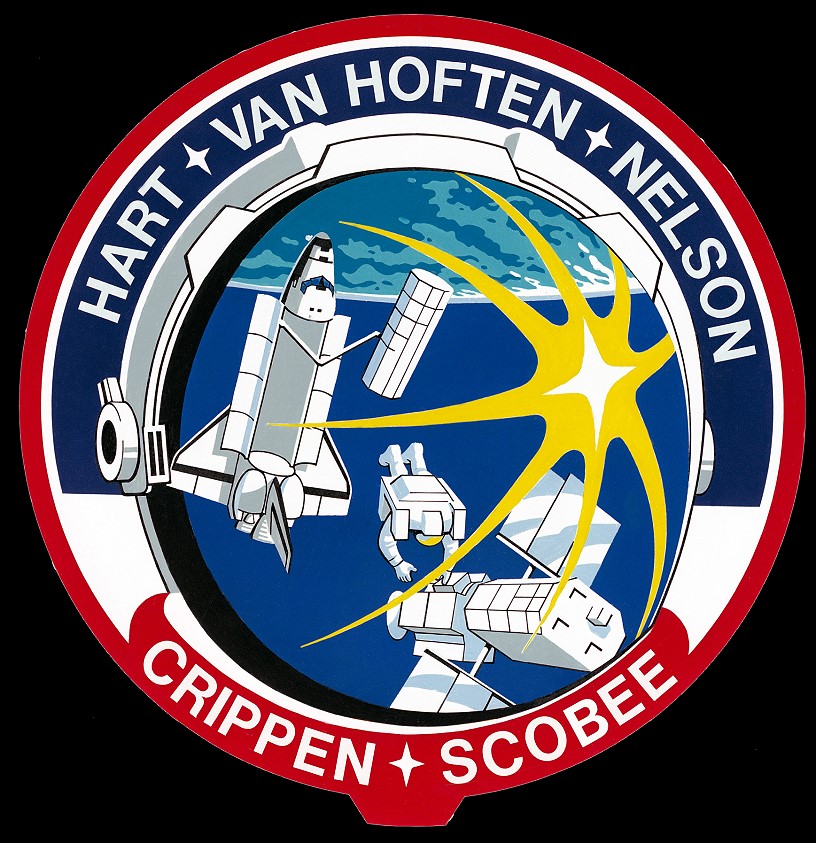 Mission 41C’s official crew patch included LDEF (center) and Solar Max (lower), together with the MMU-equipped EVA team. Image Credit: SpaceFacts.deThe satellite took the form of a 12-sided structure, and, as its name implied, it was designed to house experiments which required long-term exposure to the hostile environment of low-Earth orbit. No one could possibly have foreseen, at the time of LDEF’s launch, exactly how long it would remain in space before being retrieved by another shuttle mission and returned to Earth. NASA intended to collect the satellite during Mission 51D in February 1985, but that was repeatedly delayed, and by the time Challenger exploded the retrieval had been rescheduled for Mission 61I in September 1986. In fact, it would not be recovered until January 1990, by which point it was only weeks away from an uncontrolled and fiery re-entry. It was a peculiar object, measuring 29.8 feet (9.1 meters) long by 13.8 feet (4.2 meters) wide and weighing 20,990 pounds (9,520 kg). At its most basic, it consisted of an intricate frame of aluminum rings and longerons, loaded with trays for 57 experiments, whose disciplines ranged from materials and structures to power and propulsion and from science and technology to electronics and optics.
Deployment of LDEF occurred 24 hours into Mission 41C, on 7 April 1984, and, although Terry Hart admitted “that was exciting,” it hardly compared with his first and only shuttle launch a day earlier. “It was a clear, cool morning,” he said of Friday the 6th, “and we went through the traditions of having breakfast together and there was always a cake there for the crew before they went out. Next, we went out to the launch pad and up the elevator. As usual, people don’t say much in elevators—whether you’re in a hotel or on the launch pad—and you watch the numbers tick by and, instead of floors, they do everything in feet in the launch pad elevators. When you walk across the gantry to board the shuttle, you can look down into the flame trench. The obvious thing that’s striking you is that this is for real: we’re going to go! Everything was pretty smooth on our launch countdown. We got strapped in and, again, the guys strapping us in were a lot of the same guys that strapped in Al Shepard on his Mercury flight [in May 1961].”
By the time of launch, the 41C crew had spent 14 months together as a team and all five men would agree that this mission was the mission that everyone wanted. With a background as a pilot in the Air Force Reserve and master’s degrees in mechanical and electrical engineering, Hart had spent his first few years as an astronaut working on new rendezvous procedures. Although rendezvous had been accomplished during the Gemini and Apollo programs, bringing the orbiter alongside Solar Max for repairs was quite different. “The shuttle was this big truck,” he told the NASA oral historian, “and it had a very limited amount of fuel on board, whereas the Apollo command module and Gemini were like sports cars. They could just zip around and change orbits much more readily, especially in close, around an object, they could just kind of move right around with great ease. If we started to do much of that, we’d very quickly run out of fuel and have to de-orbit, so we had to come up with new design trajectories and procedures to accommodate that difference to ensure that we were flying the most fuel-optimal approach during a rendezvous.”
When he was assigned to 41C, Hart’s initial suspicion was that he would be involved in the rendezvous, and not the EVAs, but the word on the astronaut office grapevine was that James van Hoften (nicknamed “Ox,” due to his physical height and size) was too big to perform a spacewalk. Nevertheless, one day Bob Crippen approached Hart and told him that his expertise was needed to perform the RMS work and the rendezvous. The EVAs would be done by van Hoften and Nelson.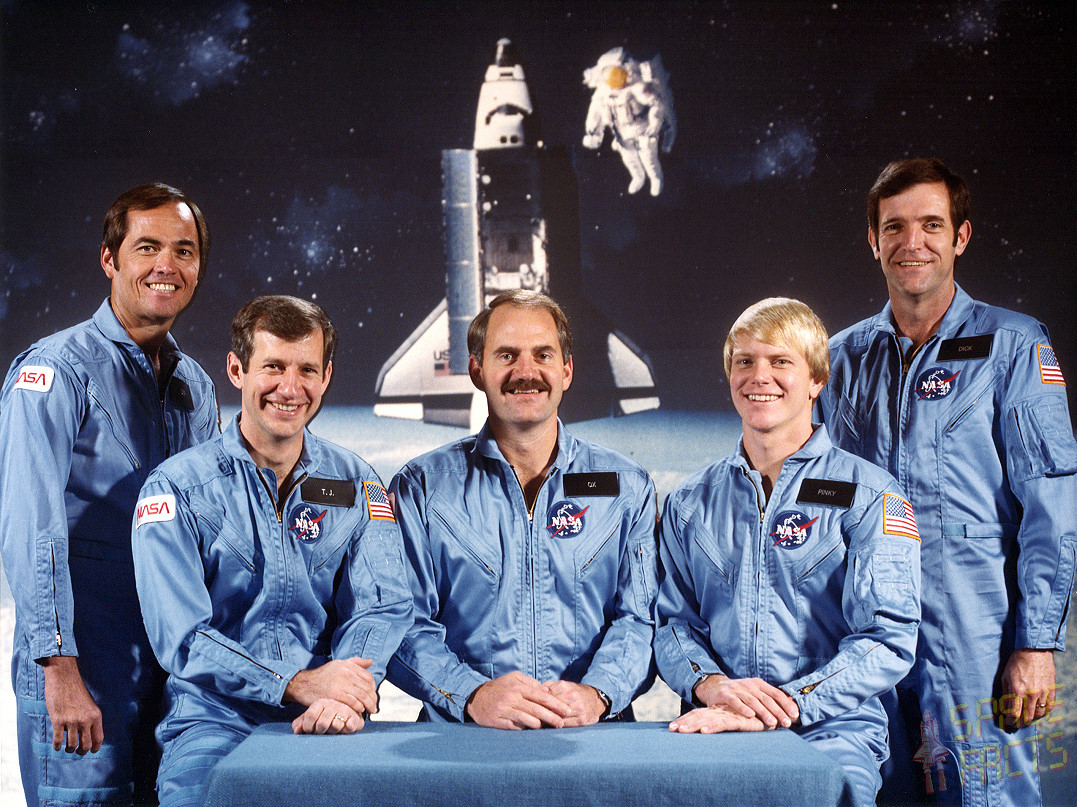 The crew of Mission 41C. From the left are Bob Crippen, Terry Hart, James “Ox” van Hoften, George “Pinky” Nelson, and Dick Scobee. Photo Credit: SpaceFacts.deThroughout 1983 and into the spring of 1984, Hart’s attention was entirely devoted to preparing for the intricate RMS operations in support of the Solar Max repair and the LDEF deployment. “The arm engineers wanted to make sure we properly tested the arm moving such a large object,” he explained, “so they could understand that it was going to be able to do what it was designed to do, so I spent a lot of time working with the engineers to make sure that I was doing everything that they wanted done during testing.” Much of the simulation work was done at the Johnson Space Center (JSC) in Houston, Texas, and at RMS prime contractor Spar Aerospace’s facility in Toronto, Canada, and Hart found himself routinely testing the flex of the arm with the huge LDEF attached and capturing Solar Max in a rotating mode.
One of Hart’s responsibilities during Challenger’s ascent to orbit was to act as a “second flight engineer”; seated behind Dick Scobee, he assisted van Hoften with checking off the milestones and monitoring the procedures needed in the event of problems. There were none. “Off we went,” he said of the 8:58 a.m. EDT liftoff, “right on time on a perfectly clear day. I had a couple of surprises: the shake, rattle and roll of the Solid Rocket Boosters for the first two minutes is a very low-frequency rumble; just a tremendous sense of power. You can look back over your shoulder or look out the top window when you’re in the flight deck and watch the world disappearing behind you. Very quickly, the SRBs taper off and separate and that was the surprise I had, because your G-loading builds up close to 2.5 G as the boosters reach their peak thrust. As the solid rockets burn off and separate, the sensation that you have at that point I wasn’t quite prepared for, because you go from 2.5 G back to about one and a half. The sensation you have is that you’re losing out, that you’re falling back into the water! You don’t think you’re accelerating as much as you should be to get going and, of course, I’d worked on the main engine program anyway, so I was very familiar with what the engines could do or not do. I think in the next minute I must have checked the main engines to make sure they were running, because I’d swear we only had two working: it just didn’t feel like we had enough thrust to make it to orbit! Then, gradually, the External Tank gets lighter and as it does, of course, with the same thrust on the engines, you begin to accelerate faster and faster. After a couple of minutes, I felt like, yes, I guess they’re all working.”
Indeed, Challenger’s fifth launch had proceeded without incident. The External Tank behaved superbly and the performance of the main engines, read NASA’s post-mission report, “appeared to be normal.” The only deviation was when the engines throttled down to 67 percent, rather than the predicted 71 percent, as Challenger passed through maximum aerodynamic pressure (known as “Max Q”), a minute into the flight; this lower level was later attributed to a higher than anticipated SRB impulse during the first 20 seconds. Chase aircraft also revealed that one of the main parachutes on the right hand booster failed to inflate, although both boosters were recovered successfully.
Experiencing the launch from a somewhat different perspective, seated on Challenger’s darkened middeck, next to the side hatch, George “Pinky” Nelson did not have the luxury of viewing the ascent through the wrap-around windows of the cockpit as Crippen, Scobee, Hart, and van Hoften could. Still, he recalled the rapidity of his first ride into orbit. He was also able to peer through a tiny circular window in the side hatch and capture a fleeting glimpse of the enormous, controlled explosion that was underway outside. “I could see the tower go by and the sky and horizon as we ascended,” he told this author in an email correspondence from March 2006. “It was a bit lonely down there, but Crip kept a running commentary on how the launch was going, since we were all rookies, but him. That helped keeping up with the events. My first experience with weightlessness was problematic. I’d had many flights on the KC-135 aircraft and hundreds of hours in the water tank, so was familiar with the sensations of weightlessness. I remember how pleasant a sensation it was and how surprised I was that I didn’t get sick!”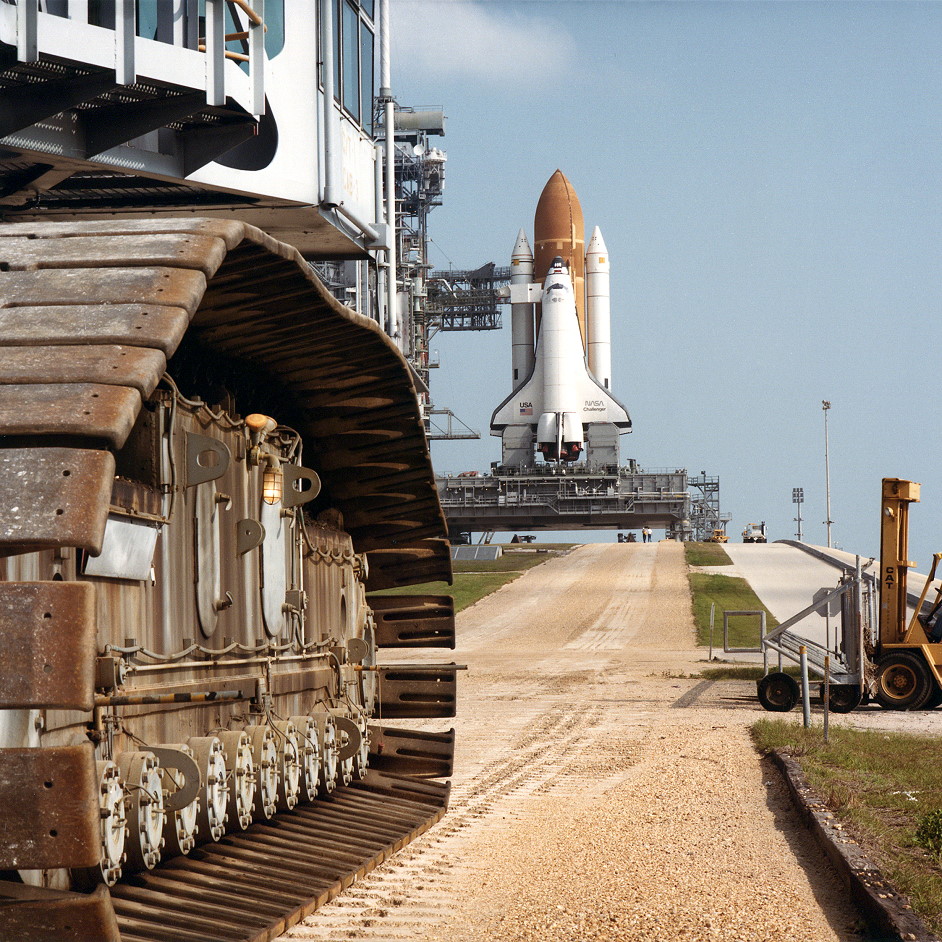 Pictured from the perspective of the departing crawler, the 41C stack has just been deposited on Pad 39A in March 1984. Photo Credit: SpaceFacts.deOn his first voyage into space, Nelson adapted well to the new environment. Unfortunately, the same could not be said for Terry Hart. Mission 41C marked the shuttle’s first “direct insertion” ascent. In other words, only one Orbital Maneuvering System (OMS) engine firing—rather than two—was needed to circularize Challenger’s orbit at an altitude of around 330 miles (530 km). Previously, when less performance data was available for the main engines and some targeting precision was lacking, an initial OMS burn was made to raise the apogee, followed by another, half an orbit later, to raise the perigee and circularize the orbit. On 41C, however, the ascent was to achieve an initial orbit with an apogee at the desired altitude without performing the OMS-1 burn, and the OMS-2 burn provided circularization. This enabled the engines to provide more energy and permit the easier use of on-board software.
The high orbit was needed for the rendezvous with Solar Max and also simplified the post-insertion procedures for the astronauts. “It’s a much easier task from a crew standpoint,” explained Bob Crippen, “because you’re pretty busy there right after main engine cutoff and this took away some work, so it was a neat thing to try.” As Crippen, Scobee, and van Hoften busied themselves with readying their ship for orbital operations, Hart was granted the opportunity to unstrap and leave his seat to photograph the jettisoned External Tank as it tumbled Earthward. It was perhaps fortuitous that the LDEF deployment was still a day away, because Hart’s initial euphoria turned rapidly into a severe dose of space sickness.
“I had never had any motion sickness,” he recalled years later. “I was a fighter pilot and could do anything in an airplane. I had a light airplane I used to do aerobatics in and nothing ever bothered me in terms of flying or riding a boat or a train or a car or whatever. I wasn’t weightless for more than three minutes and I knew I was in trouble! I could just tell my whole gastro-intestinal system was going into high-speed reverse and I didn’t understand it because, psychologically, I was elated. Maybe I got up too quick and started moving around or started looking out the window too soon, but for the whole first day I was really out of it.
“There were some things I had to do that first day, but they were minimal,” Hart continued. “I had to unstow the RMS and barely made it through that. I really was totally incapacitated for the first day and I tried the usual drugs that they give you to help, but I had it so bad that nothing helped at all. That night, when we got ready to go to sleep, I was exhausted, really depleted. I remember falling asleep and was asleep for maybe a half hour, when I dreamt that I was falling and I remember reaching out to grab something and I did it with such force that I ripped my sleeping bag. I don’t think the other guys were asleep yet, but if they were, I woke them up when I yelled out. That was kind of a low spot and, after that, I acclimatized. I had some kind of fundamental neurological brainstem reaction to a fear of falling. I think my initial sickness, after three or four minutes of weightlessness, was something that triggered my basic instincts of falling, even though it wasn’t conscious. I couldn’t detect it consciously and I think it stayed with me for that first night. The next day, I was able to do all my duties, but it was just a terrible experience. I never heard anyone else relate such a bad experience.”
 Wątek: [AS] Fixing Solar Max: 30 Years Since Mission 41C (Przeczytany 2527 razy)