'A Mirror-Image Flight': 20 Years Since Columbia's Landing-to-Launch Record (Part 2)By Ben Evans, on April 2nd, 2017
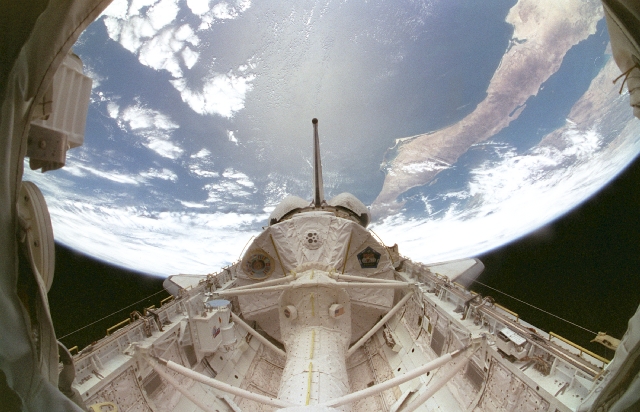 With the reprioritization of mission objectives, the around-the-clock Spacelab operations in the Microgravity Science Laboratory (MSL-1) changed dramatically. The astronauts even worked by torchlight at times to maintain power levels below critical levels. Photo Credit: NASATwenty years ago, this week, Space Shuttle Columbia rocketed into orbit for what should have been an ambitious mission, devoted to materials processing, combustion science and fluid physics; the last dedicated microgravity research flight before the on-orbit construction of the International Space Station (ISS) was due to commence. An experienced seven-member crew, with five PhDs and seven previous space missions between them, had trained for more than a year to support 25 complex experiments aboard the Microgravity Science Laboratory (MSL-1). Little could they have known in the hours after their 4 April 1997 launch that they would be back on Earth before the 16-day flight was 100 hours old.
As outlined in yesterday’s AmericaSpace history article, STS-83 had caused a few hearts to flutter in early 1997, when Mission Specialist Don Thomas slipped down some stairs at the Johnson Space Center (JSC) in Houston, Texas, and broke his ankle. An additional astronaut was assigned to train in parallel with him, protecting all available options in case Thomas did not recover in time to make the flight. Fortunately, several weeks of intensive therapy brought Thomas back to full health and Columbia launched smoothly into orbit on the afternoon of 4 April. Within hours, the seven astronauts—which, in addition to Thomas, also included Commander Jim Halsell, Pilot Susan Still, Mission Specialists Mike Gernhardt and Janice Voss and Payload Specialists Roger Crouch and Greg Linteris—had divided into two 12-hour teams to operate the MSL-1 experiments around-the-clock.
“Everything’s going great!” remarked MSL-1 Mission Manager Teresa Vanhooser of NASA’s Marshall Space Flight Center (MSFC) in Huntsville, Ala., as the experiments got underway. Her words proved disappointingly prophetic, for the fortunes of STS-83 and her crew were about to drastically change to the worse. Shortly after launch, Mission Control had begun seeing erratic behavior from one of the shuttle’s three power-producing fuel cells. Although one cell was technically sufficient to support on-orbit and landing operations, flight rules dictated that all three had to be fully functional for a mission to continue.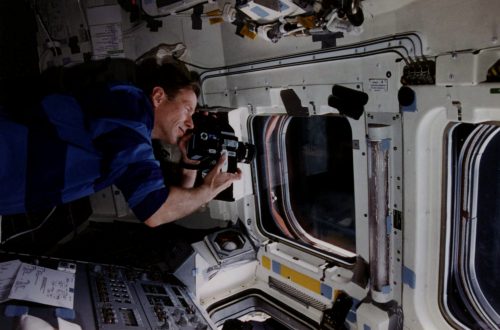 Mike Gernhardt conducts Earth photography through Columbia’s overhead windows during the shortened STS-83 flight. Photo Credit: NASAEach cell carried three “stacks”, made up of two banks of 16 cells each. In one of Fuel Cell No. 2’s stacks, the difference in output voltage between the two banks indicated an increase. The problem had been spotted on the night before Columbia launched, but had leveled-off and was considered an “in-family” glitch and cleared for flight. Late on 5 April, Halsell and Still adjusted the electrical system configuration to reduce demands on the ailing fuel cell, thereby allowing Mission Control to stabilize and continue to monitor it.
Overnight, the rate of change in the cell slowed from five millivolts per hour to around two millivolts, but continued to exhibit a slight upward trend. “There’s always a difference between the two halves of the stack,” Mission Operations Directorate (MOD) representative and former flight director Jeff Bantle told journalists, “but we’re noticing a changing difference. Actually, that changing difference has leveled off a lot, so the degradation was greater the first 12 hours of the mission.”
If the difference between the two stacks increased as high as 300 millivolts—and it was pushing 250 by the night of the 5th—it could force the STS-83 crew to shut down Fuel Cell No. 2 entirely. “The concern is degradation in a single cell,” Bantle explained. “If it degrades enough, rather than getting power out from the cell, you would have power output into that cell. You could actually have crossover and localized heating, exchange of hydrogen and oxygen within the cell, and could even have a localized fire. That’s the very worst case. That’s why we have flight rules that are very conservative to try to avoid and try to shut down and safe a fuel cell before you would ever get to that point.”
At the Capcom’s console in Mission Control for much of this drama was Canadian astronaut Chris Hadfield. Writing years later in his memoir, An Astronaut’s Guide to Life on Earth, Hadfield was initially convinced that it was a sensor problem, rather than a glitch with the fuel cell itself. “But Flight Rules insisted the fuel cell had to be shut down,” he wrote, “and then, with only two fuel cells deemed fully operational, another flight rule kicked in: the mission had to be terminated.”
A manual purge of the cell by Halsell and Still proved fruitless and it was left to Hadfield to break the bad news. On the afternoon of 6 April, a Minimum Duration Flight (MDF) had been declared and preparations got underway to bring Columbia back to Earth on the 8th. “Listen, I know you just got up there,” Hadfield told Halsell, paraphrased in his memoir, “but you have to come on back. Starting now.”
Notwithstanding the crushing disappointment, Mission Control retained a sense of humor, by faxing the astronauts a tongue-in-cheek list of the Top Ten “real” reasons why they were coming home early. These included running out of “Columbian” coffee, forgetting to record the latest episode of Friends, forgetting to do their taxes before launch and that the entire situation was an April Fool’s prank.
As the premature end of STS-83 neared, the crew and ground personnel worked together to devise an alternate flight plan. Fuel Cell No. 2 was shut down, as were a number of other non-critical pieces of equipment, in order for science operations to continue. The lights were turned off inside the Spacelab module, forcing the astronauts to run experiments by torchlight, but Jim Halsell was philosophical. As one of the original electric fly-by-wire vehicles, the loss of a third of the Space Shuttle’s power-producing potential had to be taken with the utmost seriousness. Still, the crew expressed shock and disbelief as their carefully choreographed 16 days in space was abruptly ruined.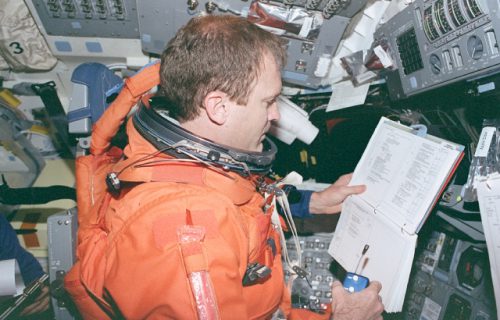 Jim Halsell looks over a procedures checklist on 8 April 1997, as Columbia is prepared for a premature return to Earth. Photo Credit: NASAOver the following 36 hours, the crew worked around the clock aboard MSL-1 and a remarkable amount of research was completed. Before the shuttle landed, informal discussions were already underway to refly the mission, later in 1997. “There were rumors already flying,” Don Thomas later recounted on his website, OhioAstronaut.com, “that after fixing the problem NASA would be re-flying our crew in a few months to complete our Spacelab science mission. That definitely helped ease the sting of coming home early.” Crewmate Roger Crouch agreed. “In some ways, this could make for a more meaningful flight in the long run,” he said, “but, certainly, this one was a bummer!”
Columbia landed safely on Runway 15 of the Shuttle Landing Facility (SLF) at the Kennedy Space Center (KSC) in Florida at 1:33 p.m. EDT on 8 April, wrapping up a flight of just 95 hours in space. It was the fourth-shortest shuttle mission ever completed: surpassed by Columbia’s first two test-flights in April and November 1981 and by STS-51C, a classified voyage by Discovery in January 1985.
And as Halsell climbed out of his ship, he was approached by KSC Director Roy Bridges, who offered him a handshake and the words: “We’re going to try to give you an oil change and send you back.” Two weeks later, NASA announced that the mission would refly in early July 1997, taking on the next-available unused shuttle flight number of “STS-94”. Thanks to the identical nature of the payload, a significant portion of post-flight processing was simplified. In fact, when Columbia prepared to fly again on the afternoon of 1 July a mere $55 million had been expended on her processing and £8.6 million on the turnaround of the MSL-1 payload itself.
The shuttle spent just 56 days in the Orbiter Processing Facility (OPF), less than two-thirds of what would ordinarily be required for flight-to-flight preparations. In order to allow for necessary tasks to take place—such as the replacement of two Auxiliary Power Units (APUs) and several Reaction Control System (RCS) thrusters—a number of structural inspections were deferred until Columbia’s next processing flow. Remarkably, this was the shortest turnaround for a single shuttle in the post-Challenger era. By 11 June 1997, the vehicle was back at Pad 39A, tracking an opening launch attempt on 1 July.
“Our approach,” said STS-83 and STS-94 Lead Flight Director Rob Kelso, “has been to treat this flight as a launch delay. The crew is exactly the same, the flight directors are all the same and the flight control team is almost identical. It’s a mirror-image flight in many respects.” Even the embroidered patch, worn by Halsell’s crew, was the same, albeit with a red border for STS-83 and a blue border for STS-94.
In Halsell’s words, the reflight was “a marvelous, once-in-a-career opportunity”. And at 12:50 p.m. EDT on 1 July 1997, just 84 days since their return from STS-83, Halsell and his six crewmates headed into orbit a second time. In so doing, they eclipsed the 128-day landing-to-launch record established by NASA astronaut Steve Nagel and—even to this day—they collectively hold the empirical record for the shortest period between landing and launch of any group of spacefarers.
“Thanks to the whole ascent team for getting us to a safe orbit,” said Susan Still after the shuttle safely achieved orbit.
“It looks like Columbia’s performing like a champ,” radioed Capcom Dom Gorie.
This time around, she certainly was.Source:
https://www.americaspace.com/2017/04/02/a-mirror-image-flight-20-years-since-columbias-landing-to-launch-record-part-2/
 Wątek: [AS] 'Once-In-A-Career Opportunity': 20 Years Since Columbia's Landing-to-Launch (Przeczytany 2365 razy)