"Without Hiatus": The Apollo Applications Program in June 1966 (2)
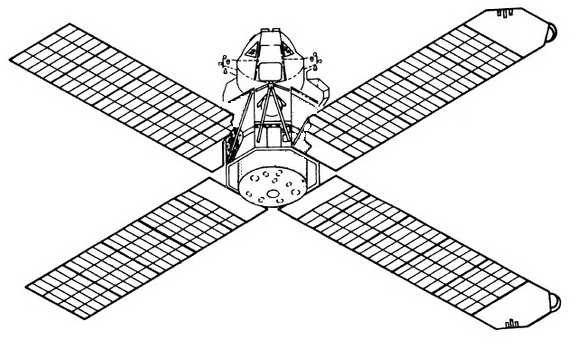 AS-214 would include the first Apollo Telescope Mount (ATM). Two astronauts would operate the ATM from the LM ascent stage; astronomical instruments would fill the stripped-out LM descent stage. Image credit: NASA.
 The proposed AAP Laser Communications lab was not specifically mentioned as a payload in the June 1966 AAP program plan, though its design was typical of proposed LM-derived AAP labs. Image credit: Perkin Elmer.
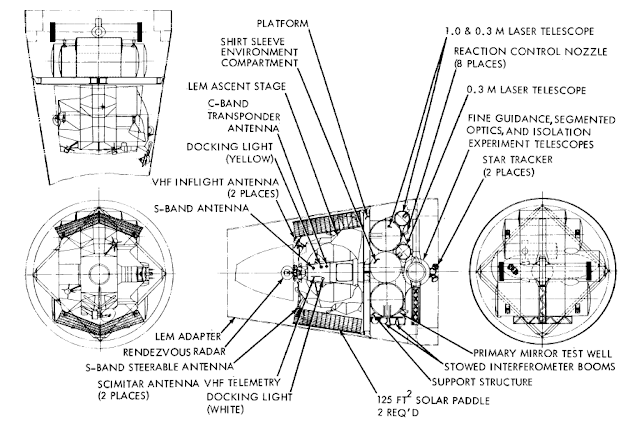 The proposed AAP Optics Lab as it would appear stowed for launch in the SLA. Note that experiment equipment (mainly telescopes) and a square "platform" with attachment points at its corners for linking to the SLA completely replace the descent stage. Image credit: NASA.The third 1969 mission, AS-215, was envisioned as a meteorology-oriented mission dubbed "Applications-A." It would probably have operated in an orbit steeply inclined relative to Earth's equator and employed an experiment/sensor carrier based on the LM design.
The AS-510 mission, the final 1969 AAP mission and the first AAP mission to launch on a Saturn V rocket, would place a CSM into geosynchronous Earth orbit (GEO) for communications, biomedicine, and Earth observation experiments. The rocket's S-IVB third stage, modified to permit two restarts, would ignite in low-Earth orbit to boost the CSM into an elliptical transfer orbit, then would fire again 5.5 hours later to circularize the CSM's orbit at the GEO altitude of 35,870 kilometers.
Five AAP Saturn IB missions would fly in 1970. These would include a 135-day stay on board a spent-stage Workshop in Earth orbit, two resupply visits to the spent-stage Workshop as part of other AAP missions, two solar ATM flights, a Biomed Lab mission, a fluids lab for studying weightless propellant behavior, the Applications-B Earth observation mission, and the introduction of an "Extended Capability CSM" for independent 45-day flights. Extended Capability CSM modifications would include long-life, high-capacity fuel cells for making electricity and water, an oxygen-nitrogen breathing mixture to replace Apollo's pure oxygen atmosphere (this was a concession to aerospace physicians, who worried about the health effects of breathing pure oxygen for long periods), and a long-life C-1 rocket engine in place of the Apollo CSM's Service Propulsion System main engine.
The Biomed Lab would be based on the Apollo LM or a "refurbished Command Module." The latter was envisioned as a used Command Module stripped of its heat shield, parachutes, and other systems, fitted out as a small pressurized laboratory, and launched a second time on a Saturn IB with a piloted CSM.
Four AAP Saturn V missions would fly in 1970, of which three would voyage to the Moon. These would be the first lunar missions since Apollo's end. The AS-511 Saturn V would launch a piloted mapping mission to lunar polar orbit. It would orbit for up to two weeks while the Moon rotated beneath it. This would enable the CSM to pass over nearly the entire lunar surface (and fly over half the surface in daylight).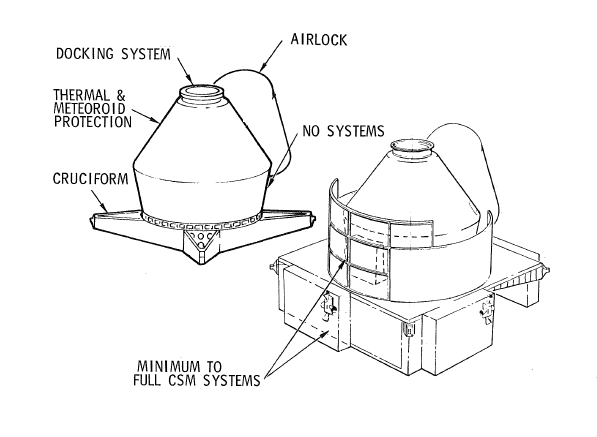 The refurbished Command Module (CM) Lab came in dependent (upper left) and independent (lower right) forms. The "cruciform" was included in the design to provide attachment points linking the dependent CM Lab to the SLA. Image credit: North American Aviation.
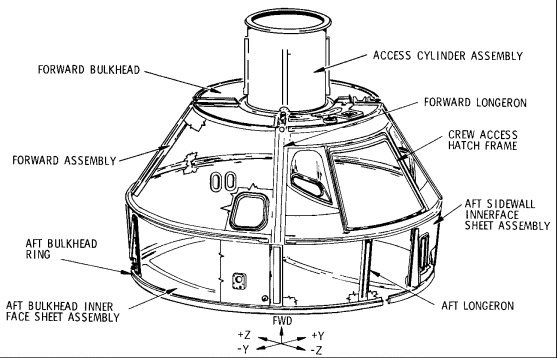 Apollo CM pressure vessel. Image credit: NASA.The AS-512 CSM would transport to lunar orbit an LM Shelter containing living quarters, supplies, and exploration gear (a small rover, a core drill, and an advanced sensor package). Once in orbit about the Moon, the LM Shelter would undock from the CSM and land automatically, then the piloted CSM would return to Earth. Less than three months later, the AS-513 Saturn V would launch an Extended Capability CSM and an LM Taxi to the Moon. The latter would land near the LM Shelter with two astronauts on board, including the first scientist-astronaut to reach the Moon. They would explore their landing site for 14 days.
The year 1970 would end with the AS-514 launch, which would place the first modified ("Mod") S-IVB Workshop into Earth orbit. The Mod S-IVB Workshop was a step up from the spent-stage Workshop; it would launch with no propellants in its tanks and its hydrogen tank outfitted with living quarters, supplies, and experiment gear. The four Saturn IB-launched AAP missions in 1971 would, the memorandum explained, support a one-year stay by a single crew on board the AS-514 Mod S-IVB Workshop.
In 1971, the AS-515 Saturn V would launch an Extended Capability CSM and an ATM on a 45-day mission to GEO to conduct stellar and solar astronomy, relativity, and space physics experiments. AS-516 (the first Saturn V built specifically for AAP) and AS-517 would launch an advanced lunar exploration mission similar to the AS-512/AS-513 pair, and AS-518 would launch a second Mod S-IVB Workshop.
The four Saturn IBs launched in 1972 (AS-225 through AS-228) would support stays on the second Mod S-IVB station. One of these missions would also test Command Module modifications meant to replace Apollo ocean splashdowns with cheaper land landings. Modifications would include steerable parachutes.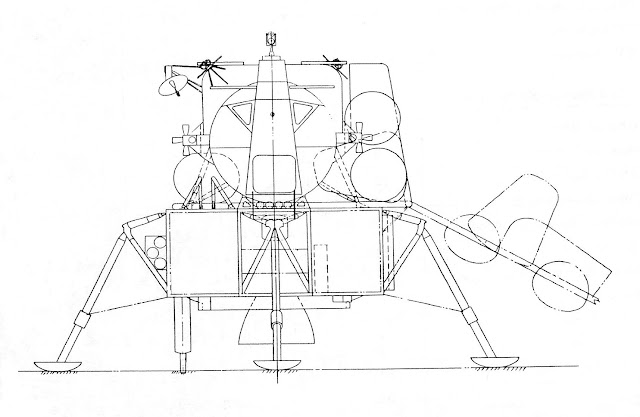 AS-512 in 1970 would deliver the LM Shelter to the lunar surface; AS-513 would see two astronauts arrive separately in an LM Taxi and live in the LM Shelter for 14 days. The LM Shelter would include a rover (shown stowed and in release position) and a core drill (shown deployed). This image dates from January 1965 but is applicable to the June 1966 AAP plan. Image credit: NASA.
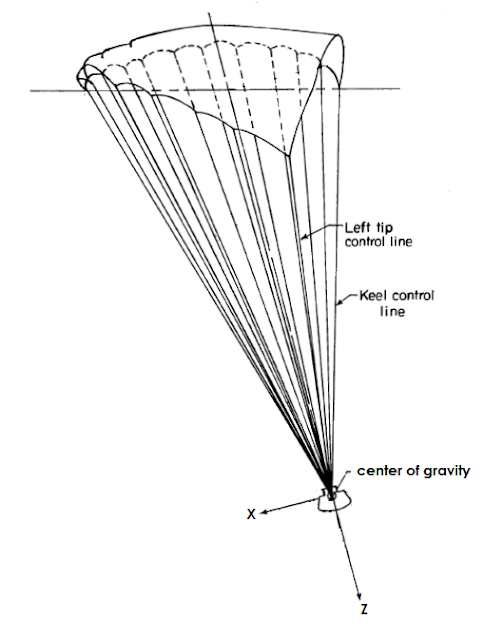 Apollo CM with deployed parawing. Image credit: North American Aviation.From 1972 through 1975, the memorandum explained, AAP missions would support a transition to an unspecified post-AAP piloted "follow-on program." NASA would increase its Saturn IB launch rate to six per year by 1973, and would continue to launch Saturn V rockets at a rate of four per year. The latter would launch four missions to GEO to conduct stellar astronomy, physics, and technology applications experiments (1972-1973), the automated Voyager Mars probes (1973), and a lunar mission similar to the AS-512/AS-513 pair each year through 1975. Two of the GEO missions would include ATMs. AS-520/AS-521 would launch the 1972 lunar mission pair and AS-525/AS-526 the 1973 pair.
The SAA Program Office envisioned that ATM missions might lead in late 1973 to an AAP astronomy mission featuring a reflecting telescope with a mirror measuring from 60 to 100 inches across. This, the memorandum explained, might serve to verify the mirror design ahead of its use in planned orbiting National Astronomical Observatories, sophisticated space telescopes expected to reach Earth orbit in the late 1970s.
As mentioned above, NASA began AAP amid increasing fiscal pressures. After pushing off a formal start to AAP as requested by Congress in FY 1966, President Johnson submitted a $5.01 billion NASA budget for FY 1967, of which $270 million was meant to fund AAP. Congress slashed the FY 1967 AAP budget to $83 million.
Observers of the U.S. space program were surprised when President Johnson went to bat for AAP again the following year. He requested that NASA's FY 1968 budget total $5.1 billion, with $455 million allotted to AAP. On 27 January 1967, the day after NASA OMSF director George Mueller briefed the press corps on the planned rapid ramp-up in AAP development, fire broke out inside the AS-204 Apollo CSM crew cabin during a test on the launch pad. Fed by the CSM's pure oxygen atmosphere, it immediately became an inferno. A poorly designed hatch trapped astronauts Grissom, White, and Chaffee inside, so they perished.
After the fire, NASA came under close scrutiny and was found wanting. Congress could not "punish" the agency by cutting the Apollo Program budget — to do so would have endangered achievement of President Kennedy's goal of a man on the Moon by 1970 — but it could express its displeasure by cutting programs meant to give NASA a post-Apollo future. The agency's FY 1968 appropriation was slashed to $4.59 billion, with AAP receiving only $122 million.
Under President Richard Nixon, NASA's budget slide accelerated. The Saturn rocket production lines were placed on standby in January 1970. At the same time, AAP became the Skylab Program. NASA Administrator Thomas Paine, who saw Skylab as a step toward a late 1970s 50-to-100-man Earth-orbiting Space Base, cancelled the Apollo 20 Moon mission so that its Saturn V (AS-513) could launch Skylab, a Saturn IB S-IVB-derived Orbital Workshop (OWS) resembling the AAP Mod S-IVB Workshop. Two years later, in January 1972, Nixon called for new-start funding for the Space Shuttle, which became NASA's main post-Apollo piloted program.
Work toward using Saturn-Apollo hardware in post-Apollo missions continued, though on a much-reduced scale. Apollo 17 (December 1972) saw the sixth and last piloted Moon landing of the 20th century and the last flight of the LM. NASA designated its Saturn V SA-512. On 14 May 1973, SA-513, the last Saturn V to fly, launched Skylab. An ATM for solar studies — the design of which was not based on the LM — reached orbit permanently attached to the OWS, and the Multiple Docking Adapter (MDA) replaced the SSESM. Three Saturn IBs (SA-206 through SA-208) launched three-man crews to Skylab in Apollo CSMs. The final Skylab crew splashed down on 8 February 1974, after 84 days in space.
The SA-210 Saturn IB, the last Saturn rocket to fly, launched the last Apollo CSM to fly. Its July 1975 mission to dock with a Soviet Soyuz spacecraft in low-Earth orbit brought the Apollo era to a close.Source"Saturn/Apollo Applications Program Summary Description," memorandum with attachments, MLD/Deputy Director (Steven S. Levenson for John H. Disher), Saturn/Apollo Applications, NASA Headquarters, to George M. Low, Manned Spacecraft Center, Leland F. Belew, Marshall Space Flight Center, and Robert C. Hock, John F. Kennedy Space Center, 13 June 1966.
More InformationA Forgotten Rocket — The Saturn IB
Space Station Resupply: The 1963 Plan to Turn the Apollo Spacecraft Into a Space Freighter
Apollo Extension System Flight Mission Assignment Plan (1965)
"Assuming That Everything Goes Perfectly Well in the Apollo Program. . ." (1967)
The First Voyager (1967)
"Still Under Active Consideration": Five Proposed Earth-Orbital Apollo Missions for the 1970s (1971)
Source:
http://spaceflighthistory.blogspot.com/2020/01/without-hiatus-apollo-applications.html
 Wątek: [SHB] "Without Hiatus": The Apollo Applications Program in June 1966 (Przeczytany 1873 razy)