The Story of the Vanishing Satellite: Remembering Top-Secret STS-36, 30 Years OnBy Ben Evans, on March 1st, 2020
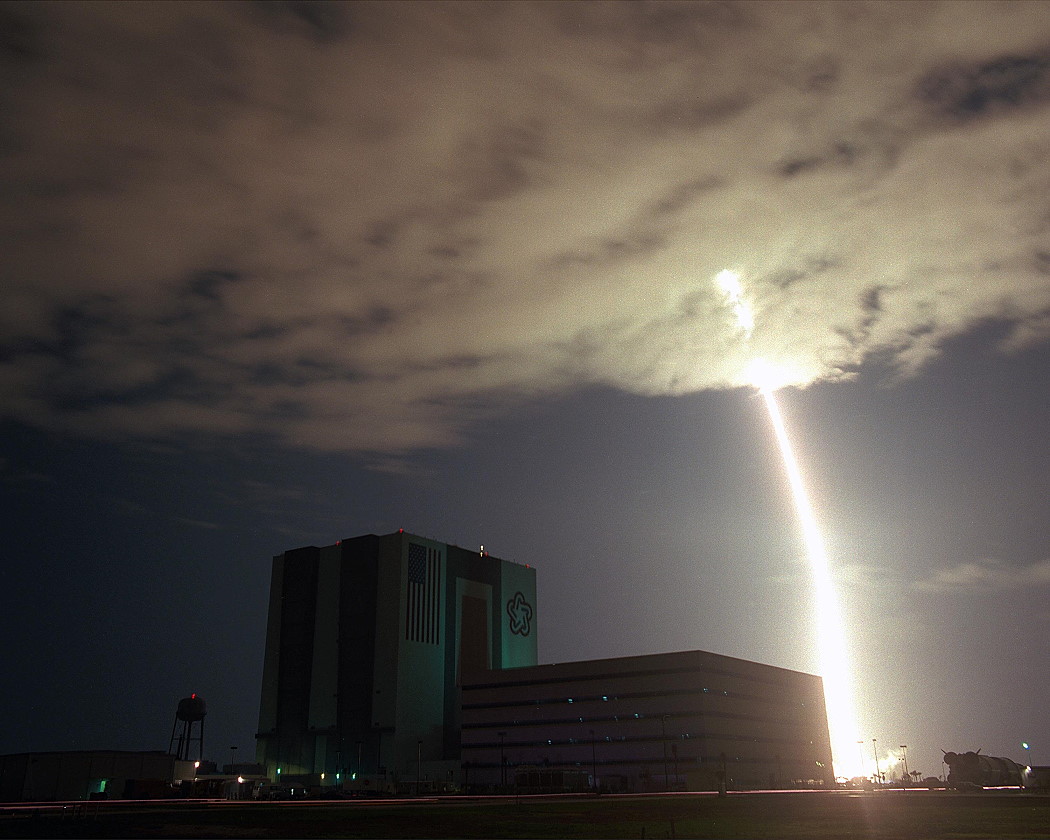 Atlantis spears for the heavens at 2:50 a.m. EST on 28 February 1990. Photo Credit: NASAIn many minds, STS-36—a top-secret Department of Defense mission, flown 30 years ago this month—was one of the greatest flights ever undertaken in the three decades of Space Shuttle operations. In his memoir Man On A Mission, astronaut Dave Hilmers recalled that Flight Director Rob Kelso made this remark to a reporter, although STS-36’s classified nature meant the reality of what the crew did during their four days in space in early 1990 will never be widely known.
Hilmers hinted that shuttle Atlantis’ exceptionally low altitude “gave us the best views of Earth I would ever have while in space”, and indeed STS-36 flew much lower than many other shuttle missions, achieved a unique orbital inclination and deployed a satellite which seemingly “disappeared” shortly after its launch. Video Credits: NASA/YouTubeReportedly weighing in the region of 36,600 pounds (16,640kg), the satellite proved to be extremely bright and easy to follow in the night sky, but by mid-March 1990, just two weeks after launch, it appeared to have broken into five large fragments. Claims that this newest sentinel for America’s national security armory—later identified as Air Force Program-731 (AFP-731) or “Misty”—had catastrophically malfunctioned were quickly rebuffed by the Pentagon, whose public response appeared to indicate that the debris actually represented jettisoned payload shrouds or instrument covers.
Certainly, the satellite’s visual brightness suggested a spacecraft about the same size, shape and mass as the Hubble Space Telescope (HST) and the website GlobalSecurity.org later noted that it comprised a short, offset imaging instrument with a large, black-colored photo-shutter window to permit wide fields of view. Curved, body-hugging solar arrays of gallium arsenide, arranged in three segments and affixed to a rotatable boom, provided electrical power for a satellite whose exact nature, even 30 years on, remains shrouded in mystery.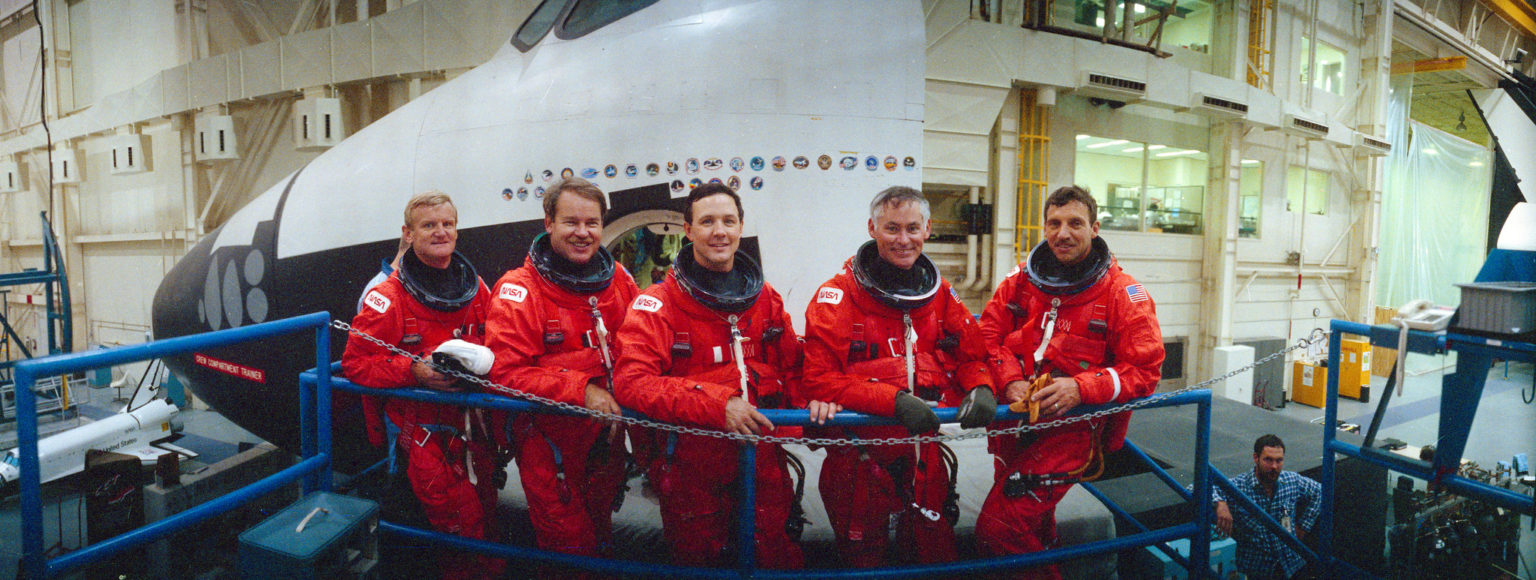 The STS-36 crew during pre-flight training in October 1989. From left to right are John Casper, John “J.O.” Creighton, Pierre Thuot, Mike Mullane and Dave Hilmers. Photo Credit: NASAThe STS-36 crew—Commander John “J.O.” Creighton, Pilot John Casper and Mission Specialists Mike Mullane, Dave Hilmers and Pierre Thuot—had been assigned to the flight in February 1989. And they were one of very few shuttle crews in this early post-Challenger timeframe to fly close to their originally targeted date. But that is not to imply that STS-36 did not fall foul to problems. In fact, Creighton’s crew experienced no fewer than five scrubbed launch attempts. With liftoff timed to occur in the small hours of the morning, this produced the need for the astronauts to adjust their sleep cycles. “We were going to bed at 11 a.m. and waking up at 7 p.m.,” wrote Mullane in his memoir, Riding Rockets. “Breakfast was at 8 p.m., lunch at midnight and supper at 6 a.m. A vampire kept better hours!”
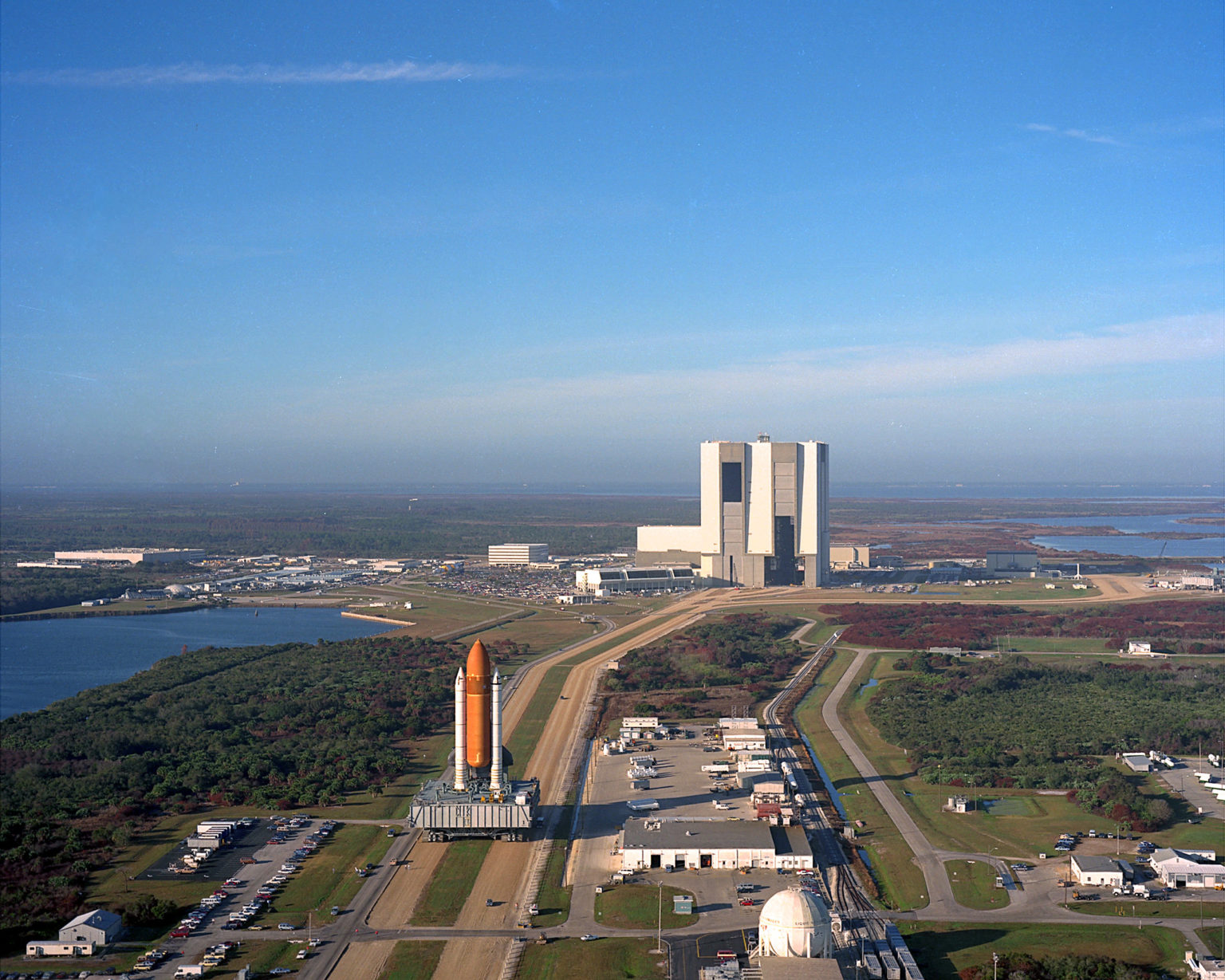 The STS-36 shuttle stack rolls from the Vehicle Assembly Building (VAB) out to Pad 39A, in the weeks prior to the mission. Photo Credit: NASAThe first launch attempt on 22 February 1990 was called off due to Creighton himself, who had for several days been battling a bad cough, which the flight surgeon eventually diagnosed as an upper respiratory infection. He had not improved by the 23rd or 24th, by which time the weather also took a turn for the worse and prompted two more scrubbed launch tries. To avoid the risk of infecting the others, Creighton was moved out of crew quarters and into an old space suit room, painted brilliant white and with a ceiling covered in fluorescent lights to ensure his sleep-shifting regime did not suffer. But his crewmates could not resist a prank on their sick commander, placing his food tray on the floor, pushing it close to his table with a long-handled broom, then hurriedly retreating from his room. Creighton took their humor in good part, offering a croaky laugh as they greeted him with plastic bags over their heads. Years later, he was convinced that a bug, combined with sheer exhaustion from extensive sleep-shifting, had conspired against him. “Our body clocks were thrown out of whack,” wrote Hilmers in his memoir, “by sleeping during the daytime hours and staying up through the night.”
Very soon, however, a tainted water supply caused both Casper and Hilmers to also fall foul to infection, with only Mullane and Thuot left fully healthy. A malfunction in a range safety backup computer and lower-than-allowable inlet temperatures on Atlantis’ three main engines put paid to a launch attempt on 25 February, with weather effecting a scrub the following night, too. A 48-hour turnaround was set in place to give launch personnel some rest time and finally on the evening of the 28th Creighton led his men out of the Operations & Checkout Building for Pad 39A and their waiting shuttle. 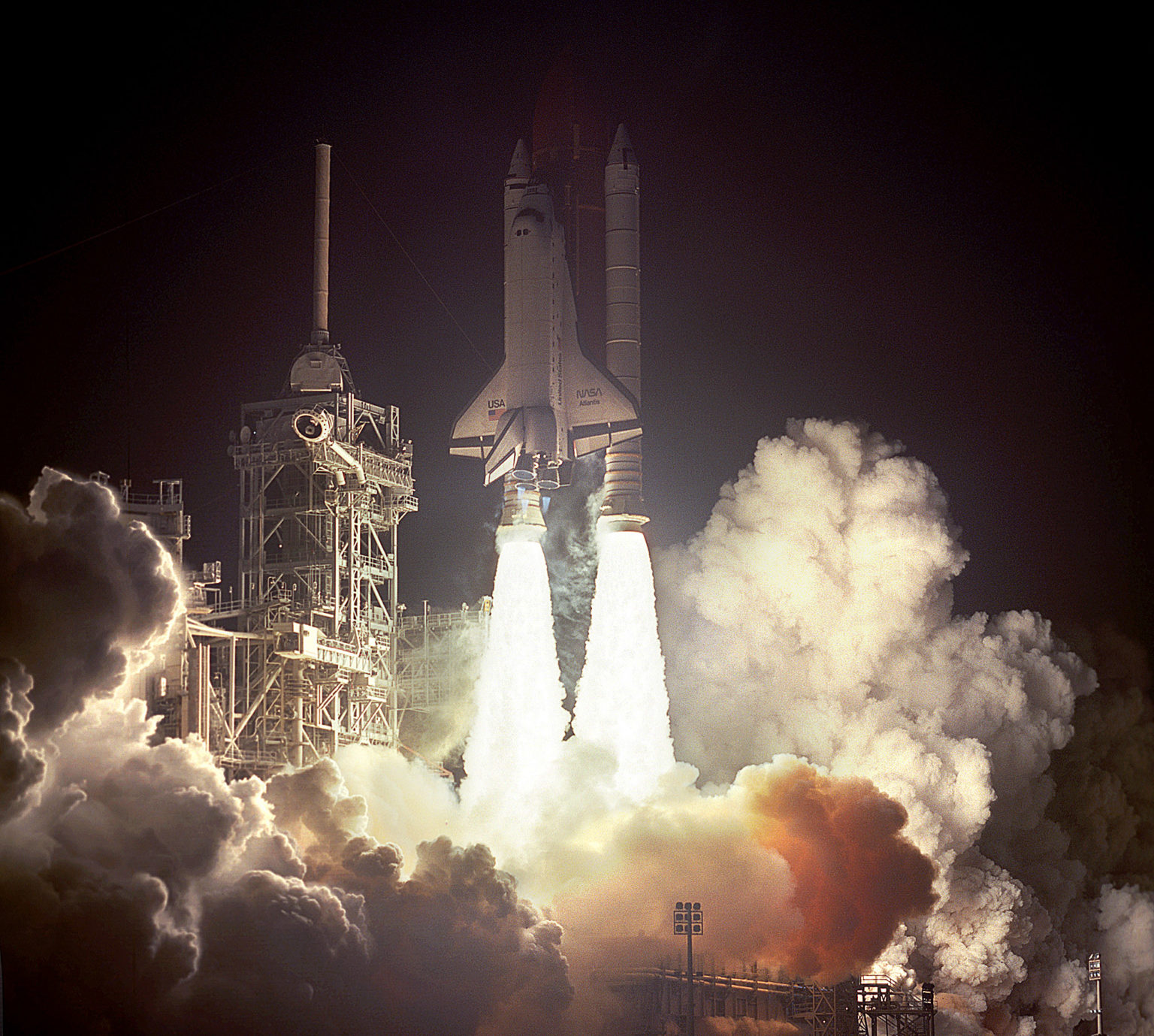 Atlantis roars into the night on 28 February 1990. Photo Credit: NASAIt seemed as if another scrub was in store, as flight controllers and the crew awaited a break in the weather. Rain showers lashed the Cape and the Transoceanic Abort Landing (TAL) sites in Spain—which Atlantis might be obliged to use in the event of a major emergency during ascent—were declared “No-Go”. Finally, conditions on both sides of the Atlantic seemed to improve and at 2:41 a.m. EST the countdown emerged from an extended built-in hold at T-9 minutes. In the feverish minutes that followed, Casper activated the shuttle’s three Auxiliary Power Units (APUs) and the men closed their visors.
Liftoff occurred at 2:50 a.m. EST, with the customary gushing announcement from the public affairs officer—“Liftoff of Atlantis and mission STS-36”—offering no indication of the content of the flight ahead. But one component of ascent was impossible to hide. For the first (and only) time in shuttle program history, STS-36 entered a 62-degree-inclination orbit, far higher than even the 57 degrees achieved on earlier Department of Defense missions. To accomplish this 62-degree tilt, a unique “dog-leg” maneuver was implemented, in which the shuttle flew downrange on a nominal flight azimuth, then maneuvered to a higher azimuth whilst high above the Atlantic. Admittedly, this carried penalties in terms of performance, but it was the only means of reaching such a high-inclination orbit from the Cape.Video Credit: NASA/YouTube“Normally, the highest inclination you’ll ever get is 57 degrees,” said Creighton in a NASA oral history, “which keeps you just off the East Coast, so in case anything bad happened, where you blew up, you’re not going to rain debris down on a major city in the United States. This particular flight was the one exception—the only time in U.S. manned space flight—where we’ve ever gone beyond 57 degrees. It’s kind of hard to hide that fact after you launch, when you’re up there and the Russians are tracking you, so that was declassified after we launched.” For STS-36, the payload so important that normal flight rules which precluded overflights of land were suspended and Atlantis passed near Cape Hatteras, Cape Cod and parts of Canada during her rise to orbit.
And the orbital altitude was one of the shuttle’s lowest, often reaching no higher than 124 miles (200 km). In Mullane’s words, the effect was that Earth seemed “hugely close” and the mission’s inclination allowed him to view icebergs in the Southern Ocean and, through binoculars, a far-off glimpse of Antarctica. “The pole was nearly 1,800 miles distant, so I had no view of it,” he wrote in Riding Rockets. “Instead, I focused on the rugged coastal mountain chains. The occasional black of a windswept cliff was the only color in an otherwise sheet-white topography.” In Man On A Mission, Hilmers recalled seeing the green and blue plumes of the aurora borealis at northerly latitudes. “Our low altitude gave us the best views of Earth I would ever have while in space,” he wrote. “The details you could pick out were simply amazing.”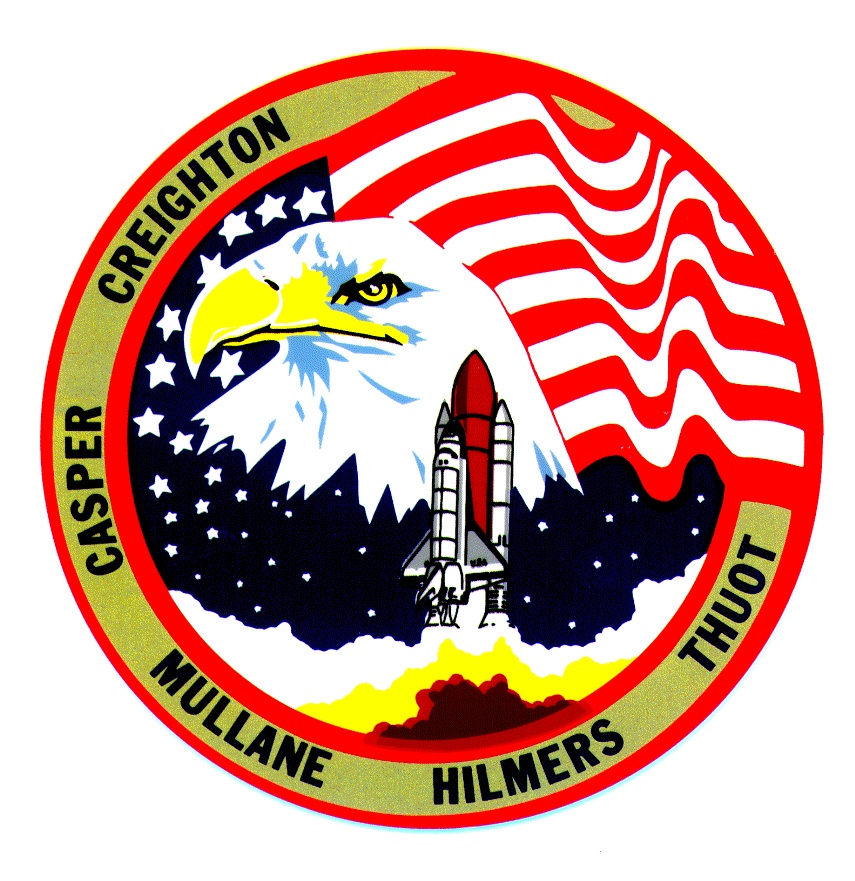 STS-36 crew patch, designed by the five crew members. Image Credit: NASAIt appeared that the secretive satellite was deployed on the second day of the mission, 1 March, sometime after 31.5 hours into the flight, according to skywatchers who observed Atlantis’ path across the sky. Creighton and his men returned to Earth on the 4th, touching down at Edwards Air Force Base, Calif., but the following months would prompt great speculation and rumor about AFP-731/Misty. It appeared to have been deployed by means of an electromechanical device known as the Stabilized Payload Deployment System (SPDS), which “rolled” it over the shuttle’s payload bay wall and released it at an offset, near-vertical angle of 65-80 degrees.
Amateur skywatchers observed that the satellite appeared to increase its altitude in the days after Atlantis’ landing and after the detection of the five “fragments” nothing more was recorded until October 1990 when European observers tracked something at an altitude of 504 miles (811 km) and an inclination of 65 degrees. It seemed that STS-36’s bird was the most likely culprit and it was suggested that the “fragments” seen in March were actually debris associated with its gradual transfer to a higher orbit. That orbit was adjusted again in November 1990, possibly to monitor the deteriorating situation in the Persian Gulf, and it has been speculated that Misty’s “vanishing act” might represent the operational use of optical or radar stealth capability. It was seen again in the mid-1990s and appeared to have been deorbited sometime after 1997. 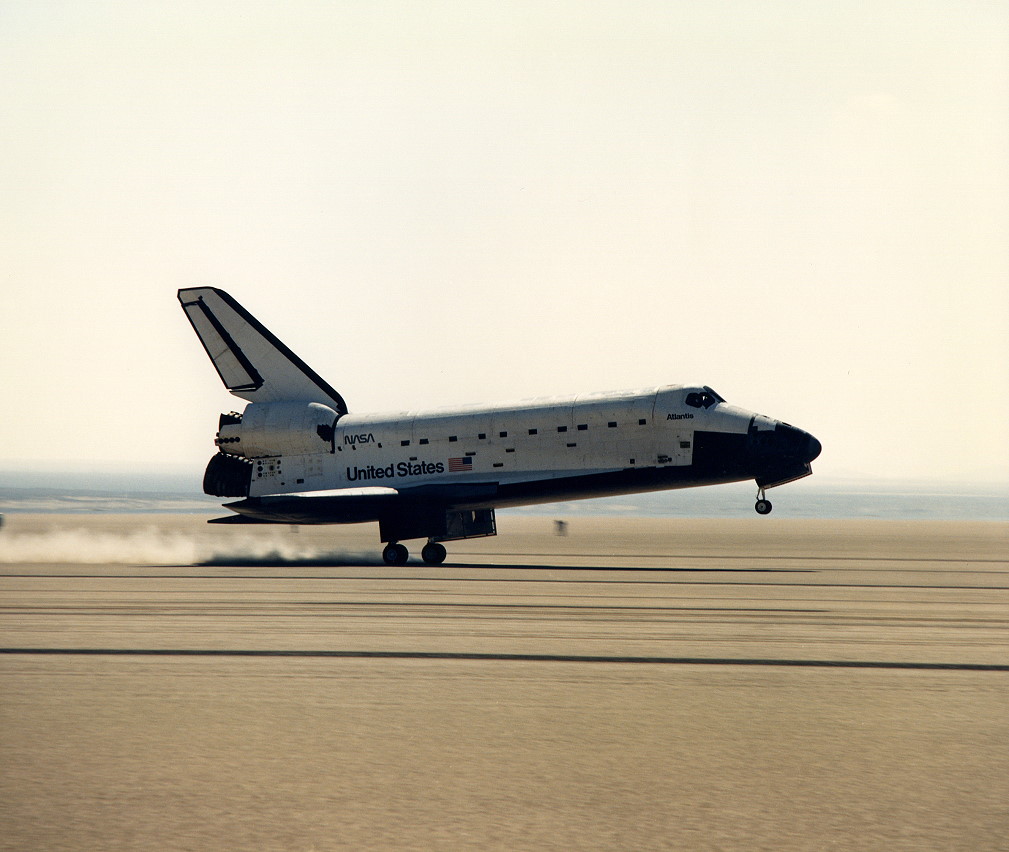 Atlantis lands at Edwards Air Force Base, Calif., on 4 March 1990. Photo Credit: NASAThirty years on, little further information of substance has emerged about what the STS-36 astronauts did during their four days in space. Creighton and his men had been subjected to intensive background checks by the intelligence community during the process to select them as NASA astronaut candidates, but flying any Department of Defense shuttle mission required a new level of security clearance.
“Most of the military guys had already had a Top Secret clearance when they were in the military, but it’s only good for specific purposes,” he told the NASA oral historian. “I’m sure they did a background check on us before we were announced as a crew, unbeknownst to any of us.” Creighton’s recollection is that only a handful of others knew what they did on STS-36, including the NASA Administrator and the mission’s flight directors. Years later, Mullane exhibited pride in being part of a flight that he remains forbidden to talk about, whilst Hilmers noted simply that the mission was one of the greatest ever flown by NASA.
“Or not,” he added, wryly. “I can’t say!”Source:
https://www.americaspace.com/2020/03/01/the-story-of-the-vanishing-satellite-remembering-top-secret-sts-36-30-years-on/#more-111251
 Wątek: [AS] The Story of the Vanishing Satellite: Remembering Top-Secret STS-36 (Przeczytany 2049 razy)