From TACSAT to JUMPSEAT: Hughes and the top secret Gyrostat satellite gambleby Dwayne A. Day and Nicholas W. Watkins Monday, December 21, 2020
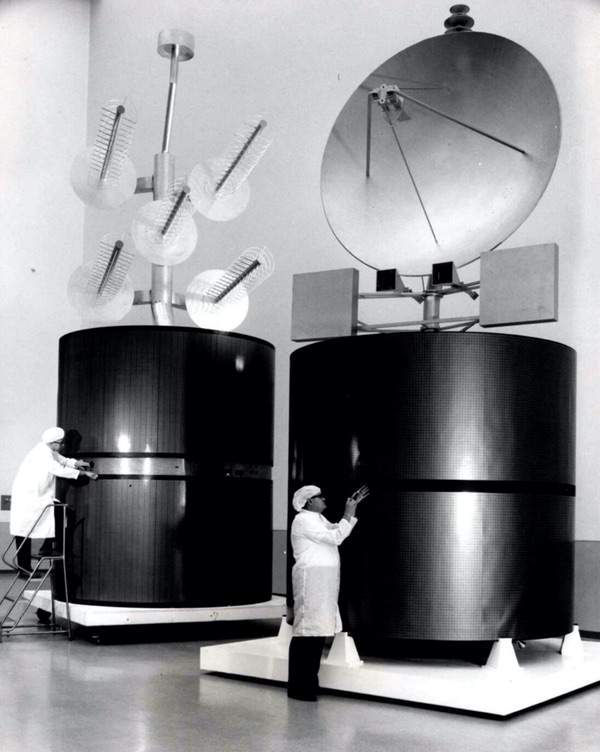 Photo of Hughes’ HS-308 TACSAT (left) in May 1968 next to their proposal for Intelsat IV based on the HS 312 bus. These are mockups. Intelsat IV had a different antenna farm at top. This basic design led to the JUMPSEAT and Satellite Data System satellites for the National Reconnaissance Office. (credit: Hughes)
Starting in August 1968, the secretive National Reconnaissance Office began launching new intelligence satellites into much higher orbits to accomplish their missions. The first was the CANYON series of communications intelligence satellites, followed in 1970 by the first of the RHYOLITE telemetry interception satellites. In spring 1971, the NRO launched a new and enigmatic satellite named JUMPSEAT, which has remained perhaps the most mysterious of these high-orbit satellites. Each of these satellites pushed the state of the art in terms of payloads, antennas, and satellite design. But JUMPSEAT represented a concerted effort by a civil and commercial satellite designer to break into the top-secret world of satellite intelligence by leveraging a new technology and a military contract to demonstrate that it could perform the mission of both detecting signals from the ground, and spotting missile launches with an infrared telescope.
https://www.thespacereview.com/article/4096/1(Editor’s Note: The Space Review will not publish the week of December 28. Our next issue will be January 4, 2021. Happy holidays!)
 Wątek: The Space Review (Przeczytany 194975 razy)