9/III 2004 [25-27]25)
What’s the frequency, Jacques?by Taylor Dinerman Monday, March 1, 2004
 While Galileo may have had geopolitical origins, it could, in cooperation with GPS, become a major tool to support precision agriculture in the developing world. (credit: ESA)
The European Space Agency and the EU have decided to build a satellite navigation system, similar to the US Navstar/GPS system, called Galileo. Publicly, they claimed that they were doing so because they distrusted the US, and feared that the Pentagon might somehow disrupt the GPS signal. They also claimed that they needed to build this system in order to protect Europe’s independence from the US. Their plan, as it now stands, is to launch two test satellites that will begin transmitting, on frequencies allocated to the Europeans by the International Telecommunications Union, in 2006. In 2008, they hope to begin launching the first of 30 operational navigation satellites.
https://www.thespacereview.com/article/107/126)
The thin line between success and catastropheby Dwayne A. Day Monday, March 1, 2004
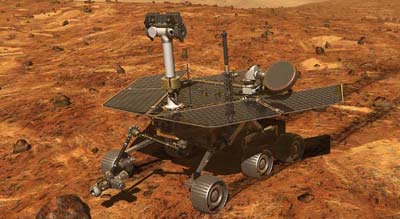 The success of Spirit and Opportunity proved NASA can learn from its failures, but can it also learn from its successes? (credit: NASA/JPL)
Thirteen months ago the space shuttle Columbia disintegrated above east Texas. After six and a half months of inquiry, the independent Columbia Accident Investigation Board concluded among its findings that the culture at NASA had prevented the agency from properly identifying and correcting long-standing problems in the space shuttle program. Introspection and dissent were suppressed in part because mission managers assumed that successful flights of the space shuttle proved that everything was working properly.
https://www.thespacereview.com/article/108/127)
Commercializing the new space initiativeby Jeff Foust Monday, March 1, 2004
 A number of commercial lunar missions, like the SuperSat orbiter by LunaCorp, have been proposed in recent years. Can such missions help support the Bush space initiative? (credit: LunaCorp)
When President George W. Bush officially announced the new space initiative at NASA Headquarters on January 14, he invoked the memory of a famous pair of explorers, Lewis and Clark. As Bush put it:
Two centuries ago, Meriwether Lewis and William Clark left St. Louis to explore the new lands acquired in the Louisiana Purchase. They made that journey in the spirit of discovery, to learn the potential of vast new territory, and to chart a way for others to follow. America has ventured forth into space for the same reasons.https://www.thespacereview.com/article/109/110/III 2004 [28-30]28)
Review: Lost in Spaceby Jeff Foust Monday, March 8, 2004
 Lost in Space: The Fall of NASA and the Dream of a New Space Age
by Greg Klerkx
Pantheon, 2004
Hardcover, 392 pp., illus.
ISBN 0-375-42150-5
US$27.95/C$41.95
https://www.amazon.pl/s?k=Lost+in+Space%3A+The+Fall+of+NASA+and+the+Dream+of+a+New+Space+Age&ar_srct=T1There is something to be said about the power of good timing. Greg Klerkx’s book Lost in Space was released in January at the same time space policy was back on the front pages thanks to President Bush’s new space policy announcement. At first glance, the timing might appear to be poor—after all, here was a book proclaiming that NASA had lost its way just as the President was giving the space agency the bold new agenda so many had clamored for—but the coincidence ensured that the book would receive considerable attention by book reviewers and the public alike. Timing will only go so far, though. Klerkx provides an interesting, although imperfect, look at how NASA has clashed with the private sector in a wide range of space ventures.
https://www.thespacereview.com/article/110/129)
Space shuttle safety and the Hubble servicing missionby Dwayne A. Day Monday, March 8, 2004
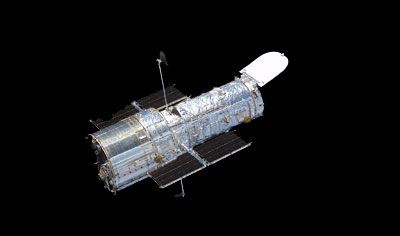 The future of the Hubble Space Telescope has become a subject of controversy and debate over the last two months. (credit: NASA)
The decision to cancel the fourth servicing mission to the Hubble Space Telescope has led to controversy within the astronomical community and Congress. What follows is a summary of the safety explanations provided by NASA to justify the cancellation decision. Because NASA has not provided a detailed explanation of the decision in writing, what follows is largely a synthesis of comments made by agency officials over the past seven weeks.
https://www.thespacereview.com/article/111/130)
Code T: goals, decisions and technologyby Taylor Dinerman Monday, March 8, 2004
 Efforts within Code T like Project Prometheus and its Jupiter Icy Moons Orbiter (JIMO) mission (pictured above) stand in sharp contrast to the other major Code T project, the Crew Exploration Vehicle. (credit: NASA)
NASA’s new Office of Exploration Systems, known in the jargon as Code T, has already given rise to a number of wisecracks about the agency’s new space race. Which will come first, astronauts beyond low Earth orbit or the end of the alphabet? In any case, the idea behind Code T seems logical enough if one accepts the premise that human and robotic exploration must be complementary.
https://www.thespacereview.com/article/112/111/III 2004 [31-34]31)
Fostering links between space and the environmentby Charles Cockell and Douglas M. Messier Monday, March 15, 2004
 The Earth and Space Foundation includes an art collection such as “Farewell! Departure for the Pole!” that depict the future of human exploration of the solar system. (credit: David A. Hardy/Earth and Space Foundation)
Throughout the Space Age, the ties between the space and environmental communities have been alternately cooperative and antagonistic. On the positive side, there has always been broad agreement on the value of satellites for monitoring the weather, measuring long-term climate change, and investigating environmental problems.
https://www.thespacereview.com/article/113/132)
Beaver pelts, communication satellites, and space explorationby Taylor Dinerman Monday, March 15, 2004
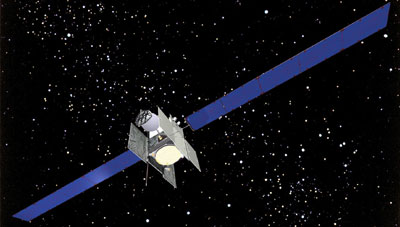 Communication satellites have established a commercial foothold in space in much the same way as frontiersmen made a living in the West prior to the arrival of the railroads. (credit: Boeing)
Space commercialization has always been a major slogan for those who wish to see humans settle the space frontier. The idea that space could be settled exclusively by astronauts, scientists and others who are almost all government employees has never been taken seriously outside the old Soviet Union. The problem has always been how to get there from here.
https://www.thespacereview.com/article/114/133)
The last lunar outpostby Dwayne A. Day Monday, March 15, 2004
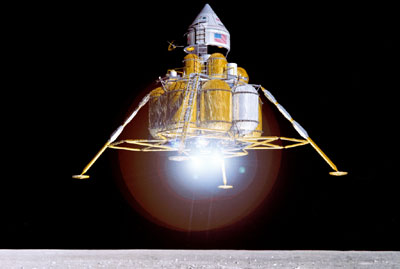 An illustration of a First Lunar Outpost (FLO) lander touching down on the lunar surface. (credit: NASA)
On March 10, the House Science Committee held a hearing on NASA’s new space exploration plan. One of the witnesses testifying before the committee was Michael Griffin, the former NASA Associate Administrator for Exploration in the early 1990s. Griffin had arrived at NASA at the tail end of the Space Exploration Initiative (SEI), after it had become clear that SEI was all but dead. One of Griffin’s actions while in this job was presiding over a more realistic plan for returning Americans to the Moon. This plan was called the First Lunar Outpost, or FLO. While testifying, Griffin was asked how much his plan would have cost and he responded that in today’s dollars it would cost approximately $33 billion.
https://www.thespacereview.com/article/115/134)
A look inside the Aldridge Commissionby Jeff Foust Monday, March 15, 2004
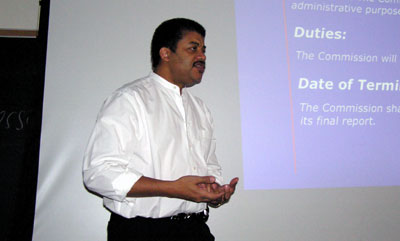 Neil Tyson speaks about the commission’s examination of the new space initiative during a talk at New York University March 13. (credit: J. Foust)
Since President George W. Bush introduced his new space initiative two months ago, one of the biggest criticisms about it is the lack of specific details. The plan as presented by Bush lays out some broad goals and deadlines—shutting down the shuttle program by 2010, returning humans to the Moon by 2020—but since then NASA has provided few additional details regarding how this would be accomplished. This lack of information threatens the plan with paralysis within Congress: last week Rep. Sherwood Boehlert, the chairman of the House Science Committee, and Rep. Bart Gordon, the ranking Democrat on that committee, both said they remained undecided about the plan because they had not gotten enough information about it yet. “As the outlines of the likely fiscal 2005 budget become clearer, my questions about the initiative only become more pressing,” Boehlert said.
https://www.thespacereview.com/article/116/112/III 2004 [35-37]35)
Space commercialization: the view from 1966by Jeff Foust Monday, March 22, 2004
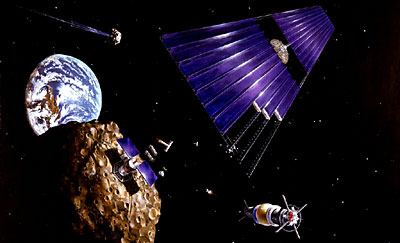 Utilizing the resources of space has long been a vision of space commercialization proponents. (credit: NASA)Editor’s Note: The commercialization of space is often considered a relatively contemporary idea. However, for decades people have proposed ways to go into space not in the pursuit of knowledge or glory, but to make money. One such person was Austin Stanton, founder of Varo, Inc., a company that, several decades ago, developed aerospace electrical systems. Stanton was a strong proponent of spaceflight in general and commercial space ventures in particular.
At the national meeting of the American Astronautical Society in San Diego in February 1966, Stanton gave a speech titled “Commercial Development of the Resources of Space”. That speech was later published in pamphlet form by Varo. In that speech, Stanton outlined what he perceived to be the various attributes of space—weightlessness, vacuum, etc.—and how they could be utilized for industrial ventures in orbit and beyond.
Today, the concept of space industrialization seems a bit quaint: industrial ventures in space have never taken hold, in part because of the high costs of space access as well as the lack of an identifiable key product that can only be manufactured in space. Commercial ventures today focus more on services than goods: communications, remote sensing, and, in perhaps the near future, tourism. However, Stanton’s speech is still useful in that it offers a view of what was once considered the forefront of space commercialization.
Stanton’s speech, as printed in the Varo pamphlet, is provided below. Some of the language is certainly dated (like the “philosophy of microcircuitry”), but his views on other topics, notably transportation, are as relevant today as they were 38 years ago. We thank Phil Smith of the Futron Corporation for bringing this speech to our attention and James Kirkpatrick of the American Astronautical Society for granting permission to republish it.--------------------------------------------------------------------------------------------------------------------------------
My purpose is to examine the state-of-the art of astronautics and the economic ecology in which it is embedded, to expose the present opportunity for exploitation of the resources of space.
https://www.thespacereview.com/article/117/136)
In space, no one can hear you explainby Jeff Foust Monday, March 22, 2004
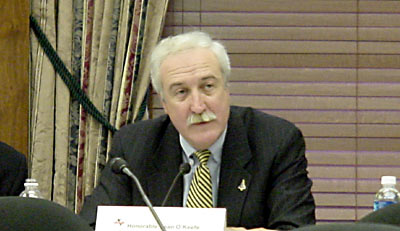 NASA Administrator Sean O'Keefe has had his hands full the last couple of months dealing with criticism of the new exploration initiative and the SM4 cancellation; have these problems been in part self-inflicted? (credit: J. Foust)
Overall, this should be a relatively good time for NASA. While the agency is still recovering from the Columbia accident last year and its aftermath, NASA has had its share of good news. Spirit and Opportunity, the twin Mars Exploration Rovers, are an unquestioned success, providing scientists with the strongest evidence to date that Mars once had liquid water, an essential condition for supporting life. In an ideal world, these missions, and the strong public interest in them, would provide momentum for the new exploration initiative announced by President Bush in January that gave the agency a long-desired new vision, one that focuses on human exploration of the Moon and, eventually, Mars.
https://www.thespacereview.com/article/118/137)
Whispers in the echo chamberby Dwayne A. Day Monday, March 22, 2004
Why the media says the space plan costs a trillion dollars While the new exploration initiative may be expensive, the trillion-dollar figure quoted in many articles has no basis in fact. (credit: iStockPhoto)
There is an old children’s game that teachers occasionally inflict upon their students as a morality play. A group of children are placed in a circle and then one of them is told a story that they are to whisper to the person to their right. That child is supposed to whisper it to the person on their right and so on until they reach the originator, by which time it no longer resembles the original story. Distortions are introduced by miscommunication or deliberate fraud. The lesson is that you should not believe everything you hear.
https://www.thespacereview.com/article/119/113/III 2004 [38-41]38)
Constellation and Prometheus: Uncomfortable bedfellowsby Taylor Dinerman Monday, March 29, 2004
Efforts within Code T like Project Prometheus and its Jupiter Icy Moons Orbiter (JIMO) mission (pictured above) stand in sharp contrast to the other major Code T project, the Crew Exploration Vehicle. (credit: NASA)The way the leadership at NASA explains it, there is a certain logic in putting the Crew Exploration Vehicle (CRV) and related elements, known as Project Constellation, and the Nuclear Systems Initiative, now called Project Prometheus, under the new Office of Exploration Systems (Code T). Both projects are new, ambitious, and hungry for both funds and management talent. They are both essential to the long-term goal of exploring the solar system, and they both represent the Administration’s highest priorities for the United States government’s civil space program.
https://www.thespacereview.com/article/120/139)
General Dynamics buys Spectrum Astro: Good deal for whom?by Taylor Dinerman Monday, March 29, 2004
 Spectrum Astro’s “Factory of the Future” in Arizona is one of the major assets obtained by General Dynamics when it acquired the company earlier this month. (credit: Spectrum Astro)
General Dynamics was probably the only major aerospace firm that could have bought Spectrum Astro without setting off antitrust alarm bells, both in the Justice Department and at the Pentagon. The industry is over-consolidated enough as it is. Unlike some, General Dynamics is not known for making acquisitions just to get its name in the papers or to provide fat fees for bankers and lawyers. So the question arises: what are they up to?
40)
Selling dreams: the promise and challenge of space tourismby Jeff Foust Monday, March 29, 2004
 Miles O’Brien (left) and Eric Anderson discuss the state of the space tourism industry during the March 11 IASE event outside Washington. (credit: J. Foust)
Two years ago the prospects for space tourism looked quite promising. By early 2002 one space tourist, Dennis Tito, had already flown to the International Space Station while a second, Mark Shuttleworth, was in the final stages of preparations for his flight. Moreover, at least two people—Lori “AstroMom” Garver and pop star Lance Bass—were vying to fly on the next Soyuz flight to the station in the fall of 2002. At the same time, there was growing interest in suborbital space tourism, with the hopes that a vehicle would soon win the X Prize and offer tourist services.
https://www.thespacereview.com/article/122/141)
Gravity Rules: The nature of planethoodby S. Alan Stern Monday, March 29, 2004
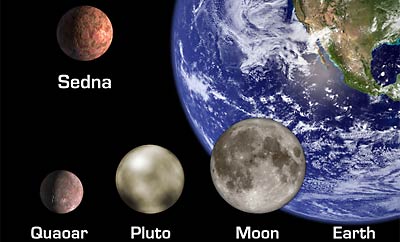 The growing number of known solar system bodies—and their wide array of sizes—has raised the question of what should be called a planet. (credit: NASA)
I am a planetary scientist, so you won’t find it surprising that one night recently, the dinner table conversation at our home eventually turned to the discovery of the largest ever Kuiper Belt Object, Sedna (2003 VB12). When I remarked that I was amused by the fact that some astronomers don’t consider Sedna a planet, our teenage daughter Kate joined in—agreeing that Sedna shouldn’t be classified a planet. Surprised, I asked why. “Dad, if Sedna is a planet, then Ceres is too, and there are probably lots and lots more things this big that we haven’t discovered. You all should leave it to just the normal nine we learned about in school. We can’t have so many planets that you can’t name them all!”
https://www.thespacereview.com/article/123/1
 Wątek: The Space Review (Przeczytany 194974 razy)