46/XI 2020 [216-220]216)
Review: Spacepower Ascendantby Jeff Foust Monday, November 23, 2020
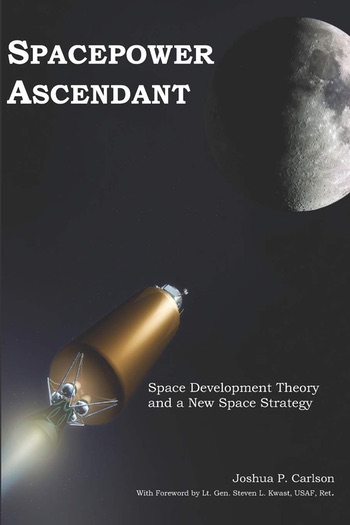 Spacepower Ascendant: Space Development Theory and a New Space Strategy
By Joshua P. Carlson
independently published, 2020
paperback, 257 pp., illus.
ISBN 979-8655659230
US$19.99
https://www.amazon.com/exec/obidos/ASIN/B08BWGPR8V/spaceviewsThis week’s launch of China’s Chang’e-5 lunar sample return mission will doubtless reinvigorate claims of a space race between the US and China, including those who believe the US is falling behind China in such a competition. The Chinese effort will likely be depicted as part of a grand strategy by China to harness the resources of the Moon (water, rare earth elements, helium-3, etc.), if not seize the Moon itself, to become the dominant power in space and therefore on Earth. If America does not respond, they argue, it risks ultimately being subservient to China.
https://www.thespacereview.com/article/4072/1217)
In the new spectrum of space law, will Biden favor the Moon Treaty?by Dennis O’Brien Monday, November 23, 2020
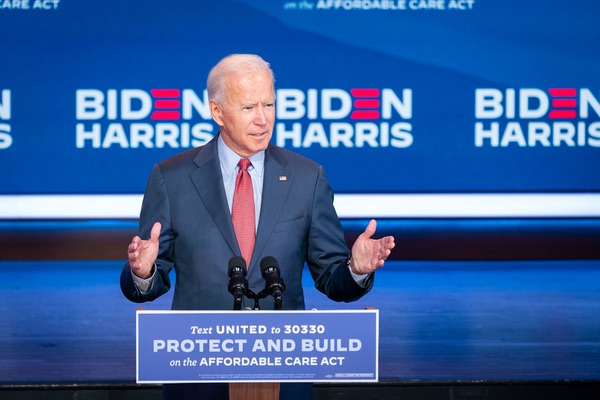 President-elect Joe Biden has said little about space, but his views on the Convention on the Law of the Seas from his time in the Senate could shape plans for the Artemis Accords and space resources. (credit: Adam Schultz/Biden for President)
The full spectrum of space law, from nationalist to internationalist, was on display at the Moon Village Association’s annual symposium earlier this month. But the question on everyone’s mind was, what will be the effect of Joe Biden’s election as the next President of the United States? He has already declared his intent to rejoin the Paris Climate Accords and the World Health Organization. A look at his Senate record gives us a hint concerning his space policy.
https://www.thespacereview.com/article/4073/1218)
The space resources debate pivots from asteroids to the Moonby Jeff Foust Monday, November 23, 2020
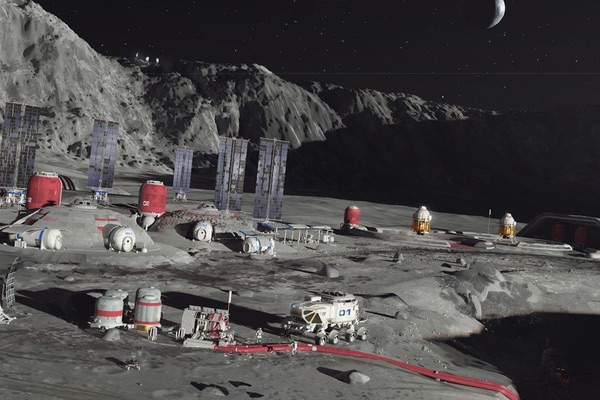 Over the last five years, the issue of using space resources has shifted from asteroid mining to lunar exploration. (credit: ESA)
Five years ago this week, President Obama signed into law the Commercial Space Launch Competitiveness Act (CSLCA) of 2015. The bill, as its name suggests, primarily dealt with commercial launch issues, such as extending the indemnification regime for commercial launch liability and establishing a class of spaceflight participants known as “government astronauts” who would be treated differently than their commercial counterparts.
The CSLCA, though, is best known for a section that was once a standalone bill, the Space Resource Exploration and Utilization Act of 2015. That section stated that any US company that extracted resources from asteroids or other celestial bodies beyond Earth would be entitled to them, “including to possess, own, transport, use, and sell the asteroid resource or space resource obtained in accordance with applicable law.”
https://www.thespacereview.com/article/4074/1219)
An iconic observatory faces its demiseby Jeff Foust Monday, November 23, 2020
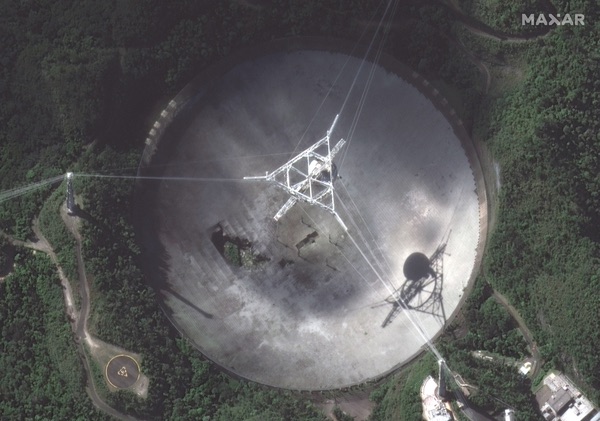 A satellite image of Arecibo taken November 17, showing the damage to the giant dish caused by two broken cables that support the platform suspended over it. (credit: Satellite image ©2020 Maxar Technologies)
A few astronomical observatories are iconic, in the sense they are distinctive enough to be recognized in the broader culture. The Arecibo Observatory certainly qualifies, with its 305-meter main dish nestled in the terrain of Puerto Rico and a platform hosting receivers suspended above it, connected by cables to three towers. Few people might know much about the astronomy done at Arecibo (beyond, perhaps, its supporting role in the search for extraterrestrial intelligence), but it became famous in movies like
Contact and
GoldenEye.
https://www.thespacereview.com/article/4075/1220)
We were heroes once: National Geographic’s “The Right Stuff” and the deflation of the astronautby Dwayne A. Day Monday, November 23, 2020
 Actor Sam Shepard as Chuck Yeager in the 1983 movie The Right Stuff, an exploration of themes of American masculinity and heroism.
Several years ago, National Geographic ventured out beyond documentaries to start producing scripted dramas. So far none of them have hit a high mark—nothing on the order of “Mad Men,” “Breaking Bad,” “Fargo,” or other prestige television. Most recently they produced “The Right Stuff,” based on Tom Wolfe’s famous book and currently streaming on Disney+. But whereas Wolfe’s book was an exploration of the qualities required of men in a new and highly dangerous job, exploring space, the series is focused on depicting the Mercury astronauts as a bunch of back-biting, egotistical, insecure, argumentative jerks. The differences may be explained by the needs of a multi-episode series, and our changing cultural views of heroism, but the result is unfortunately mediocre.
https://www.thespacereview.com/article/4076/1
 Wątek: The Space Review (Przeczytany 178526 razy)