25/VI 2021 [99-103]99)
Review: My Remarkable Journeyby Jeff Foust Monday, June 21, 2021
 My Remarkable Journey: A Memoir
by Katherine Johnson with Joylette Hylick and Katherine Moore
Amistad, 2021
hardcover, 256 pp., illus.
ISBN 978-0-06-289766-4
US$25.99
https://www.amazon.com/exec/obidos/ASIN/0062897667/spaceviewsAt a hearing last week by a Senate appropriations subcommittee about NASA’s fiscal year 2022 budget proposal, Sen. Joe Manchin (D-WV) asked NASA administrator Bill Nelson about funding for the agency’s Independent Verification and Validation Facility, located in his state. In 2019, NASA renamed the facility after Katherine Johnson, the Black mathematician who became famous after the publication of the book Hidden Figures and the release of the movie of the same title. Nelson responded he would investigate the funding issue for the facility, then added, “if I might, tell you a story about Katherine Johnson.” He then mentioned the movie version of Hidden Figures.
https://www.thespacereview.com/article/4195/1100)
Why Astrofeminism?by Layla Martin Monday, June 21, 2021
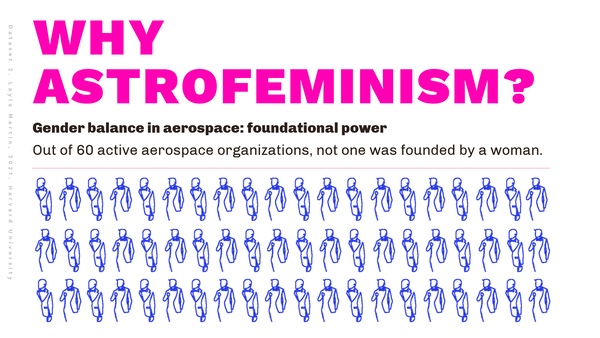 There are few companies in the space industry founded by women, just one example of the field’s gender gap.
The ancient universal practice of studying the moon, planets and stars from Earth helped to define primordial calendars and shape our earliest conception of gods, spirits, seasons, and tides. Today, space-based assets educate and connect humanity as well as revealing information that furthers efforts to mitigate anthropogenic climate change. At its best, what space offers us is the possibility to evolve the human condition. The power of space has benefited the United States on a global scale for decades, inspiring generations while expanding democratic soft power. To illustrate, in every single place around the world I’ve spent time in, from Akiruno, Tokyo to Zanzibar, Tanzania, I’ve observed local people proudly wearing NASA t-shirts! From a non-scientific perspective, images of space reveal patterns of light and color that are so beautiful it’s difficult to describe them as anything other than magical. Yet, they are in fact, very real!
https://www.thespacereview.com/article/4196/1101)
A shifting balance of space cooperation?by Jeff Foust Monday, June 21, 2021
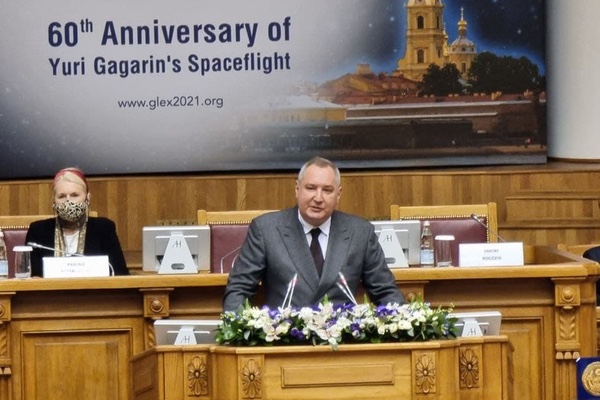 Roscosmos director general Dmitry Rogozin used a conference last week to express support for international cooperation in space exploration, even while continuing to raise questions about the future of the International Space Station. (credit: Roscosmos)
For nearly three decades, cooperation in human spaceflight has been defined by the partnership between the United States and Russia in the International Space Station program. After the end of the Cold War and the collapse of the Soviet Union, the US brought Russia into its space station program with the goal of keeping Russia’s space program engaged in peaceful endeavors rather than producing missiles for Iran or North Korea. (It also had the benefit of providing a new justification for a space station program that, in the US, was facing threats of cancellation.) For better or worse, the two countries have worked together, along with Europe, Japan, and Canada, to build and operate the ISS to this day.
https://www.thespacereview.com/article/4197/1102)
Burning Frost, the view from the ground: shooting down a spy satellite in 2008by Dwayne A. Day Monday, June 21, 2021
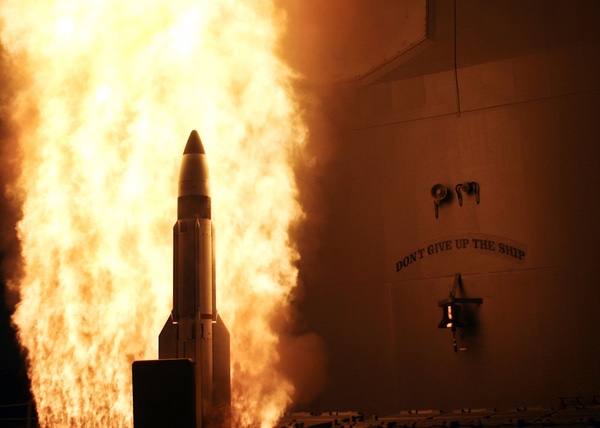 Launch of an SM-3 missile from the cruiser USS Lake Erie in February 2008 on an intercept course with a disabled American reconnaissance satellite. (credit: US Navy)
In February 2008, a missile fired from the Aegis class cruiser USS Lake Erie, several hundred kilometers northwest of Hawaii, blasted high into the sky and a few minutes later destroyed a malfunctioning top-secret American satellite. The operation was known as “Burnt Frost,” and according to American officials, it was undertaken to prevent potentially toxic debris from the satellite from falling on populated areas. The operation occurred only a few months after a heavily criticized Chinese anti-satellite test produced a large amount of orbital debris. The American action was designed to minimize the generation of debris but was nevertheless controversial. Now, a newly published account of the decision-making that led to the American action provides unique insight into how it was made. The author, orbital debris expert and longtime space writer Nicolas Johnson, died in April at age 71, and his article, titled “Operation Burnt Frost: A View From Inside,” was made available free of charge by the journal Space Policy.
https://www.thespacereview.com/article/4198/1103)
Scrutinizing the Russian-Iranian satellite dealby Bart Hendrickx Monday, June 21, 2021
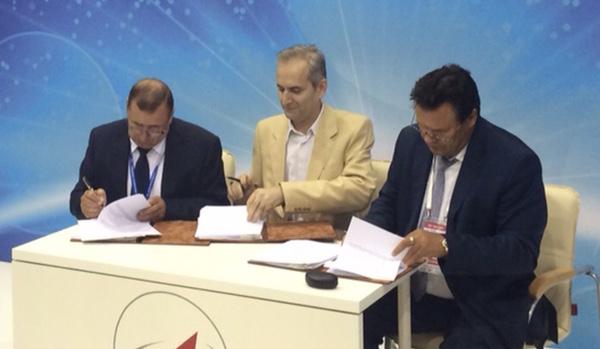 Signing of a pre-contractual agreement on a Russian-Iranian satellite project by Leonid Makridenko (VNIIEM), Alireza Zolali (Bonyan Danesh Shargh) and Sergei Baskov (NPK Barl) in August 2015. (Source)
On June 11, the Washington Post published an article claiming that Russia is preparing to supply Iran with an advanced remote sensing satellite that will give Tehran an unprecedented ability to track potential military targets across the Middle East and beyond. When asked to comment on the story the following day, President Vladimir Putin dismissed it as “fake news” and “nonsense”. However, plans for the joint satellite project were openly reported in the Russian and Iranian media until several years ago and an analysis of various recent Russian online sources corroborates the Post’s claim that it is not far away from launch.
https://www.thespacereview.com/article/4199/1
 Wątek: The Space Review (Przeczytany 178715 razy)