Autor Wątek: The Space Review  (Przeczytany 184097 razy)

0 użytkowników i 4 Gości przegląda ten wątek.

Online Orionid

  • Weteran
  • *****
  • Wiadomości: 29904
  • Very easy - Harrison Schmitt
Odp: The Space Review
« Odpowiedź #360 dnia: Stycznia 11, 2022, 11:00 »
Review: Zwicky: The Outcast Genius Who Unmasked the Universe
by Jeff Foust Monday, September 30, 2019


Zwicky: The Outcast Genius Who Unmasked the Universe
by John Johnson Jr.
Harvard Univ. Press, 2019
hardcover, 368 pp., illus.
ISBN 978-0-674-97967-3
US$35.00
https://www.amazon.com/exec/obidos/ASIN/0674979672/spaceviews

If you’ve seen a picture of the late astronomer Fritz Zwicky, it’s probably this one: an elderly man, in white shirt and bolo tie, pinching his left thumb and index finger together with a sneer, or at least a look of disdain, on his face. More than 45 years after his death, Zwicky is remembered as much as for his abrasive, confrontational personality as he was for his contributions to astronomy.
https://www.thespacereview.com/article/3801/1

Review: Manned Lunar Landing and Return
by Dwayne A. Day Monday, September 30, 2019


Manned Lunar Landing and Return
by Robert Godwin
Apogee Books, 2019
paperback, 131 pages, illus.
ISBN 978-1-926837-42-0
US$25.95
https://www.amazon.com/exec/obidos/ASIN/1926837428/spaceviews

There’s an old saying that history is what is written down, and the obvious corollary is that it is not the totality of what happened. So much more happened that never got recorded, and often not everything that got written down, filmed, or otherwise recorded is used by historians who have to tell a story in a finite number of pages.
https://www.thespacereview.com/article/3802/1

The highest glass ceiling
by Eric R. Hedman Monday, September 30, 2019


NASA expects that, when it returns astronauts to the surface of the Moon under the Artemis program, at least one of those people walking on the lunar surface will be a woman. (credit: NASA)

Almost every time I hear Jim Bridenstine talk about the Artemis program to return to the Moon, he mentions that It will have an American as the first woman to walk on the lunar surface. It is a somewhat subtle way to put the leverage of gender politics into the campaign to get support from the public and, more importantly, Congress. He is far from the first to use this kind of tactic to get political support for a program or law. He most certainly won’t be the last to do so.
https://www.thespacereview.com/article/3803/1

Starships are meant to fly
by Jeff Foust Monday, September 30, 2019


SpaceX’s Starship Mark 1 shared the stage Saturday night with a Falcon 1 first stage, honoring a rocket that reached orbit for the first time exactly 11 years earlier. (credit: J. Foust)

Do something at least three times, they say, and it becomes a tradition. SpaceX is securely in that territory with its annual presentations in September by company CEO Elon Musk on the company’s next-generation launch vehicle, even as the vehicle, and its name, have changed.

In 2016, Musk gave a presentation on what had recently been renamed from “Mars Colonial Transporter” to “Interplanetary Transport System”: a giant spacecraft launched atop a massive booster—both reusable—intended to carry 100 people to Mars or other destinations in the solar system (see “Elon Musk’s road to Mars”, The Space Review, October 3, 2016). The vehicle was still in its early design stages, and the talk at the International Astronautical Congress in Mexico remains famous, or perhaps infamous, for the legions of SpaceX fans who lined up hours in advance and then peppered him with odd questions and requests.
https://www.thespacereview.com/article/3804/1
« Ostatnia zmiana: Czerwca 25, 2026, 09:52 wysłana przez Orionid »

Online Orionid

  • Weteran
  • *****
  • Wiadomości: 29904
  • Very easy - Harrison Schmitt
Odp: The Space Review
« Odpowiedź #361 dnia: Stycznia 11, 2022, 11:00 »
Review: Ad Astra
by Jeff Foust Monday, October 7, 2019


Ad Astra
Directed by James Gray
123 minutes
Rated PG-13

Over the last couple weeks, at space industry events and other encounters, I’ve had several conversations along these lines:

“Hey, Jeff, have you seen Ad Astra?”
“No, not yet.”
“Don’t! It’s terrible.”

Over time, those comments seem less like helpful advice and more like a dare. How bad could this movie be? So, this weekend, I spent two hours and $12.99 to find out. And, dear reader, they were right.
https://www.thespacereview.com/article/3805/1

On objections to space force naval rank
by Brent D. Ziarnick Monday, October 7, 2019


Naval ranks offer a better option for a Space Force than those used by the Air Force, or even an entirely new structure. (credit: U.S. Navy photo by Darwin Lam)

In July, I argued that the US Space Force should adopt naval, or maritime, rank structures for officers in order to develop a separate and unique service culture, independent of the US Air Force and suited best for the reality of military space missions (see “Why the Space Corps needs to use naval rank”, The Space Review, July 22, 2019). That essay has by far generated the most discussion about Space Force. The relationship between the two armed forces has been compared often to that of the US Navy and US Marine Corps, which have separate and unique service cultures, and also have different rank nomenclature and structures. In this article, I respond to some more persuasive objections.
https://www.thespacereview.com/article/3806/1

The satellite industry catches a cold
by Jeff Foust Monday, October 7, 2019


Boeing introduced last month the 702X, a new commercial satellite bus intended to serve the growing demand for smaller, more flexible communications satellites. (credit: Boeing)

Some commercial space activities get a lot of attention: space tourism, commercial lunar landers, satellite megaconstellations, and so on. But today, as has been the case for the last few decades, the real money in commercial space remains in satellite communications, primarily using satellites in geostationary orbit (GEO). Look at any chart of the size of the “space economy,” and you’ll see communications services, like direct-to-home television or video distribution, dominating. It may not capture headlines, but it has been lucrative.
https://www.thespacereview.com/article/3807/1

God’s eye view: HEXADOR and the very high resolution satellite
by Dwayne A. Day Monday, October 7, 2019


Artist conception of the HEXADOR very high resolution satellite, which would have combined the DORIAN optics system from the Manned Orbiting Laboratory and the recovery vehicle section and possibly the satellite control section from the KH-9 HEXAGON satellite. (credit: Giuseppe de Chiara)

On October 23, 1962, the skies over Cuba were cracked open by the roar of Navy RF-8 Crusader reconnaissance aircraft flying at high speed and very low level. A little over a week earlier, a high-flying U-2 reconnaissance plane had photographed unusual activity on the island. The U-2 photographs had been alarming enough to initiate a major crisis. But what they revealed was hard for untrained people to interpret, and so President John F. Kennedy had authorized risky and provocative low-level reconnaissance flights. Now the Crusaders were screaming over the scrub with their side-looking cameras peering at the various structures and vehicles that dotted the terrain, far closer than the high-flying U-2. When they returned to Florida and their film was processed and looked at by trained human eyes—and even untrained human eyes—it was clear to everybody who saw them that a very serious problem existed not far from American shores.
https://www.thespacereview.com/article/3808/1

Ekipazh: Russia’s top-secret nuclear-powered satellite
by Bart Hendrickx Monday, October 7, 2019


The one-megawatt TEM as proposed in 2010.

There is strong evidence from publicly available sources that a Russian company called KB Arsenal is working on a new type of military satellite equipped with a nuclear power source. Called Ekipazh, its mission may well be to perform electronic warfare from space.

KB Arsenal, based in St. Petersburg, is no newcomer to the development of nuclear-powered satellites. In the Soviet days it built satellites known as US-A (standing for “active controllable satellite”), which carried nuclear reactors to power radars used for ocean reconnaissance (in the West they were known as “radar ocean reconnaissance satellites” or RORSAT for short.) The satellites had been conceived in the early 1960s at the OKB-52 design bureau of Vladimir Chelomei before work on them was transferred to KB Arsenal at the end of that decade. The satellites’ three-kilowatt thermoelectric reactors, known as BES-5 or Buk, were built by the Krasnaya Zvezda (“Red Star”) organization. The US-A satellites operated in low Earth orbits at an altitude of roughly 260 kilometers and, after finishing their mission, the reactors were boosted to storage orbits at an altitude of about 900 kilometers. However, three of the satellites (Cosmos 954, 1402, and 1900) experienced problems with the boost maneuver; the first showered radioactive debris over northwestern Canada in January 1978. The program saw a total of 37 missions between 1965 and 1988.
https://www.thespacereview.com/article/3809/1
« Ostatnia zmiana: Czerwca 25, 2026, 10:14 wysłana przez Orionid »

Online Orionid

  • Weteran
  • *****
  • Wiadomości: 29904
  • Very easy - Harrison Schmitt
Odp: The Space Review
« Odpowiedź #362 dnia: Stycznia 11, 2022, 11:01 »
Review: The Number of the Heavens
by Jeff Foust Monday, October 14, 2019


The Number of the Heavens: A History of the Multiverse and the Quest to Understand the Cosmos
by Tom Siegfried
Harvard Univ. Press, 2019
hardcover, 352 pp., illus.
ISBN 978-0-674-97588-0
US$29.95
https://www.amazon.com/exec/obidos/ASIN/067497588X/spaceviews

The idea of parallel universes has been a staple of science fiction for decades, and perhaps wishful thinking as well: many pine for an alternate universe where the outcome of an election, or game, or date was different. The idea, though, is gaining traction in scientific circles, as some physicists argue that our universe could be one of many, which could also explain why our universe’s physical constants seem just right for us to exist.
https://www.thespacereview.com/article/3810/1

Modern monetary theory and lunar development
by Vidvuds Beldavs Monday, October 14, 2019


Novel financial models may be needed to suport a “big push” for lunar industrialization. (credit: Alliance for Space Development)

Lunar development has been paced to the hard budgetary constraints placed on NASA, ESA, and other space agencies that are subject to political approval. If funding could be made available based on the soundness of a plan from a long-term perspective, then lunar exploration and development as envisioned in the Bush-era Vision for Space Exploration would have been possible. Even the space colonies vision of Gerard K. O’Neill of millions of people living and working in outer space could be realized. What’s needed is a way to depoliticize spending for outer space. Given that long-term goals have been agreed to, then maintaining funding to achieve the goals could result in not only achieving the goals but doing so sooner. It would be less wasteful and, by implication, much less costly over the long haul. Multiyear budgeting can help but cannot prevent imposition of spending limits on space development as long as the spending is constrained by the national budget and competing near-term priorities of a sovereign state.
https://www.thespacereview.com/article/3811/1

How to make an urgent and affordable return to the Moon
by Ajay Kothari Monday, October 14, 2019


New Glenn, like Falcon Heavy, can be used to support development of a low cost “railroad” for the Moon and Mars. (credit: Blue Origin)

In a recent essay, Namrata Goswami rightly warns of the peril of deemphasizing the lunar strategy (see “America’s incoherent Moon strategy is weakening its space leadership”, The Space Review, September 23, 2019). Here I try to formulate the justifications of why we should not do so and suggest possible ways to get there fast.

Let us also be frank. NASA has long had fervent plans for going to the Moon. Any recent stirring is due to NASA’s apt desire to be in line with the President, who has mentioned Mars several times recently, including a tweet from June. I humbly and respectfully submit the arguments below with the hope that they can be used to convince the Trump Administration of the importance of being on the Moon in a big way, for exigency and optics both.
https://www.thespacereview.com/article/3812/1

Getting commercial crew flying, at last
by Jeff Foust Monday, October 14, 2019


Jim Bridenstine and Elon Musk appeared to see eye-to-eye on the importance of commercial crew during their meeting last week at SpaceX’s headquarters in California. (credit: NASA/Aubrey Gemignani)

In the end, they were all smiles.

On Thursday, NASA administrator Jim Bridenstine and SpaceX CEO and founder Elon Musk appeared before the media at SpaceX’s Hawthorne, California, headquarters. With a Crew Dragon spacecraft behind them, and NASA astronauts Bob Behnken and Doug Hurley, who will be the first to fly in that spacecraft, at their sides, the space agency leader and the space company executive said they were all on the same page, at last, about the priority of developing that spacecraft.
https://www.thespacereview.com/article/3813/1
« Ostatnia zmiana: Czerwca 26, 2026, 07:45 wysłana przez Orionid »

Online Orionid

  • Weteran
  • *****
  • Wiadomości: 29904
  • Very easy - Harrison Schmitt
Odp: The Space Review
« Odpowiedź #363 dnia: Stycznia 18, 2022, 15:18 »
Review: Light from the Void
by Jeff Foust Monday, October 21, 2019


Light from the Void: Twenty Years of Discovery with NASA's Chandra X-ray Observatory
by Kimberly K. Arcand, Grant Tremblay, Megan Watzke, Martin C. Weisskopf, and Belinda J. Wilkes
Smithsonian Books, 2019
hardcover, 204 pp., illus.
ISBN 978-1-58834-669-8
US$45.00
https://www.amazon.com/exec/obidos/ASIN/1588346692/spaceviews

The celebrations in July for the 50th anniversary of Apollo 11 overshadowed another major space anniversary. July 23 marked the 20th anniversary of the launch of the shuttle Columbia on mission STS-93, commanded by Eileen Collins, the first female commander of a shuttle mission. (The launch had been scheduled for July 20th, the anniversary of the Apollo 11 landing, but scrubbed by a technical issue.) For astronomers, though, the mission is historic because is placed into orbit the Chandra X-Ray Observatory, a giant x-ray telescope that was one of NASA’s original “Great Observatories” alongside Hubble and others.
https://www.thespacereview.com/article/3814/1

Can single-stage-to-orbit disrupt spaceflight?
by John Hollaway Monday, October 21, 2019
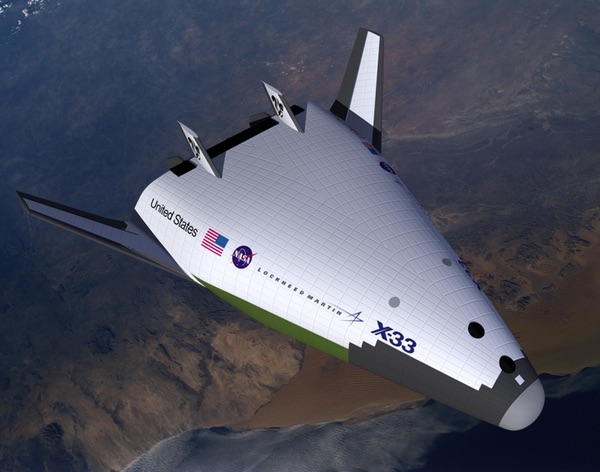

The X-33, which failed to take flight even once after spending more than $1 billion on it, is one of the most infamous examples of failed spaceplane projects. (credit: NASA)

In recent issues of The Space Review, Mike Snead has surveyed the history of, and options for, commercial passenger spaceflight (see “Solving the commercial passenger spaceflight puzzle”, Part 1, Part 2, Part 3; September 3, 9, and 16, 2019). This valuable document is nearly 16,000 words long, with excellent illustrations, and is probably the most useful record of the fraught history of this topic for many years. He makes this key point: despite what some would have us believe, outer space will not be permanently opened to commercial development and settlement without first establishing acceptably safe commercial passenger spaceflight.
https://www.thespacereview.com/article/3815/1

Tailoring spacesuits
by Jeff Foust Monday, October 21, 2019


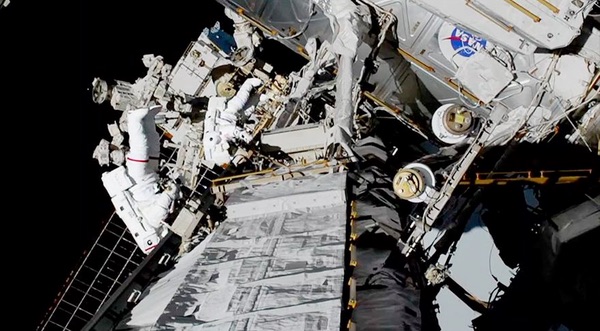
NASA astronauts Christina Koch and Jessica Meir work outside the ISS during their historic all-woman spacewalk last Friday. (credit: NASA)

It was a milestone that came both earlier than expected but later than desired.

When NASA announced early this month its plans to conduct a series of spacewalks to replace batteries in the station’s power supply, it announced astronaut pairings for the five spacewalks it expected it would take to replace the batteries. That included a spacewalk on October 21 by Christina Koch and Jessica Meir, which would have been the first spacewalk by two female astronauts—a milestone previously planned for the spring, but cancelled because of a spacesuit sizing issue that generated its share of negative reactions.
https://www.thespacereview.com/article/3816/1

What happens when you leave empty seats at the table?
by Monica Vidaurri Monday, October 21, 2019
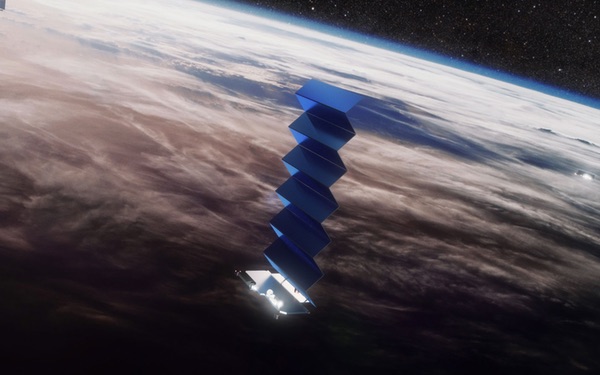

Constellations like SpaceX’s Starlink could provide broadband Internet access globally, but also jeopardize astronomy and threaten safe operations in low Earth orbit, effects that need to be considered by a wider audience. (credit: SpaceX)

The drafters of the Outer Space Treaty could not have predicted artificial constellations that hinder astronomical observing and storm tracking, actors shooting down space debris, and tardigrades unknowingly placed on a lunar lander and subsequently spilled on the Moon. This is, of course, to say nothing of human survivability in non-Earth environments. A critical component of assessing our impact on other worlds is assessing other worlds’ impact on us, both physically and socioeconomically. Physically, neither space agencies nor private spaceflight companies have conducted sufficient research regarding human survivability in space, in terms of radiation exposures, differences in gravity, psychological complications, and many other factors.
https://www.thespacereview.com/article/3817/1

Blacker than blue: the US Navy and the Manned Orbiting Laboratory
by Dwayne A. Day Monday, October 21, 2019
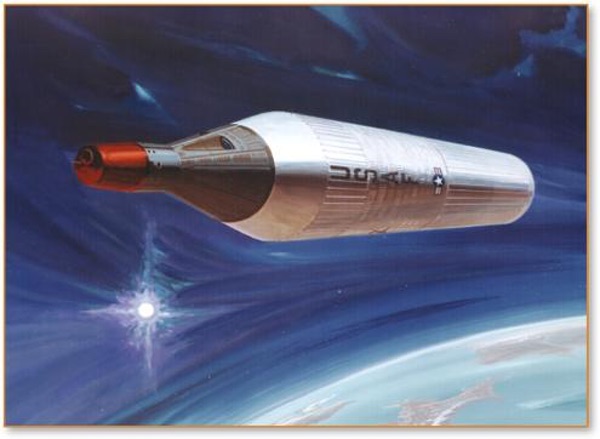

The Manned Orbiting Laboratory was from the beginning an operational reconnaissance platform rather than a “laboratory” for military space experiments. The US Navy learned this the hard way.

One of the enduring mysteries of the National Reconnaissance Office’s Manned Orbiting Laboratory (MOL), an ambitious space station program that started in late 1963 and was rather abruptly canceled in summer 1969, is to what degree it was ever a “laboratory.” There is information indicating that about a dozen different experiments were considered for the space station. And yet, the remaining astronauts who worked on the project, and substantial documentation, indicate that the laboratory name was primarily a public cover story for the project’s real mission: taking high resolution reconnaissance photographs of the Soviet Union. The experiments were all, or mostly, eliminated.
https://www.thespacereview.com/article/3818/1
« Ostatnia zmiana: Czerwca 26, 2026, 07:54 wysłana przez Orionid »

Polskie Forum Astronautyczne

Odp: The Space Review
« Odpowiedź #363 dnia: Stycznia 18, 2022, 15:18 »

Online Orionid

  • Weteran
  • *****
  • Wiadomości: 29904
  • Very easy - Harrison Schmitt
Odp: The Space Review
« Odpowiedź #364 dnia: Stycznia 18, 2022, 15:18 »
Review: Imagined Life
by Jeff Foust Monday, October 28, 2019


Imagined Life: A Speculative Scientific Journey among the Exoplanets in Search of Intelligent Aliens, Ice Creatures, and Supergravity Animals
by James Trefil and Michael Summers
Smithsonian Books, 2019
hardcover, 240 pp., illus.
ISBN 978-1-58834-664-3
US$29.95
https://www.amazon.com/exec/obidos/ASIN/1588346641/spaceviews

Earlier this month, astronomers Michel Mayor and Didier Queloz were among the recipients of the Nobel Prize in Physics for their discovery of the first exoplanets orbiting Sun-like stars, work that opened a new era in both astronomy and astrobiology. Since that discovery nearly a quarter-century ago, astronomers have found thousands of exoplanets, including a growing number with sizes and orbits like the Earth, raising speculation that they could be habitable. (Nevermind that there’s precious little data about them, including knowledge about their composition and existence of any atmosphere.)
https://www.thespacereview.com/article/3819/1

A possible technique for giving names to nameless satellites
by Charles Phillips Monday, October 28, 2019


Tracking some US military satellites can be a challenge because they are not in the official Air Force catalog, but some techniques exist to match up observations by others to known satellite families. (credit: Northrop Grumman)

There are many satellites in space and we know which launch put most of them up there. But there are a number of them that are not associated with a specific launch, though it would be desirable to identify which put them into orbit. This article is about a technique which could help associate objects in space with particular launches, one that I am currently developing. But let’s start with some background information: what do we know about most satellites?
https://www.thespacereview.com/article/3820/1

One scientist’s 15-year (and counting) quest to save Earth from asteroid impacts
by Alfred McEwen, Erik Asphaug, and Vishnu Reddy Monday, October 28, 2019


The proposed NEOCam mission, years in the making, would search for near Earth objects using a space-based infrared telescope. (credit: NASA/JPL-Caltech)

Professor Amy Mainzer of the University of Arizona may finally have her near-Earth object (NEO) survey mission. She has led the NEOCam proposal through three rounds of the NASA Discovery program, and in 2015 was one of five mission proposals awarded a Phase A study. In 2017 the Psyche and Lucy missions were selected for flight, and Amy Mainzer’s mission was supported for further funding to develop its infrared detectors.
https://www.thespacereview.com/article/3821/1

Coming together to go to the Moon
by Jeff Foust Monday, October 28, 2019


Attendees at the 70th International Astronautical Congress gawk at the full-sized model of Blue Origin’s Blue Moon lander on display outside the exhibit call. (credit: J. Foust)

If you like lunar landers—or, at least, mockups of lunar landers—Washington DC was the place to be last week.

One of the first sights attendees of the 70th International Astronautical Congress (IAC) glimpsed as they entered the Washington Convention Center was a mockup of a proposed Lockheed Martin lunar lander for crews. After ascending the escalators towards the exhibit hall, they saw the full-sized model of Blue Origin’s Blue Moon lunar lander, the same one that the company unveiled at the same building more than five months earlier (see “Blue Moon and the infrastructure of space settlement”, The Space Review, May 13, 2019).
https://www.thespacereview.com/article/3822/1
« Ostatnia zmiana: Czerwca 28, 2026, 07:03 wysłana przez Orionid »

Online Orionid

  • Weteran
  • *****
  • Wiadomości: 29904
  • Very easy - Harrison Schmitt
Odp: The Space Review
« Odpowiedź #365 dnia: Stycznia 18, 2022, 15:18 »
Review: See You in Orbit?
by Jeff Foust Monday, November 4, 2019


See You in Orbit? Our Dream of Spaceflight
by Alan Ladwig
To Orbit Productions, 2019
paperback, 500 pp., illus.
ISBN 978-1-7332657-0-6
US$18.00
https://www.amazon.com/exec/obidos/ASIN/1733265708/spaceviews

Last week marked a new era in space tourism, as Virgin Galactic started trading on the New York Stock Exchange Monday after its merger with special-purpose acquisition company Social Capital Hedosophia closed the preceding Friday. The stock exchange building was wrapped in company banners, and there was a celebration inside that included company founder Sir Richard Branson. He was walking around the floor of the exchange in a blue flight suit he and other customers will wear on SpaceShipTwo flights starting next year, a suit developed by athletic apparel company Under Armour but looking like something from the set of Star Trek: Enterprise. He and others were ebullient as shares rose in early trading.
https://www.thespacereview.com/article/3823/1

Space weapons are proliferating fast: should we accept it?
by Taylor Dinerman Monday, November 4, 2019


India, which tested an ASAT weapon earlier this year, is one of a number of countries developing, or at least considering, such weapons. (credit: DRDO)

This summer, French President Macron announced that France would develop armed satellites and an anti-satellite laser weapon, while Japan announced it is considering its own anti-satellite system for some time in the 2020s. Earlier this year, India tested an ASAT. No reasonably informed observer will be surprised that active “kinetic” space warfare is closer than ever to being a reality.

What most people outside the military don’t realize is that space warfare happens every minute, every day. America’s space systems are under constant cyber and electronic warfare attack. In 2006, it was reported that one of our billion-dollar spy satellites was hit by a Chinese laser, with reportedly minimum, temporary effect. China’s constant attempts to harm US and other nations’ space assets has not gone unnoticed. Without question, the US is aggressively trying to gather as much information as possible on hostile space systems and, perhaps occasionally, launches its own cyber-attacks. This silent, but never-ending, form of space war is part of the background noise of 21st century great power politics.
https://www.thespacereview.com/article/3824/1

Space exploration and nuclear proliferation
by Jeff Foust Monday, November 4, 2019


NASA is proposing to develop a reactor called Kilopower that could be ready to support lunar bases in the latter half of the 2020s, but the choice of fuel for that reactor worries nuclear nonproliferation experts. (credit: NASA)

Space nuclear power is enjoying something of a renaissance in recent years. Congress has directed money to NASA to work on nuclear thermal propulsion, including $125 million in the House version of a fiscal year 2020 spending bill for NASA that calls for a flight demonstration of such technology in 2024.

“If we are to fulfill the objectives of President Trump’s first space policy directive to establish a long-term presence on the Moon and send the first crewed mission to Mars, nuclear power is arguably the most important technology to enable these bold national goals,” Rex Geveden, president and chief executive of BWX Technologies and a former NASA associate administrator, said at the most recent meeting of the National Space Council in August.
https://www.thespacereview.com/article/3825/1

Nuking the site from orbit: when the Air Force wanted a base on the Moon
by Dwayne A. Day Monday, November 4, 2019


A military base on the Moon—a plot point in a new TV series—was something seriously studied by the US Air Force at the beginning of the Space Age.

The new Apple TV+ show “For All Mankind” premiered November 1. The premise of the show is an alternative history of the space program after the Soviet Union beats the United States to landing a man on the Moon. Without giving away any spoilers, one of the subplots of the series is that in the wake of this event, President Nixon decides to establish a military base on the Moon. This storyline, like many in the show, is based upon actual history. Before the Apollo program, both the US Army and the US Air Force investigated the potential of military Moon bases. A new book from Apogee covers the Army’s Project Horizon, but aspects of that story remain classified, as do most of the Air Force’s studies. Some of that information, however, has been released.
https://www.thespacereview.com/article/3826/1
« Ostatnia zmiana: Czerwca 28, 2026, 07:10 wysłana przez Orionid »

Online Orionid

  • Weteran
  • *****
  • Wiadomości: 29904
  • Very easy - Harrison Schmitt
Odp: The Space Review
« Odpowiedź #366 dnia: Stycznia 18, 2022, 15:18 »
Review: Dr Space Junk vs The Universe
by Jeff Foust Monday, November 11, 2019


Dr Space Junk vs The Universe: Archaeology and the Future
by Alice Gorman
MIT Press, 2019
hardcover, 304 pp., illus.
ISBN 978-0-262-04343-4
US$27.95
https://www.amazon.com/exec/obidos/ASIN/0262043432/spaceviews

It’s hard in the space industry these days to escape discussions of orbital debris. There’s plenty of hand-wringing about the growing amount of debris, tracked and untracked, in orbit, and how the situation might be exacerbated by the deployment of megaconstellations of satellites. Some companies have proposed approaches to removing debris, but face challenges regarding both technology and policy.
https://www.thespacereview.com/article/3827/1

China’s Earth-Moon space economic zone venture
by Ajey Lele Monday, November 11, 2019


China’s growth in space includes plans to build a space station by the early 2020s, a step towards more ambitious plans for the 2030s and beyond. (credit: CNSA)

More than a decade ago, Dr APJ Abdul Kalam, a scientist also known as the Missile Man of India who was also the 11th President of India, articulated the concept of Earth-Moon-Mars economy. His broad argument was that the Earth, Moon and Mars should be considered as single economic entity. At the 97th Indian Science Congress, which was hosted by the Indian Space Research Organisation (ISRO) in January, 2010. he said, “Scientists should start considering Earth, Moon and Mars as an economic complex for future habitat expansion of human beings.” He made similar arguments at a seminar held at the Institute for Defence Studies and Analyses (IDSA) in New Delhi in November 2007.
https://www.thespacereview.com/article/3828/1

Commercial cargo’s next phase
by Jeff Foust Monday, November 11, 2019


A Northrop Grumman Antares rocket lifts off from Wallops Island, Virginia, November 2 carrying a Cygnus cargo spacecraft on the first mission under the company’s CRS-2 contract with NASA. (credit: J. Foust)

On a Saturday morning a little more than a week ago, a Northrop Grumman Antares rocket lifted off from the Mid-Atlantic Regional Spaceport on Wallops Island, Virginia, carrying a Cygnus cargo spacecraft bound for the International Space Station. Less than 48 hours later, that Cygnus was grappled by the station’s robotic arm and attached to a port on the station. Neither the launch of the Cygnus nor its arrival looked out of the ordinary, much like many other missions over the last several years.
https://www.thespacereview.com/article/3829/1

Near-Earth space governance is all about the money
by Adam Routh Monday, November 11, 2019

“Rules of the road” to maximize US competitiveness in the emerging space economy


The growth of commercial activities in space, including constellations like SpaceX’s Starlink, requires a new approach to space governance. (credit: SpaceX)

Global space governance is a collection of international, regional, or national laws as well as regulatory institutions and actions/manners/processes of governing or regulating space-related affairs or activities.

–Jakhu and Pelton[1]

Services provided by satellites orbiting the Earth empower the globe’s most lucrative economic sectors and advanced militaries. As a result, near-Earth space has become critical to America’s modern way of life, a trend that shows no sign of abating in the future. Indeed, in the coming years, the proliferation of companies providing small satellites, on-orbit servicing, remote sensing, and other space-based services will likely spur explosive growth in the near-Earth space economy.
https://www.thespacereview.com/article/3830/1
« Ostatnia zmiana: Lipca 01, 2026, 08:23 wysłana przez Orionid »

Online Orionid

  • Weteran
  • *****
  • Wiadomości: 29904
  • Very easy - Harrison Schmitt
Odp: The Space Review
« Odpowiedź #367 dnia: Stycznia 25, 2022, 07:52 »
Review: At the Edge of Time
by Jeff Foust Monday, November 18, 2019


At the Edge of Time: Exploring the Mysteries of Our Universe’s First Seconds
by Dan Hooper
Princeton Univ. Press, 2019
hardcover, 248 pp., illus.
ISBN 978-0-691-18356-5
US$24.95
https://www.amazon.com/exec/obidos/ASIN/0691183562/spaceviews

In a speech near the end of last month’s International Astronautical Congress in Washington, NASA administrator Jim Bridenstine talked about the science that can be done in and around the Moon, including science not directly related to the Moon itself. One example he mentioned is a proposed mission called the Dark Ages Polarimetry Pathfinder (DAPPER) that would use the radio-quiet region on the Moon’s far side to enable observations of the distant, early universe. “We’re going to see not just the first light in the universe after the Big Bang, we’re going to see before the first light,” he said. “We’re going to see what are called the ‘dark ages.’’”
https://www.thespacereview.com/article/3831/1

Cheers! Alcoholic beverages in space
by Chris Carberry Monday, November 18, 2019


One of a dozen bottles of wine being prepared for launch to the ISS on the latest Cygnus cargo mission earlier this month. (credit: Space Cargo Unlimited)

On November 2, 12 bottles of Bordeaux wine were launched to the International Space Station (ISS). These bottles are not intended for holiday celebrations by the crew, however (consumption of alcohol is officially prohibited in space.) Instead. the bottles are part of an experiment conducted by the University of Bordeaux’s Institute of Vine and Wine Science (ISVV) and a company called Space Cargo Unlimited to investigate if the aging process of wine is affected by microgravity conditions.

As novel as this experiment sounds, the Bordeaux team is not the first group to examine how alcoholic beverages age in space. That distinction is held by two whisky producers, one in Scotland, the other in Japan. In 2011, Scotch whisky producer Ardbeg partnered with Nanoracks to launch the first whisky aging experiment in orbit. When the samples were returned to Earth in 2014, a clear difference was readily apparent from the control samples that remained on Earth—and not for the better. According to an Ardbeg white paper, the aftertaste was “pungent, intense and long, with hints of wood, antiseptic lozenges and rubbery smoke.” However, Ardbeg was not certain if this was a result of the aging process or other extreme factors that the samples encountered.
https://www.thespacereview.com/article/3832/1

My years working on black programs
by Robert E. Andrews Monday, November 18, 2019


Robert Andrews in 1970.

Preface

Several weeks ago, I was contacted by Robert Andrews, who informed me that he had worked for General Electric on Satellite Recovery Vehicles (SRVs) for several early American satellite reconnaissance programs, notably the first reconnaissance satellite CORONA, which first launched in 1959, and the high-resolution GAMBIT-1 satellite, that first launched in 1963. I encouraged Robert to write about his experiences, noting that although both programs are discussed in numerous declassified documents and official histories, the stories of the individuals who made these programs successful have rarely been told. Who were they? Where did they live and go to school? How did they end up working on these programs and what was that like? In the course of our discussions, I learned that Robert also worked on an obscure part of the Manned Orbiting Laboratory program: a small reentry vehicle that would enable MOL astronauts to return film to Earth before they ended their mission and returned in their Gemini spacecraft. I encouraged him to discuss that project as well, including what happened when MOL was canceled in summer 1969. What follows is Mr. Andrews’ recollections of his work during these early years of satellite reconnaissance. — Dwayne A. Day

Hello, my name is Robert E Andrews and I had the good fortune of working in the aerospace business from its early stage in the ’50s through the end of the century.

I attended Drexel University in Philadelphia after high school, matriculating into the mechanical engineering major. I didn’t like this field, lost interest, and dropped out after two years. However, during these years, I did learn a skill that gave me employment. I got a job with the helicopter pioneer Frank Piasecki as a draftsman. I also applied for work with General Electric’s new Missiles and Space Department in Philadelphia, which was located just across the street from Drexel.
https://www.thespacereview.com/article/3833/1

Seeking a bigger role for a big rocket
by Jeff Foust Monday, November 18, 2019


The core stage of the first SLS at Michoud Assembly Facility after the installation in early November of its four RS-25 engines. (credit: NASA/Jude Guidry)

Earlier this month, NASA announced the newest milestone in the development of its long-awaited (and long-delayed) Space Launch System. At the Michoud Assembly Facility in New Orleans, workers completed installation of the four RS-25 engines into the rocket’s core stage. With those engines in place, the core stage will soon be ready for shipment to the nearby Stennis Space Center for testing, including a “Green Run” test around the middle of next year where those four engines will fire for eight minutes, just as they will on an SLS launch.

The SLS has been a key part of NASA’s exploration plans since the language in the 2010 NASA authorization act that directed the agency to develop it. While the plans themselves have changed, the agency has maintained that the SLS will nonetheless be essential for human spaceflight beyond Earth orbit, despite cost and schedule issues that have pushed back its first launch to at least late 2020, and more likely 2021. NASA has held firm despite criticisms that it would be better off adopting commercial alternatives, such as (but certainly not limited to) SpaceX.
https://www.thespacereview.com/article/3834/1
« Ostatnia zmiana: Lipca 02, 2026, 03:33 wysłana przez Orionid »

Online Orionid

  • Weteran
  • *****
  • Wiadomości: 29904
  • Very easy - Harrison Schmitt
Odp: The Space Review
« Odpowiedź #368 dnia: Stycznia 25, 2022, 07:53 »
Review: Extraterrestrial Languages
by Jeff Foust Monday, November 25, 2019


Extraterrestrial Languages
by Daniel Oberhaus
MIT Press, 2019
hardcover, 264 pp.
ISBN 978-0-262-04306-9
US$24.95
https://www.amazon.com/exec/obidos/ASIN/0262043068/spaceviews

Often in science fiction the difficulties of communications between two alien species is minimized: think, for example, of Star Trek’s universal communicator or Han Solo and Greedo speaking in their own languages in the Mos Eisely cantina yet understanding each other (but good luck figuring out the meaning of Greedo’s final “maclunkey” in the latest re-edit of that scene.) Less often do the challenges of such communication become a major issue in a story, as in the movie Arrival.
https://www.thespacereview.com/article/3835/1

Will Artemis fail in the halls of Congress?
by Jonathan Coopersmith Monday, November 25, 2019


The administration might have to cut deals with Congress to free up the funding needed to get humans back on the Moon by 2024. (credit: NASA)

I’m normally not a betting person (I’m a longtime Senators/Nationals fan), but I would wager the 2024 Artemis goal may not survive the Congressional budget battles of 2020–21. The obstacles will not be technological, challenging as they are, but rather financial and political. These are the same factors that sank NASA’s post-Apollo 11 plans to land on Mars by 1985, George H.W. Bush’s Space Exploration Initiative, and George W. Bush’s Vision for Space Exploration.

In the October issue of Aerospace America, space historian John Logsdon, in his usual astute style, described the two most important non-technical factors NASA got right for Apollo: engaging Congress in a partnership and enunciating clear, understandable geopolitical goals. At this point, the Trump Administration has not really accomplished either. Concern about the growing Chinese technological competition does not extend to the Moon.
https://www.thespacereview.com/article/3836/1

Joining the lunar lander club
by Jeff Foust Monday, November 25, 2019


An illustration of India’s Vikram lander making its descent to the lunar surface. The Indian government had provided only few details so far about why the lander crashed in September. (credit: ISRO)

Landing on the Moon is harder than it looks. Ask India and Israel.

Both countries had aspirations earlier this year to become just the fourth country—after the former Soviet Union, the United States, and China—to soft-land a spacecraft on the Moon. But in April, SpaceIL’s Beresheet lander malfunctioned during its descent, crashing to the surface. Less than five months later, the Indian Space Research Organisation (ISRO) tried to land its Vikram spacecraft, but lost contact during its final descent and was presumed lost.

More than two months later, ISRO has said little about the attempted landing, including confirming that Vikram in fact crashed. So it was noteworthy last week when Jitendra Singh, minister of state for the Department of Space, provided a few details about the attempted landing in a written response to questions from the Lok Sabha, the lower house of India’s parliament.
https://www.thespacereview.com/article/3837/1

The myth of the “new space race”
by Benjamin Charlton Monday, November 25, 2019


The Chang’e-4 lunar lander, seen by the Yutu-2 rover, after landing on the Moon in January. It landed on the Moon around the same time NASA’s New Horizons spacecraft made the most distant flyby of a solar system object ever. (credit: CNSA)

“We want a new space race—space races are exciting,” declared SpaceX founder Elon Musk after the successful inaugural flight last year of the Falcon Heavy, the most powerful rocket since the Space Shuttle.

Hawks and headline writers think space races are exciting too, especially the “new space race” between China and the United States. That’s why they keep referring to it—even though it doesn’t exist.

Historic changes are indeed afoot in the space sector. Private crewed spaceflight is about to come of age. Mobile robotic spacecraft are being built to rendezvous with satellites to service them. Vast swarms of broadband satellites are set to make the Internet truly global for the first time, and increase the number of spacecraft in orbit tenfold. Back on Earth, satellite imagery fed through artificial intelligence algorithms promises powerful insights into all manner of human activity. Dozens of countries are active in space and the number is growing all the time. The tired trope of the superpower space race does little to make sense of all this.
https://www.thespacereview.com/article/3838/1
« Ostatnia zmiana: Lipca 02, 2026, 03:40 wysłana przez Orionid »

Online Orionid

  • Weteran
  • *****
  • Wiadomości: 29904
  • Very easy - Harrison Schmitt
Odp: The Space Review
« Odpowiedź #369 dnia: Stycznia 25, 2022, 07:53 »
Review: Alcohol in Space
by Jeff Foust Monday, December 2, 2019


Alcohol in Space: Past, Present and Future
by Chris Carberry
McFarland, 2019
paperback, 217 pp., illus.
ISBN 978-1-4766-7924-2
US$29.95
https://www.amazon.com/exec/obidos/ASIN/147667924X/spaceviews

Later this week, Budweiser is going to the International Space Station. Not the beer, mind you, but instead a barley experiment sponsored by the company, part of a set of research payloads on board the latest SpaceX Dragon cargo mission. According to the ISS National Lab, the experiment will understand how barley is affected by microgravity. “In this latest investigation,” an ISS National Lab press release last week stated, “Budweiser will examine the barley malting process, and results could have implications in food production on Earth and in space.”
https://www.thespacereview.com/article/3839/1

Trends in technology development in the US and USSR during the Space Race
by Michael Howell, Venkat Kodali, Vladik Kreinovich, Hyacinthe Aboudja, Venkata Jaipal Reddy Batthula, Richard Segall, and Daniel Berleant Monday, December 2, 2019


Long-lived spacecraft like Voyagers 1 and 2 demonstrated the advances of the US in space technology over the former Soviet Union as the Space Race progresses. (credit: NASA)

The “Space Race” ushered in the era of space exploration with an extraordinary government-led rivalry between the United States and the Soviet Union, and their competing political ideologies. This rivalry is rightly regarded as a primary impetus to the early development of space exploration technology. Among the populace, leaving aside politics and even more in the USSR than the US, the inherent appeal of exploring this vast and mysterious “outer space” generated excitement.
https://www.thespacereview.com/article/3840/1

In search of a space culture
by Jack Anthony Monday, December 2, 2019


With the reestablishment of US Space Command in August (above) and plans for a Space Force, it’s time to consider what sort of culture is needed for a separate space service to be effective. (credit: DOD/Lisa Ferdinando)

The Space Force debate covers a wide range of topics, from “who will be in charge?” to “what color will the uniforms be?” The one topic, however, that should be paramount to all in this debate should be, “how can we create a Space Force culture supportive and worthy of a separate service?” Without such a culture, I believe, we cannot truly realize the full potential and strength of a separate service dedicated to the protection and defense as well as peaceful and prosperous utilization of space. This overarching space force culture that I propose here would be the foundation for the greater culture to be developed and honed, that of a Space Warfighter.
https://www.thespacereview.com/article/3841/1

All in the family
by Dwayne A. Day Monday, December 2, 2019


The Columbia accident served as a reminder that safety in human spaceflight ges beyond not just technical issues but also the culture of an organization, including how it uses language. (credit: NASA)

Next year, if everything goes according to plan, American astronauts will once again ride into space on board American spacecraft. This has been a long time coming, and at least part of the delay has been due to NASA conducting extensive safety reviews of the new spacecraft and space companies learning how to design and operate spacecraft safely. NASA is out of practice with launching rockets with humans aboard, and Commercial Crew is a different way of operations and oversight than NASA has traditionally used. Hopefully those overseeing this return to flight will be looking at past programs for lessons and insights. If they do, they will almost certainly look at the experience with the 2003 Columbia accident.
https://www.thespacereview.com/article/3842/1

Funding Europe’s space ambitions
by Jeff Foust Monday, December 2, 2019


Jan Wörner, director general of the European Space Agency, discusses the outcome of the Space19+ ministerial meeting at a press conference Thursday in Seville, Spain. (credit: ESA/S. Corvaja)

If you wondered into one of the plazas in the heart of Seville, Spain, during the middle of last week, you would have encountered a big, white… blob. It was, in fact, a giant tent, erected by Airbus Defence and Space and open to the public. The European aerospace giant stocked the interior of the tent with displays about various aspects of space, from Earth observation and telecommunications to exploration. The exhibits ranged from models of hardware to a giant inflated Mars globe. Curious locals and tourists wondered in, took selfies with the Mars globe, and headed back out.
https://www.thespacereview.com/article/3843/1
« Ostatnia zmiana: Lipca 03, 2026, 05:24 wysłana przez Orionid »

Online Orionid

  • Weteran
  • *****
  • Wiadomości: 29904
  • Very easy - Harrison Schmitt
Odp: The Space Review
« Odpowiedź #370 dnia: Stycznia 25, 2022, 07:53 »
Review: Beyond the Known
by Jeff Foust Monday, December 9, 2019


Beyond the Known: How Exploration Created the Modern World and Will Take Us to the Stars
by Andrew Rader
Scribner, 2019
hardcover, 352 pp., illus.
ISBN 978-1-9821-2353-6
US$28
https://www.amazon.com/exec/obidos/ASIN/1982123532/spaceviews

If you’ve been in the space field for any length of time, you’ve probably heard some variation of the phrase, “Exploration is in our DNA.” Sometimes the phrase is meant literally—pointing to a specific gene linked to curiosity and willingness to take risks—but more often it’s figurative: a reference to how humans have traveled across the planet over thousands of years, ultimately exploring every part of the Earth. Thus, space advocates argue, it’s only natural to expect humans to continue that exploration beyond Earth.
https://www.thespacereview.com/article/3844/1

Giant leaps for humanity: Liberalism for a multiplanetary species
by Ian McCann Monday, December 9, 2019


Mars in true color from the OSIRIS camera, 2007. Exploration and settlement of Mars, and other worlds beyond Earth, opens up new opportunities for liberalism in all its forms. (credit: ESA)

Elon Musk has recently launched a second set of 60 Starlink satellites, and says that a sustainable city on Mars will take only 20 years. At the same time, NASA is planning to the next man, and the first woman, on the Moon in 2024. It is becoming more and more likely that people will be living outside of the confines of Earth’s atmosphere for good by 2050. This is wonderful news for the various groups that comprise the liberal tradition.
https://www.thespacereview.com/article/3845/1

How many spaceports are too many?
by Jeff Foust Monday, December 9, 2019


Houston has ambitious long-term visions for a spaceport at Ellington Airport, but for now the focus is on developing a business park for aerospace businesses. (credit: Houston Airport System)

There is no shortage of spaceports in the United States. When launch sites come to mind, one usually thinks of Cape Canaveral Air Force Station and neighboring Kennedy Space Center, or perhaps Vandenberg Air Force Base in California or Wallops Flight Facility in Virginia. Perhaps, also, Spaceport America in New Mexico, the future home of Virgin Galactic’s SpaceShipTwo (see “An ‘operationally ready’ spaceport”, The Space Review, August 19, 2019)
https://www.thespacereview.com/article/3846/1

Catalyzing space debris removal, salvage, and use
by Peter Garretson, Alfred B. Anzaldúa, and Hoyt Davidson Monday, December 9, 2019

Maritime lessons and a proposal for a space salvage entity and pollution credit system


Mechanisms modeled on maritime law could enable removal od orbital debris without changes to existing outer space treaties. (credit: ESA)

The authors foresee that, over the next couple of decades, there will be a significant expansion into space. In our estimation, much of industry will eventually move off Earth and millions of people will someday be living and working in space in thriving communities for the benefit of all humans, including those remaining on Earth. Given that level of space activity expansion in both the near and longer term, advanced space projects will greatly benefit from the ability to salvage and re-purpose derelict spacecraft. Safety of navigation will also require that we “dredge the harbor” of dangerous orbiting debris. More specifically, derelict pieces of orbital debris need to be either actively deorbited, repaired, refurbished, repurposed, or recycled in orbit. Debris on planetary surfaces will also have to be dealt with, but less urgently and eventually more easily. In any case, we believe that private commercial contractors tied to a Space Salvage Entity (SSE) could play a major role in carrying out these actions, and crucial to commercial entities carrying out these actions would be multilateral agreements for managing liability risk and compensation.
https://www.thespacereview.com/article/3847/1
« Ostatnia zmiana: Lipca 03, 2026, 05:33 wysłana przez Orionid »

Online Orionid

  • Weteran
  • *****
  • Wiadomości: 29904
  • Very easy - Harrison Schmitt
Odp: The Space Review
« Odpowiedź #371 dnia: Lutego 02, 2022, 09:19 »
Review: The Consequential Frontier
by Jeff Foust Monday, December 16, 2019


The Consequential Frontier: Challenging the Privatization of Space
by Peter Ward
Melville House Publishing, 2019
hardcover, 224 pp.
ISBN 978-1-61219-800-2
US$26.99
https://www.amazon.com/exec/obidos/ASIN/1612198007/spaceviews

As the decade of the 2010s comes to a close, it’s clear the commercial space activities played a leading role shaping what happened—or didn’t happen—over the last ten years. The rise of SpaceX is perhaps the biggest example, but many more companies have emerged and found varying degrees of success, from Blue Origin and Virgin Galactic to Planet and Spire. Yet, many of these companies have struggled to meet their schedules or other promises, with many failing outright, like last week’s bankruptcy filing by small launch vehicle developer Vector.
https://www.thespacereview.com/article/3848/1

The promise and challenges of Starlink
by Namrata Goswami Monday, December 16, 2019


Starlink has its critics, from astronomers who fear the satellites will disrupt their observations to those worried about orbital debris creation, but it also offers opportunities beyond improved communications. (credit: SpaceX)

While on a work retreat to Pikesville, Tennessee, in May, I gazed up at the night sky after a day of writing. To my utter astonishment, I suddenly glimpsed a line of satellites, like soft lights strung on a string, pass over me. It was my first glimpse of SpaceX’s Starlink satellites visible to the naked eye, 60 of which were launched on May 23, followed by 60 more last month.
https://www.thespacereview.com/article/3849/1

A work in progress
by Jeff Foust Monday, December 16, 2019


NASA administrator Jim Bridenstine announces that the core stage of the first SLS is now complete during a December 9 event at the Michoud Assembly Facility in New Orleans. (credit: NASA/Bill Ingalls)

There was a core stage in there, somewhere.

Last Monday, NASA invited industry and government officials, and the media, to an “Artemis Day” event at the Michoud Assembly Facility in New Orleans. The event was designed to celebrate the completion of the core stage for the first Space Launch System rocket. The stage itself, though, was hard to see, surrounding by scaffolding to give technicians access to the stage as they carried out some final tests. What stood out the most were the four RS-25 engines at its base, thanks in part to bright red covers over them.
https://www.thespacereview.com/article/3850/1

Launch failures: management
by Wayne Eleazer Monday, December 16, 2019


The failure of the Atlas 76E/Navstar 7 launch in December 1981. (credit:USAF)

Management is a factor in any kind of a failure. Failures may be due to sins of omission or definite actions, specific flawed decisions, or more vague philosophical approaches. In any case, management is usually a factor, obvious or not, but there are some noteworthy cases in which management decisions are the ultimate cause of launch failures.

Space Shuttle

One of the most outstanding examples of a management-driven failure occurred with the loss of the Space Shuttle Challenger on January 28, 1986. As previously described (See “Weather and launch failures”, The Space Review, July 12, 2010), NASA had not established temperature limits for shuttle launches, a serious failing in its own right. But in reality, a much broader series of management decisions drove the loss of the Challenger.
https://www.thespacereview.com/article/3851/1
« Ostatnia zmiana: Lipca 22, 2026, 09:10 wysłana przez Orionid »

Online Orionid

  • Weteran
  • *****
  • Wiadomości: 29904
  • Very easy - Harrison Schmitt
Odp: The Space Review
« Odpowiedź #372 dnia: Lutego 02, 2022, 09:19 »
Review: NASA and the Long Civil Rights Movement
by Jeff Foust Monday, December 23, 2019


NASA and the Long Civil Rights Movement
by Brian C. Odom and Stephen P. Waring (eds.)
University Press of Florida, 2019
hardcover, 266 pp., illus.
ISBN 978-0-8130-6620-2
US$85.00
https://www.amazon.com/exec/obidos/ASIN/0813066204/spaceviews

In recent years, some historians have worked to recast the civil rights movement as part of a longer effort. Rather than its conventional definition from the mid-1950s through the late 1960s, historians have argued that the “long civil rights movement” started in the late 1930s and early 1940s, and extended well into the 1970s or even beyond. That puts the better-known events of the 1950s and 1960s into a broader perspective.
https://www.thespacereview.com/article/3852/1

The rocketeer who never was
by Mark Wade Monday, December 23, 2019


A photo of William Swan’s rocket-powered aircraft flight. The smoke may have been added by a newspaper artist.

History says that the first American rocket-powered aircraft flight was made by William Swan at Atlantic City, New Jersey, on June 4, 1931. He appeared in newspapers and newsreels around the nation, declaring that rocketplanes would soon take passengers on transatlantic flights at 500 mph. He made the first air-launched rocketplane flight in 1932. Then, in 1933, he bailed from an aircraft over Boca Chica, Texas, now the site of the SpaceX Starship launch facility, in an attempted manned rocket backpack flight. He disappeared into the clouds and was never seen again.
https://www.thespacereview.com/article/3853/1

What’s in a name?
by Andrew Rader Monday, December 23, 2019


The Kuiper Belt object 2014 MU69, recently given the formal name Arrokoth after being provisionally known as Ultima Thule. (credit: NASA/Johns Hopkins University Applied Physics Laboratory/Southwest Research Institute/Roman Tkachenko)

Recently, there was a stir in the news when it was reported that the most distant object ever visited by human spacecraft, a 36-kilometer chunk of ice and rock out past Pluto, was “renamed” Arrokoth from its original moniker, “Ultima Thule.” Allegedly, the rename was motivated by the fact that “Ultima Thule” had, at one point, been co-opted by the Nazis (even though the name comes from the 2,000-year-old Greek adventurer Pytheas of Massalia, one of the first scientists to explore Britain and northern islands.) But in truth, Ultima Thule had always been a provisional placeholder until a permanent name was agreed.
https://www.thespacereview.com/article/3854/1

Nuking Moscow with a Space Shuttle
by Dwayne A. Day Monday, December 23, 2019


A Soviet report recently uncovered showed that officials there were worried a shuttle launched from Vandenberg Air Force Base in California could be used to drop nuclear weapons on Moscow with little warning. (credit: USAF)

During the Cold War, both superpowers spent enormous amounts of money and resources responding to threats from the other side that turned out to not be real. The United States had its bomber gap and missile gap, both based upon faulty intelligence. Those may be the most well-known examples, but there were many others. The Soviet Union, for its part, made numerous false assumptions about what the United States was planning or doing. The most dangerous was the “war scare of 1983,” but there were many instances where the Soviet Union pursued weapon systems to counter nonexistent American threats. One of those is the still murky story of the Soviet conclusion that the American space shuttle was developed in part to drop a bomb on Moscow. Fortunately, thanks to an enterprising researcher, new light is being shed on how that myth was born.
https://www.thespacereview.com/article/3855/1

The year of commercial crew comes to an end, without crew
by Jeff Foust Monday, December 23, 2019


A member of Boeing’s recovery team watches as the CST-100 Starliner spacecraft lands at White Sands, New Mexico, December 22. (credit: NASA/Aubrey Gemignani)

Remember when 2019 was going to be the year of commercial crew?

NASA and the space community certainly entered the year with high hopes that this would, at last, be the year that American astronauts, launching on American rockets from American soil (to use a common refrain of NASA administrator Jim Bridenstine), would reach orbit for the first time since the end of the shuttle program. Both Boeing and SpaceX appeared to be getting close to the test flights of their commercial crew vehicles, optimism buoyed by SpaceX’s successful Demo-1 mission, an uncrewed test flight of its Crew Dragon spacecraft in March (see “The beginning of the end of commercial crew development”, The Space Review, March 11, 2019).
https://www.thespacereview.com/article/3856/1
« Ostatnia zmiana: Lipca 22, 2026, 09:19 wysłana przez Orionid »

Online Orionid

  • Weteran
  • *****
  • Wiadomości: 29904
  • Very easy - Harrison Schmitt
Odp: The Space Review
« Odpowiedź #373 dnia: Lutego 02, 2022, 09:19 »
Building a commercial space sustainability ecosystem
by Jeff Foust Monday, January 31, 2022


Astroscale launched its ELSA-d mission last year to demonstrate technologies to capture and deorbit defunct satellites and other debris. (credit: Astroscale)

Few would disagree that there’s a growing problem with space debris, particularly in low Earth orbit. The sharply increasing population of active satellites, thanks to megaconstellations like SpaceX’s Starlink, along with defunct spacecraft and other objects result in far more close approaches and risks of collisions.
https://www.thespacereview.com/article/4323/1
« Ostatnia zmiana: Listopada 18, 2024, 14:44 wysłana przez Orionid »

Online Orionid

  • Weteran
  • *****
  • Wiadomości: 29904
  • Very easy - Harrison Schmitt
Odp: The Space Review
« Odpowiedź #374 dnia: Lutego 02, 2022, 09:19 »
The NRO and the Space Shuttle
by Dwayne Day Monday, January 31, 2022


The NRO was going to be a major user of the Space Shuttle, including launches of reconnaissance satellites from Vandenberg Air Force Base. (credit: USAF)

One of the few remaining gaps in the history of the space shuttle program is how it was affected and used by the secretive National Reconnaissance Office (NRO). The NRO was involved with the shuttle in several key ways: it influenced the initial design of the shuttle in the early 1970s, it negotiated with NASA over the use of the shuttle during the 1970s and planned for the transition of its own spacecraft to the shuttle when it became operational, and then it used the shuttle during approximately a half dozen missions between 1985 and 1992.
https://www.thespacereview.com/article/4324/1
« Ostatnia zmiana: Listopada 18, 2024, 14:45 wysłana przez Orionid »

Polskie Forum Astronautyczne

Odp: The Space Review
« Odpowiedź #374 dnia: Lutego 02, 2022, 09:19 »